

Environmental Degradation, Catastrophic Consequences
"We went running out, and we saw all the debris and the building was just gone.""We heard a couple of people yelling, 'Help, help, please!"Alexis Watson, 21, Texas vacationer"It's hard to explain. This doesn't happen in America. It's doesn't happen in Miami Beach. It doesn't happen in our homes. And it's very difficult to comprehend how it's possible.""I have to tell you, when I walked past ground zero, there was row after row after row of firefighters who are literally waiting to rush into a building that could fall at any time."Rabbi Eliot Pearlson, Temple Menorah, Bal Harbour, Miami"You always hold out hope. Until we definitively know, we are trying to stay hopeful. But after seeing the video of the collapse it's increasingly difficult, because they were in that section that was pancaked in, in the first section that fell in, and then the other building fell on top of it, so it's not easy to watch.""It was just a comment she made offhand, that's why she woke up, [his mother said that creaking noises woke her up in the building the night before the collapse], and then she wasn't able to go back to sleep afterward -- but now in hindsight, you always wonder.""We are praying for a miracle, but at the same time trying to be as realistic about it as possible [whether he will see his mother and his grandmother again].""Until we definitely know, there is hope. It's just dwindling by the minute."Pablo Rodriguez, Surfside, Miami
 |
| This aerial photo shows part of the 12-story oceanfront Champlain Towers South Condo that collapsed early Thursday, June 24, 2021 in Surfside, Fla. (Amy Beth Bennett/South Florida Sun-Sentinel via AP) |
A professor in the department of earth and environment at Florida International University produced a study in 2020, that found the building that partially collapsed in Surfside, Florida early Thursday morning had been steadily sinking since the 1990s. The 12-story oceanfront condominium building had been built on what can be seen in hindsight was an unstable foundation. Built on what has been euphemistically called 'reclaimed wetland'. Reclaimed wetland is wetland that had been degraded and had then been restored to its natural functionality.
Wetlands have important -- vital -- environmental properties that are normally considered off limits for tampering with. They represent nature's way of helping to absorb excess moisture; with a rising ocean attributed to climate change, the wetland's critical function is to act as a protective barrier between the ocean and the land. What happened to that wetland was that it was destroyed for the purpose of 'reclamation', a spurious term, whereby infill, construction garbage and detritus and soil from elsewhere was dumped to destroy the wetland and create a building site.
Land is valuable for the construction trade in areas where demand is high for accommodation in a tourism-industry geographic area. Where moderate weather calls out to winter-weary residents of other geographies with harsh winters, along with the prospect of beach-and-sun leisure making for a situation that adds tourism dollars from visitors from abroad, to the state coffers. Where entrepreneurs and construction companies can persuade a municipality to issue building licenses in areas that should be under environmental protection.
Residents of Surfside, Florida, not far from Miami Beach had a rude awakening before 2:00 a.m. on Thursday when the building they were in was shuddering, and then part of it collapsed. In the shock of the collapse, surrounded by smoke and debris, screams resounded, heard by other residents living in nearby buildings that remained intact. "It is just overwhelming to see when we opened the door and saw that the building had collapsed", one woman recounted after she was rescued from her balcony.
The bodies of four people who were killed outright when the northeast corridor of the 12-story Champlain Towers condominium collapsed is only the beginning. An estimated 150 people are unaccounted for. In the building lived a wide mix of people, from Latin America, from the Jewish community. Unaccounted for is the sister and brother-in-law of the first lady of Paraguay. Unaccounted for are entire family units.
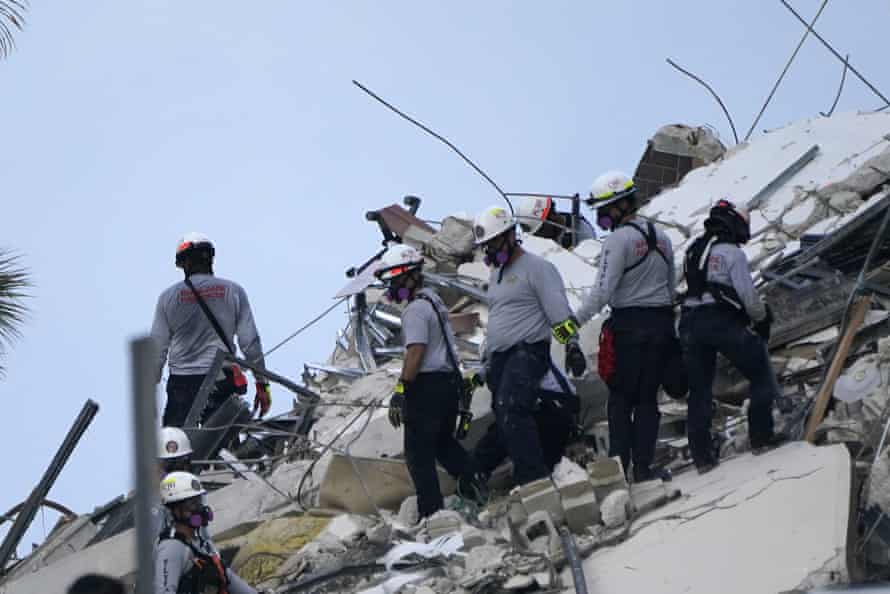 |
| Rescue workers look through the rubble of Champlain Towers South in the Surfside area of Miami. Photograph: Lynne Sladky/Associated Press |
Rescuers evacuated dozens of people from the building with its 136 units. Fifty-five of the total units were entirely destroyed. A wing of the building is seen in footage captured by nearby security cameras, suddenly collapsing with an immense dust cloud erupting over the collapse. A witness spoke of seeing people trapped within, making use of their phone flashlights signalling desperately for rescue. Rescuers pulled a few people from the rubble and firefighters rescued other tenants from balconies in the part of the tower that remained standing.
"He was yelling, 'Please help me!' It was sheer panic", said Nicholas Balboa who lives right next to the condo, of a boy's hand he saw waving through the rubble, while he helped in his rescue. The building had passed inspection just one day before the collapse. Engineers were on the scene the day of the collapse 'examining' what might have caused the collapse, according to the vice mayor of Surfside. "It's a tragic day. We still have hope to be able to identify additional survivors", said Florida Governor Ron DeSantis.
Rescuers reported initially they could hear banging and knocking within the rubble, of people desperately trying to indicate their presence, to be rescued. Later, first responders spoke of their confidence that all survivors had been rescued. "Everyone who is alive is out of the building", director of Miami-Dade Emergency Management, finally stated. "It's hard to imagine how this could happen. Buildings just don't fall down", said Surfside Mayor Charles Burkett. "Unless someone literally pulls out the supports from underneath, or
they get washed out, or there’s a sinkhole or something like that,
because it just went down."
On all of Miami Beach towns are built on a barrier island, building sites that climate scientists and geologists long have given warning of the islands' instability, made up of a loose mixture of sand and mud, nature's protection for the shoreline, which cannot responsibly be developed. "These are very dynamic features. We didn’t
understand that these islands actually migrate until the 1970s", explained professor emeritus of geology Orrin Pilkey. Professor Pilkey has studied sea-level rise and the coast's overdevelopment. "As
sea level rises, they move back."
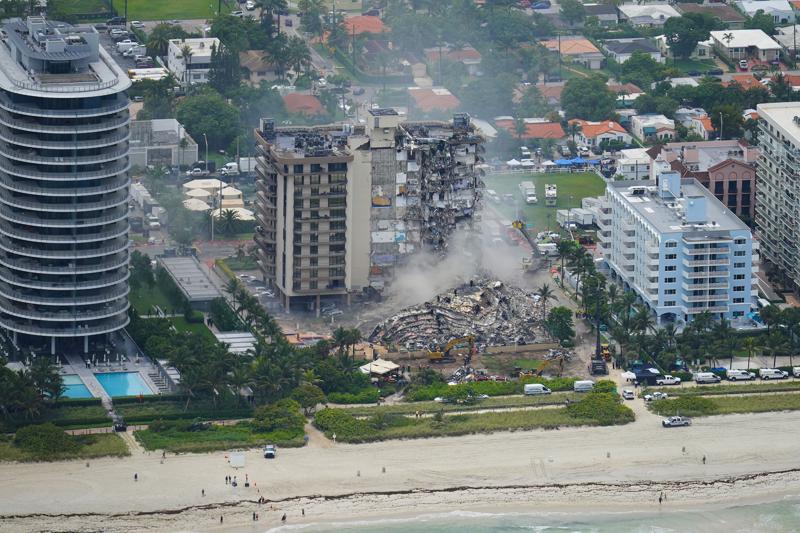 |
| Rescue personnel work on the collapsed condo tower Friday, June 25, 2021, Photo: AP |
Labels: Catastrophe, Condo Collapse, Environmental Instability, Florida, Miami, Surfside City, Wetland Conversions
posted by Pieface | 9:59 PM
|
0 comments