Politic?

This is a blog dedicated to a personal interpretation of political news of the day. I attempt to be as knowledgeable as possible before commenting and committing my thoughts to a day's communication.

Tuesday, January 28, 2025

Auschwitz, "The Largest Hungarian Mass Grave"


"I must not forget."
"In my subconscious, I can never get over the possibility that a six-pointed star could be placed on my gate again at any moment."
"It is always in my mind."
"[Hungarian society] refuses to face its part; [collaboration with the Nazis remains within the country's consciousness]."
"It's just a matter of time before we get to a moment where people think the time has come to hate someone again."
Tamas Lederer, Budapest artist

"We carry in our genes what our grandparents' or our parents' generation went through."
"I think that in order for us to happily observe Jewish holidays or to have Jewishness in our homes, what they experienced must remain a fresh memory and that memory has to be part of our lives."
"[For Jews, preserving the memory of the Holocaust is a way to] commit ourselves to showing the world that learning from the events of the past, we will not allow anything similar to happen to anyone else."
Tamas Vero, Budapest rabbi
https://english.news.cn/20250128/b4d0f85b4d52452288a6eca56f2881f8/f7d41cd54c5a4d0cb8bd07e589fb4bcc.jpg
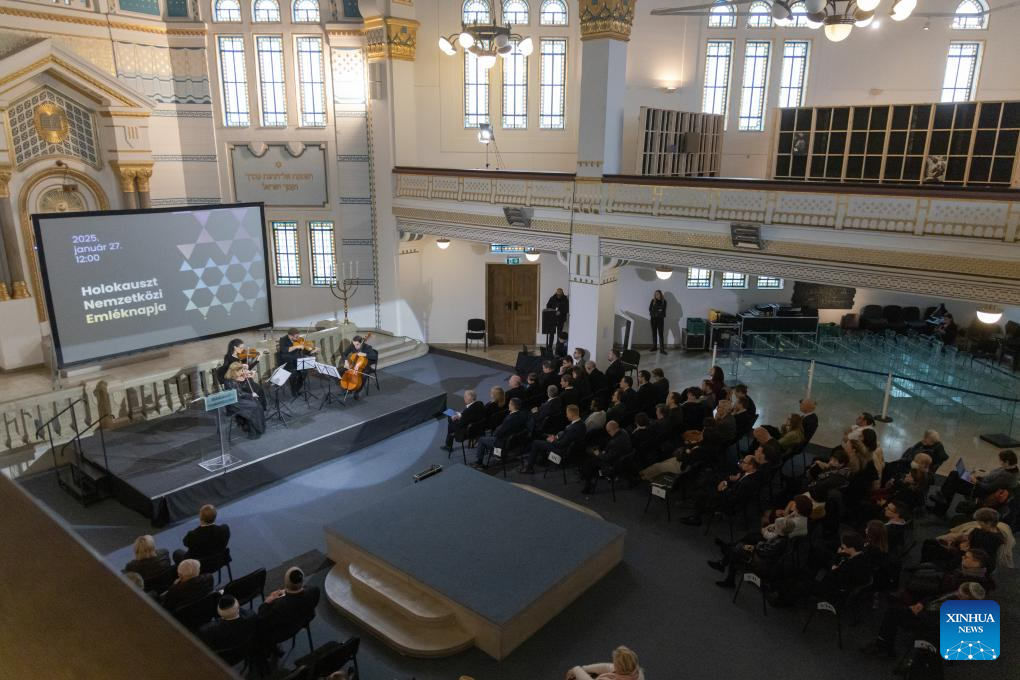
People commemorate the International Holocaust Remembrance Day at the Holocaust Memorial Center in Budapest, Hungary on Jan. 27, 2025.
 
In Auschwitz-Birkenau -- both a slave labour and a death camp complex -- close to a half-million Hungarian Jews were systematically murdered. And Tamas Lederer, born in Budapest in 1938, is haunted by the inner conviction that the horrors of the 20th century committed by Nazi Germany may yet be repeated; he feels that the world has failed to respond to that signal lesson in genocidal intent. His experience is one of survival; he evaded deportation to German camps hidden in Budapest basements after his parents tore the Jew-mandatory symbol from his clothing, of a yellow star.
 
After Auschwitz was liberated by the Soviet Red Army 80 years ago, on January 27, 1945, the 87-year-old's thoughts turn to the risks inherent in growing hate-full violence against Jews, completely unsettling him. Close to ten percent of the 6 million Jews killed by the Nazis were Hungarian Jews. Of the 1.1 million people who died at Auschwitz-Birkenau, over 90 percent of whom were Jews, roughly 435,000 of them were of Hungarian origin, a toll of Hungarian Jews that exceeded those of any other nationality.

Although Hungary made common cause with Germany, becoming part of the German Axis, and Hungary was also the first country in Europe to pass anti-Jewish laws in 1920, the government under its then-leader, Regent Miklos Horthy, while cooperating with Adolf Hitler throughout the war, also resisted German demands to deport the large Jewish population of Hungary. Hitler ordered the invasion of Hungary in March 1944, fearing that Horthy might defect from the Axis to join the Allies.

With the invasion, mass deportations swiftly took place. Between March and May of 1944, in less than two months, 435,000 Hungarian Jews, mostly rounded up from countryside cities and villages, were deported to Poland where they were incarcerated at Auschwitz. On arrival, most of the Hungarian Jews were ordered directly to the gas chambers. As war's end approached, thousands of other Jews still in Hungary were murdered by the Hungarian fascist Arrow Cross Party death squads, shot en masse in Budapest, into the Danube River.

Rabbi Vero on Monday and others gathered in Budapest at the Holocaust Memorial Centre for International Holocaust Remembrance Day for prayers, where a handful among the attendees were  Holocaust survivors. Dr. Andras Zima, director of the centre, spoke of Auschwitz as "the largest Hungarian mass grave".
https://english.news.cn/20250128/b4d0f85b4d52452288a6eca56f2881f8/2d10f966d41348d49a7ff02d55cd3368.jpg
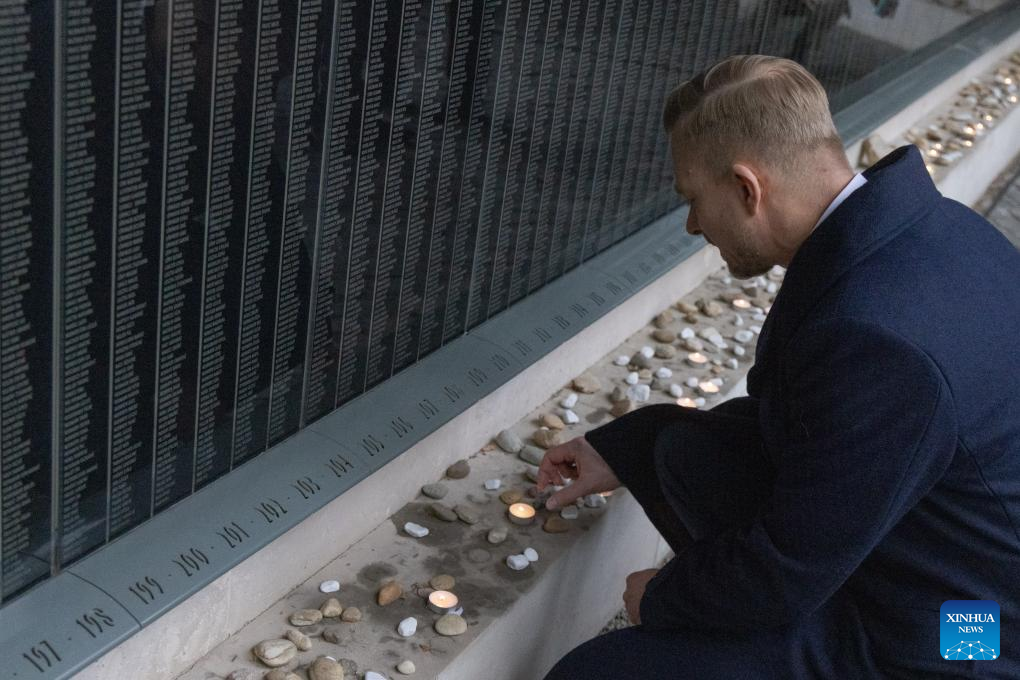
A man lays a candle in commemoration of Holocaust victims at the Holocaust Memorial Center in Budapest, Hungary on Jan. 27, 2025. Hungarian Minister of Regional Development Tibor Navracsics described the Holocaust as the "indefensible, inexplicable low point of European civilization" during a commemoration in Budapest on Monday. The event at the Holocaust Memorial Center marked International Holocaust Remembrance Day and the 80th anniversary of Auschwitz's liberation. (Xinhua/Attila Volgyi)

Labels: , , , , ,

Tuesday, December 18, 2018

Redress


"I met Marion at the Jewish Museum, where she was patiently waiting for me on a bench in the lobby. Incredibly spry and eloquent, particularly for a woman of her age [90], she was born Marion Sauerbrunn to a Polish mother and Berliner father. As a 16-year-old girl, she fled Germany on a Kindertransport to England in May 1939, yet returned to the country immediately after the war to serve as a German language censor for the U.S. Army. She was reunited with her parents, who had opted to stay in Germany rather than abandon Marion’s 82-year-old grandfather and had survived the Theresienstadt concentration camp. Upon immigrating to the United States, she worked as a consultant to other survivors, helping them achieve financial redress from the German government (she has also participated, for decades, in a weekly intellectual salon of German émigrés in New York, profiled by the Forward in 2008). And since 2005, she has visited Berlin annually to discuss her life experience with students at the very same gymnasium she attended, and from which she was expelled due to her being Jewish."
"The crowning display of 'The Whole Truth: Everything You’ve Ever Wanted to Know About Jews', is a three-sided glass box, where, for two hours every day, a real, live Jewish person sits and interacts with visitors [German citizens who are invited to pose questions to the box-sitter/s]. Initially skeptical of the exhibit, I came away positively affected by my interactions with regular Germans after spending some time in the box myself."
James Kirchick, Tablet magazine 
Header

A German Holocaust Survivor Steps into the Box The controversial Berlin exhibit gets an unprecedented guest


One time-redress payments, nominal in nature, are being offered by Germany to children of the infamous 'Kindertransport' initiative to rescue a relative handful of children and young people, mostly Jews, by separating them from their parents and sending them to haven in Great Britain for the duration of the war years. The evacuation of these children -- most of whom never again had the opportunity to see their parents, who when the children were taken from them, ended up in death camps where they perished -- allowed them to live and of the ten thousand on the 'Kindertransport' 80 years ago, an estimated thousand still live.

Marion House is one such survivor, and her experience was quite unlike that of the majority. She was reunited with their parents who had survived Theresienstadt concentration camp; most did not. New York-based Conference on Jewish Material Claims Against Germany had advocated on behalf of the Kindertransport survivors and the German government agreed to payments of $3,800 to be presented to those still living. Of the estimated thousand survivors still alive, roughly half are thought to be living in Britain to this day.

The Central British Fund for German Jewry, later known as Jewish Relief, discovered these documents in 1994. They show photographs and details for three children who were brought to Britain from Austria to escape the Nazis. 
The payment, to people in their 80s and 90s obviously represents a "symbolic recognition of their suffering". As symbols go, it's not much of a recognition. On the other hand, it would be hard to imagine what could possibly compensate for such an unforgivable loss as one's parents, one's security, one's loss of a normal life, one's separation from all that is dear and valuable in a child's life; siblings, extended family, friends, neighbours, emotional stability. There is no possible recompense for such a staggering absence in anyone's life. The vacuum that was created, that vast void of emotional yearning is a lifetime pain.

Children boarding the Kindertransport train
The 48th child transport with 10,000 Viennese children goes to Switzerland.
"In almost all the cases the parents who remained were killed in concentration camps in the Holocaust and they [survivors] have tremendous psychological issues."
"This money is acknowledgment that this was a traumatic, horrible thing that happened to them."
Greg Schneider, negotiator, Conference on Jewish Material Claims against Germany
The Night of Broken Glass -- Kristallnacht -- stirred Great Britain to permit unaccompanied Jewish children into the country as refugees from Nazi Germany or from Nazi-annexed European territories. The transports had been planned by Jewish groups within Nazi Germany; the first arriving in Harwich on December 2, 1938, as documented by the United States Holocaust Memorial Museum. The final transport left Germany on September 1, 1939, the very day Germany invaded Poland recognized as the day the Second World War broke out.

Three refugee children at the Dovercourt Bay camp near Harwich in December 1938.
May 14, 1940 marked the ultimate transport from continental Europe leaving the Netherlands, the very day that Dutch forces surrendered to the Nazi occupation. Children from Germany, Austria, Czechoslovakia and Poland were transported to Britain; of the ten thousand, 7,500 were Jewish children half of whom were placed with foster families, the older children put up in hostels, schools or on farms. Beside the children who remained in Britain others resettled in the United States, Israel, Canada, Australia and elsewhere.

Now in their 80s and 90s those children recall their escape, placed alone onto trains that were to transport them to some unknown place as they parted with their parents and their siblings, most never to be seen again. How to offer 'recompense' for that experience?

Tired and alone, 8-year-old Josepha Salmon, arriving from Germany destined for the Dovercourt Bay camp near Harwich in December 1938.
Tired and alone, 8-year-old Josepha Salmon, arriving from Germany destined for the Dovercourt Bay camp near Harwich in December 1938. 
Fred Morley/Getty Image


Labels: , , ,

() Follow @rheytah Tweet