This is a blog dedicated to a personal interpretation of political news of the day. I attempt to be as knowledgeable as possible before commenting and committing my thoughts to a day's communication.
Incomparably Beautiful Naturally Scenic British Columbia and Atlanta's FIFA Islam Compliance
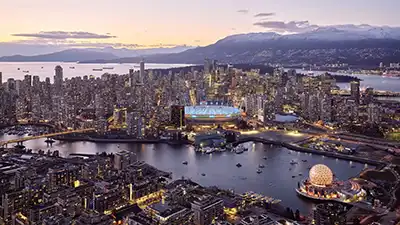
FIFA World Cup 2026™ Vancouver
"The unregulated drug supply in Vancouver is unpredictable and may be more dangerous than what visitors are used to in other countries or regions."
"Carry naloxone and know how to use it."
"Start low, go slow [use only] one substance at a time."
FIFA Vancouver website : Know Before You Go
Vancouver is being ravaged by an opioid crisis that makes the United States' epidemic pale in comparison
Credit: Simon Townsley
These tips to sport tourists arriving in Vancouver hosting its portion of the FIFA World Cup instructs visitors to the city on how best to use illicit drugs, and the wisdom of having naloxone in one's possession. The website goes so far as to recommend that tourists submit their cellphone numbers to the Province of B.C. enabling receipt of public health alerts should a batch of illicit drugs be discovered of particular potency. How very considerate.
Of course, illicit drug use is particularly widespread in the province and the province responds to that reality by extending its concern to all drug users to be aware of best practices in pursuit of stemming the tide of drug overdoses, particularly with the use of fentanyl and street drugs laced with the artificial opioid. An alert just happened to coincide with the World Cup when Vancouver Police reported a cluster of overdoses in East Vancouver.
Friendly injection /The Telegraph
The website does not confine itself to concerns over safe drug use, but adds tips on fraudulent game ticket avoidance, drawing police attention to use of drones, aside from the "information on safer substance use and laws", where the section informs visitors that the province is in the midst of a "toxic drug public health emergency"(aka "overdose crisis").
Even Vancouver Police get in on the action, since it's also a concern of theirs: "For questions about what drugs are allowed in Canada, see this list of controlled and illegal drugs", alongside a link to a Government of Canada database of illicit drugs. Will seasoned drug users and sport aficionados really distract themselves with the nuisance call of educating themselves for the purpose of self-protection that will likely recall their mothers' cautions when they were impressionable kiddies?
Vancouver stands out as a host city to include illicit drug tips in its FIFA guide, when San Francisco and Baltimore, also experiencing fatal drug overdoses, tent cities and fentanyl addicts featuring their urban core, wouldn't think of it. Perhaps they're not as nice-addicted. Public health officials in New York City reported in February all-time highs of fatal overdoses. "From world-class entertainment to iconic landmarks and rich cultural experiences, this is more than a tournament, it's a once-in-a-lifetime celebration" New York's guide touts.
Vancouver's B.C. Place where seven 2026 FIFA matches are taking place, is a 15-minute stroll from the Downtown Eastside, the core of the city's drug addiction conundrum and there the third-of-million-estimated visitors will encounter the city's approved open-air drug use and squalid street disorder. Case in point -- when two U.S. visitors praised the sushi and the "beautiful, beautiful stadium", but what was even more memorable for them was the "drug zombies walking all over the place".
Perhaps, on the other hand, Vancouver isn't so remarkable in its focus, even as Toronto, the other host city in Canada, has its website appearing as a tourism brochure where illegal drugs are mentioned on a list of "prohibited items" allowed at sanctioned viewing sites. Neither is anything like Atlanta's venue, however, where well-organized Muslim groups have FIFA's permission to greet all incoming ticket-holders with publications on Islam. And where posters informing visitors where prayer rooms are located for their convenience at the venue.
"I went to the Morocco vs. Haiti game in Atlanta yesterday. One thing immediately caught my attention.
Right after scanning your ticket at the entrance to Mercedes-Benz Stadium, there were groups of people handing out "Muslim Hospitality" pamphlets. They showed where to pray and which food was halal. Then, just a few steps inside, there was a large sign with the same information."
" It didn't feel like simple visitor assistance. It felt like the promotion of a religion.
The stadium doesn't hand every fan a printed map, stadium rules, or event information, those are all available online. Yet for Islam, there were printed pamphlets being handed to everyone and an entire team dedicated to distributing them."
"No other religion had volunteers handing out pamphlets at the entrance. There were no Christian hospitality teams, no Jewish hospitality teams, no Hindu or Buddhist pamphlets, only Islam."
"This is a soccer match, not a religious event. If someone wants to pray, there are churches, synagogues, temples, and mosques for that."
"The irony is even greater considering that, according to many Islamic scholars, professional soccer itself is considered haram, and FIFA generates revenue from sponsors such as Budweiser. Yet instead of addressing that contradiction, there is an organized effort to promote Islamic practices inside the stadium."
"Residents in Vancouver are sick of this cap. It's bulls---t."
"[The incident was] devastating. There's a lot of anger actually."
"We
can talk about how crime's down, violence, assaults are down, but when
these things happen, they're jarring and they really impact the entire
community."
"The federal government needs to step up, or at least have a
conversation with us.Their
responsibility is to help us out because we don’t have the
jurisdiction."
"It isn’t only those in Vancouver who are fed up, but] residents of this entire country."
"The
federal government, we need them to come to the table, or just tell the
country they’re not serious about this, and they’re going to do nothing
about it, and then we’ll deal with it."
"But don’t waste our time and don’t tell people that you’re going to deal with the issue."
Vancouver Mayor Ken Sim
The
very Vancouver that is widely recognized as a beautiful city in a
geographically spectacular province of mountains, lakes, rivers and
forests, is also considered one of best cities of the world to live in.
This, despite, the infamous Downtown East Side with its homeless,
drug-addicted individuals, the presence of opioid 'harm-reduction
clinics' set up to prevent drug overdoses, and the greatest number of
deaths from Fentanyl in any Canadian jurisdiction.
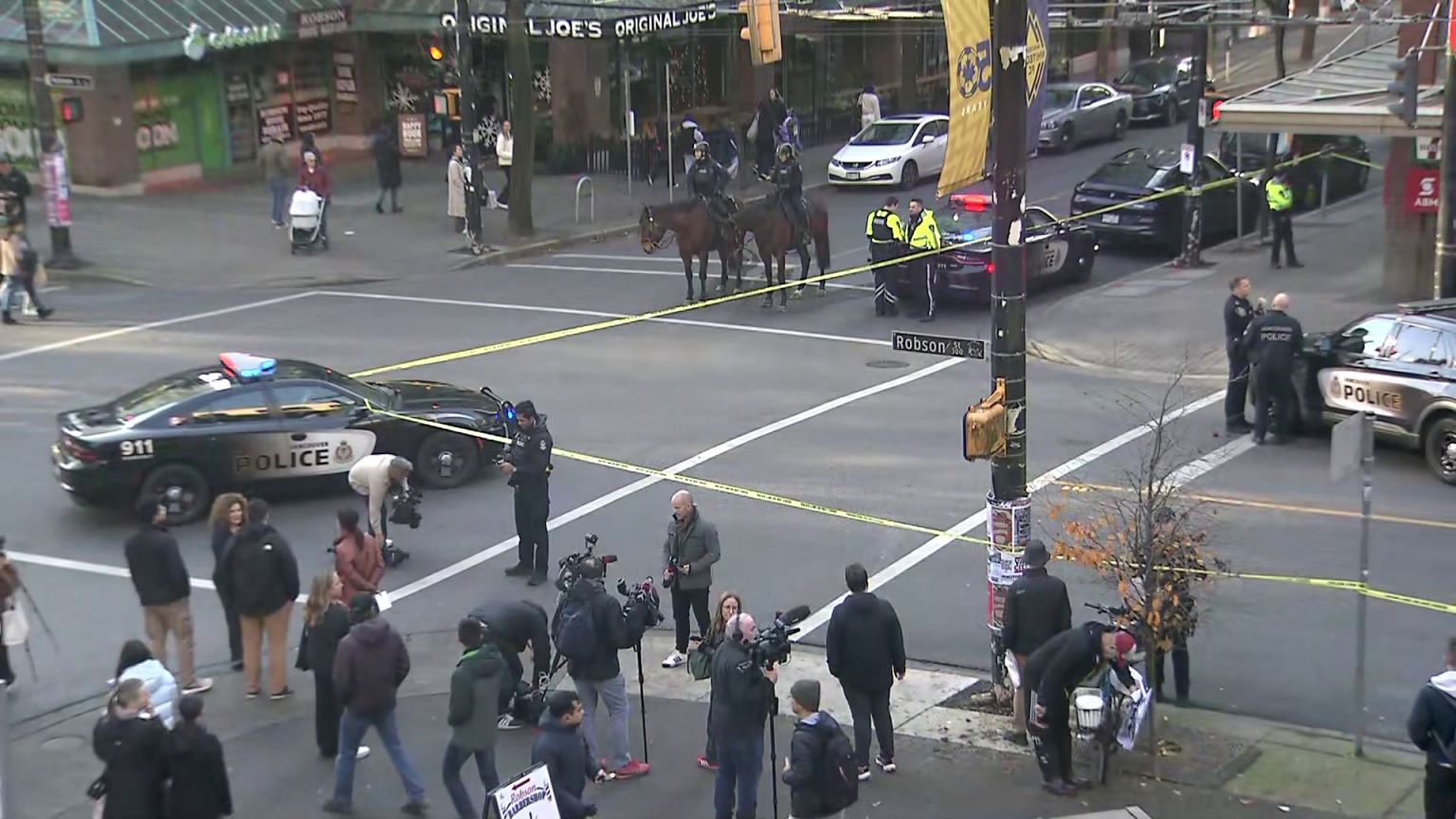
Vancouver police officers on the scene outside a 7-Eleven store after
police shot and killed a man who injured two people in downtown
Vancouver, British Columbia, on Wednesday, Dec. 4, 2024. (Ben Nelms/CBC)
Vancouver's
problem -- and it's one that plagues most of Canada's large cities --
is random 'stranger' attacks. Random stabbing sprees have become
distressingly all too common. It is a symbol of a justice system
incapable of protecting the public from the erratic behaviour of violent
criminals. On Wednesday one such individual went into an Original Joe's
shop located close by the Vancouver Public Library, where he stole a
knife and a bottle of liquor. He then went on to stab random strangers
in the neighbourhood before being shot fatally by police inside a 7-11.
In
January 2022, a man by the name of David Morin repeatedly plunged a
knife into a stranger's back at a Vancouver Tim Horton's. Vancouver
Police revealed last week that though classified as a "high risk to reoffend",
the man had been set free. It all seemed to begin back in 2002 when a
22-year-old Korean student, Ji-Won Park, was attacked in Stanley Park,
while he was out jogging. "Stranger attacks" are now a near-daily event. Not all are stabbings, sometimes a push, a shove, a jab, a punch.
Wednesday's
attack was one of the more serious events. A predictable pattern of
such attacks begin with a mentally unstable offender, one with a
criminal record, and often someone with that background, out on bail or
probation. Vancouver Police analyzed 44 separate stranger attacks that
took place over a three-month period, with the finding that mental
health was a factor in 73 percent of cases; 60 percent of suspects had
been charged previously with a violent crime.
The
problem seems to stem from two sources, one impacting the other; a
mental health system unable to keep violent mental health patients from
stalking and harming the public. Aligned with a justice system for which
bail and early release are routinely granted, even when the most brazen
repeat offenders are before them. A random stabbing spree in September
saw 70-year-old Francis David Laporte killed, and a man in his 50s
mutilated, his hand severed. Both had been strolling the downtown core,
then were suddenly victimized by multiple stab wounds.
An erratic and "very troubled"
34-year-old Brendan McBride was arrested. He had been on probation and
credited with a lengthy history of court-ordered psychiatric care. "I think that we have to realize that there's too many unwell people walking around in our streets",
commented Vancouver Police Chief Adam Palmer. Coast Mental Health
called the incident an indictment of the B.C. approach to mental health:
"Nothing excuses what's happened here. People want answers. They're not easy solutions", said CEO Kier Macdonald.
An image of the man alleged to have stolen liquor from a bar and wounded
two people in downtown Vancouver before being shot and killed by
police. CBC News has not yet learned the man's identity. (Submitted to CBC News by a witness)
At
the September 2023 Light Up Chinatown festival, the suspect who had
stabbed several people randomly, turned out to be a man with a history
of stabbing attacks. He was hospitalized, but was given a day pass from a
local psychiatric hospital. Charged with three counts of aggravated
assault, Blair Donnelly had stabbed his own daughter to death in 2006.
Found not criminally responsible for the murder as a result of a mental
disorder, Donnelly had been accused since then of stabbing someone while
on leave from a mental hospital.
The
legal system -- and this is not confined solely to British Columbia --
has proven willing to grant constant release to violent and
unpredictable offenders. Leading police forces in British Columbia to
refer to a new category of 'super-prolific offenders', defined as an
offender with over 30 convictions. Mohammed Majidpour with 30
convictions to his name, in September 2022 randomly attacked a
19-year-old woman in Downtown Vancouver with a pole. Later that same day
he set fire to a car. When he was arrested he spent a weekend in
detention and then was out on bail.
After
which he was arrested several more times. Majidpour was on bail less
than three hours before being arrested again for attempting to steal
$300-worth of merchandise. Two officers who had arrested Majidpour the
previous day on a separate incident, followed him until he broke the law
once more. "At the time of his arrest, the suspect had been out of custody for two hours, 18 minutes" a police statement read of the event.
"If this is a prolific offender, and if the courts will not keep them
off our streets, then we should be using the Mental Health Act."
"We need to strengthen the Mental Health Act so that
these people who are at risk of harming themselves or others can be held
and treated and not be released until they’re no longer a risk."
John Rustad, B.C. Opposition Conservative Leader
Vancouver Police officers responded to a “violent” incident that left multiple people injured Wednesday. (CityNews Image)
A Toronto police officer walks alongside a TTC streetcar after a woman,
23, was stabbed several times on the vehicle late last month. Another
woman, 43, was arrested and charged with attempted murder, among other
offences, in connection with the attack. (Evan Mitsui/CBC)
"That Canadians have a right to feel safe in their own cities should go without saying."
"Yet it needs to be said, because too many judges, politicians and left-wing voters have leaned so far into the soft-on-crime, defund-the-police rhetoric,they fail to see that the lack of deterrence in our justice system is contributing to a culture of lawlessness on our streets."
"Declining public safety and heightened dissatisfaction in a justice system that is seen as being too soft on crime, led to a major swing during last fall's municipal elections in British Columbia, which were dominated by law-and-order candidates, including Mayor Sim, who ran on a platform of hiring 100 additional police officers."
"Given the heightened fear and growing awareness of the inadequacies of our police forces and criminal justice system, there is now a significant opportunity for a political party to pull a similar feat at the federal level."
Editorial, National Post
The
rise in the Canadian homicide rate can almost exclusively be blamed on
gang-related killings, which represented 23 per cent of all murders.Photo by Gavin Young/Postmedia/File
When the Liberal government of Justin Trudeau resumed power after an unusually long period of Conservative rule under former Prime Minister Stephen Harper, much changed in Canada. For one thing, many of the initiatives taken by the Harper administration to amend some of Canada's lax criminal justice laws on minimum sentences, on bail, and other issues were tightened. It took no time for the new administration under Prime Minister Justin Trudeau to reverse all these changes and the results have not been impressive.
A 22-year-old homeless man with a long rap sheet in Newfoundland and Ontario was involved a week ago in a spontaneous, unprovoked attack on a teen, Gabriel Magalhaes, who was siting quietly on a bench at a Toronto subway station. He was stabbed in the chest three times, killing the 16-year-old. The attacker, Jordan O'Brien-Tobin, had an outstanding arrest warrant for the past two years in Newfoundland.
Despite which, during those two years when he moved to Ontario, he committed a series of crimes for which he was convicted -- of sexual assault, attacking someone with scissors, assaulting a man with a boxcutter, and breaching release conditions. A 150-day sentence was the most he received. Time after time the justice system deemed O'Brien-Tobin's mental health and addiction took priority over removing him as a danger to the community.
An ambulance is pictured here parked near a TTC sign late last month. (Evan Mitsui/CBC)
This death was not in the realm of isolated incidents. A Toronto Transit Commission report recently released highlighted 1,058 violent incidents on the city's public transit system in 2022 representing a 60 percent rise over the 2018's 666 recorded incidents, at a time when ridership has been reduced to 60 percent of pre-pandemic levels. Incidents of random violence include physical and sexual assaults, robbery, harassment and indecent exposure. And then there are the more fearsome attacks where TTC passengers and employees were stabbed and assaulted.
The report measuring last year's violent assaults on Toronto's public transportation system included a student who was shot, a woman pushed onto the tracks, another set on fire, and a homeless man killed in a swarming attack; this one by a group of teen-age girls. A recent poll verified that fully 40 percent of TTC users consider the system to be unsafe.
"Nobody should ever feel unsafe walking around [our] city", Vancouver Mayor Ken Sim tweeted following a stabbing a week ago when a man was stabbed to death in the company of his fiancee and three-year-old daughter outside a Starbucks in the downtown. The stabbed man had requested of another man that he not vape in close proximity to his three-year-old child. The general consensus in Vancouver is in agreement that particular areas of the city are seeing a steep decline in public safety.
The casket of South Simcoe Police Service Const. Morgan Russell is
carried into a joint funeral service in Barrie, Ont., Thursday, Oct. 20,
2022. Russell and fellow SSPS constable Devon Northrup were killed in a
shooting in Innisfil, Ont. (Nathan Denette/The Canadian Press)
Close to nine of ten people surveyed walking along Granville Street, a major downtown thoroughfare, responded to a survey that they felt unsafe in the area. A 2022 poll found province-wide that over half of respondents feel British Columbia's cities' downtown cores are in decline; 98 percent cited increased crime. The Vancouver Police Department show statistics of violent crime increasing 4.1 percent year-over-year to 2022's rise of 12.1 percent in comparison to the pre-pandemic average from 2017-19.
Toronto police data point to major crimes increasing 18 percent between 2021 and 2022. The number of major crimes reported to police for 2023 rose by 21 percent over 2022. Police too have been the recipients of violent crime, with nine police officers dying in the line of service since September. A week ago, Sgt. Maureen Breau, mother of two, was stabbed to death while making an arrest in Louiseville, Quebec.
The man who murdered her has a long line of violent crimes, dating back ten years, while for various reasons he was not kept behind bars in the country's catch-and-release justice system. Between 1991 and 2014 there was a distinct downward trend in per capita crime rates. The last seven years have been spent by the federal Liberal government and the courts dismantling the criminal justice reforms instituted by the Harper government. Many mandatory minimum sentences were trashed.
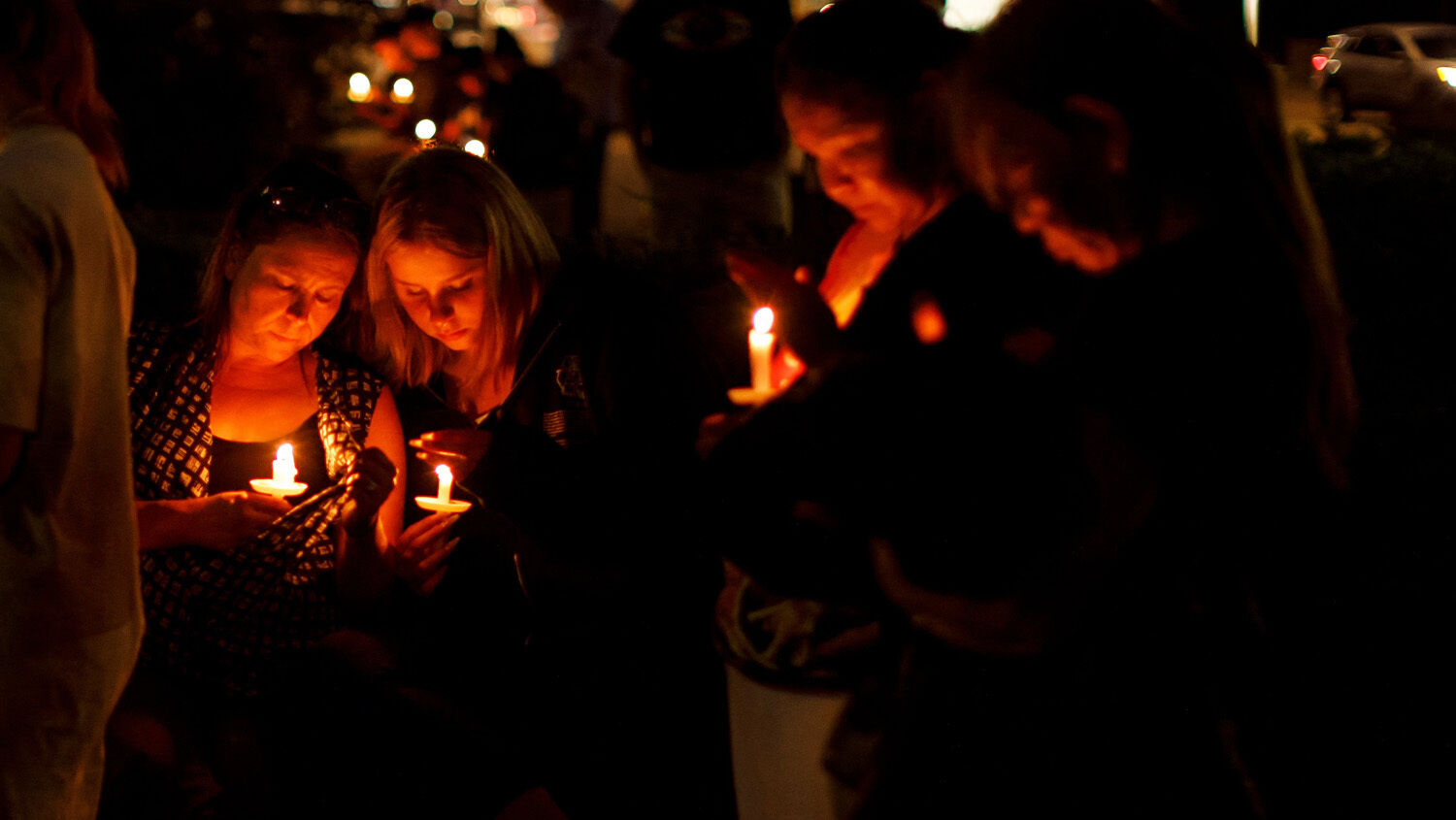
People light candles during a vigil in
honour of the victims of the nearby community of James Smith Cree
Nation’s series of stabbings, in Saskatoon, Saskatchewan, Canada,
"[The] externally-booked event prompted UBC community members to express
their views on freedom of expression and academic freedom, and ask
questions around the university’s commitment to equity and inclusion." "[The university remains] deeply committed to the principles of
equity, diversity, inclusion. [It acknowledges some community
members were] personally affected [by the event]." "UBC remains committed to finding more ways to maintain a respectful environment for everyone in our community." University of British Columbia vice-president academic, Andrew Szeri
UBC has been barred from the 2019 Vancouver Pride Parade after
hosting what the Pride society describes as a "transphobic" speaker. Simon Little / Global News
How, a logical mind might ask, can someone who identifies as a transgender male be labelled "transphobic" by the LGBTQ2 community. Jenn Smith describes himself as an 'activist', and he campaigns, as a "transgender-identified male", through speaking engagements and published articles on the deleterious effects on society of "the dangers" of "transgender ideology". On June 23 Jenn Smith spoke on "The Erosion of Freedom: How Transgender Politics in School and Society is Undermining Our Freedom and Harming Women & Children"; the venue was UBC.
Jenn Smith, who identifies as a transgender man, has caused controversy across B.C. for recent anti-SOGI events. (Jenn Smith)
This did not sit well with Vancouver Pride, who warns groups and institutions that if they wish to be viewed as friendly to the LGBTQ2+ community and enjoy the privileges of a valued supporter of said community, they must submit to strict guidelines. The Vancouver Pride Society has taken the drastic step of 'disinviting' UBC from a presence at the Vancouver Pride Parade; due punishment for its indiscretion in permitting a 'transphobic' transgender male to air his rejection of the social climate that surrenders to the demands of the transgender community, introducing young children to trans identity at school.
The Society takes its entitlements seriously. It is on the constant lookout for "any recent homophobic or transphobic events and the institutional response", which led in this instance to disallowing the university to attend Pride events since it had dropped below Pride's minimum score enabling parade participation. While the university's invitation to attend the parade has been withdrawn, the generous offer to permit students, employees and faculty as individuals to march in the parade was extended; in other words disavowing their links to the university in favour of attending the parade.
"We reject applications every year. But not usually once they've been accepted and ready to go in the parade, in this instance." "There was significant commentary and requests from the queer and
trans community on campus and also other community groups for UBC to
cancel the event." "We definitely want to send a message to UBC and to other organizations as well." "It's
probably going to be disappointing for some people and to that I say:
we're holding your organization, your university, to be accountable to
make changes."
Andrea Arnot, executive director, Vancouver Pride
Society
Participants in Vancouver's Pride Parade in 2016. UBC won't be marching this year. (Lien Yeung/CBC)
Well, several weeks have passed since Vancouver Pride disciplined UBC, forbidding them the privilege of marching in the Vancouver Pride Parade. And now, UBC has company; sitting in the penalty box with them is the Vancouver Public Library. Which failed to exercise its discretionary intelligence by permitting "transphobic hate speech" on their premises. A violation of the B.C. Human Rights Code, they thundered. And it's true the B.C. Human Rights Commission has certain standards of protection of human rights in favour of Pride.
But in accusing the library of hosting feminist activist Meghan Murphy whom Pride considers a purveyor of "transphobic hate speech" and where, they claimed "During this event five speakers asserted that transwomen are not women and should not be treated as women", they made their point. To which the detested feminist Meghan Murphy responded: "No one on the panel said anything derogatory, hateful or discriminatory about trans-identified people". Which goes to show how little an earnest critic knows of the trans community to whom any doubts as to the eligibility of a male to claim womanhood or vice versa is impermissibly violent.
"To frame my speech, which advocates explicitly for women's
rights, as well as for free speech, democracy, and the importance of
public debate about policy and legislation impacting us all, as 'transphobic', dangerous, or 'discriminatory', is absolutely
inaccurate." Innocently naive; the temper of the times mitigates against such dangerous thought as opposite opinions and reasonable debate, much less the airing of any opinions contradicting the 'settled question' of the authenticity of gender fluidity. In theory universities and libraries have been bastions of free speech, arenas of intelligent discussion where students are exposed to all aspects by which any given topic may be viewed, questioned and determined on the basis of cerebral functioning and an open mind. Back to the B.C. Human Rights Code; it entertains discriminatory publication issues, not free and open debates. And nor have either Meghan Murphy, feminist activist, nor Jenn Smith, anti Sexual Orientation and Gender Identity activist been found guilty by law of "hate speech". At an earlier event where Meghan Murphy rented a room at the Vancouver Public Library, Vancouver Pride objected as well at that time. In response, VPL chief librarian Christina de Castell issued a statement to the effect that the library is"not
endorsing, or hosting this event" and that it has "zero tolerance for
discrimination and does not agree with the views of the Feminist Current" founded by Ms. Murphy. The library permitted the event to proceed in reflection of its "commitment to free speech and intellectual freedom".
"As
such, we will not refuse to rent to an individual or organization simply
because they are discussing controversial topics or views, even those
we find offensive." "We seek to be a welcoming place
for all, and actively find ways to support the trans, gender variant and
two-spirit communities."
The Vancouver Public Library's central branch has held LGBT events, such as this Pride display in 2013. Photo: Charlie Smith
"I knew Hong Kong would eventually be handed over to the [Chinese] regime. My friends and I, we feared Hong Kong would be totally under the dictatorial rule." "The younger generation -- and the people who decided to stay and are now fighting, they have my utmost admiration." Ivy Li, 63, formerly from Hong Kong, Vancouver resident
Ms. Li was responding to the mass demonstrations in Hong Kong, where people were out on the streets adamant that they would not accept the proposed extradition bill signifying Chinese control over Hong Kong and the erosion of civil liberties in what was once a thriving British colony. Although the Hong Kong government, sympathetic to Chinese rule, announced the bill was suspended, demonstrations continue, demanding it be entirely withdrawn.
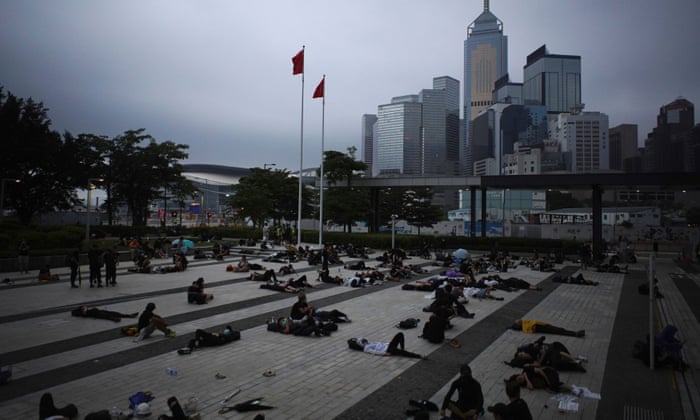
Protesters against a
proposed extradition bill, rest near the Legislative Council building
in the early morning in Hong Kong Photograph: Athit
Perawongmetha/Reuters
The measure to suspend the bill represents a temporary stop-gap to restore order to the city, according to Carrie Lam, chief executive, who uncharacteristically apologized for the measure to carry the bill to completion having been conducted in an imperious manner. This has failed to satisfy the people of Hong Kong who envision, with good reason, that the extradition law carried to fruition would mark the end of semi-autonomous Hong Kong and the firm entrance of aggressive authoritarian moves from China.
Tens of thousands of people from Hong Kong emigrated to Canada, among them Ms. Li and her family when the United Kingdom agreed to hand control of Hong Kong back to China in 1997. Hong Kong was supposed to retain a high degree of autonomy, with an independent judiciary for 50 years, under the agreement reached between China and the U.K. It is not yet 2047, but the Communist Peoples Republic of China is anxious to reclaim its own, sundering the "One Country, Two Systems" agreement.
Most people immigrating to Canada flooded into Vancouver, on Canada's West Coast. Sparing them from greater Canada's geography where weather extremes can be guaranteed with long, cold, snowy winters and hot and humid summers. On the arrival of people from Hong Kong, the Vancouver real estate market went into overdrive, and property prices soared. Many Chinese from Hong Kong planned to qualify for Canadian citizenship, and then to return to Hong Kong, using their dual citizenship as a lifeboat should it become necessary.
Several hundred protesters showed up Saturday
at the Consulate General of of the People's Republic of China in
Vancouver. The protest was a reaction to controversial legislation in
Hong Kong that allows extraditions to Mainland China. Jason Payne / Postmedia
"Vancouver has a special relationship with Hong Kong", explained Vancouver urban planner Andy Yan, who wryly described Vancouver as the 18th district of Hong Kong. According to the 2016 census, 24,120 residents of Metro Vancouver were born in Hong Kong. Most of the Chinese who emigrated to Vancouver were from the southern part of China; Hong Kong where Cantonese is the spoken dialect. Since 2016 however, continued migration to Canada has led to Mandarin overtaking Cantonese.
But the Chinese-Canadian population vastly pre-dates these most recent migrations. Chinese people have lived in Canada for over a hundred years. They were brought to Canada to work on constructing Canada's coast-to-coast railways. And they were subjected to dreadful discrimination, among them the notorious 'head tax' in an effort to keep Canada free of non-Caucasians. They were an oppressed minority for generations, working menial jobs, opening laundries and small mom-and-pop stores.
Canada has a huge Chinese population/ mostly from mainland China which long pre-dated the Hong Kong diaspora, however, with large demographics in Toronto and Ottawa; in total close to two million people of Chinese descent enriching the Canadian culture. Now, it is anticipated given the unrest and fear circulating in Hong Kong that emigration from the country will once again pick up.
Vancouver's Chinatown is one of the oldest neighbourhoods in the city
and a nationally-recognized historic site. (Photo by: Judy Lam Maxwell)
"I would assume more parents would want their children educated abroad, particularly pursuing North American education, possibly as a path of immigration" "The political environment, the abundance of home-owning opportunities, or the well-being of their children and reuniting the family here, are all factors in that process." Will Tao, Vancouver immigration lawyer
Mr. Tao is anticipating a potential surge in immigration from Hong Kong. He has received overtures from clients who had lived in Canada, as children or as parents of children who had returned to Hong Kong in the last two decades and now consider a return to Canada. Many of these people already hold Canadian citizenship. And there will be many more, he hazards to conjecture, that will want to join them, escaping what they fear will be the inevitable takeover of Hong Kong by China.
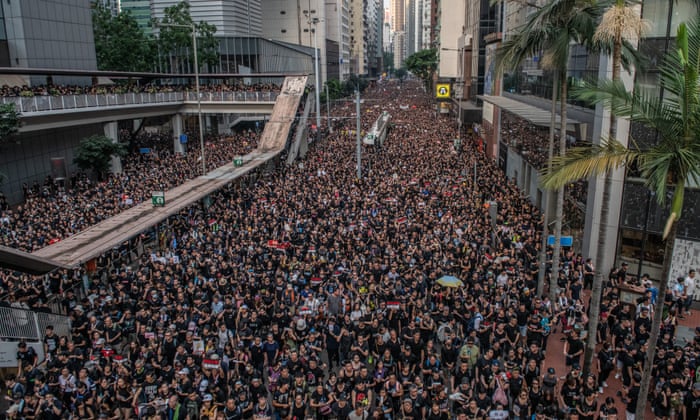
Protesters demonstrate against the now-suspended extradition bill on 16 June in Hong Kong
Photograph: Carl Court/Getty Images
"[Vancouver Rape Relief is] non-compliant with Canadian law [guilty of] systematic, consistent misbehaviour, [as the last women's shelter in British Columbia to continue denying services to the trans community]." "I can open any organization I want and discriminate against the people I don't like ... but when I start to bring taxpayer funding into this it makes this entire room [council chamber] responsible for my actions." "There
is a long history of discrimination and violence against transgender
women. We are a vulnerable group. There’s stigma and shame
.. and then to ask for help and have someone on the phone say ’sorry’
you are not women enough for us to help you....’." Morgane Oger, transgender advocate, vice-president, British Columbia New Democratic Party
"[Vancouver Rape Relief and Women's Shelter is a victim of] discrimination against women in the name of inclusion. [Vancouver City Council is trying to] coerce us to change our position." "We do not have the experience to offer services to people without the same life experience ... this is not our work." "Because we are an oppressed group who fights for equality we have a right to decide who our membership is and who we serve." "Rape Relief is strong enough and principled enough and has enough
supporters in the community ... we will say no to that kind of money [financial support from Vancouver city coffers that comes with demands]." "I think it [the demand] is
undemocratic and a very dangerous bullying move on [the part of] of councillors
... It says, ‘If you want the money, change how you operate, change
your political principles, change your basis of unity'."
Hilla Kerner, representative, Vancouver Rape Relief
Hilla Kerner speaks to city council about funding for Vancouver Rape Relief. Vancouver Star
The longest-operating rape crisis centre in Canada has a policy of giving aid and support only to females. People transitioning from male to female who contact the Vancouver Rape Relief and Women's Shelter will get a sympathetic hearing and advice over the telephone but they will not be admitted to the shelter and they will not receive services from the centre which focuses strictly on women. Because they have been unmoving in their strictly female-centered policies the City of Vancouver has voted to discontinue funding the group.
The measure is a disciplinary one, the city council informing the centre and its board of directors that it is not pleased with what it views as intransigence on their part to continue refusing serving the needs of females born as males; men who have transitioned to women and who become victims of sexual violence. "Trans women are women and sex work is work ... I can't support (organizations) who exclude them" wrote Vancouver city councillor Christine Boyle, accusing the organization of "supporting transphobia".
Aye, there's the rub. You may be sympathetic to the plight of transgender women who elicit scorn from society and who are often targeted with violence and certainly are socially discriminated against. But generally speaking, society at large has become more accepting of alternate-sexed, gays, and others who don't represent the norm. Accepting in the sense that they are who they are. And so the tensions inherent in life as a gay or lesbian or trans, is relieved for the most part of the dangers in being 'outed'.
Problems arise, however, when the LGBTQ-2 community insists that they be recognized as entitled to complete inclusion; marriage between same sex couples was merely the appetizer; the push to guide children into differentiated gender streams, to push for the right to impose upon the rest of society the adamant need to change the English lexicon to address them differently, the yearly exhibitions of crude and colourful 'parades' not pleasing to everyone, has the tendency to invoke annoyance not support among many in society.
And thrusting upon general society the obligation to recognize LGBTQ-2 'rights' to the extent where their charter rights are paramount and the charter rights of others who prefer not to be engaged with them in the provision of services creates yet another burden that many in society are not prepared to shoulder. Born female, and fleeing male violence, the Rape Relief shelter dedicates itself to these vulnerable women; it is gender-specific in its mission.
That trans-activists have enlisted sympathizers to their cause of 'equal' treatment to place the security and comfort of women in general in jeopardy they choose confrontation and slander over accommodation. When transgender women feel they are entitled to impose themselves on groups whose mandate is other than to serve them, they do a disservice to the greater community and to themselves as well.
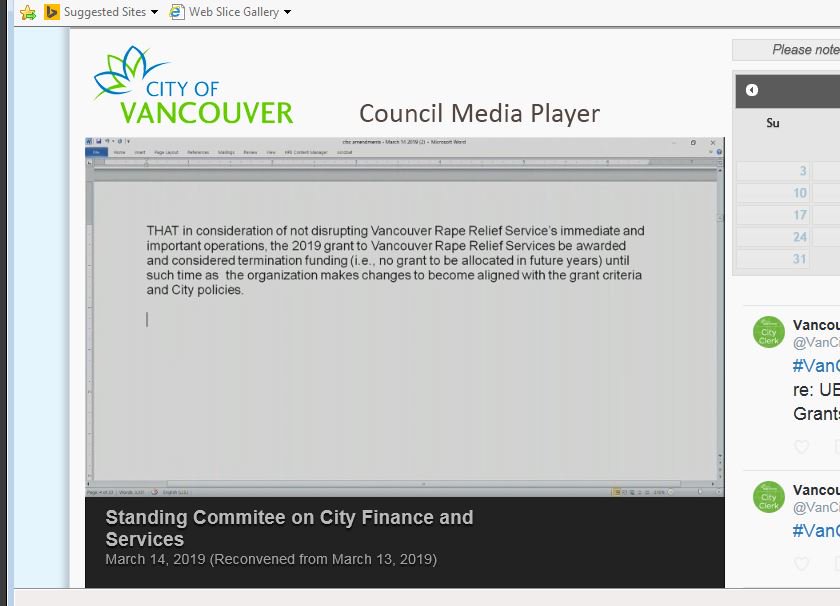
From 2020 forward, city council in Vancouver has voted to no longer fund any of the activities of the Rape Crisis centre. That funding by no means amounts to their entire operation's funding; the city provides them with $33,972 annually, which the group uses for educational outreach "free and accessible and available to everyone", including trans people. Not good enough for Vancouver council which will deny access to those funds "until such time as the organization makes changes to become aligned with City policies."
In fact, the Vancouver Rape Relief and Women's Shelter's operating funds amount to $1-million annually, an amount mostly provided to them by the Province of British Columbia. Since its founding in 1974 the centre restricts its core services; peer counselling sessions, shelters or transition homes to women born female. And it has faced criticism for its refusal to admit trans women for those services. A criticism that the centre is resigned to, but refuses to succumb to.
A post-operative transgender woman denied progamming at Vancouver Rape Relief launched a discrimination lawsuit in 1995 against the centre. "She was rejected from the training program because she did not share the same life experiences as women born and raised as girls and into womenhood", stated the centre. And the B.C. Court of Appeals found that argument reasonable, ruling in favour of the centre. When an appeal was made to the Supreme Court of Canada, it was denied.
An East Vancouver candy shop, the Licorice Parlour, had placed a poster advertising a fundraiser for the Rape Relief centre in May, and it became the focus of trans activists resulting in online harassment and slanderous reviews calling them out for being "oppressive" and "transphobic". Women who are feminists tend to support women's needs. Should government really feel that transgender women require similar support for their dissimilar backgrounds adjusting to a new reality a standalone centre specifically geared to their needs becomes an option.
In the meantime, little wonder there is push-back from that segment of society that is fed up with the LGBTQ-2 community believing its rights supersede all others', and in the pursuit of gaining never-ending concessions go on to demand more and in the process don't mind stepping on other groups' rights to achieve their ends using means both fair and foul.
Members of Vancouver Rape Relief and Women¹s Shelter pictured at a 2014 rally to call attention to domestic homicides.Vancouver Province
"We will be discussing with our partners and allies the kind of steps that we can take on maritime interdiction and to be disrupting funding and disrupting resources." "And maritime interdiction helps us to disrupt resources and then the financial side helps us to disrupt the financing of their nuclear and missile program." "This ministerial [conference] will enhance and strengthen all of the efforts underway to achieve our policy goals." "China has the same policy goal in terms of ensuring that North Korea does not become a nuclear-weapons state and acquire the means to deliver a nuclear warhead." Brian Hook, director of policy, U.S. State Department
"The current situation in the Korean Peninsula is very complicated and sensitive." "All parties should work to defuse tensions and promote dialogue, rather than blindly resort to pressure and isolation." Lu Kang, Chinese foreign ministry
People watch a TV screen showing North
Korean leader Kim Jong-un's New Year's speech, at Seoul Railway Station
in Seoul, South Korea, Wednesday, Jan. 3.Ahn Young-joon / AP Next week in Vancouver the 17 countries that deployed troops as part of the United Nations alliance between 1950 and 1953 during the Korean War will be sitting down together as invited participants to discuss North Korea's recent nuclear and ballistic missile tests. It transpires that the co-hosts of the conference, United States and Canada, failed to find it a requirement to invite two critical players; China and Russia.
At the Vancouver meeting, emphasis will be placed on finding ways of cracking down on the smuggling and money-laundering schemes Pyongyang has resorted to in its efforts to sidestep sanctions, and to enable it to afford its costly nuclear program. There can be little doubt that neither Russia nor China would be amenable to such a move, just as there is little doubt that China has acted as an enabler to North Korea in its smuggling and money-laundering, irrespective of the fact that China does have concerns over Kim Jong-un's propensity to destabilize the region.
This is a gamble for China. It looks forward to a controlled regional destabilization in the sense that all eyes have pivoted to North Korea. All of North Korea's neighbours, from South Korea to Japan, the Philippines and even Australia are riveted to the activities, actions and threats emanating from Pyongyang. In the process, that anxiety takes attention away from Beijing, with its 'distractions' in its expansionist agenda in the South and East China Seas. With bated breath being expended on North Korea, China's plans go unheeded and unimpeded.
The purpose of this meeting of allies and think-alikes is to approve of and strengthen a "maximum-pressure campaign" to deter North Korea from its intransigent determination of achieving its nuclear-ballistic coupling agenda. Russia and China have been suspected and accused of exporting oil to North Korea, representing a violation of UN sanctions, though both have denied the charges. Obviously, the maritime trade and smuggling aids North Korea's survival and weapons development.
There are those who question the kind of progress that can be achieved in the absence of the two nations representing North Korea's key neighbours, both influential in their capability to exert their own pressure on Pyongyang, and both to a degree concerned about the explosive nature of the North's program and aspirations. Both understandably curious about how this will impact on the United States, the global giant they each still marginally defer to, while witnessing its diminishing global influence.
2017/10/13: Ships by the Yalu River near the Sino-Korean Friendship Bridge in Sinuiju North Korea. Photo by Stephen J. Boitano/LightRocket via Getty Images