Politic?

This is a blog dedicated to a personal interpretation of political news of the day. I attempt to be as knowledgeable as possible before commenting and committing my thoughts to a day's communication.

Wednesday, February 09, 2022

The Vital Imperative of Remembrance

"It is where it all began for the Jewish community, and it has such historical significance."
"It's going to be eco-friendly. It's going to have a memorial garden. It's going to be a beautiful space. It's going to be a hub of research and education. It's going to have a beautiful auditorium with 150 places." "It's going to have a gallery that can host temporary exhibits."
Richard Schnurback, president, Montreal Holocaust Museum 

"It will transform the landscape of the area. It will help to revitalize downtown and so we feel we're really contributing to our city in a significant way as we all hope eventually to come out of this pandemic."
"We expect it to be an internationally renowned, world-class institution and an architectural statement."
"It will be a gathering place for other communities who have been targeted by genocide, for the local population, for students, for tourists. We are going to be a warm, welcoming, accessible space that draws people in and that transforms them and encourages them to stand up today, to act, to remember."
Dorothy Zalcman Howard, co-president, Montreal Holocaust Museum renewal project
"We've outgrown our physical facilities and we have to regularly refuse school groups."
"This museum will really be Canada's Holocaust Museum. It will tell the story of the Holocaust and also talk about the Montreal survivors, people who came to Canada, to Quebec, and helped to build our city."
Julia Reitman, campaign cabinet president, Montreal Holocaust Museum
Eva Kuper, standing in front of the Montreal Holocaust Museum, tells how her life was saved just as she and her mother were being loaded onto cattle cars for transport away from the Warsaw Ghetto
 
"[The] relocation to downtown Montreal should allow increased accessibility and that is all the more necessary, as we have seen in recent days."
"Unfortunately, many people are not sufficiently aware of the Holocaust and of the consequences and the lingering after-affects of that tragedy."
"Let's hope that having a museum that allows us to better understand this reality will lead people who have trivialized the use of the yellow star and trivialized certain Nazi symbols in the past few months to reflect." 
Benoit Charette, Quebec minister of Culture
A collection of yellow stars, worn by Jews during the Holocaust, is one of the many exhibits by the Montreal Holocaust Museum. (Simon Nakonechny/CBC)
 
A museum, another museum dedicated to the premise that to forget is to airbrush history out of existence. Can there be too many museums and edifices whose sole purpose is to remind humanity of its obligations to ensure that the organized mass elimination of a people -- whose humanity had been denigrated amidst accusations of sinister conspiracies to rule the world, to establish themselves as an ethnic-religious-ideological world power, subjugating all other peoples to their command -- is never repeated?

A criminal, deliberately purposeful campaign undertaken by Nazi Germany to dehumanize Europe's Jews, to justify the Third Reich's carefully staged enterprise of delegitimization of what they labelled sub-humans belonging to a specific ethnic-religious group in preparation to launch a program of mass slaughter, one that would not raise objections among populations inured to compassion for the men, women and children slated for death, because they were exposed to a lethal hatred and believed that Jewish dominion over the globe must be stopped at all costs.
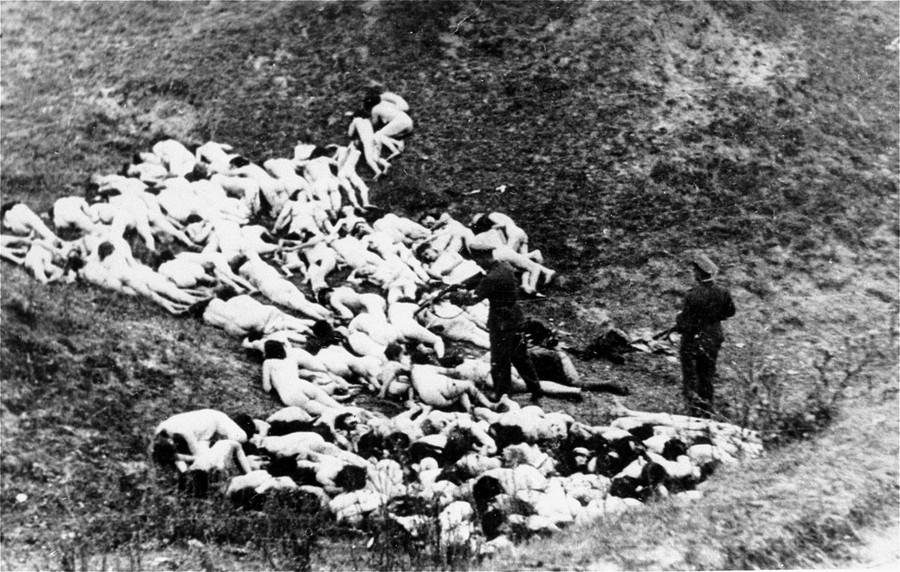
 
A German in a military uniform shoots at a Jewish woman after a mass execution in Mizocz, Ukraine. In October of 1942, the 1,700 people in the Mizocz ghetto fought with Ukrainian auxiliaries and German policemen who had intended to liquidate the population. About half the residents were able to flee or hide during the confusion before the uprising was finally put down. The captured survivors were taken to a ravine and shot. Photo provided by Paris' Holocaust Memorial.
 
The cost was six million lives. The European Jew-cleansing pogrom cost Jewish children their future, Jewish women and men their hopes, as they were gathered up, murdered en masse, buried in mass graves, used as slave labour, died of starvation and disease. And then the Final Solution seeking more efficient, quicker methods thought of Zyclone B to gas assembled Jews whose humanity had been stripped away, just as their worldly possessions, their hair, their gold rings and gold teeth were gathered to help the World War II effort of the Axis forces.
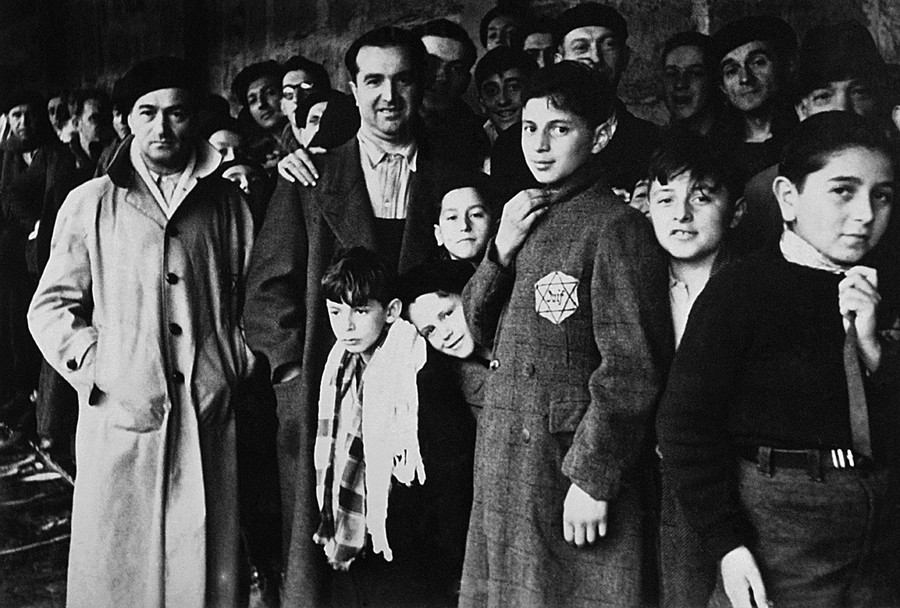
 
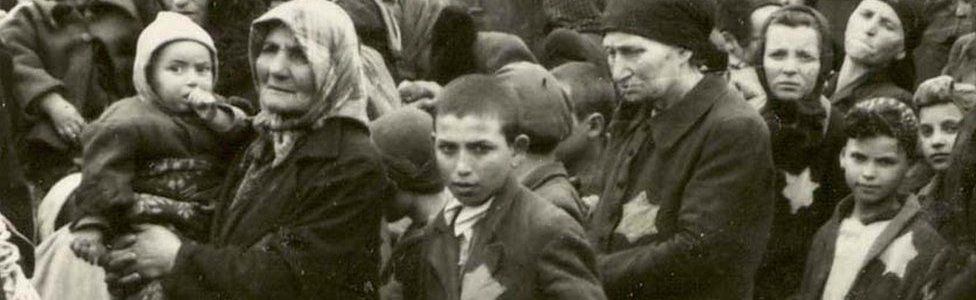
Jewish deportees in the Drancy transit camp near Paris, France, in 1942, on their last stop before the German concentration camps. Some 13,152 Jews (including 4,115 children) were rounded up by French police forces, taken from their homes to the "Vel d'Hiv", or winter cycling stadium in southwestern Paris, in July of 1942. They were later taken to a rail terminal at Drancy, northeast of the French capital, and then deported to the east. Only a handful ever returned.
 
This was their destiny; a giant sacrifice for their noble cause; ridding the world of Jews for the greater purpose of elevating Aryan qualities of physique, emphasizing the health virtues of abstaining from alcohol, smoking, poor nutrition, and global command of lesser nations. The golden mean of 'doing unto others as you would have them do unto you', underpinning Jewish traditions only emphasized their suffering as they cried out to the heavens for having abandoned them. Remembering the atrocities, the humiliations, the suffering is integral to modern Jewish life. 

The promise made Never to Forget was forged in blood and bone in memory of those whose lives were taken. So, no, such places of memorial and teaching must carry the torch of remembrance. There are far too many in today's world who doubt the very existence of a machinery vast enough and dedicated enough to have murdered six million Jews. And many among them feel the effort was halted before it could properly complete its goal. The spectre of once-hushed Jew-hatred has resurfaced with a vengeance.
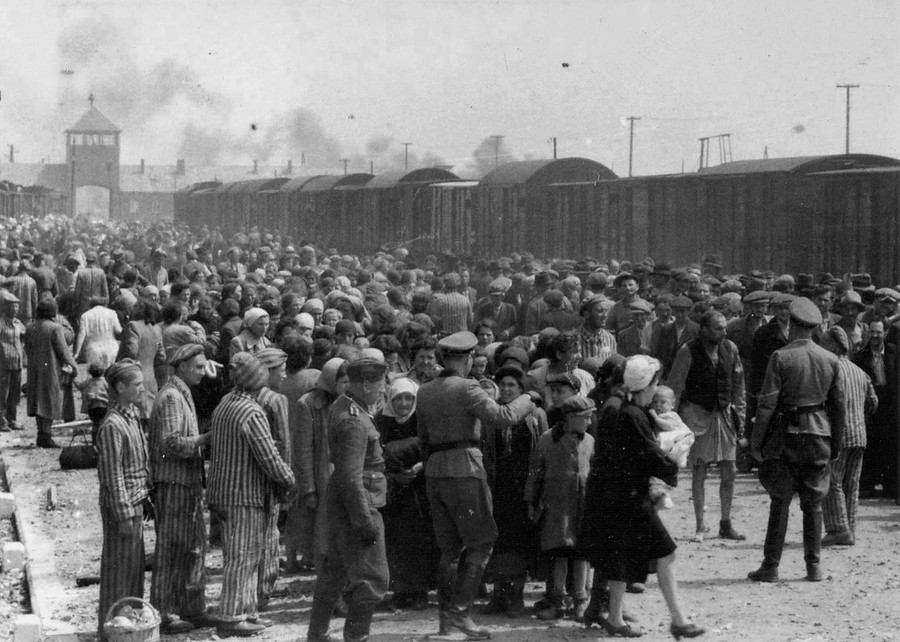
 
The arrival and processing of an entire transport of Jews from Carpatho-Ruthenia, a region annexed in 1939 to Hungary from Czechoslovakia, at Auschwitz-Birkenau extermination camp in Poland, in May of 1944. The picture was donated to Yad Vashem in 1980 by Lili Jacob.
 
The Montreal Holocaust Museum's current location in a building shared with other Jewish community organizations has outlived its ability to convey the full measure of what fascist Germany accomplished. A mere 400 of its 14,000 artifacts are displayed, reflecting a lack of room to amply and effectively expose visitors to a fuller understanding of the Holocaust. With a purpose-built edifice for which funding is being raised, for construction to commence in 2023 in the expectation of the museum opening two years later, a generous endowment by the province's Culture Ministry of $20 million, another $15 million from the Azrieli Foundation, as well as public, corporate and private sources see the project on goal for $80 million.

The museum is to move from Cote Ste-Catherine Road to what once was the beating heart of the Montreal Jewish community, St.-Laurent Blvd., The Main. Where a parking lot now sits, a building to house the Holocaust Museum is to rise, with 71 percent of its funding already raised. Destination Montreal represented the third most important city per capita after Israel and New York, for Holocaust survivors leaving the charnel house of Europe for a new beginning. Of the roughly 40,000 survivors immigrating to Canada after the Second World War, 9,000 arrived in Montreal.

Among the museum's collection, there are 858 recorded survivor testimonies. Research indicates that people who learn about the Holocaust are likelier to be aware of and to care about other communities, to oppose persecution and to tend to develop anti-racist values. "For so many victims, there are no places that mark their existence. In a way, we are their voices. We are the repository for those people who were killed. We tell some of their stories and we encourage future generations to care about what happened and to translate those stories so they find expression in their own times", explained Dorothy Salcman Howard.

An urn containing ashes from the Auschwitz concentration camps sits surrounded by the names of other Nazi extermination camps at the Montreal Holocaust Museum. (Simon Nakonechny/CBC)

Labels: , , , , , , ,

Sunday, January 27, 2019

Recalling The Holocaust

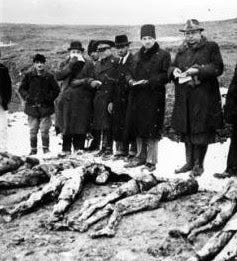
Cemetery of Jews killed by Horthysts in Sărmașu

Recalling The Holocaust

"Because my father and I had fled Romania when World War Two broke out and managed to get visas to Australia, I was in the Australian army on my twenty-first birthday. My commanding officer had given me a short leave. Thus, I spent my birthday alone, walking in the Australian countryside and thinking about who among my family and friends back in Transylvania were alive or dead. What had happened to them?"

"Soon after the war, I learned that on that very day, Hungarian soldiers shot the entire Jewish population of Sarmas, a village east of Kolozsvar, in Transylvania. Those poor people. They had thought of themselves as Hungarians. They spoke Hungarian. They had managed to survive five years of fascism without being deported to concentration camps. It was as if they had been miraculously forgotten while every kind of horror reigned around them. Then their own Hungarian soldiers appeared in Sarmas, and what did they do? They herded all the Jews into pigsties for several days and then took them to a hill and massacred them. Within the Holocaust, there were many little pogroms."

A week after Fischer [Rudolf Fischer] told me this story, I would visit that same hill in Sarmasu, Romania. It was a vast and sloping fold of grass surrounded by villages of rotting wood, where wild pigs scampered through the mud and peasants in black sheepskins worked with scythes. I saw three lines of graves, 126 in all, each with a Star of David and a Hebrew inscription. The graves were surrounded by an ugly cement barrier, a brutal box that might be called 'modern history'. I climbed over the barrier and read the Romanian inscription:

"....[Hungarian] fascist troops, the enemies of mankind, occupied the village of Sarmasu, where they herded all the Jews -- men, women, and children -- inside pigsties, where they kept them without food and tortured and humiliated them in the most vicious manner for ten days, after which they were taken to this hill of weeping and killed in the most sadistic ways on the eve of the Jewish holiday Rosh Hashanah....."
Exhuming the victims of the Sarmas massacre for burial, 1945. Photo of exhumation via Yad Vashem, via MemorialMuseums.org.

Of course, this monument in Romania made no mention of equally horrible atrocities perpetrated against Jews by the Romanians themselves during World War II.

Eastward to Tartary, Travels in the Balkans, the Middle East, and the Caucasus, Robert D. Kaplan

RO CJ Camarasu 6.jpg
Sărmașu massacrePart of the Holocaust in Northern Transylvania

Labels: ,

Tuesday, May 23, 2017

Ageless Cerebral Researcher

"We reached an agreement, right then and there. He [driving instructor] let me pass the [driving] test, and I promised never to drive."
"You see, my spatial skills aren't so good. That's primarily a right-brain function."
"People think because I'm 98 years old I must be emerita [retired with grace]. Well, not at all. I'm still nosy, you know, curious."
"I come into the office [at McGill University, as a senior/senior researcher] about three days a week or so, that is plenty."
"And I have some rules. I will take on post-doctoral students, but not graduate students. Graduate students need to know you'll be around for five years or so, and well -- well, it's very difficult if they have to switch to someone else, you know."
"I live very close [to the university and her office]. It's a ten-minute walk up the hill. So it gives me a good reason to come in regularly."
Dr. Brenda Milner, psychology professor, McGill University
Dr. Brenda Milner in her office at the Montreal Neurological Institute and Hospital last month. Credit Aaron Vincent Elkaim for The New York Times

In 1962, Dr. Milner demonstrated that the brain has at least two systems for processing memory. One whose function is explicit in the handling of names, faces and experiences. And the other implicit in incorporating skills such as riding a bicycle, playing a guitar, practising dance steps. Earlier, in 1957 her research was instrumental in changing the course of brain science understanding when a paper she wrote with a brain surgeon concluded that the hippocampus in the medial temporal area of the brain was critical to memory formation.

Even before that, with doctorate in hand, she identified the specific brain organ critical to memory formation, by observing a 29-year-old man from Connecticut who had undergone an operation to relieve severe epileptic seizures. She worked with that patient to demonstrate that his motor memory remained intact, recalling how to perform physical drawing tests, even though lacking the memory of having learned them to begin with.

Dr. Milner, now 98 years of age and determined to continue working and conducting research, may have been unable to satisfy the basic moves in parallel parking, but her brain could always be relied upon to work in overdrive. As a professor of psychology in the McGill department of neurology and neurosurgery in Montreal, she is known for having discovered the seat of memory in the brain.  Its relevance to cognitive neuroscience cannot be overstated.

Her career has spanned close to 70 years of professional life and she has no intention of surrendering it simply because of advanced age.

Her brilliance as a researcher and her single-minded devotion to her craft ensured that if gender barriers to advancement existed, she took little notice of them and simply forged ahead to achieve her goals, and in so doing earned her international reputation as a neuro-cognitive researcher par excellence. No one, either McGill University or the Montreal Neurological Institute affiliated with the university has suggested she step aside.

Funding is available to her through three prominent achievement awards granted her in 2014, providing research money. Her current project focuses on an ongoing study to investigate how the healthy brain's intellectual left hemisphere's co-ordination with the aesthetic right hemisphere in thinking and memory comes about as a vital feature of the human brain. The biology of memory is her bailiwick.
Neuroscience Pioneer, Dr. Brenda Milner       Yannick Grandmont, New York Times


Labels: , ,

Tuesday, April 25, 2017

Nameless Ciphers in Genocide

Hungarian Jews arrive in Auschwitz, 1944
Yad Vashem, Israel
"These people [Holocaust survivors] are dying out. We won't be able to access the information they have in their minds."
"Members of the family [of those who were murdered] don't remember the names of small children. Cousins who lived 60 kilometres away never knew those newborns [whose young lives were obliterated]."
"[Children or grandchildren call Yad Vashem to ask] 'Maybe you can talk to my grandfather and convince them [to recall]'."                                                       "The difficulty is compounded by the fact that sources can be in 30-40 different languages, most are handwritten and can be in different scripts, such as Latin, Hebrew and Cyrillic. Our staff not only need to be linguists but they need to know calligraphy,"
Alexander Avram, director, Yad Vashem, Hall of Names
A visitor pauses under photographs of Jewish victims of the Nazis in the Hall of Names at the Yad Vashem Holocaust Memorial  in 2005.
David Silverman / Getty Images   A visitor pauses under photographs of Jewish victims of the Nazis in the Hall of Names at the Yad Vashem Holocaust Memorial in 2005.
"I thought I should leave this evidence behind. For me they are not just names, there are faces behind these names."
"It's all etched into your memory: their faces, they will always be there."
Vera Schiff, author, Holocaust survivor, Toronto
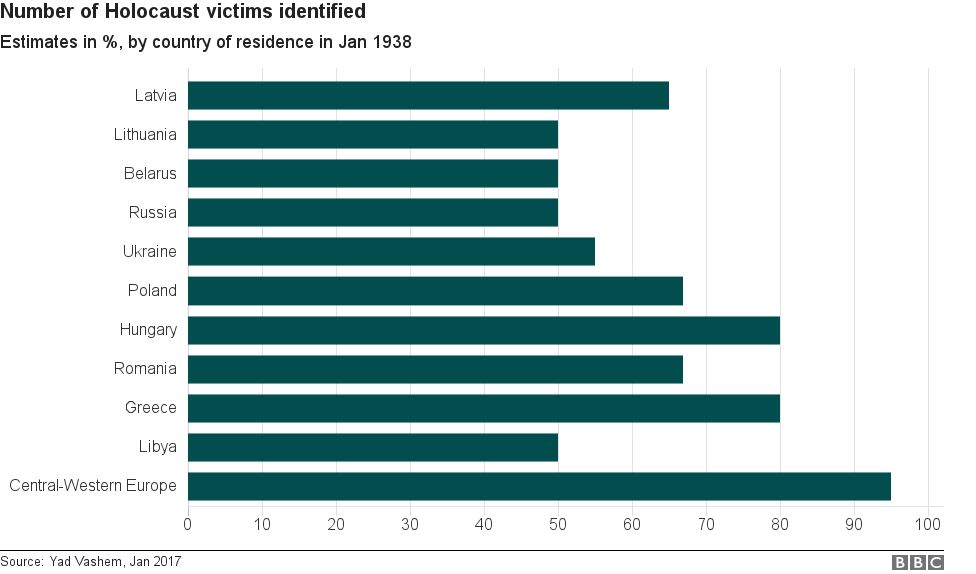
The World Holocaust Remembrance Centre in Jerusalem's staff has managed through patient effort to identify most of the six million victims of the Holocaust; their names, ages, genders, where they lived, who their relatives were who died alongside them. Anything relevant about each of these victims of genocide that would help to put a human face, a life, an existence to a dead memory. To ensure that their presence is not lost in a dead zone of forgetfulness. They lived, and their lives should be documented as much as can be possible.

The researchers in Jerusalem have an estimated 1.3-million dead whose backgrounds, whose family names have yet to be revealed, for lack of testimony that would identify them and bring them back to life through recognizing their identities. They hope yet to be able to persuade reluctant survivors to document whatever little they may know of extended family members to enable the researchers to make that vital identification of individuals. Understandably, Holocaust survivors would prefer not to remember the horrors that marked those traumatizing years of suffering and death.

The Center has so far recorded 4.7-million names of Jews whose lives were extinguished in the Final Solution of Nazi Germany's death camps. That gigantic task was initiated in 1950 and has been carried on ever since, but is still far from completion. And it will not be completed until every last Jew who was murdered by order of the Third Reich is documented properly. Archives containing victims' names through a collection of over 2.5 million "pages of testimony", single-page forms containing whatever is available of the personal details identifying a person represents the last-stage resource.

Each was completed by a survivor of the Holocaust, by a descendant of the dead, or by a friend whose memory of the dead has been invaluable in the documentation process. Where the person was born, lived, married, how they made their livelihood. Holocaust survivors are declining steadily in numbers after the passage of so much time. And those who are left may or may not wish to divulge what they are reluctant to recall of painful times and memories that torment them still.

The issue of child victims who died while other family members managed to survive is another complicating factor. There were one-and-a-half million Jewish children alone murdered during the Holocaust, and of that number an estimated half have been named. "It's one of the saddest things, we have reports where parents are named with say three or four children, unnamed. They were little children and people just don't remember", says Dr Avram

"Filling out this page of information saying this was my father, mother, grandfather, nephews and nieces - you cannot bury your relatives who perished but you can remember them in a way that will commemorate them forever, so this is very important and also therapeutic for many survivors", explained Dr. Martin Auerback, at Amcha, a support service for Holocaust survivors in Jerusalem.

Beyond the death camps that gassed Jews to death with Zyklon B, then moved their bodies into giant crematoria where dense black clouds of smoke covered the skies and rained down particles on the land below, the stench of burning flesh and bones making no secret to nearby residents in various Nazi-occupied countries of Europe of what was occurring, there were other methods employed by the Third Reich to rid Europe of its Jews.

Mobile killing squads called Einsatzgruppen shot an estimated 1.5-million Jews to death after the invasion of the Soviet Union in 1941. And in Ukraine, at Babi Yar, 33,000 Jews from the capital Kiev alone were shot to death and toppled into a ravine in 1941, half of whom are awaiting identification. Yet other Jews died from starvation, disease, or slave-labour-related exhaustion in ghettos and in labour camps, or killed in the extermination camps with which the work camps were twinned.

They were seen by their killers, and treated as sub-human ciphers to each of whom a number was assigned as their identification, the infamous branding of human beings as a means of keeping records. Naming them, elaborating as much as possible on their identities with details of their existence can be viewed as a gesture to restore a modicum of dignity to them in their appalling deaths, a restoration of sorts denied them by their murderers.

Bar chart of number of identified victims

Labels: , ,

() Follow @rheytah Tweet