


Canada's Parliamentary Democracy Revised
"There's been no justification from the very beginning for shutting down Parliament completely.""What the Liberals have been doing with regards to essentially derailing Parliament goes against everything they promised in the 2015 election campaign about open, honest and accountable government.""The New Democratic Party forgot the middle part of their name in rolling over and supporting the Liberals in this undemocratic move."Duff Conacher, co-founder, Democracy Watch"Four hours [given under the Liberals new closed Parliament to debate the massive debt incurred by the public aid package] for that amount of money [roughly estimated at $260 billion] is virtually nothing.""It's a bit surprising given all the measures the government has been introducing."Parliamentary Budget Officer Yves Giroux
 |
| Prime Minister Justin Trudeau speaks and is projected onto large screens as he takes part in the COVID-19 Pandemic Committee in the House of Commons on May 27, 2020. |
At a time when the entire nation is caught up in the grips of a global pandemic, where a highly infectious SARS-CoV-2 virus causing COVID-19 has resulted in a nationwide lockdown, huge unemployment, a devastated economy and massive borrowing, the country's prime minister, Justin Trudeau has seen fit to sequester himself for months, appearing only before reporters for a daily press conference outside the front steps of the temporary official residence to give updates mostly focusing on how his government has generously decided to sprinkle money at affected groups.
Where some demographics have been identified as in dire financial straits due to job loss and loss of opportunities for working students to pay for tuition, and temporary foreign workers awaiting the results of refugee claims, and seniors struggling with higher lockdown costs have been given relief funding. There has been no oversight, those who make application for the weekly deposits to their bank accounts need give no proof of need and even those on social assistance can apply for CERB [Canada Emergency Relief Benefit].
An estimated total of $150 billion in emergency funding, most of it representing borrowed finances that will add massively to Canada's deficit represents a government response to the emergency situation Canada finds itself in resulting from the overall lockdown of industry, business, trade and any commercial transactions in the initial effort to control the runaway viral outbreak. Because of the outbreak, Parliament's regular sittings were suspended, but for skeleton sittings. The Liberal government has been shielded from questions by the opposition.
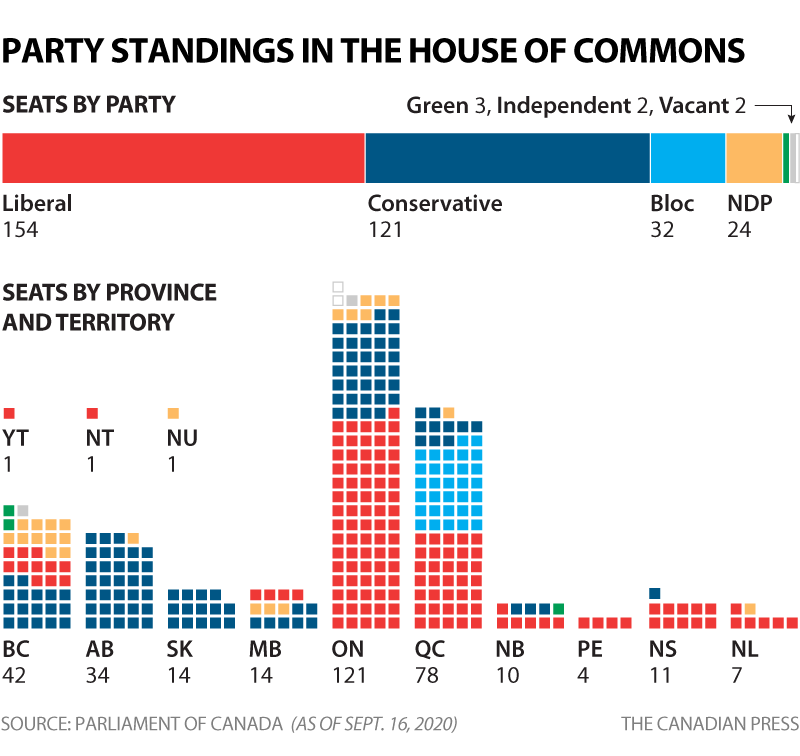
In very fact the Liberal government of Canada, re-elected as a minority government, has been governing as though there is no opposition, in a manner that is more akin to a dictatorship than a parliamentary democracy. In effect, Justin Trudeau has succeeded in undermining parliamentary accountability by suspending Parliament until mid-September. An action supported by the NDP opposition and opposed by the official opposition party, the Conservative Party of Canada.
In a little traditional game of quid pro quo, the NDP extracted a price for its support, as part of its socialist platform the Liberals were only too happy to accede to, to gain the votes it needed to pass the suspension of Parliament but for a few special hearings on COVID-19. The prime minister who speculated once on his admiration for Beijing and the Communist Party of China to turn matters around on a dime, has finally manipulated a situation during a crisis emulating that of the CPC, bringing Canada to the status of 'your basic dictatorship'.
The motion to suspend Parliament until September 21 passed with the assent of the New Democratic Party, which obviously gave short shrift to its own namesake values. Giving the Liberal government the cover it wanted to sidestep scrutiny of the emergency spending launched by the government. Which has proven to be as much an opportunity for popularity and vote-buying for the Liberals as it has been to support Canadians facing economic difficulties during the COVID epidemic.
The vote passed 28-23, representing those elected Members of Parliament who were in the House of Commons in the much-diminished Parliament. As for Parliament not operating as it should, during this time of the pandemic, it's passing strange that elected Parliamentarians cannot do what they were elected for, while people working in hospitals, grocery stores and other employees deemed vital to the situation are managing to serve the public while observing safe distance, but high-paid MPs cannot.
With the passing of the motion, the dangers the Liberals face of a no confidence vote in their minority status cannot occur. A special COVID-19 committee is slated to continue meeting into June without the powers of Parliament, where opposition parties are able to do what they too were elected for. The four-hour limit set aside for one sitting to enable opposition questioning of the government's emergency agenda, came under criticism by Aaron Wudrick, director of the Canadian Taxpayers Federation, leaving the government spending programs free to continue as the government wishes without accountability.
"There's just no reason for them [the Liberals] to do it this way, except that they don't want to be bothered with basic parliamentary accountability" he noted. "These are historical changes to program spending. MPs cannot scrutinize in a proper way" -- the spending proposals within a four-hour window -- observed Kevin Page, founding president, Institute of Fiscal Studies and Democracy and formerly Canada's first Parliamentary Budget Officer.
Labels: COVID-19, Emergency, House of Commons, Parliament of Canada, Prime Minister JustinTrudeau, Shutdown
posted by Pieface | 8:02 PM
|
0 comments


