Politic?

This is a blog dedicated to a personal interpretation of political news of the day. I attempt to be as knowledgeable as possible before commenting and committing my thoughts to a day's communication.

Tuesday, April 23, 2019

Forewarned, Unprepared, Stricken

"The reality is that inevitably this group has links outside. My assessment is that the motivation, the masterminds, are outside the country."
"I think their aim is global, it's not in Sri Lanka. Wherever they can get a soft spot they hit because they need recruits all the time and the only way that they can get recruits is by doing these kinds of spectacular activities."
"This is essentially a recruiting tool for them."
Madhav Nalapat, professor of geopolitics, Manipal University, India

"These attacks appear to be quite different and look as if they came right out of the [ISIL], al-Qaeda, global militant jihadi playbook, as these are attacks fomenting religious hatred by attacking multiple churches on a  high religious holiday."
"It is not about a separatist movement. It is about religion and punishing."
Anne Speckhard, director, International Center for the Study of Violent Extremism


"Given the gradual but steady growth of radicalization in Sri Lanka and more importantly the emergence of the Islamic State in Sri Lanka, this could pose a serious threat to the security of Sri Lanka."
"Continued marginalization of the Muslim community in Sri Lanka has produced a conducive environment for extremist elements to breed. These extremist elements could exploit the fault lines within the Muslim community and use the situation akin to how the Rohingya crISIL in Myanmar was used to foment and create extremist groups elsewhere in the region."
"This situation could ideally present the jihadist groups such as the Islamic State with a window of opportunity to plant their footprint in the Sri Lankan soil."
Geopolitical Monitor
Dead bodies of victims lie inside St. Sebastian's Church damaged in blast in Negombo, north of Colombo, Sri Lanka, on Sunday. (Chamila Karunarathne/Associated Press)

There it is in bold letters, former ISIL fighters returning to their  home countries intent on setting up regional terror hubs, a preoccupied concern of Europe and North America come to roost, its first showing since the destruction, but not complete demoralization of Islamic State, to turn to alternate means of evidencing its malign existence and its higher purpose, to slowly and steadily infiltrate and wreak destabilizing chaos through terror and slaughter, leaving the impression on vulnerable populations that they will never know where and when the next strike will appear....

The National Thowheeth Jamaath, a local Sri Lankan Muslim extremist group was a powder keg only needing the spark to set it in motion to create a devastating blow against government disinterest and inaction, its attention diverted by other pressing problems of political upheaval, separatist determination and violent terrorism by Tamil Tigers. The irony here is that the Tamil Tigers were credited with being the first such group to invent suicide bombing. An effective tactic of terror and mass slaughter enthusiastically embraced by jihadists.

The Tamil Tigers are a spent force in the wake of the destructive civil war and its ignominious defeat at the cost of untold numbers of Sri Lankan lives. Yet the Sri Lankan government and intelligence focus remained fixed on the Tigers, overlooking the more viral promise of Islamist jihadists revelling in their reawakening to the joys of Islamic martyrdom in service to the Koran's injunctions to the faithful. Friday mosque prayers are not complete without the customary jog to Muslim sensibilities of the sacred principle of jihad.


Out of Indian intelligence came a warning to Sri Lanka of imminent attacks, eliciting slightly more than a shrug, but not much more. And then came a whirlwind of action out of Muslim-majority Kattankudy in eastern Sri Lanka, reflecting detailed planning leading to a surprise multi-pronged assault where Christians and Westerners were both the message and the targets. In the aftermath, the realization that Thowheeth Jamaath aligned itself with global terrorism; ISIL or al-Qaeda on the Indian subcontinent (AQIS).

It was predicted. Analysts spoke of the "localization" of terrorism, reminiscent of Islamic State grooming its recruits to remain where they are, and to attack there,  using whatever means available. Small, local groups and individuals inspired by the magnificent exploits of those affiliated with global jihadi networks. And thus was outlined the future of Asia. Of Europe. Of North America. In this instance, with the Christian Sri Lankan churches and Western-style hotels targeted and the deaths of over three hundred innocents, the wounding of over five hundred, the message was sent, and received.

"The Bloody days in your church has begun", was the message alongside videos of the Sri Lankan bombings from an Indonesian Instagram account supporting Islamic State, reported SITE.

A Sri Lankan police commando enters a house suspected to be a hideout of militants following a shoot out in Colombo, Sri Lanka on Sunday. Thirteen people were arrested and three officers were killed during raids in search of suspects following the attacks. (Eranga Jayawardena/Associated Press)

Labels: , , , , ,

Tuesday, September 04, 2018

Erased From History

"One day I was ordered to drive my truck out of town. I had a Ukrainian with me. It was about 10 a.m. On our way, we passed Jews marching in columns in the same direction, we were going. They were carrying their belongings. There were whole families. The farther we drove away from the town, the more people we saw in the columns. There were piles of clothes in a wide open field. My job was to fetch them."  
"I stopped the engine nearby, and the Ukrainians standing around started loading the car with this stuff. From where I was, I saw other Ukrainians meeting the Jews who arrived, men, women and children, and directing them to the place where, one after another, they were supposed to remove their belongings, coats, shoes, outer garments and even their underwear."
"They were supposed to put all their belongings together in a pile. Everything happened very quickly, the Ukrainians hurried those who hesitated by kicking and pushing them. I think it took less than a minute from the moment a person took off his coat before he was standing completely naked."
"No distinction was made between men, women and children. The Jews who were arriving could have turned back when they saw those who had come earlier taking off their clothes. Even today I cannot understand why they didn’t run."
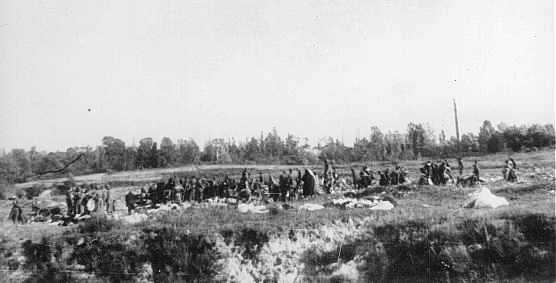
"Naked Jews were led to a ravine about 150 metres long, 30 metres wide and 15 metres deep. The Jews went down into the ravine through two or three narrow paths. When they got closer to the edge of the ravine, members of the Schutzpolizei (Germans) grabbed them and made them lie down over the corpses of the Jews who had already been shot."
"It took no time. The corpses were carefully laid down in rows. As soon as a Jew lay down, a Schutzpolizist came along with a sub-machine gun and shot him in the back of the head.The Jews who descended into the ravine were so frightened by this terrible scene that they completely lost their will. You could even see some of them lying down in the row on their own and waiting for the shot to come."
"Only two members of the Schutzpolizei did the shooting. One of them was working at one of the ravine, the other started at the other end. I saw them standing on the bodies and shooting one person after another."
"Walking over the corpses toward a new victim who had already laid down, the machine gunner shot him on the spot. It was an extermination machine that made no distinction between men, women and children.Children were kept with their mothers and shot with them. I did not watch for long. When I approached the edge, I was so frightened of what I that I could not look at it for a long time."
"I saw dead bodies at the bottom laid across in three rows, each of which was approximately 60 metres long. I could not see how many layers were there. It was beyond my comprehension to see bodies twitching in convulsions and covered with blood, so I could not make sense of the details.Apart from the two machine gunners, there were two other members of the Schutzpolizei standing near each passage into the ravine."
"They made each victim lie down on the corpses, so that the machine gunner could shoot while he walked by. When victims descended into the ravine and saw this terrible scene at the last moment, they let out a cry of terror. But they were grabbed by the waiting Schutzpolizei right away and hurled down onto the others."
"Those who followed them could not see the terrible scene because it was obstructed by the edge of the ravine. While some people were getting undressed and most of the others were waiting their turn, there was a lot of noise. The Ukrainians paid no attention to the noise and just kept forcing people through the passages into the ravine."
"You could not see the ravine from the site where people were taking off their clothes, because it was situated about 150 metres away from the first pile of clothes. Besides, a strong wind was blowing and it was very cold. You couldn’t hear the shooting in the ravine."
"So I concluded that the Jews had no idea what was actually happening. Even today I wonder why the Jews did nothing to challenge what was going on. Masses of people were coming from town and they did not seem to suspect anything."
"They thought they were just being relocated."
Fritz Hoefer  - Eyewitness to Mass Murder

Testimony at the Einsatzgruppen war crimes trial: Babi Yar,
Witness and Survivor accounts of the Mass Murder in Kiev


"We do one by one by one."
"If we give one more victim a grave, we've accomplished something."
Michael Schudrich, chief rabbi, Poland

"What we know about the murders in concentration camps is only half the knowledge of what truly took place in the Holocaust."
"Researchers have only scratched the surface in our understanding of the perhaps millions of people who lie beneath fields and ravines whom we will never know about."
"They are undocumented and erased from history."
Avi Benlolo, president, CEO, Friends of Simon Wiesenthal Center for Holocaust Studies, Toronto
"For 70 years, the local communities have kept the memory about the fate that had befallen their Jewish neighbours" reads part of a study written by Agnieszka Nieradko, Sebastian Rozycki, Jerzy Karezewski and Aleksander Schwarz, all involved as researchers with the Rabbinical Commission for Jewish Cemeteries, assigned to scour the Polish countryside in a search for forgotten mass graves from the era of World War Two's Holocaust years.

"I saw it with my own eyes. Germans shot Jews on the way to the train station and then ordered Poles to take the bodies to the local Jewish cemetery and bury them in previously prepared pits", recounted one witness in 1976. "We are living next to the graves. They are everywhere", commented Agnieszka Nieradko. But though they are everywhere, their locations have not yet been fully explored and it is her task and that of her fellow researchers to interview possible witnesses, to scour the countryside around the small towns and villages where the mass murders took place, to position the gravesites and to memorialize them.

Witnesses, needless to say, are hard to come by, since a lifetime has passed since the mass atrocities took place. Hearsay, though, has a habit of trickling down in a close-spaced population where people know everything that happens. And generally speaking people would be unwilling to speak of everything that they know. The usefulness to the German authorities, for example, of the Polish locals. What happened in Ukraine at Babi Yar was repeated elsewhere, all over Europe. In some countries in particular, like Poland and Ukraine, the Nazis knew there would be no opposition to their grand plan of genocidal extermination.

The townspeople who watched from near or afar, aiding or preferring not to, as their neighbours were systematically rounded up, ordered to obey instructions and surrender their lives; the elderly grandparents, the parents, the children, not precisely acquiescing, but befuddled, confused, in a daze of apprehension and concern but incapable of realizing fully that the life they were familiar with was set to expire suddenly and finally, leaving a legacy to their fellow townspeople not of bereavement but of acquisition of all that they had owned, enriching their neighbours by their absence.

The few survivors who managed to return to their villages soon discovered the extent of the hostility when attempting to reclaim their homes.

There is an urgency at this juncture for the researchers with the Rabbinical Commission for Jewish Cemeteries to identify as many mass graves as they can manage before impending and inevitable land development begins its work transforming woodland, farmland and small town forests into urban centres. Of the countless towns and villages, Nieradko knows, each in all likelihood has the presence of at least one mass grave, awaiting the researchers' placement and memorialization with a small plaque of acknowledgement that there lies the remnants of each village's contingent of Jews.

Simply finding where the gravesites are located is the primary purpose since Jewish law forbids that graves be disturbed. Ground-penetrating radar is used to affirm the presence of mass graves where on occasion an elderly person leads the researchers, excavating her memory for its location. The area is then marked, tracing the mass grave's edges with stones, and a plaque and headstone placed beside it, as they did in the forest of the village outside Lublin.

An estimated tens of thousands of unmarked Holocaust graves are sprinkled throughout Poland and eastern Europe, beside roads, in forests, marshes or fields. Where millions of Jews are known to have been shot en masse by the Nazi mobile killing units helped by their local collaborators, the remnants of countless lives buried in unmarked mass graves all through eastern Europe's countryside. Reverend Patrick Desbois, a Catholic priest, one of the most dedicated searchers for unmarked Jewish graves has named the phenomenon the Holocaust by Bullets, where people were shot outside their homes, on village outskirts, executed on marches, burned in barns, discovered in hideouts, killed by grenades.

Aerial photographs help lead the researchers to soil disturbances; oblong shapes, many metres wide and long; L-shapes among them, with radar indicating the shapes -- identify the mass graves whose interiors metres below the ground hold evidence of man's inhumanity to man.

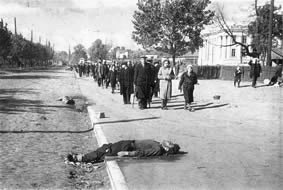
Jews march towards the ravine at Babi Yar


Labels: , , , , ,

Friday, July 13, 2018

Bashar al-Assad Triumphant

"It's over, we're finished."
"We have no friends any more. This is where it all ends. We're cornered and the entire country has been handed over [to the Syrian regime].
"We can't do anything anymore despite having weapons; the rebel leaders took the pay cheque."
"I am a special case because I am a child of the revolution. I am sure the Russians will hand me over to the regime."
"My fate is unknown now, I don't know what to do. I need to leave Syria because they [the Syrian military] won't leave me alive."
Mouawiya Syasneh, rebel fighter, Daraa, Syria
The Syrian national flag rises in the midst of damaged buildings in Daraa-al-Balad, an opposition-held part of the southern city of Dara on July 12. (Mohamad Abazeed/AFP/Getty Images)

Now an adult, Mouawiya Syasneh was a teen before Syria's civil war roared into action taking the attention of the world through the ferociously barbaric steps taken by Syrian President Bashar al-Assad to destroy the intention of the "terrorists" who were in fact, Sunni Syrian civilians, the majority population in Syria, protesting that the government failed their needs, treating them with gross inequality in comparison to the minority Alawite Shiites but who comprised the government.

The city of Daraa, where Syasneh was born and raised and went to school, was rebellion central in 2011, when he and some of his teen-age friends expressed their resistance to a government that failed to respect its entire population's needs in a clear sectarian division of the haves and the have-nots. Those boys defiantly sprayed a graffiti message on the walls of their school that was clearly anti-Assad. In Syria the eyes and ears of the government are everywhere.

It took no time before all the boys were arrested for their act of insubordination to authority and insults to the president. Incarcerated, they were tortured before finally being released, although the modus operandi of the military changed somewhat as hostilities became heightened and conflict began in earnest with rebel groups fighting a guerrilla-style war, and the regime responding with a clear human-rights offending program of annihilation of the "terrorists".

Foreign fighters from elsewhere were attracted both by the breakdown of orderly restraint and the compulsion of Sunnis to respond to Shiite aggression and the entry of seasoned Islamist fighters with links to al-Qaeda, along with the various rebel Syrian groups began to make headway in toppling the Syrian regime, even as it resorted to deadly mass assaults through chemical weapons bombs, barrel bombs and helicopter gunships firing at helpless civilians.

The conflict gradually reduced Syria's second largest city to rubble, as well as half of its capital city. Ancient heritage sites and mosques, along with hospitals and schools were targeted by the regime. But the balance of power had shifted away from the government even though Iran's al-Quds force of the Republican Guard Corps and the Shiite Lebanese terrorist group Hezbollah fought alongside regime forces. The tide turned when Russia entered and began aerial bombing in support of Assad.
Smoke rises over buildings that were hit by Syrian government forces bombardment, in Daraa province, southern Syria, in early July. Syrian activists and state media said Thursday the rebels have agreed to surrender Daraa, the first city to revolt against President al-Bashar Assad with Arab Spring-inspired protests seven years ago. (Nabaa Media via AP)

Now, Daraa, the city where the revolt against Assad's misrule began, is under government control. Syria has lost 400,000 of its citizens to the rebellion; Assad's response to his people's request for an even hand resulting in the deaths that mark the savagery of this civil war. Millions of Syrians have been internally displaced, and millions more - in all representing half of the entire population -- have become refugees; most settling in refugee camps in Turkey, Lebanon, Jordan and Egypt, but many struggling to reach Europe, inundating that continent with the desperation of their flight from Assad.

The Free Syrian Army, a coalition of rebel groups, had decided it had little option but to negotiate away their hold on Daraa for a promise by the regime to allow the fighters and their families to withdraw and seek haven in other parts of the country still in the hands of rebel groups. While they can be assured of amnesty, Syasneh and others like him are in most likelihood exempt from the agreement and marked for a very nasty death.

There is this that distinguishes many Arab Muslim dictators; they like Saddam Hussein and now Bashar al-Assad, have the stomach for inflicting mass murder on their fellows; it is what is being seen in Yemen through Saudi Arabia's intervention in that civil war, spurred on by the Islamic Republic of Iran inciting the Shiite Houthis to rebel against the ruling Sunnis. It is what Iraq and Iran experienced when they fought for years, each slaughtering the other's young males, including teens.

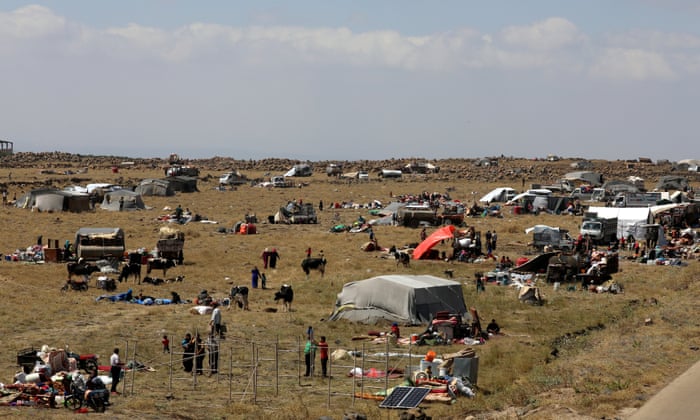
Internally displaced people from Deraa province are gathered near the Israeli-occupied Golan Heights in Quneitra, Syria. Photograph: Alaa Al-Faqir/Reuters

The Daraa agreement is of a type seen elsewhere as the Syrian regime recovers its ruined geography, allowing the rebels to leave the shattered infrastructure that was once a city, and to withdraw to other areas still held by the rebels, and which government forces and their allies plan to wipe out and up one after the other until the entire territory is restored to its former status, minus millions of Syrians in a vast display of sectarian wiping-up, transforming the country to a Shiite stronghold.

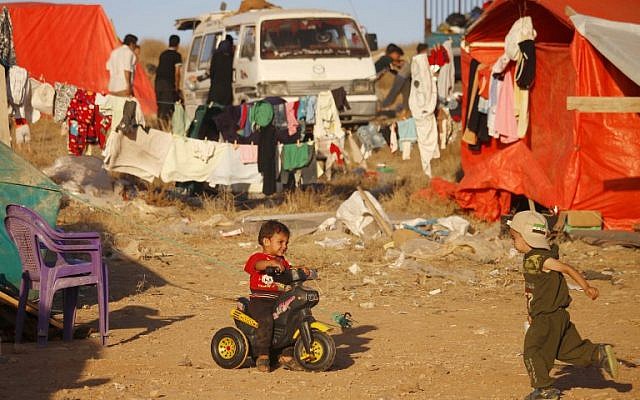
An estimated 250,000 Syrian civilians flooded out of the area, displaced by the government offensive. They sit now in the misery of mass displacement around Quneitra, a province bordering Israel, and along the border with Jordan. Where they will go from there is  unknown since both Israel and Jordan have closed their borders to refugees; Israel for obvious reasons and Jordan because it can manage no further intake of Syrian refugees.

For the time being they are no worse off than Syrian civilians in Idlib, the northwest Syrian province holding a million displaced Syrians in dire living conditions, exposed to airstrikes carried out by the regime which can never recognize too much material destruction much less heaps of mangled bodies. "Idlib is a crematory", Russian mediators have warned those fleeing Daraa. They should know, after all.

Displaced Syrian children from the Daraa province fleeing shelling by pro-government forces wait in a makeshift camp to cross the Jordanian border, near the town of Nasib, southern Syria, on July 1, 2018.( AFP / Mohamad ABAZEED)
Displaced Syrian children from the Daraa province fleeing shelling by pro-government forces wait in a makeshift camp to cross the Jordanian border, near the town of Nasib, southern Syria, on July 1, 2018. ( AFP / Mohamad ABAZEED)

Labels: , , , ,

() Follow @rheytah Tweet