This is a blog dedicated to a personal interpretation of political news of the day. I attempt to be as knowledgeable as possible before commenting and committing my thoughts to a day's communication.

Israel's Iron Dome anti-missile system fires to intercept a rocket
launched from the Gaza Strip towards Israel near Ashdod, Israel August
6, 2022. REUTERS/Ronen Zvulun
"This was a very narrow tactical operation with limited targets and a
huge tactical success. But there is no real change in the situation in Gaza and it did
not relieve the problems of the Palestinian system which is controlled
by the Hamas terror group. The lack of strategy and vision for a
solution of the conflict has still not changed and this is the challenge
that Israel is facing."
"We saw the capabilities of the PIJ — one of the weakest terrorist
groups surrounding Israel — which don’t really match the defense
capabilities of the Iron Dome"
"The military capabilities of
PIJ are now dramatically beneath the level of the capabilities of
Hamas."
Tamir Hayman, Managing Director,
Institute for National Security Studies
"[It will take some time for the PIJ to
rebuild its leadership structure and train the next generation]. That said there is a risk that there could be a hydra that grows in its place."
"A more centralized leadership structure could follow. One could
potentially imagine multiple nodes that would sprout up in its place
with multiple cells and with multiple leaders which would make it harder
for Israel to dismantle it."
"The primary funder, trainer and provider of arms is Iran, and its
ability to provide all of that to Islamic Jihad, as well as Hamas and
others, has not diminished in the least. This means that
future clashes are a foregone conclusion."
"Israel’s near-total intelligence dominance over the last week
probably sent something of a stark message to both Hamas, and perhaps
Hezbollah and maybe Iran as well, that Israel has the ability to strike
at the top leadership and to do significant damage without a lot of
protracted battle."
"Whether that changes their calculus is another story, but it’s the
thought that all proxies could bog Israel down in a painful conflict — I
think they learned that the opposite was true."
Jonathan Schanzer, Middle East scholar, Foundation for Defense
of Democracies
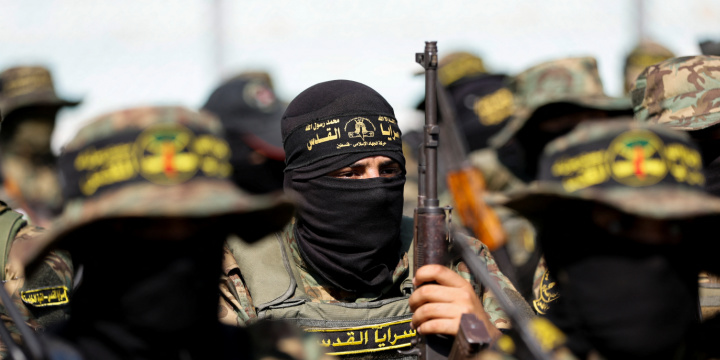
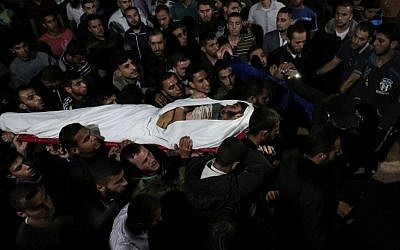
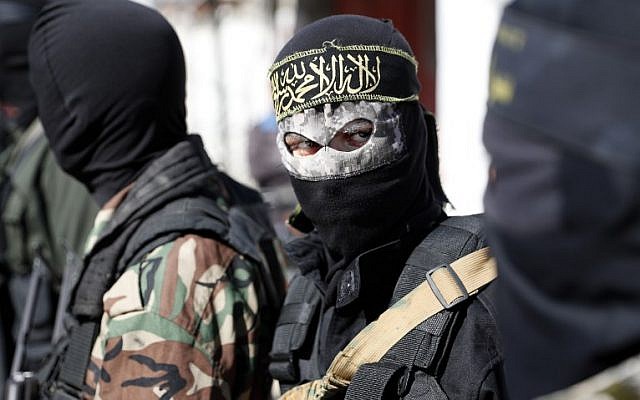
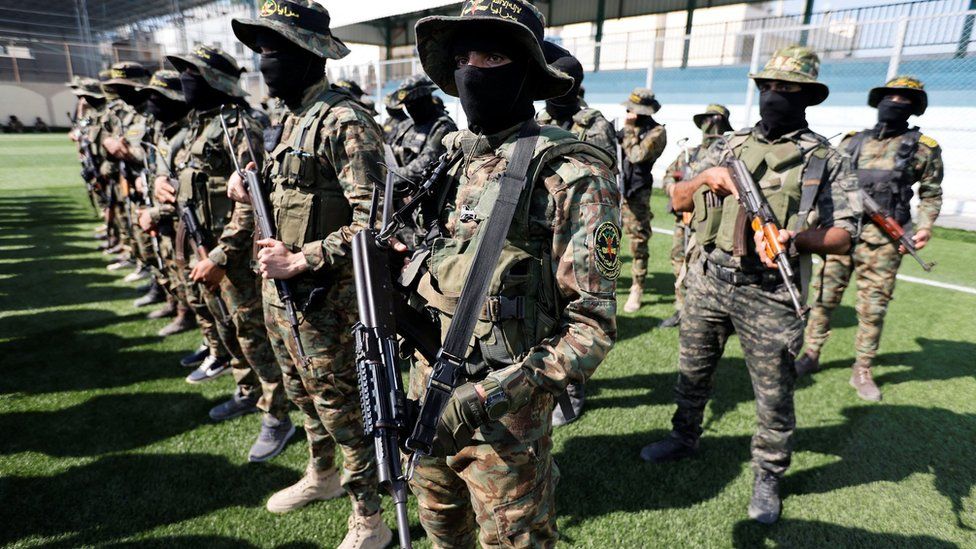
Palestinian Islamic Jihad militants gather at a mourning house for
Palestinians who were killed during Israel-Gaza fighting, as a ceasefire
holds, in Rafah in the southern Gaza Strip, August 8, 2022.
REUTERS/Ibraheem Abu Mustafa
Israeli intelligence had firm information that Palestinian Islamic Jihad, a proxy militia of Iran's hoping to become as influential and lethal and as useful to the Islamic Republic as Hezbollah has been and continues to be, was planning another attack on Israeli military units or on an Israeli border town. The IDF and the Israeli government have been anticipating a violent response of some kind from PIJ following the arrest of one of its top leaders, in the West Bank.
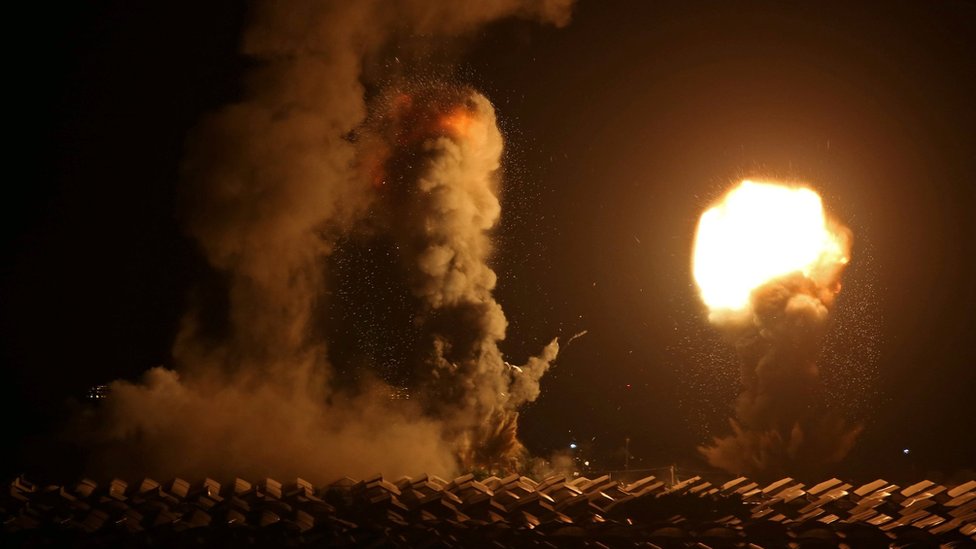
Following days of tense expectation, a convoy of PIJ trucks making its way to the border inspired the IDF to a preemptive strike, one targeting yet another leader of the Islamist group. A series of rockets from Gaza followed, hundreds aiming for Israeli towns and villages. In Sderot, a constant PIJ and Hamas target, a family escaped death when a rocket levelled their home. The IDF bombed identified PIJ munitions sites and buildings.
When an apartment building came under target, all residents were first instructed to vacate the building. Palestinian journalists gathered to watch the precision targeting of the building. While the IDF and Gaza's secondary terrorist group were engaged in combat, Hamas made no effort to intervene or to join the conflict. Although Hamas rules Gaza, the PIJ competes with them for influence and power, no doubt leading Hamas to leave the PIJ on its own. Any major losses sustained by PIJ is a win for Hamas.
As for teaching terrorist groups through the IDF's swift and unequivocal action to defang the threat of a terrorist group with clarity, dispatch and accuracy, even to the extent of pinpoint targeting of their leaders, the unfortunate truth is that terrorist groups are inflamed with the passion of hatred of a designated enemy balanced with love of violence and the meting out of death in the delusion of martyrdom; that they might take a reasonable lesson in caution from the event is unlikely.
What the violence did succeed in revealing was the presence within Israel itself of a third column of Israeli Palestinian citizens who cheered wildly when PIJ rockets managed to reach central Israel.
All together a dozen PIJ members were targeted and put out of commission, two senior commanders included. The Israeli army destroyed a number of PIJ military emplacements, destroying underground tunnels across Gaza, in the process. Reality? The tunnels will be rebuilt. The military sites will be reestablished.
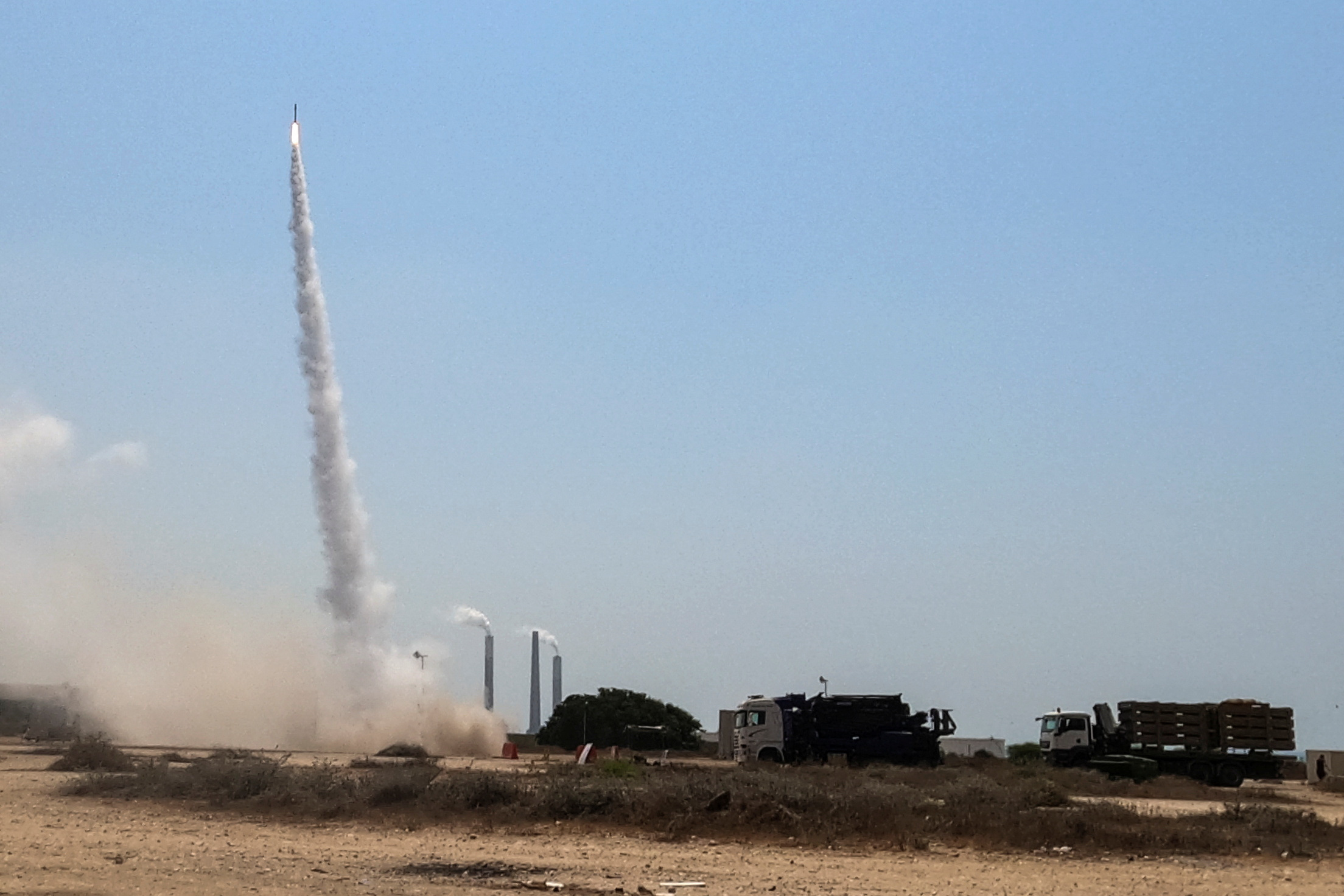
Israel's Iron Dome anti-missile system fires to intercept a rocket
launched from the Gaza Strip towards Israel August 6, 2022. REUTERS/Ilan
Rosenberg
Over 1,100 rockets were fired by PIJ toward Israel throughout three days of fighting. 990 of the rockets crossed into Israel; 200 misfired, ending up within Gaza, causing a number of civilian casualties, including the death of Palestinian children. The Iron Dome defence missile system shot down 380 missiles for a 96 percent success rate.
All of this, with thousands of Gaza residents given work permits to enter Israel for gainful employment. Israel's Friday strike of the Islamic Jihad leader followed by its Saturday targeted strike on a second leader should amply demonstrate the vulnerability of terrorist leadership to Israel's intelligence capabilities coupled with its capacity for pinpoint-accuracy strikes.
Khaled Mansour the second PIJ commander killed was hit in an airstrike in the Rafah refugee camp in southern Gaza where two other terrorists were killed as well. The three-storey building was flattened when struck by the missile, but some deaths of Palestinians during the three-day round of fighting were caused by rocket fire that went awry, a not-uncommon occurrence with rockets lobbed off by both PIJ and Hamas.
PIJ lost its two most senior commanders on the ground, Tayseer Jaabari
and Khaled Mansour, as well as sites used to manufacture and store
missiles, command headquarters and outposts. The IDF says it hit 170
PIJ targets. Reuters
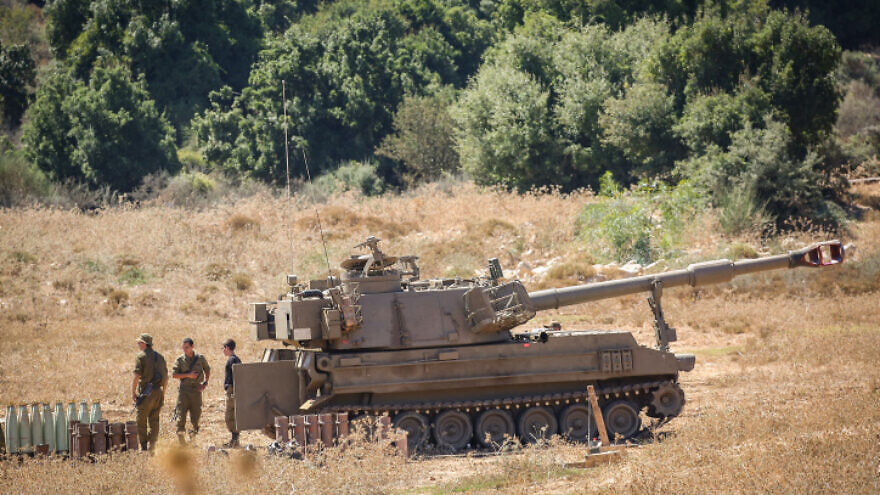
Israeli soldiers stand near artillery units deployed near the Lebanese
border northern Israel on August 26, 2020. Photo by David Cohen/Flash90.
"In response, overnight, the IDF [Israel Defence Forces] attack helicopters and aircraft struck observation posts belonging to the Hezbollah terror organization in the border area [between Lebanon and Israel]." Israeli military spokesperson
"Our message to Hezbollah is sharp and clear: We will continue to thwart
its attempts to gain achievements."Brig. Gen. Shlomi Binder, commander, IDF Galilee
Division
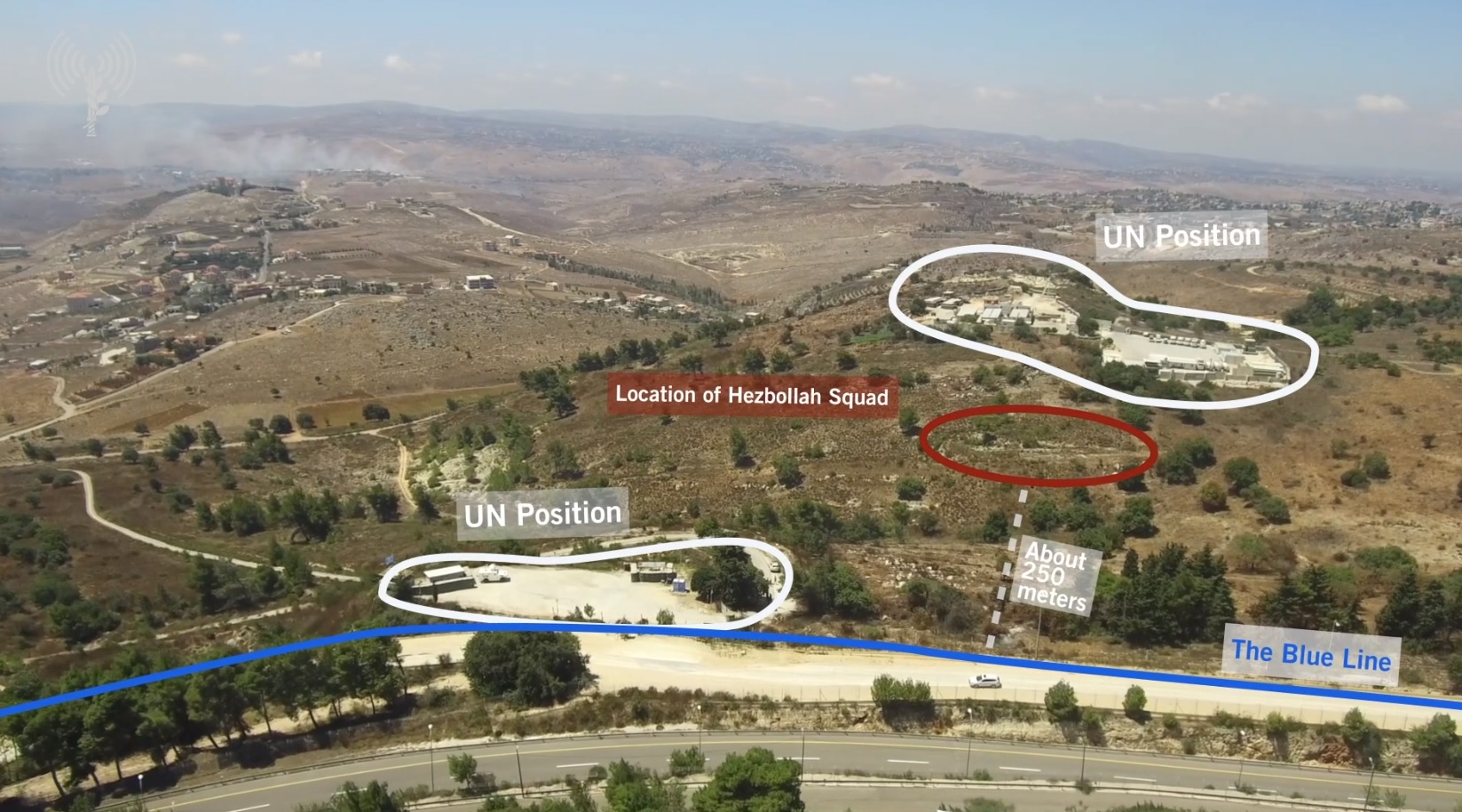
"It is our assessment that the choice of location by Hezbollah [for the sniping attack] was not accidental ... probably in order to [draw] Israeli retaliation towards a United Nations position or near it." "I would emphasize that this was a very dangerous and cynical practice
to deliberately locate their combat troops close to U.N. positions and
then engage against the IDF, violating U.N. Resolution 1701 [which bans
the presence of armed Hezbollah cells in south Lebanon] … and probably
hoping for there to be U.N. casualties as a result of Israeli
retaliation. The IDF is very much aware of the location of U.N. troops,
and does [its] utmost not to affect them." "Our objective is not to escalate the situation, but to protect our
civilians, uphold sovereignty and allow hundreds of thousands of
Israelis enjoying [he] last days of summer to vacation in northern Israel."Lieutenant-Colonel Jonathan Conricus, Israeli military spokesman
An IDF labeled view showing the proximity of the Hezbollah terror squad
to UN peacekeeping forces and the Israel-Lebanese border. Source:
Screenshot.
Palestinians release
balloon-borne explosive to Israel Fadi Fahd/Flash90
"One device was found next to a playground and a second was found in a
tree. In both cases, a police sapper was called. No damage or injuries
were caused."Eshkol Regional Council spokesperson
"Following the continued violation of security stability, and following
the decision to close the Kerem Shalom Commercial Crossing with the
exception of humanitarian equipment, it will be noted that the import of
vehicles, which has so far been carried out through the Erez Crossing,
was stopped as well starting today." Spokesperson, Erez crossing with Gaza
Oh, did Lebanon just several weeks back suffer a horrendous Beirut-dock explosion that killed 200 people, injured thousands and made hundreds of thousands Beirutis homeless, causing thousands of Lebanese to march in the streets demanding their Hezbollah-driven government step down? If so, the magnitude of the catastrophe has not yet penetrated the minds and consciences of the Hezbollah elite who far prefer to provoke Israel by attacking its soldiers across the blue line in Israel in hopes of inciting a lash-back to harm UN representatives keeping the 'peace' to enable an 'incident'.
The Israeli military responded as it must, striking Hezbollah posts with no loss of life, in the knowledge that the incident was a ruse to place UN personnel within the nearby peacekeeping post at risk. According to a Lebanese army announcement Israeli helicopters fired missiles at a local environmental group center. The following day the Israeli military gave the all-clear to Israelis living near the border -- instructed to remain indoors -- that they might now resume normal activities. Israel's north and Lebanon's south are on uneasy terms.
An attempt by Hezbollah operatives the month before to infiltrate Israel failed. Within Israel itself, Palestinians find the opportunity to stab Jews, sometimes causing grave injury, and sometimes causing death as happened last week when an Israeli rabbi was stabbed to death in the central Israeli city of Petah Tikva, leaving four children without a father. The attacker, father to five children, will now face Israeli justice, and his family will be left homeless when their house is destroyed.
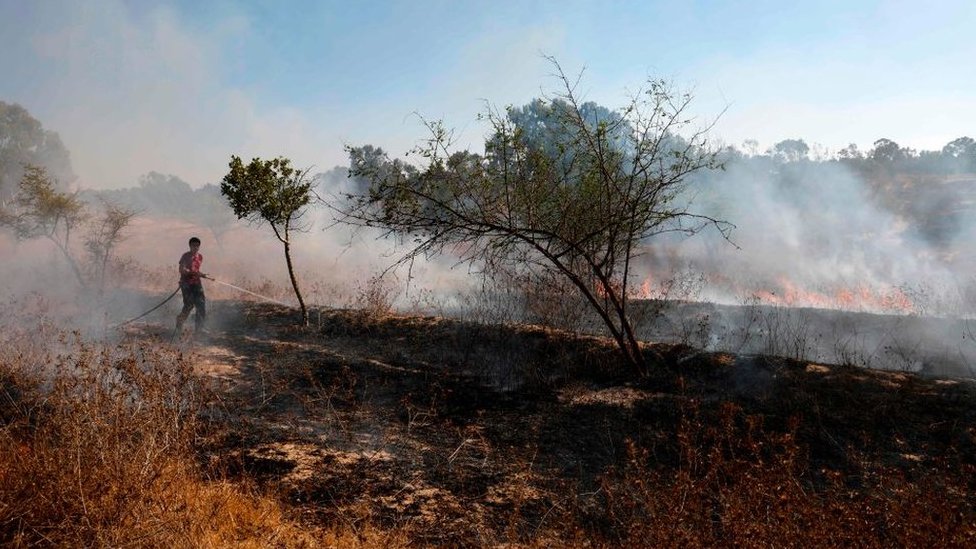
Incendiary balloons launched from Gaza have caused dozens of fires in Israel in recent days AFP
Attacks by Palestinians on Jews, though routine enough, and incited by the Palestinian Authority which claims the attackers to be Palestinian heroic 'martyrs', are not the only means of violence committed against Israel. Incendiary devices attached to helium-filled balloons are regularly released by Palestinians over the border from Gaza into Israel, where vast acreages of forest and farmland are burned. Other balloons carrying explosive devices wreak carnage of the type that exploded into a home in an Israeli town last week, its occupants miraculously escaping harm.
Israeli aircraft and tanks last Friday retaliated by striking Hamas facilities in Gaza while Hamas responded by firing a half-dozen rockets into southern Israel. No casualties were reported despite the exchanges, on either side, Israel or Gaza. According to Israel, the military struck underground infrastructure and a military post belonging to Hamas, as well as a Hamas armed training camp. This time, it is Israel's south and Gaza's north where the neighbourly exchanges are taking place.
Israel has responded to the attacks by bombing militant targets Reuters
These are pressure tactics used by Hamas to 'persuade' Israel to open the blockade of Gaza, to allow Hamas free reign to bring in materials to continue building tunnels, and arms to continue posing its existential threat to Israel. Israel, despite the blockade, opens the Erez crossing daily to ensure that vital supplies enter Gaza. The cement and other building materials that Israel will not permit entry other than in limited amounts, is smuggled into Gaza by Hamas and used not for civilian infrastructure but for more tunnel-building.
The endless cycle of threats and violence plays its course through the relationship Israel labours under, with its neighbours who place low value on quality of life for ordinary Palestinians and Lebanese and high value on destroying stability for Israelis, with the intention of ultimately bringing violent destruction to the nation, cleansing the historical heritage Judean landscape of the presence of Jews in a Jewish state, renewed with the intention of defending Jews in their own homeland restored, from a world that has repeatedly proven it has no place for them elsewhere in the diaspora.
What other nation on Earth has its legitimacy and sovereignty challenged continually by its neighbours in never-ending attacks? What other nation must defend its population from ongoing threats of attack leading to death from violent terrorists, the world looking on with detached interest, while segments of that world rise to the defense of the attackers claiming them to have been ill done by, refusing to condemn the violence, and expecting Israel to escape condemnation by restraining its military from imposing the full strength of its defence against indomitable hatred and hostility threatening to annihilate the country?
An Israeli soldier battles a blaze close to the southern kibbutz of Nir
Am that was apparently caused by a balloon-borne incendiary device
launched from the Gaza Strip, August 23, 2020. (Menahem Kahana/AFP)
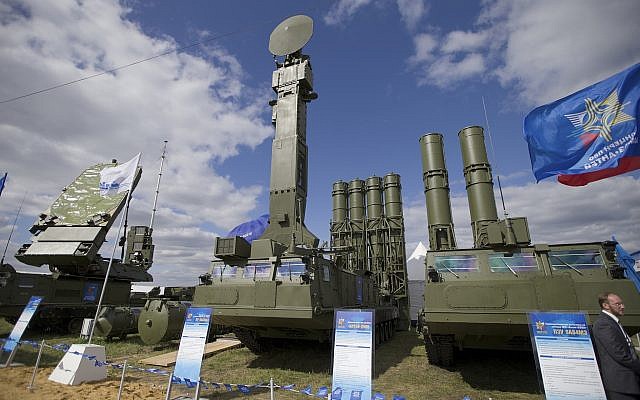
In this photo, a Russian air defense system missile
system Antey 2500, or S-300 VM, is on display at the opening of the MAKS
Air Show in Zhukovsky outside Moscow, Russia. (AP Photo/Ivan
Sekretarev, file)
"The presented objective data testifies that the actions of the
Israeli fighter pilots, which led to the loss of life of 15 Russian
servicemen, either lacked professionalism or were an act of criminal
negligence to say the least. Therefore, we believe that the blame for
the tragedy with the Russian Ilyushin Il-20 aircraft lies entirely with
the Israeli air forces and those who made the decision to carry out such
actions." "[Those actions represented] an extremely ungrateful response to all that has
been done by the Russian federation for Israel and for the Israeli
people, recently." Russian Defence Ministry spokesman Maj. Gen. Igor Konashenkov
"[For Israel, training against the
Crete S-300 would be] precisely what you need [to study the system’s
radar frequency, pattern and reach]." "If you know all these
details then you are perfectly fitted to replicate this same signal,
which means you have a chance to imitate, to sort of bluff-echo [the
S-300]." "You can brutally jam it. You can take
the signal and return it, and then you send another ping which imitates
the same signal. So instead of one target, the radar operator sees
three, five or 10 and he does not know where to fire." Igor Sutyagin, Russian military expert, Royal United
Services Institute, London
"[S-300s in areas where Israel
operates or might want to operate would challenge its advanced,
U.S.-backed military - but not insuperably so]." "In general, any
system can be defeated this way or that. Some are harder and some are
easier. The rule of thumb is that if your friends [the Greek military] have a
system that you are interested in, you can learn all kinds of things
about it." Tal
Inbar, senior scholar, Fisher Institute for Air and Space
Strategic Studies, Tel Aviv
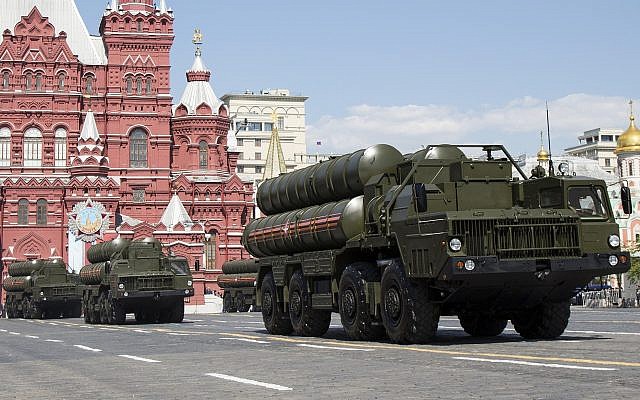
Russian S-300 air defense missile systems drive during a Victory
Day military parade marking the victory in WWII in Red Square in Moscow,
Russia, May 9, 2016. (AP Photo/Alexander Zemlianichenko)
"The information provided by the Israeli military… runs counter to
conclusions of the Russian defense ministry [that the actions of the
Israeli pilots had led to the plane being targeted by Syrian air defense
systems]." "The Russian side proceeds from the fact that the actions by the Israeli air force were the main reason for the tragedy." "According to information of our military experts, the reason [behind the
downing] were premeditated actions by Israeli pilots which certainly
cannot but harm our relations." Kremlin statement
Israel had been left with the impression, just several days earlier, that its delegation to Moscow led by IAF chief
Amikam Norkin, explaining that it had provided considerable
advance warning — 12 minutes according to Israeli reports — and precise
information on the target area to the Russians before the strike; that
its jets hadn't hid stealthily behind the Russian plane, and that its planes had vacated the airspace before the Syrians ineptly and "indiscriminately" fired one of 40 anti-aircraft missiles downing the Russian plane, had sufficed to persuade the Russian military that Israel had no part in the tragedy that led to the deaths of 15 Russian airmen.
The so-called 'friendly fire' incident whereby the Russian military’s reconnaissance Ilyushin Il-20 was shot
down by Syrian missile defense systems responding to an Israeli
airstrike now, it appears, in the Russian version, is completely Israel's fault. Data
collected by Russian air defense systems in Syria ostensibly indicated
that one of the Israeli F-16 fighter jets was flying close to the much
larger Russian plane. When the F-16 was targeted by a Syrian missile it
suddenly veered off, resulting in the missile homing in on the larger
target, a version exonerating Syria. That version disputes the Israeli version that its fighters were gone long before the Syrian missiles were launched.
The Kremlin and its Defense Minister Sergei Shoigu are delivering a punishing resolution that Russia now plans to jam radars
of military planes striking off the coast of the Mediterranean —
measures obviously geared to complicate Israel’s defensive plans, inclusive of preventive airstrikes, to ensure that Iran's deepening of its military presence in
Syria is foiled, and to effectively thwart the transfer of weapons in Syria to Hezbollah. "In regions near Syria over the Mediterranean Sea, there will be
radio-electronic suppression of satellite navigation, on-board radar
systems and communication systems of military aviation attacking objects
on Syrian territory", assured Shoigu.
“This is absurd. The Syrians down a Russian plane and get the prize of an
advanced weapons system, said Israeli Middle East analyst Ehud Ya’ari. Quite so. As absurd as a Turkish fighter jet downing a Russian warplane that had strayed into Turkish airspace, and after sanctions imposed to injure Turkish economic interests, Ankara and Moscow find themselves steadfast pals despite their clear differences. As absurd as the Kremlin failing to learn its lesson when it provided Ukrainian-Russian rebels with a sophisticated anti-aircraft missile which it used to destroy a Malaysian passenger airliner out of the skies over Ukraine, causing hundreds of deaths.
The unfortunate episode whereby 15 Russian airmen lost their lives stems from a confusion of actors in the region all of whom focus on their own special perspectives, advantages, priorities and influences. This is a regional tinder-box, apart from the fact that wholesale slaughter has been perpetrated by the leader of the country on his own civilian population in a sectarian rebellion. In the Syrian regime's determination to foil the efforts of the Syrian opposition and destroy its leaders, it has not hesitated to destroy its civilians as well. A half-million Syrian lives lost, and millions made homeless, more millions, refugees.
Without the intervention of the region's most infamous supporter of terrorism, the Islamic Republic of Iran, its elite al Quds division of the Republican Guard Corps involved in blueprinting strategy along with Iran calling in its Shiite militias, including Lebanon's deadly Hezbollah group, Bashar al-Assad would never have been able to surmount the legions of Syrian Sunni rebels, much less the presence of foreign fighters and terrorist groups. The tide turned completely with Vladimir Putin's decision to make a place for Russia in the Middle East, abandoned by the Obama administration.
The Kremlin-backed Syrian regime is guaranteed its survival. Turkey, which serviced the needs of a number of Sunni terrorist groups, could have intervened at an early stage of the rebellion to remove the Syrian ruler it detested, but Turkey, despite having the second largest armed forces in NATO, awaited action by NATO and the U.S. to intervene. Now Turkey, a member of NATO, has aligned itself however reluctantly with Russia and Iran, swallowing their insistence that Assad prevail. Russia has succeeded in ingratiating itself with Syria, Iran and Turkey, a grim balancing act, but one the Kremlin is well suited to.
And Vladimir Putin appeared, while negotiating all of these ties and juggling the various interests with his own, to have had a soft spot for Israel and its existential dilemma, threatened by all the actors, governmental and non-governmental that he dances with. The agreement between Putin and Netanyahu that Russia would countenance Israeli strikes against Iranian and Hezbollah transfers of weaponry being stockpiled for the purpose of destroying Israel was built on slender trust. It appears now to have been shredded.
Sunday's announcement that Russia is now prepared to deliver the advanced anti-aircraft systems it had held off in response to Israel's appeals, testifies to that. Prime Minister Benjamin Netanyahu's Monday call to Vladimir Putin for a last appeal was rebuffed. Israel, having ensured its military was schooled in methods [war games with Greece] whereby it could strategically bypass detection by the more technically advanced system to be released in two weeks' time to Syria will likely manage the additional challenge to its Syrian overflights to destroy the weapons threatening its survival.
But its very survival is at stake here, which is vastly different from the reason that Russia is in Syria; to advantage Russian political ambitions and military expansion.
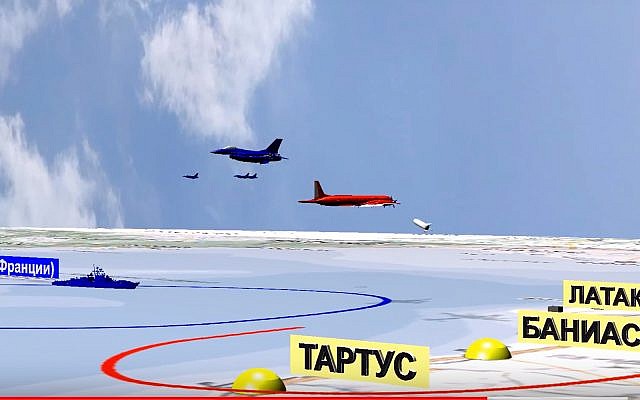
A computer simulation released by the Russian Defense Ministry, Sunday,
September 23, 2018, purports to show Israeli jets near a Russian
reconnaissance plane, in red, off Syria’s coast before it was
accidentally shot down by Syria forces responding to the Israeli air
strike. The Russian Defense Ministry on Sunday again blamed Israel for
the downing of its plane, as Syrian government forces are thought to
have mistook the Russian Il-20 reconnaissance plane for an Israeli jet
and shot it down Monday, killing all 15 people aboard. (Russian Defense
Ministry Press Service via AP)
Palestinians carry the body of Hamdan Abu Amsha, said killed a day
earlier by Israeli fire during a mass border protest along the security
fence, in Beit Hanun in the northern of Gaza Strip on March 31, 2018. (AFP/ MAHMUD HAMS)
"[The army faced] a violent, terrorist demonstration at
six points [along the fence. The IDF used] pinpoint fire [wherever there were attempts to breach or damage the security fence]." "All the fatalities were aged 18-30, several of the fatalities were
known to us, and at least two of them were members of Hamas commando
forces." "[If violence drags on along the Gaza border,
Israel will expand its reaction to strike the terrorists behind it. If attacks continue, the IDF will go after terrorists] in
other places, too. [Israel] will not allow a massive breach of the fence into Israeli territory." “We will not be able to continue limiting our activity to the fence area
and will act against these terror organizations in other places too." IDF Spokesman Brig. Gen. Ronen Manelis
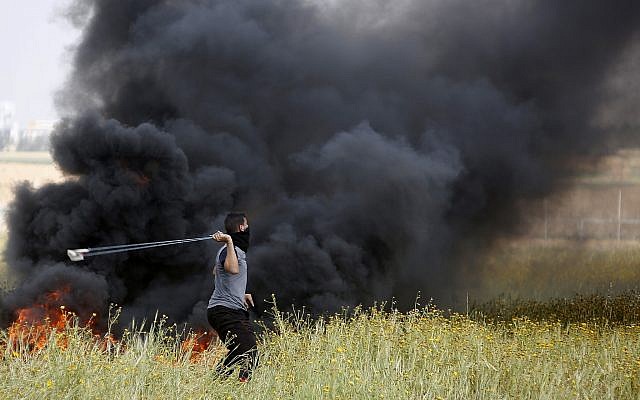
A Palestinian protester slings stones towards Israeli soldiers during
clashes with Israeli troops along the Gaza Strip border with Israel,
east of Khan Younis, Gaza Strip, Friday, March 30, 2018.(AP/Adel Hana)
"The large crowds ... reflect the Palestinian people's determination to achieve the right of return and break the siege and no force can stop this right." Fawzi Barhoum, Hamas Spokesman
"Hamas is using you and distracting your attention from its
responsibility to take care of you and govern the Gaza Strip. Hamas is
sacrificing you to move forward with useless agendas and wasting
millions instead of investing in your well-being." "Don’t let Hamas use you! Don’t put yourselves in danger for nothing.
You deserve a better future than what Hamas has planned! You deserve
more than a reality of violence, incitement and terrorism." Lt. Col. Avichay Adraee, IDF Arabic spokesperson
"[The protests mark the beginning of the Palestinians’ return to] all of Palestine."
"We are here to declare today that our people will not agree to keep the ‘right of return’ only as a slogan." Gaza leader Ismail Haniyeh
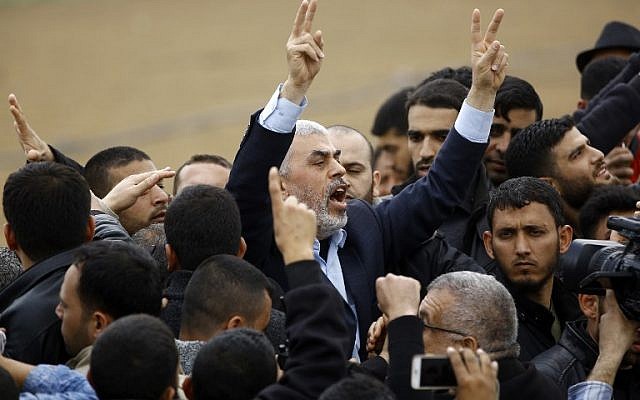
Hamas leader Yahya Sinwar (C) shouts slogans and flashes the victory
gesture as he takes part in a tent city protest near the Gaza border on
March 30, 2018 to commemorate Land Day. (AFP PHOTO / Mohammed ABED)
The Israel Defence Forces, performing the function for which it was formed, is defending its borders along the Gaza coastal strip from penetration by Gazan Palestinians incited to 'protest' Palestinian-style by rioting and acting as human shields and coerced, manipulated civilians, giving cover to the 'militants' among them who throw Molotov cocktails and rocks at Israeli troops while rolling burning tires toward the barriers that restrain them from infiltrating the Israeli border.
There are casualties in numbers; an estimated 17 dead with hundreds wounded; numbers given by the Islamist jihadi group Hamas, which Israel is unable for obvious reasons to verify, but the IDF does know that among those dead are members of the Hamas fighting forces. This is Hamas doing what it does best; combatively and rhetorically challenging Israel, to provoke its forces to respond with the kind of force that results in casualties among civilians to bring censure to Israel by the watching international community.
The people of Gaza are fed an unvarying diet of propagandist hatred against Israel, to ensure they view the Jewish State as an impediment to their own strictured prosperity by denying them all that they have been taught since childhood to expect from life; above all, that the prosperity on which Israel is based is the Gazans' own heritage. And that only if they return to those places where those originally from areas in what is now Israel, a good life would be restored to them; the presence of the Jews preventing them from achieving their destiny.
That the terrorist group dedicated to vanquishing the IDF and destroying the State of Israel, which dominates their daily life with actions and activities focused on that goal, ignoring the purpose of a responsible government to provide the template of infrastructure for the delivery of social support to the governed, is what has impoverished the people of Gaza bypasses them. For the lifetime of the oldest among them the international community has been providing funding and material support which their leaders have waylaid to fulfill their own designs.
The desperation of indigent life in Gaza contrasts sharply with the wealth acquired by their leaders, by the sidelining of material support for the population toward Hamas projects, both costly in materials and upkeep and purposeless for the well-being of the subjugated held in thrall to the Hamas version of 'justice' seeking to destroy a nation, and enabling in the process tribal-religious conquest and a restoration of Arab 'honour'.
Hamas has enjoined Gazan Palestinians to march on Israel's border and to continue their barrage of protests and violence for six weeks until the day of Palestinian mourning and Israeli celebration is reached; for the former the Naqba, for the latter the establishment of the State of Israel. Persuading an estimated 20,000 Palestinians to march on the border throwing stones, firebombs and rolling burning tires toward troops on the opposite side. Sending children into the fray and toward danger; a tactic beloved by Hamas.
The "right of return" insisting that millions of the progeny of the original 70,000 Palestinians who fled, overwhelm Israel, as simply another vehicle of destruction.
Rising unemployment, miserable poverty, lack of power, and questions about the availability of potable water all make life intolerable in the Gaza Strip. Israel has done what it too does best; warning that it intended to make use of live ammunition, and scattering leaflets explaining that to come within 300 metres of the fence is to court direct danger. In response to which some of the Gazan civilians are indifferent, claiming their lives are so dire, death would be a relief.
Not far from the border where protesting Gazans in family groups assemble, there is a different atmosphere, one of gaiety and celebration with family picnics, with stalls erected to sell ice cream, smoothies, nuts and sandwiches. Those gathered there seemingly unperturbed as ambulances screech beyond them carrying injured, and even while drones drop tear gas canisters.
"We are here to say we want to return to our land", 65-year-old Suheila Abu Rish said of her family displaced from Ashdod 50 kilometres up the coast, during the 1948 Arab-Israeli war.
A war where Arab armies coalesced after persuading Palestinians they could soon return, once the Jews had been torn away from the land, vanquished and bleeding, to surrender their new state, returned to Arab rule. This was before Suheila Abu Rish's birth; it occurred 80 years ago, but the fallacy of return is kept alive and burning in the consciousness of a people whom other Arab states never had any intention of welcoming as citizens.
As Jews embark on their annual celebration of Passover, their release from tyranny and renewed pledge as a people exiled from their traditional heritage landscape, the symbolism and rage of Arab displacement exemplifies the entitlement of a religion which had not existed until a thousand years later and a people for whom the land was foreign, to now claim it as their birthright. Even so, there is no coordination or singleness of purpose to benefit Palestinians between Hamas and the Palestinian Authority.
No reconciliation possible between the West Bank and Gazan Palestinians with their leaders planning to demolish one another's leadership rights and lives. The latest efforts at peace between them destroyed when Hamas launched a bomb to kill the PA prime minister and intelligence chief in a convoy on a road in Gaza. Typically, the Palestinians choosing lethal violence to settle matters of disagreement and restore tribal 'honour'.
Palestinian demonstrators face IDF soldiers near the fence in the northern Gaza Strip, March 30, 2018.JACK GUEZ/ AFP
Hamas announced on Saturday that five members
of its military wing, the Izz ad-Din al-Qassam Brigades, were among 16
Gazans they said were killed on Friday along
the security fence with Israel, claiming those killed were taking part "in popular events side-by-side with their people". Maj.Gen.Eyal Zamir of IDF's Southern Command spoke of Hamas planning attacks under the shield of demonstrations: "We recommend to civilians not to come near
[the fence], and warn Hamas that it is responsible for everything that
happens in the Gaza Strip with all its consequences."
For their part, and unsurprisingly, Egypt, Jordan and the Arab League have condemned what they term 'excessive use of force' against demonstrators on Israel's part, while the organizers of the march have appealed to the United Nations and Arab League to establish an
international commission of inquiry to investigate their charges of
Israel's excessive force against Palestinian demonstrators. A well-orchestrated and familiar choreograph that will ensure further censure of Israel by the general assembly of the UN.
Unparalleled Universes : Murderous, Paranoid and Delusional
"This is a massacre." "All our options are open. We will take all considerations into
account, but we will not allow the enemy to set the rules of
engagement." Senior Islamic Jihad leader Khaled al-Batash
"The Zionist terror government must realize that we will not hesitate to
protect our people and our land." "[Islamic Jihad] is considering all of
its options, [including the] option of responding to this aggression." Islamic Jihad spokesman Dawood Shehab
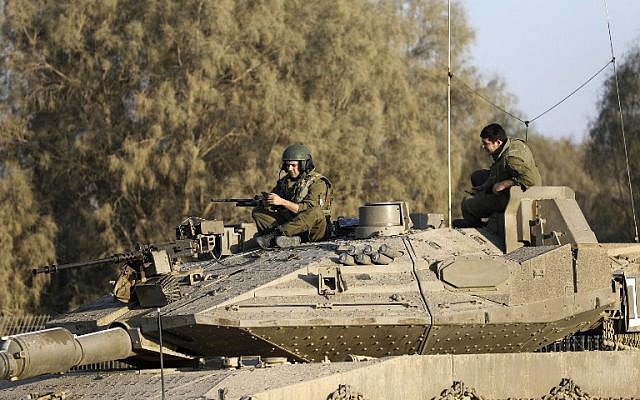
Israeli soldiers sit on a tank close to the Israeli border with the Gaza
Strip on October 30, 2017, near Kibbutz Kissufim in southern Israel.
(AFP PHOTO/MENAHEM KAHANA)
"Any response or violation of Israeli sovereignty will be answered with
determination and in a forceful and clear way, as we did yesterday." "[Following the demolition the IDF is] maintaining its preparedness, closely monitoring what is
happening among terror officials in the Gaza Strip." "The IDF’s activities removed a threat against Israeli citizens, and that was the mission." "This was an impressive operational achievement and it deserves all praise from the Southern Command." "The operation joins a host of operations, overt and covert, that IDF
troops are undertaking and will continue to do against any threat, at
any time and in any situation." IDF chief Lt. Gen. Gadi Eisenkot
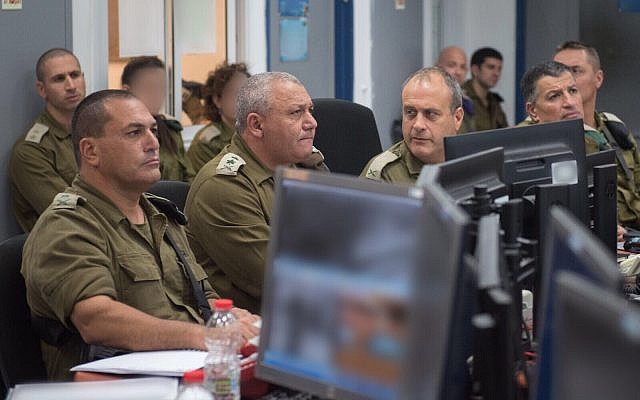
From left, Southern Command chief Maj. Gen. Eyal Zamir, IDF Chief of
Staff Gadi Eisenkot, Gaza Division commander Brig. Gen. Yehuda Fuchs and
Coordinator of the Government's Activities in the Territories Maj. Gen.
Yoav Mordechai hold a situational assessment meeting near the Gaza
border on October 31, 2017. (Israel Defense Forces)
Two terrorist groups, one subservient to the other, but both owing their existence to a fixation on destroying the State of Israel, see their mission as an imperative. To that end they stockpile weapons, gain the understanding sympathy of terrorist-sponsoring Islamic countries like Iran, Turkey and Qatar where encouragement, funding and training, alongside more arms to stockpile, derive. Their intention is clear, oft-repeated and reinforced by forwarding suicide missions, lobbing rockets across the border to Israel, and constructing sophisticated tunnels from within Gaza into Israel to enable terrorists to breach the border and plan attacks against Israeli military and Israeli towns and villages.
It is the related duty of the Israel Defence Forces to remain aware of all threats emanating from Gaza, from the major terrorist groups stationed there; Hamas which controls Gaza and Islamic Jihad which shares its mission of annihilation of the Jewish State. Hamas calls upon the international community, despite its terrorist designation in many foreign countries, to condemn the IDF and Israel as genocidal, planning to destroy the lives of Palestinian Arabs, particularly children, used as protective shields by Hamas while provoking Israel to respond to rocket attacks.
The sophisticated tunnels crawling underground from Gaza to Israel are costly to build, requiring massive amounts of cement side-lined for that use instead of building homes for Gaza's Palestinians. They are funded through the generous charity of the European Union in large part, meant to relieve the plight of Palestinians but co-opted by Hamas. The tunnels are equipped with electricity, some have tracks that motorized vehicles run on, and motorcycles are often used to traverse them. They are also used as storage facilities for weapons and as secret hideaways for Hamas officials during times of Israeli defensive operations responding to Hamas offensive forays.
The purpose of the tunnels focuses on Israel and giving Hamas the capability of covertly entering Israel to carry out attacks. During the 2014 conflict between the IDF and Hamas many tunnels were discovered and destroyed by the IDF. Occasionally others are discovered and destroyed. Last week was one of those instances, when a tunnel was discovered and explosive charges set to destroy it, where it emerged from Gaza into Israel. In the collapse of the tunnel several Hamas senior operatives died, along with a handful of others.
This 'massacre' has outraged Hamas and Islamic Jihad, as a perfidious act of war. What a strange world we live in when violent psychopaths dedicated to destruction and slaughter of those they term their enemy, shrink in horror when their own are killed while engaging in activities meant to bring about the destruction of that enemy, who demonstrates an inconceivable determination to defend itself. And so psychologically battered have commanders of the IDF become by constant criticism from the international community, condemning 'disproportionate' force of defence, that they must defend their actions, explaining the intention to destroy a tunnel, not those within it.
According to IDF authorities, this tunnel was discovered inside Israeli territory close to the
Gaza Strip, believed to have been constructed after 2014. The tunnel was
the work of Islamic Jihad, and ran from the Gazan
city of Khan Younis, to cross under the border for dozens of meters, and
finally approached Kibbutz Kissufim. Ronen Manelis. A spokesperson for the IDF described the
operation in Israeli territory to destroy the tunnel, that the fatalities were mostly occasioned by smoke inhalation and secondary blast impacts.
Seven Palestinians in total died, of whom two were senior commanders, with another dozen injured, according to the Hamas-governing Gaza Health Ministry. It is well enough known that these tunnels occasionally collapse, taking the lives of Hamas members who happen to be working in them at the time. This instance was merely a trifle more dramatic; a collapse brought about by deliberate human intervention, catching a number of terrorist operatives unaware. They will no longer pose a threat to Israel, though a host of others are ready to take their place.
The body of Marwan Alagha, 22, is carried by mourners after he was
killed when Israel blew up a tunnel built by the Islamic Jihad terror
group stretching from the Gaza Strip into its territory, at Naser
hospital in Khan Yunis, in the southern Gaza Strip, on October 30, 2017.
(SAID KHATIB / AFP)
According to reports out of Palestinian media, Islamic Jihad had demanded an immediate,
coordinated military response. Hamas, on the other hand, urged a more cautious approach before responding, along with possible
coordination with Egypt so that the nascent Palestinian unity agreement would not be jeopardized. Egypt has its own problems with these tunnels and with violent attacks by Islamist jihadis from Islamic State to Salafist Bedouin in the Sinai, as well as Hamas, targeting its military and its police.
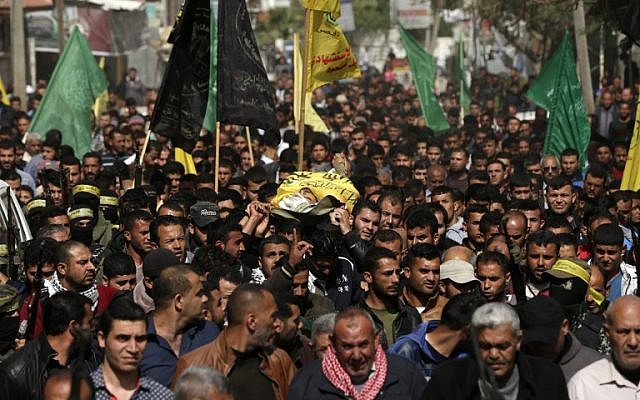
Members of the Palestinian Islamic Jihad terror group attend the funeral
of fellow terrorists killed in an Israeli operation to blow up a tunnel
stretching from the Gaza Strip into Israel, during their funeral in the
Bureij refugee camp, in central Gaza, on October 31, 2017. (AFP PHOTO /
THOMAS COEX)
"The response to this massacre is to move forward toward the restoration
of national unity because the enemy knows that our strength is in our
unity and no people under occupation can win if they are not united." "I assure the leadership of [Palestinian] Islamic Jihad: blood for blood, destruction for destruction." Hamas political leader Ismail Haniyeh
Both Hamas and Fatah, traditionally at violent loggerheads against one another, agree on this issue, that Israel is promoting chaos in Gaza, and the tunnel demolition was one of those issues, planned to disrupt the ongoing talks for reconciliation between the two sworn enemies, Fatah and Hamas. Fatah spokesperson, Fayez Abu Eita, vice chairman of the party’s
revolutionary council, charged that the tunnel detonation was aimed at disrupting the
unity talks. "This crime comes in the context of [sowing confusion] and creating
tension in order to thwart Palestinian national reconciliation."
"The explosion took place inside Israeli territory. The majority of
the dead were operatives who entered the tunnel after it was blown up
and died in the Gaza Strip, and not as a [direct] result of the
explosion." "We are not interested in an escalation, but we are ready for all scenarios." IDF spokesperson Avichay Adraee
As though any explanation were needed to begin with. Any nation on this globe has the right and the obligation to defend itself from the menace of malevolent threats and violence aimed at its complete and utter destabilization, not to mention the ongoing threats of lethal violence committed against its people, both military and civilian.