
Politic?

This is a blog dedicated to a personal interpretation of political news of the day. I attempt to be as knowledgeable as possible before commenting and committing my thoughts to a day's communication.

Saturday, September 20, 2025

Opioid Prohibition on First Nation Territory

"[There is no] hate [for those involved in drug offences; they are not considered] bad people."
"We are now seeing much more dangerous substances, like meth and fentanyl, creeping into our region..." 
"We cannot afford to ignore the signs [in considering the safety of the community]."
Chief and Council, Buffalo River Dene Nation, Saskatchewan 
 
"In Manitoba and across Canada, fentanyl poisonings are taking lives daily."
"Our front-line workers and families are doing all they can, but support from federal and provincial governments remains fragmented, underfunded and reactive."
Chief Angela Levasseur, Nisichawayasihk Cree Nation 
 
"Families are torn apart, two children are left without parents, and our social fabric is broken." 
"The scale of this crisis demands immediate, co-ordinated federal action."
"Piecemeal funding and short term pilots are not enough. The federal government has both fiduciary and treaty obligations to act."
Cold Lake First Nations Chief Kelsey Jacko 
https://www.vmcdn.ca/f/files/shared/feeds/cp/2025/09/3782237864d9358dcd26b94a735ecfcfbe715f2ce812d61534c4be0222bea34f.jpg;w=960
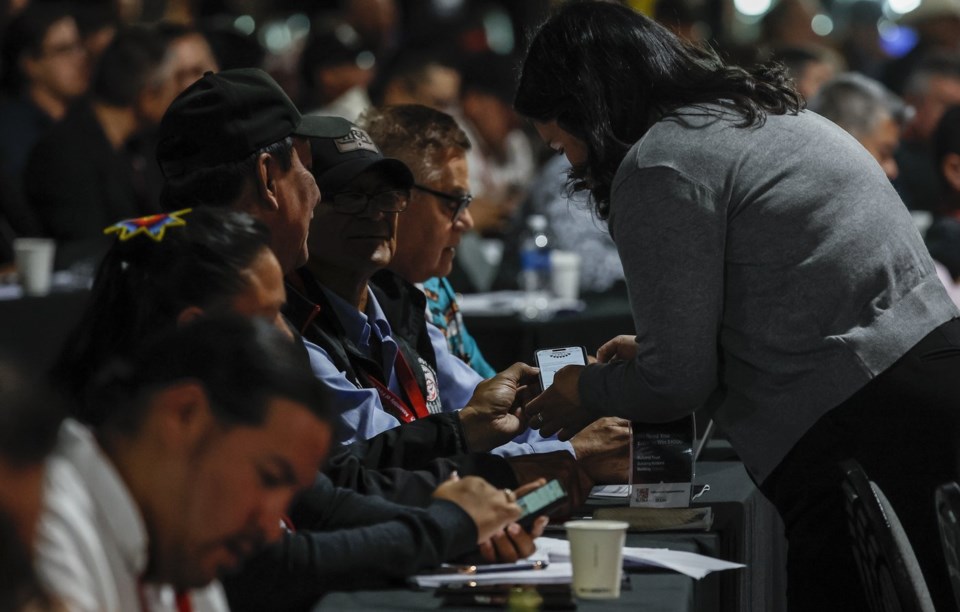
Delegates vote electronically on resolutions at the Assembly of First Nations (AFN) Annual General Assembly in Winnipeg on Wednesday, Sept. 3, 2025. THE CANADIAN PRESS/John Woods
 
Friday saw a proposed law that First Nations chiefs voted unanimously to support while calling on the federal government to begin enforcing a crackdown on drug dealers selling illegitimate drugs in their communities that claim the lives of users. The Assembly of First Nations was also called upon to declare a state of emergency among all First Nations, and to appeal to the federal government for greater support for treatment and prevention. The law, as proposed, would see sentences for drug traffickers to a 15-year minimum where death occurs from tainted drugs.
 
Law enforcement, furthermore would be given authority to access the cellphones of victims in search of those traffickers responsible for the proliferation of the drugs. The resolution appealed to the Assembly of First Nations to advocate for federal resources required to address root causes of drug use, focusing on prevention, intervention and rehabilitation. The proposal called for "legal reforms that reflect the true scale and human impact of the fentanyl crisis, and that prioritize the protection of life over the criminal impunity currently enabling  traffickers and dealers."
 
Countrywide, Canada's First Nations have become actively involved in banishing drug dealers from their communities, their effort to curb the skyrocketing rate of drug overdoses, in sharp contrast to government strategies which prioritize harm reduction and drug trafficking-lenient treatment. September 3 saw the Ojibway community of Netmizaaggamig Nishnaabeg in Ontario authorize the Anishinabek Police Service to treat unauthorized visitors as trespassers. 
 
https://scontent-yyz1-1.xx.fbcdn.net/v/t39.30808-6/547246599_1186967026800602_2002949840548466428_n.jpg?stp=dst-jpegr_s600x600_tt6&_nc_cat=108&ccb=1-7&_nc_sid=833d8c&_nc_ohc=WqlrkF0-lUoQ7kNvwE_45sn&_nc_oc=AdlnkeOUzdIo9-xOXyOvNeIJSNhbmoq0rJxKPzB-QPh2PUSDknBaBTxFm_SfVm2Lq_0&_nc_zt=23&se=-1&_nc_ht=scontent-yyz1-1.xx&_nc_gid=HXLaKvEBqX27Qy9l2Vkr4w&oh=00_AfYEGA8jVFX9qsryWOFcyfbZNxP6ODemMZpzTO03wWZosA&oe=68D5377F
 
"Unfortunately, there's people coming into the community with these drugs that are taking advantage of our people", stated deputy chief Thurston Kwissiw. Saskatchewan's Buffalo River Dene Nation last month announced it planned to begin evicting its own members from reserve housing who are involved in drug activities. Kwakiutl First Nation on Vancouver Island looked at available options for the eviction of members accused of drug dealing. Hereditary chief David Knox informed local media "we're tired of watching our loved ones get killed from these toxic drugs". 
 
The family of an alleged drug trafficker and accused murderer's family on Haida Gwaii saw their home demolished and were forced to leave the islands. Pickets followed the family to the mainland, intercepting them at bus stops to ensure they moved on. Multiple Indigenous communities in the North enforce blanket bans on alcohol, assisted by the RCMP. In the northern Alberta community of Fox Lake, a bootlegger was recently detained while attempting to smuggle in 124 bottles of illicit vodka.
 
https://www.netnewsledger.com/wp-content/uploads/2019/01/Opioid-Addiction-Depositphotos_137871552_xl-2015-696x462.jpg
Opioid Addiction – image: depositphotos.com
 
Fatal overdoses among Indigenous people in British Columbia is seven times greater than the average. Overdose deaths in Alberta have been responsible for a sharp drop in Indigenous life expectancy. The average First Nations person in Alberta lives to 62.8 years, down in a decades' time from a 2013 peak of 72.4, much less than the current non-Indigenous life expectancy in Canada of 81.8 years. 
 
It has long been acknowledged by government health authorities that Indigenous communities are affected more dramatically by illicit drugs than non-Indigenous communities. Yet, official strategies have tended to sidestep the issue of drug trafficking interdiction. Published in 2023, the official Canadian Drugs and Substance Strategy, posits that high Indigenous drug use is attributable to "historial and intergenerational trauma, including the impact of colonization".
 
The self-flagellating federal government gave expression to then-attorney general David Lametti's statement that "We hare repealed the mandatory minimum penalties that have most contributed to the over-incarceration of Indigenous people, Black persons and racialized Canadians", in explaining the 2022 passage of Bill C-5, the Liberal legislative gift influenced by Critical Race Theory to non-punishable minority groups held to be disadvantaged and not responsible for their misdemeanors, thus removing mandatory minimum penalties for drug trafficking offences.
 
Finally, the Assembly of First Nations is signalling that this approach has not worked, and will not work, to address these habitual problems of sociopathy prevalent in specific groups. The 1,500-member Mississauga First Nation last October scored a precedent-setting legal victory with an Ontario court upholding their trespassing order against an accused drug dealer who  continually frequented the community. In the process the Mississauga leaders emphasized their long struggle to have police enforce their community codes. 

 
https://smartcdn.gprod.postmedia.digital/nationalpost/wp-content/uploads/2025/09/548108040_1186967113467260_6205002241907255265_n.jpg?quality=90&strip=all&w=564&h=423&type=webp&sig=Y9wGYrGVK4prEw5padYAYg


Labels: , , , , , ,

Friday, July 03, 2015

Do As I Say, Not As I Do

"The National Chief has worked closely with his partner, Valerie, for many years in previous elected leadership capacities She was a key part of his campaign team for the position of National Chief. And she is a valuable member of the transition team as the National Chief gets established in his role."
"Valerie's transition advisory role will come to an end by the end of the year and she will pursue other opportunities outside of the Assembly of First Nations to work with First Nations."
"Valerie reports to me at the CEO and not to the National Chief."
AFN CEO Peter Dinsdale

"Our people are constantly being accused of not being accountable and transparent. If the National Chief feels that he can hire his girlfriend and pay her a salary out of the AFN coffers, this would serve only to heighten criticism that is often levelled at our people."
Chief Ava Hill, Six Nations

The Canadian Press AFN National Chief Perry Bellegarde, centre, is being criticized for hiring his partner, Valerie Galley, as a senior policy adviser in his office.

Little wonder that a chief of a reserve of 85 people can earn over $900,000 in a year, one of many unfortunate instances where various bands become aware through new federal mandated disclosure that their band councils and their chiefs elected in good faith to uphold the best interests of the band, not their personal finances, have disgraced themselves through an insistence of entitlement. Funding transferred through taxes to support First Nations reserves are meant to improve life for those living on reserves.

It is left to the discretion of band councils elected for the purpose of deciding how those funds should be used to aid in giving a better life to band members and all too often they fail the test. There are invariably excuses, but the facts remain that gross dysfunction rules the day all too often on reserves. Where the housing is sub-par, and repairs overlooked, where potable water is in short supply, and unemployment soars, and where band councils take taxpaid luxury trips and accommodation carrying out their responsibilities.

But then, why not when the National Chief, Perry Bellegarde, practices unabashed nepotism in the hiring of his girlfriend, earning a handsome, taxpaid salary as an 'adviser'. As a publicly funded organization tax dollars have a purpose and that purpose is not to line the pockets of the AFN executive. The serious problems assailing First Nations beg to be addressed. The Assembly of First Nations representing the interests of Canada's aboriginal populations loves to counter generous offers of the federal government to help solve inequity and need in aboriginal communities.

By their very dissent, demands, and insistence on more money to be devoted to First Nations health, education, and living arrangements rather than emphasize the need for aboriginals themselves to begin to take account of themselves, to renounce handouts and make an effort toward independence and to encourage young people to become fully educated rather than emulate their parents in alcohol and drug use, family violence will continue to fail the children of the aboriginal communities.

The examples and inadequate-to-absent mentoring that vulnerable children are exposed to, abrade their human rights and point them in a self-destructive direction. The results can be seen in rampant drug abuse, alcoholism, violence and suicides. If direction cannot be expected from the highest levels of First Nations administration, it's little wonder the stack of cards cannot hold itself proud and erect.

Labels: , , ,

Sunday, December 14, 2014

Conciliatory Tones or Purely Oppositional?

"We will no longer accept poverty and homelessness while resource companies and governments grow fat off our land and territories."
"Canada is Indian land. This is my truth and this is the truth of our peoples."
"To this government here, that's here now, we need to reach out and bring them to the table because the status quo in this country is just not acceptable."
"You have to bring people to the table. No question. You can't stay on the outside. You have to engage in dialogue."
Perry Bellegarde, incoming national chief, Assembly of First Nations
Ted Rhodes/Calgary Herald
Ted Rhodes/Calgary Herald   Then-newly elected Grand Chief of the Assembly of First Nations Shawn Atleo, left, gets a handshake onstage from runner-up Perry Bellegarde following Alteo's win on a marathon eighth ballot Thursday, July 23, 2009 in Calgary.

A nation within a nation, both sovereign, and each traditionally at odds with one another, each attempting to override and control the other. A national government comprised of roughly 35-million people of diverse backgrounds, ethnicities, ideologies and heritage. And an indigenous population, here before the advent of European migration, now numbering one million, four hundred thousand aboriginals in various First Nations communities.

First Nations consider all those of European and later immigration to Canada to be newcomers to the land, settlers, intruders with whom they were forced through sheer strength of numbers and the weight of arms to make peace, at the very least to accept their presence. The ongoing task by successive national governments in Canada to arrive at a mutually agreeable pact honouring treaties and providing First Nations with the means to live as the original inhabitants has brought little satisfaction to either side.

Chief Bellegarde speaks of communication and meetings and agreements but the conversations are generally one-way, with government listening and AFN speaking of the needs and demands of First Nations. The huge welfare system that has traditionally marked tribal reserves' support for aboriginals to live in 'dignity' as their ancestors once did, has been a marked failure. Remote reserves do not accommodate themselves to urban living lifestyles; and no one living on them lives in traditional mode.

With huge unemployment, resulting shiftlessness, disinterest in upkeep of houses they don't own, alcoholism and drug-addiction have become problems affecting even the youth of reserves left to their own devices where education is not recognized as a high priority, and too many parents neglect the well-being of their children, and familial violence is far too common. There is no dignity in social ills so pervasive that suicide becomes salvation. All of which blights the AFN lay squarely at the feet of the federal government.

The Assembly of First Nations in theory represents all those aboriginals living on reserves; and they and the system of reserves have not been successful in representing the best interests of First Nations peoples, too many of whom live in poverty and social destabilization. From the tenor of the speeches emanating from the new AFN chief-elect, as opposed to the more accommodating relationship between his predecessor and the Government of Canada, matters will not be any easier in the future.

As for resource-sharing demanded by leaders of First Nations communities when development projects cross into First Nations territories, that is already proceeding, honoured increasingly by the provinces and the federal governments alike. Former AFN Chief Shawn Atleo was entirely too prepared to meet the government halfway in negotiations -- from the perspective of Chief Bellegarde who contested him for the 2009 election of chief -- having concluded an agreement with Aboriginal Affairs on Bill C-33 to improve on-reserve education.

Chief Atleo faced opposition from too many of the chiefs, new Chief Bellegarde included, for being entirely too comfortable in dealing with government, and opposition was so fierce he was forced to step aside. The result of that will be to move to another process through which a version of improved education can be managed by dealing with reserves one-on-one, providing each of them with the financial resources to enable them to undertake improved education.

"When I look at the reality of First Nations in the country, they are so diverse from all corners of Canada, that I think the way forward is to work locally with the communities, the willing partners who are ready to take the steps to improve the outcomes of education on reserve. We have tools in place where we can, I think, move forward in a positive way and achieve reform without imposing, or without having a national solution", stated Aboriginal Affairs Minister Bernard Valcourt.

The Assembly of First Nations, in opposing the new Aboriginal Education Act and rendering it toothless by their rejection of it, insisting that they are prepared to take possession of the $1.9-billion funding increase that would accompany it, have made it obvious yet again, that they have outlived their promise to represent the best interests of First Nations communities in Canada.

Labels: , ,

Friday, August 01, 2014

First Nations Diplomacy

Any government department whose mandate it is to administer aboriginal affairs, faces a difficult task. And it is a task of enormous difficulties that has always presented to any appointed minister of Aboriginal Affairs, having to delicately tiptoe among the readily offended sentiments of 560 First Nations bands in Canada, all of whom clamour for increased funding from the federal government, with fewer irritating 'conditions' attached to the disposal of the cash dispersal.

The Government of Canada must have heaved a huge sigh of relief when, earlier in the year it had reached an agreement with the Assembly of First Nations under National Chief Shawn Atleo, to finally put into place conditions to ensure that education for First Nations children would see a huge improvement. The First Nations Education Bill was on the verge of being put into place, and with it an additional $1.9-billion in specific funding, when it was slammed by some First Nations chiefs.

Any initiatives put forward by the government through the Department of Aboriginal Affairs must forever contend with complaints, accusations and attempts at deep-ditching government efforts to improve conditions for reserve populations. Although the agreement to cooperate with the federal government in endorsing the new education act had been agreed to by the AFN executive committee, when rivals of the national chief critiqued it to death, the AFN executive left Mr. Atleo to pick up the pieces.
Photo: wikimedia commons
Shawn Atleo has resigned from his position as national chief of the Assembly of First Nations. Atleo made the annoucement at a news conference on May 2, 2014.

First Nations politics are venomous and self-destructive. Chiefs bridle at being told how they should conduct band and reserve affairs, complaining that their heritage and their culture are being insulted. But there has also been another initiative by the federal government, recently enacted, the First Nations Financial Transparency Act under the Department of Aboriginal Affairs & Northern Development, requiring fiduciary reporting on the part of band councils.

So now, for the first time, bands are obligated to report their finances, including annual council salaries. And those reports are fascinating. Indicating that there is little consensus between bands on the value of the work performed by band councils; where some councillors may earn $10,000, even less, and others receive over $100,000; leaving the majority in the $35,000 to $60,000 range, size of community- and council-dependent.

Then there are some high-earners like a councillor of the Snuneymuxwe First Nation in British Columbia who received $315,000, while its chief earned over $100,000. B.C.'s Shackan Indian Band paid its chief $13,000 and its two councillors $9,100 each. But in Alberta two chief/councillors for the Samson Cree Nation received $167,000 and $178,000, and $6,000 in expenses. In Manitoba four members of council were paid $280,000 and $20,000 in expenses; lavish anywhere in the world.

Those, however, were modest in comparison to Chief Ron Giesbrech of the 80-member Kwikwetlem First Nation in British Columbia who earned a tax-free salary of $914,219 and an additional $16,574 in expenses. In his LinkedIn persona the chief lists his interests as "fishing, aboriginal culture, golfing, photography and sitting on the beach." No kidding.

"The First Nations Financial Transparency Act applies the same principles and requirements that already exist for all other elected officials in Canada" noted communications director for Aboriginal Affairs Minister Bernard Valcourt. Government expects band councils, said Andrea Richer, to use taxpayer's funding responsibility, to the benefit of all community members. A happy, well-remunerated chief is one who will cheerily commiserate with band members living in poverty.

Labels: , , , ,

Wednesday, May 28, 2014

Stifling First Nations Students' Future

"Our government is extremely disappointed that the Assembly of First Nations (AFN did not honour its agreement with the government."
"As we have said all along, this legislation will not proceed without the support of AFN, and we have been clear that we will not invest new money in an education system that does not serve the best interests of First Nations children; funding will only follow real education reforms."
Andrea Richer, director of communications, Aboriginal Affairs Minister Bernard Valcourt

"[The government] must withdraw Bill C-33 and engage in an  honourable process with First Nations that recognizes and supports First Nations control of education based on our responsibilities and inherent Aboriginal and Treaty rights."
"[First Nations] reject [Bill C-33 and] demand the government withdraw it immediately."
AFN chiefs' special Tuesday meeting

OTTK101189605_high.jpg
Chief Rufus Copage of Shubenacadie (Indian Brook) First Nations, N.S., carries the Assembly of First Nations Eagle Staff as chiefs parade into a special AFN meeting in Ottawa on Tuesday.  Sean Kilpatrick/The Canadian Press

Chief Rufus Copage of Shubenacadie (Indian Brook) First Nations, N.S., carries the Assembly of First Nations Eagle Staff during the grand entry as First Nations leaders, elders, youth and delegates gather for the Assembly of First Nations Special Chiefs Assembly in Ottawa on Tuesday, May 27, 2014. THE CANADIAN PRESS/Sean Kilpatrick - See more at: http://www.princegeorgecitizen.com/news/national/chiefs-vote-to-reject-proposed-changes-to-first-nations-education-1.1076489#sthash.LHHCrKeO.dpuf
First Nations chiefs insist on their demand that the federal government "negotiate" a new agreement. Foremost among their demands, however, is that of insisting that the government immediately surrender the $1.9-billion that was supposed to accompany and accommodate the institution of Bill C-33 education reforms which proposed to hand control of on-reserve education to First Nations, at the same time setting standards along with the provision of additional funds.

This was a bill whose details were undertaken in full consultation with the Assembly of First Nations which demanded a number of alterations to the bill to reform First Nations education. Grand Chief Shawn Atleo approved of the resulting amended bill and gave it his stamp of support. The federal government was prepared to proceed, when some of the AFN chiefs protested and demanded its rejection on the basis that the federal government hadn't engaged in sufficient consultation.

Their belligerent stance caused Shawn Atleo to stand down from his post, something that had never before occurred within the Assembly of First Nations, leaving it leaderless. With Chief Atleo's resignation, Aboriginal Affairs Minister Valcourt stated the government had no intention of imposing the bill on an unwilling First Nations and placed it on hold "until the AFN clarifies its position".

It has now done so, after hours of debate between chiefs some of whom were dismayed at their internal and eternal fractious bickering: "This is ridiculous. All we do is sit here and fight amongst ourselves. Eventually, we've got to compromise", stated British Columbia Chief Byron Louis, who had supported Bill C-33.

It is, in fact, beyond mere 'ridiculous'. It is an oppositional AFN determined to reject anything and everything proposed within reasonable debate by a government that strives to meet its full obligations both to First Nations' future and to the taxpayers of Canada. In summation, short of offering unrestrained funding for anything the AFN deems fit to undertake, and never asking that the funding be accounted for, nothing will suffice to satisfy the AFN leadership.

Some chiefs, like Manitoba's Derek Nepinak and Saskatchewan's Perry Bellegarde, would be satisfied only if the government dissolved its own authority and handed over the country's funding of all national projects to the AFN for their expert disbursement, with no restraints whatever either on amounts or outcomes.

Labels: , , ,

Thursday, May 22, 2014

 Pleasing No One

"There are two main points of contention. The first one is the lack of formal consultation. Even though Minister Valcourt has been cited saying on numerous occasions that there was extensive consultation, I know for a fact that they never spoke with us."
"The second one is the main point of contention in the bill, is if you look through the bill, is that it gives more control to the minister today than the current provisions in the Indian Act."
"We in Kahnawake -- I'll be selfish for a moment -- we've been in control of education going on five decades now and we've produced lawyers and Indian chiefs up and down the line."
"We've been successful. Why are we being taken back into the dark ages -- it's almost the residential school mantra now. You must conform. It doesn't make sense. A blanket approach will not work."
Michael Delisle, grand chief, Mohawk Council of Kahnawake

"There's lots of voices out there, and there are some voices saying it's time to get rid of the AFN [Assembly of First Nations] and I disagree with those. There is a need for a national voice for First Nations people. There's a lot of good work done at the AFN, and great leaders and we should build on that rather than starting from scratch."
"The AFN as it is needs to evolve and I think that what I've seen in the past two years especially is that the grassroots want in. The voices of the average First Nations person have become really powerful."
"If you look at Shawn Atleo, he is one of the great people First Nations have to offer. He's educated in the Western sense and strong in his culture and language. And he couldn't get it done, so could anybody?"
Wab Kinew, journalist and commentator, candidate for Assembly of First Nations

A Parliament Hill protest today drew more than 1,000 of people opposed to reforms proposed for the First Nations Education Act.
A Parliament Hill protest today drew more than 1,000 of people opposed to reforms proposed for the First Nations Education Act. (Karina Roman/CBC)
 
Within the AFN critics triggered the first meeting of the Confederacy of Nations in a decade. Critics also spurred the resignation of Grand Chief Shawn Atleo from the AFN. The Confederacy represents a group of chiefs meeting in times of crisis, or between scheduled AFN gatherings. On Wednesday, at its gathering, the Confederacy declared it was unilaterally assuming responsibility for the aboriginal education file, rejecting Bill C-33, the bill that the government worked painstakingly to alter to the satisfaction of the AFN, which then approved it.

A motion threatening to shut down the Canadian economy if Bill C-33 passed, came out of that same meeting: "First Nations will determine whether or not there is international economic certainty for economic development on Turtle Island", read the motion. It is set to go before the scheduled May 27 AFN meeting. Because of the general First Nations backlash against the First Nations education bill, Aboriginal Affairs Minister Bernard Valcourt has shelved it for the time being with the understanding that it cannot be forced upon them.

The Assembly of First Nations of Quebec and Labrador filed a request for a judicial review on the consultation process on the education bill, back in February. Apart from chiefs in British Columbia who feel that the process undertaken by the government and the AFN was sufficient as far as consultative activity was concerned, other provincial chiefs bitterly oppose the bill, claiming they should all have been consulted. Limiting the consultation to the AFN seemed reasonable since it represents the interests of the 617 First Nations communities within Canada.

What kind of process might it have taken for Aboriginal Affairs to conduct interviews and consultative procedures with 617 First Nations communities? The time, the cost, the effort, the frustration, and selecting which of the many and varied complaints and recommendations to be heeded and worked with, would have presented a gargantuan task. One that, in its final results, would have pleased no one.

First Nations chiefs are so accustomed to their belligerent oppositional attitude to anything that comes out of a government anxious to meet the needs of the aboriginal community in Canada that they cannot see the positive realities of moving as per the agreement between the federal government and the Assembly of First Nations, then headed by Shawn Atleo, to forge a better educational opportunity for First Nations children than currently exists.

Labels: , , ,

() Follow @rheytah Tweet