Politic?

This is a blog dedicated to a personal interpretation of political news of the day. I attempt to be as knowledgeable as possible before commenting and committing my thoughts to a day's communication.

Tuesday, September 22, 2020

United States ... The Most COVID-Suffused Nation on Earth

"I do think that we're going to have a third act of this virus in the fall and the winter and it's likely to be a more pervasive spread in a broader part of the country."
"Hopefully this virus will start to dissipate in the summer [next year, so that the timing of vaccine availability] isn't going to make that much of a difference because the virus won't be transferring as readily by then."
(former) U.S. Food and Drug Administration Commissioner Scott Gottlieb 

"We need to hunker down and get through this fall and winter, because it's not going to be easy."
"The idea of 200,000 deaths is really very sobering, and in some respects, stunning. We do have within our capability -- even before we get a vaccine, which we will get reasonably soon -- we have the capability by doing things that we have been speaking about for so long, that could prevent the transmission, and by preventing transmission, ultimately preventing the morbidity and mortality that we see."
Dr.Anthony Fauci, immunologist, director, National Institutes of Health
 
"[Americans are in for] the worst fall, from a public health perspective, we've ever had [amidst concerns over a possible] twindemic [of COVID-19 cases alongside the seasonal flu overwhelming hospitals]."
Robert Redfield, director, Centers for Disease Control and Prevention

U.S. COVID-19
A healthcare worker interacts with motorists at a drive-thru COVID-19 testing facility in Dallas.  (Smiley N. Pool/The Dallas Morning News via AP)

The dismally expected mark of 200,000 Americans struck down by COVID-19 seemed to take no time at all from the time the SARS-CoV-2 virus arrived with a roar, plunging the United States into lockdown, devastating its economy, and necessitating closed borders in a hapless, too-late effort to control a disease whose course puzzled and continues to puzzle, the global medical community. Just as the stride and affect of the novel coronavirus has impacted the global community on a sweeping scale, the variations and complications of the hugely contagious virus grows more venomously intriguing the more that is discovered about its trajectory and outcomes.

From its initial impact centering on a handful of epicentres it has continued to travel and to grow without restraint as the medical community tries to second-guess its unfolding variations in symptoms and after-effects. Every time there seems to be a diminishing effect and hope grows that a level of control has been achieved, it flares anew, dashing hopes of recovery. Its impact and its spread continues unabated and while it smoulders and flares, thoughts turn to impending winter when people will be forced by weather conditions into interiors, leaving the relative safety of the outdoors.

An average of over 800 people daily succumb to the effects of the virus at the present time in the United States. In Australia, fewer than 15 cases are seen daily as is the case in Canada, Germany, Israel, Italy and the United Kingdom. All of whom have their own concerns at steadily rising cases of COVID. The U.S. reports close to 40,000 new infections dailym representing the highest case number in the developed world for the third-most-populous country in the world, even though new cases represent a 50 percent reduction from the July infection peak.
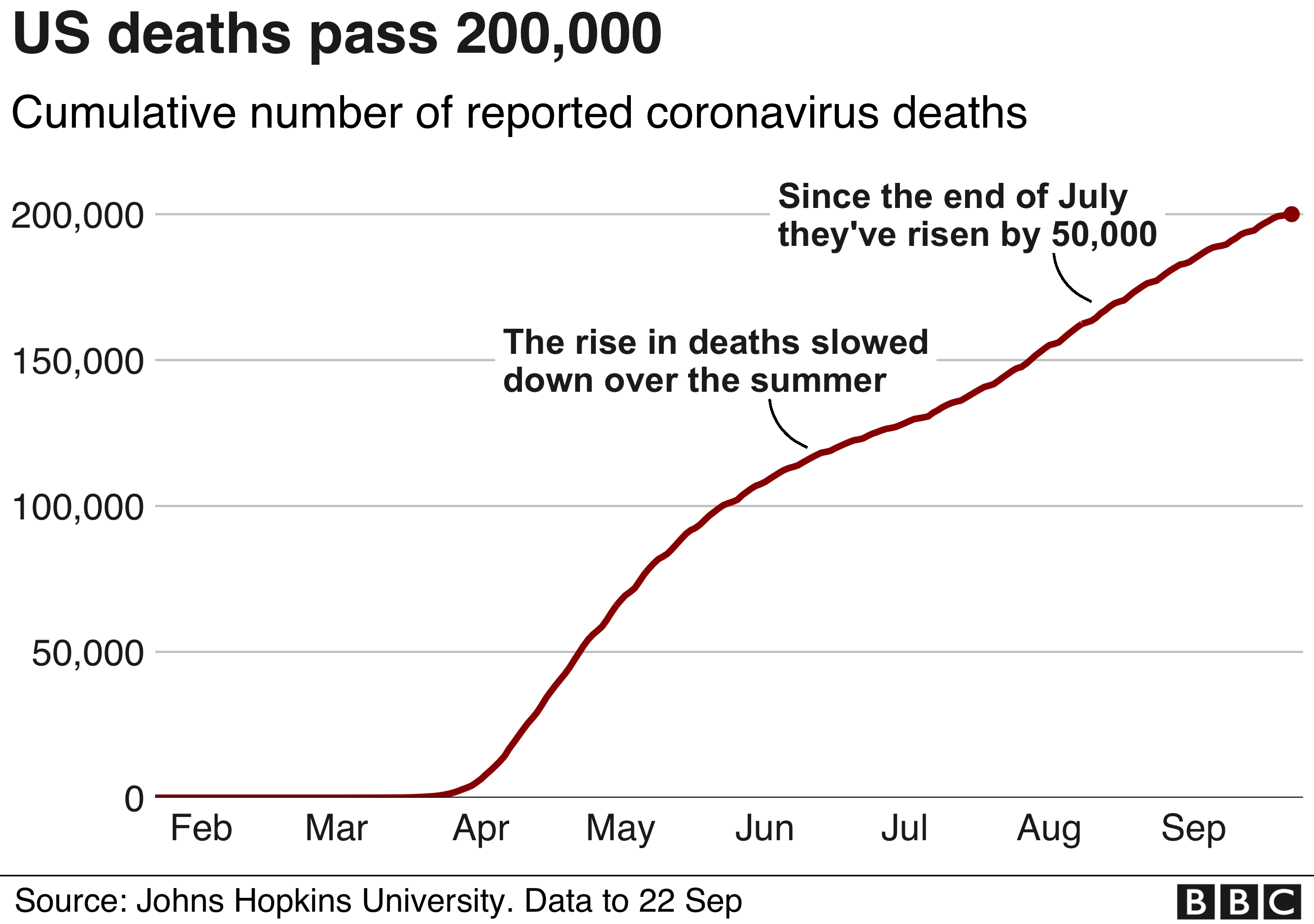
 
graph of cumulative deaths in US
 
The novel coronavirus has infected over 30.98 million people worldwide and of that number 958,453 have perished from its deadly effects. Over 210 countries and territories have reported infections in their populations since December 2019 when the first reports of mysterious respiratory cases were identified in Wuhan, China. In about 20 out of 50 states in the U.S. cases are on an upward trend. Former epicentres of New Jersey and New York where cases have declined for months are now reporting an increase in cases.

Former Food and Drug Administration Commissioner Scott Gottlieb speaks of his concerns over a third wave which might be more diffused and begin to spread in a wider swath across the country. And while he doesn't believe there will be a vaccine available until the end of the second quarter or the third quarter of 2021 for general inoculation, his professional experience clashes with that of the country's president who boasts with confidence that the nation will have a vaccine before year's end, things under control by April 2021, with an effective vaccination in wide use.

In Britain, the British government's chief scientific adviser Patrick Vallance, and Chris Whitty, chief medical officer for England have stated that the number of COVID-19 cases is doubling every seven days. "If, and that's quite a big if, but if that continues unabated ... you would end up with something like 50,000 cases in the middle of October, per day", warned Dr.Vallance. These numbers could result in over 200 deaths daily.
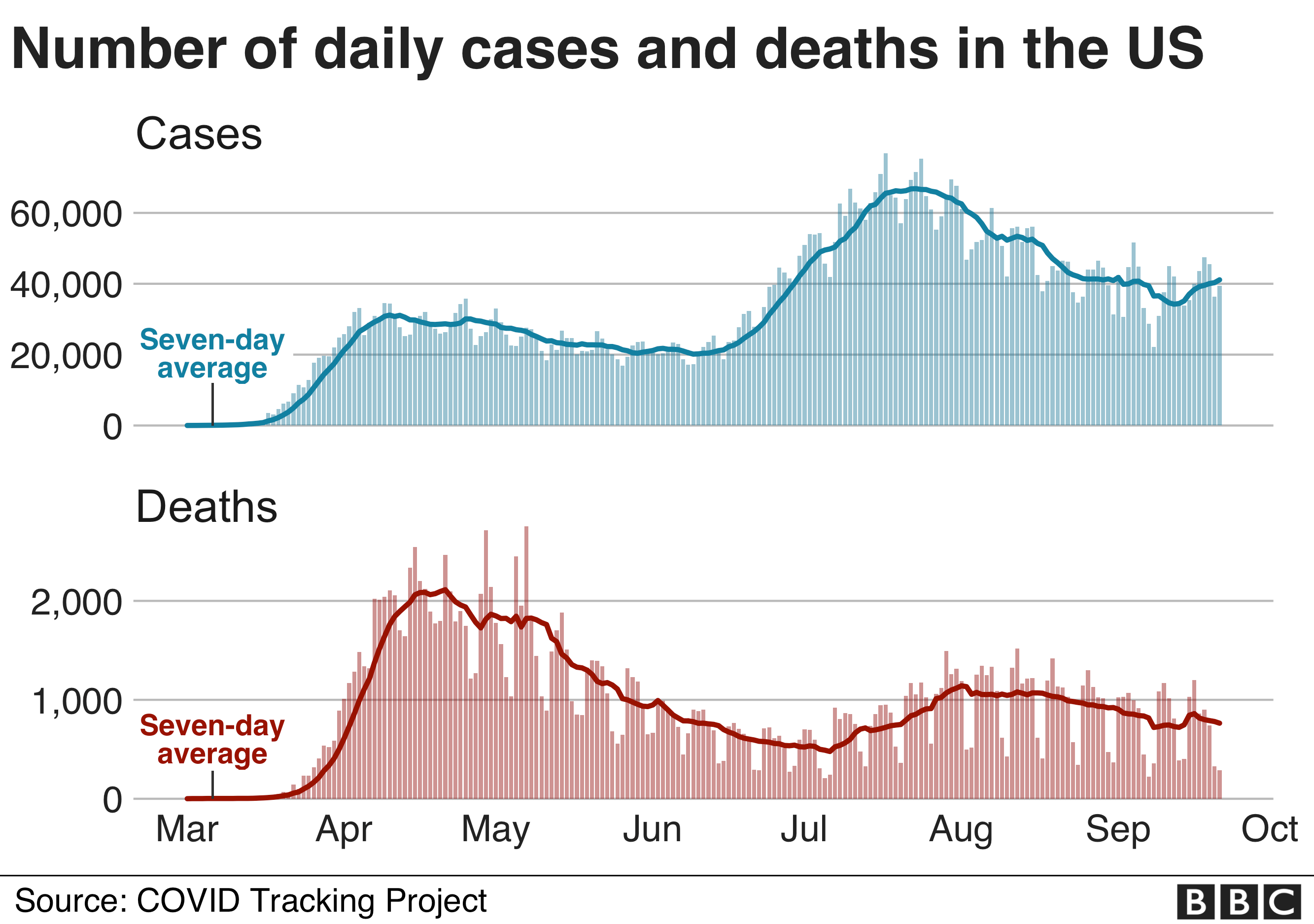
Graph showing number of daily coronavirus cases and deaths in the US

Labels: , , , ,

Tuesday, June 23, 2020

Not All Cities Are COVID-Equal

"I think we can safely say that certain drivers, such as a dense way of living, as well as age structure, in particular, the share of the population living in nursing homes, will strongly continue to predict worse [COVID] outcomes."
"What we find is that large metropolis are vulnerable mainly for two reasons. First, they are places with a dense way of life. Second, in large urban areas it is very hard to create a disease-free bubble because there is always inflow and outflow."
"Any epidemiological model of infectious disease will tell you that one of the most important drivers of the spread of the disease is the infection rate. Obviously that infection rate depends on how many other people an infected individual bumps into every day [and] that'll be much larger if I use the metro than if I live on an isolated farm in the countryside."
"Taken together, being connected to many other people makes you vulnerable. Ironically, what is very beneficial in normal times for the economy, makes you vulnerable in these abnormal times."
Klaus Desmet, economist, Southern Methodist University, Texas
According to new research, certain cities become susceptible to the novel coronavirus infection rate much in excess of others as a result of complicating circumstances. In view of expectations of potential second and even third waves in the near future as SARS-CoV-2 reasserts itself, this research may be a critical tool for planning on the part of public health officials. Experts have been busy tracking the inexorable path of the coronavirus in view of the dread toll it has taken in Italy where close to 35,000 people lost their lives from its dread effects.

Germany, on he other hand experienced a quarter of the deaths that hit Italy, while New York City suffered the agony of experiencing the absolute worst global outbreak even as Los Angeles' death toll came out one-sixth the size of New York's. The greater Toronto and Montreal areas in Canada have accounted for over 66,000 of the approximately 100,000 cases in the entire country. According to Dr. Desmet, Canada's largest two cities' plight could be attributable to the very same forces that struck New York City, leaving it with a massive death toll.

coronavirus new york city
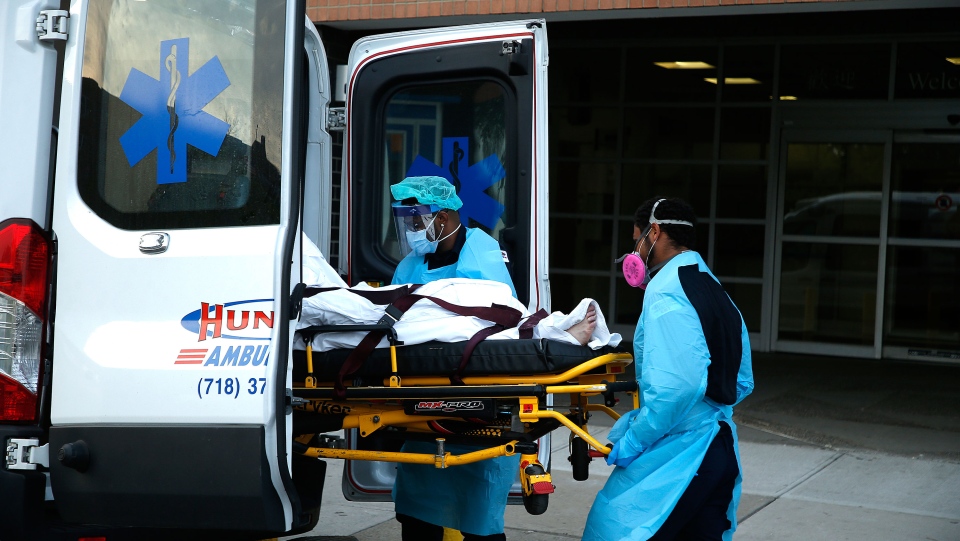
A patient is transferred from Elmhurst Hospital in New York, US, on April 25, 2020. Elmhurst Hospital Trauma Center In Queens Borough of New York City Continues Receiving Covid-19 Patients. (John Lamparski/NurPhoto via Getty Images)
A city's density represents a factor of huge proportions in the incidence of COVID transmission, with other factors such as population age, and distance to an international airport; all characteristics that the two economists posit are most likely to define the occurrence of future outbreaks. From their study it seems clear to them that waves of the disease will not necessarily hit all cities in an equal manner; leaving some cities to cope with persistent outbreaks and other will be left in a relatively unscathed state.

Should this hypothesis bear out with future incidences validating the proposed trend, health experts and municipal authorities will be able to aim their resources in those areas identified with the greatest susceptibility, confident that other areas will not become vulnerable in their turn to similar-sized outbreaks. Those areas less affected will have little need to impose stringent lockdowns and can confidently anticipate earlier reopenings without fear of overwhelming their health-care system.

Density levels come most readily to mind when weighing the susceptibility to infection of any city. Verified by a glance at the statistics identifying North America's most population-dense cities with heavy outbreaks of COVID-19. Several features of density were considered in the study; the share of individuals living in multi-unit housing structures, and the number of people representing each household, along with a breakdown of occupancy per square kilometre.

Multi-unit housing and the size of households are both recognized to be positively associated with cases and death levels; a primary feature of any future outbreak. Places with more people using public transit have worse COVID-19 outcomes, and more so in terms of the death rate. There was a clear correlation found in the United States between the distance of a city to the international airport serving it, and an early COVID-19 outbreak.

Higher infection rates were seen to be clustered around Toronto's international airport. Peel Region, home to Pearson International Airport, saw a rate of 328 cases each 100,000 population, representing one of the highest rates in Ontario, second to the city of Toronto itself, with 394 cases per100,000 people. In Calgary, where the airport remained open to international flights, infection rates were much higher than what Edmonton experienced, which has a considerably smaller airport located a further distance from the city, and not open to international travel.

covid-19-airport

Researchers discovered the more people over the age of 75 the more likely for fewer cases to emerge, the reasoning being that younger people are likelier to search out activities that tend to spread the virus, such as large social gatherings and events. In some situations, an older population, however, can lead to greater death numbers, when considering outbreaks at nursing homes where social isolation, an immune-hampered and chronic health-vulnerable population surrenders to a demonically dangerous virus.

And then there is the perennial issue of poverty, its associated poor health outcomes in indigent communities and unequal access to health services with their bearing on mortality rate for all reasons including COVID-19. Outbreaks were identified in Black and Indigenous and Hispanic communities with higher infectious rates. What the conclusion of the study seemed to point out is that many of the activities that make for a well-adjusted social community are those that now place people at an increased risk of diminished health and possibly death.

Covid Ambassadors, Free Face Masks Await Toronto Transit Riders
"This should come as no surprise: as with any other infectious disease, contact between susceptible and infected individuals is a key determinant of the spread of the disease."
"There is a randomness in locations that got the virus early. One important exception is the variable capturing distance to international airports with connections to the top five COVID incidence countries as of March 15."
"Places with a large share of retired individuals may feature fewer places [bars, stadiums] where the disease spreads rapidly."
"This finding [outbreaks at nursing homes with high death rates] is consistent with the idea that once a county is affected by the pandemic, its nursing homes can quickly become powder kegs, and account for larger shares of countrywide deaths."
"Overall, these results confirm concerns that the COVID-19 pandemic has a disparate effect on various racial groups."
Study Report: Economists Klaus Desmet and Romain Wacziarg, University of California, Los Angeles  Study on COVID numbers in large cities: Report

Labels: , , , , , ,

Thursday, April 16, 2020

The "Epidemic" In Canada

"The epidemic is slowing down."
"We've got many challenges still to deal with, including managing the outbreaks in long-term care facilities."
"The main message for all Canadians is actually not to let go ... We're doing a great job."
"Let's continue that until we can get to the bottom of that hill and then look at what that new normal would look like."
Dr.Theresa Tam, Chief Medical Officer of Health, Canada
Canadian cases
CONFIRMED
30,095
(Today: +1,731)
DEATHS
1,196
(Today: +186)
RECOVERED
9,729
(Today: +759)
499,772 individuals tested  (Today: +17,959)
"The uncomfortable and tragic truth is that the very places that care for our elderly are the most vulnerable to COVID-19."
"We all need to do better. We all need to take leadership for the seniors who've built this country."
"[The federal government will work with the provinces to get a wage boost for personal care workers] as quickly as possible."
"For many workers looking after the most vulnerable Canadians, including seniors and those with disabilities, we know conditions have gotten more difficult over the past weeks, and you need support right now."
"As we face an unprecedented threat to public health, you are our most important line of defence. We will do whatever we can to help you do your job and support you through this time."
Prime Minister Justin Trudeau
The high proportion of cases in long-term care facilities – funeral home workers seen here on April 15, 2020 removing a body from the Verdun CHSLD seniors residence in Montreal – 'unfortunately results in higher fatality amongst the people who get ill,' Chief Public Health Officer Theresa Tam said Thursday.   Ryan Remiorz/The Canadian Press
Canada's official death toll from the coronavirus swept past 1,000, surpassing the government's modelling which gave Canada an approximate number of deaths between 500 and 700 by April 16. A scenario that looks sunnily optimistic in comparison to the realized reality that arrived well before the date in question, doubling the number of deaths assumed. And almost half of all deaths seen in Canada due to the infectious COVID-19 have occurred in long-term care homes.

The statements by a prime minister who has effectively separated himself physically from the business of government, remaining secluded in his prime ministerial home, only to emerge like clockwork every morning to hold a news conference where he issues both discomfiting and quasi comforting updates as a kind of government public relations-to-the-public assurance under extreme duress updating his parliamentary authority intact, but failing to impress.

The prime minister, in self-imposed physical seclusion, iterates and reiterates the classical advice to the Canadian public that they must isolate themselves, maintain a physical distance from one another, remain in their homes, and not question the paradoxical advice to keep active and exercise, while public spaces like parks and playgrounds are now off limits even if social distancing is rigorously employed.

Canada's chief medical officer of health, stressed that remaining at home, isolating oneself means just that. That people owning more than one home should select one and remain there. That those owning summer cottages should abstain from travelling to them. That rural areas are not prepared during this time to accommodate an influx of seasonal residents. That hospitals and medical staff, public safety authorities, grocers and other services in rural areas are already coping to their limits and don't need additional strains.

To which the prime minister responded with his usual casual disregard by choosing, while commiserating with Canadians that they would have to make do over Easter by refraining from travelling, and instead connecting with their families online instead of in person. Whereas he
travelled to the prime ministerial cottage in Gatineau Park, which the National Capital Commission closed down to all other entrants, to spend the four-day Easter holiday with his wife and children.

Canada's agony of a rising death count in old age, seniors and long-term care homes has been compounded by the fact that this elderly-deadly infectious disease has also infected personal care workers and health professionals working in the homes, leading to a dire shortage of critical staffing. So even though the entirety of the Canadian population has seen an easing of the infection and death rate, the numbers keep rising in these vulnerable group homes.

In Canada, overall identified COVID cases double every ten days now in comparison to late March when they doubled every three days. And the essential care workers in long-care homes who earn less than $2,500 monthly are overworked and overwhelmed while themselves falling ill to the virus. Ontario has had outbreaks at 98 homes, with 145 long-term care deaths, and likely more, when the numbers catch up from local health units.

Over 20 deaths have occurred in at least three Ontario facilities resulting from COVID-19. Increased testing and infection control measures are now being brought in at all the long-term care homes, according to the Ontario premier. "Today we're throwing everything we've got at our long-term care homes", promised Premier Doug Ford. While in Quebec 41 care homes have serious outbreaks and an additional 104 are dealing with fewer infections. Three homes in Quebec had over 25 deaths each.

According to Quebec's Premier Francois Legault, over 1,200 care-home staff have been infected and thus are unavailable for work. He has entreated qualified people like physicians and nurses to help with staffing. Quebec is in the unenviable position of having 487 deaths reported from COVID-19, representing close to 50% of Canada's total number, and 45 percent of those deaths in Quebec relate to long-term care homes.

Labels: , , ,

Monday, March 30, 2020

The Unthinkable -- SARS/CoV-2 Deaths

"A global pandemic of this scale was inevitable. In recent years, hundreds of health experts have written books, white papers, and op-eds warning of the possibility. Bill Gates has been telling anyone who would listen, including the 18 million viewers of his TED Talk. In 2018, I wrote a story for The Atlantic arguing that America was not ready for the pandemic that would eventually come. In October, the Johns Hopkins Center for Health Security war-gamed what might happen if a new coronavirus swept the globe. And then one did. Hypotheticals became reality. 'What if?' became 'Now what'?"
"'No matter what, a virus [like SARS-CoV-2] was going to test the resilience of even the most well-equipped health systems', says Nahid Bhadelia, an infectious-diseases physician at the Boston University School of Medicine. More transmissible and fatal than seasonal influenza, the new coronavirus is also stealthier, spreading from one host to another for several days before triggering obvious symptoms. To contain such a pathogen, nations must develop a test and use it to identify infected people, isolate them, and trace those they’ve had contact with. That is what South Korea, Singapore, and Hong Kong did to tremendous effect. It is what the United States did not."
Ed Yong, The Atlantic 

US could see millions of coronavirus cases and 100,000 or more deaths, Fauci says

"Looking at what we're seeing now, we're looking at 100,000 to 200,000 deaths."
"But I don't just think that we need to make a projection when it's such a moving target, that you could so easily be wrong."
"[Measures like the travel advisory to residents of the greater New York area] will ultimately help stop the virus."
"The original proposal was to consider seriously an enforceable quarantine. After discussions with the president, we made it clear, and he agreed, that it would be much better to do what's called a strong advisory." 
"I think it's entirely conceivable that if we do not mitigate to the extent we are trying to do is that you could reach that number."
"I'm not against releasing the restrictions. I'm actually for it in an appropriate place. But I don't recommend it unless we have the tools in place in real time." 
National Institute of Allergy and Infectious Diseases Director, Anthony Fauci 

"We are asking every single governor and every single mayor to prepare like New York is preparing now."
"What we're trying to say to everyone is: when this virus comes to your metro area, please stay in your metro area where your care can be provided, because it's spreading virus more quickly around the United States." 
"This virus, we think, can spread with a lot of asymptomatic and mild cases. It's not until it gets into the vulnerable groups that you start to see the hospitalizations. If you wait for that, if the metros and rural areas don't take care now, by the time you see it, it has penetrated your community pretty significantly. And that's what we're concerned about. And that's why you have to prepare, even though you think it's not there."
Dr.Deborah Birx, White House coronavirus response co-ordinator 

"[There is a 15-page 'road map' outlining ways to transition from [sweeping mitigation strategies] to new approaches."
"A sustained reduction in the number of daily cases [over 14 days would be a trigger for lifting some of the measures in specific places]."
"It is too early to lift these measures [two weeks from the present]."
Dr.Scott Gottlieb, resident fellow, American Enterprise Institute
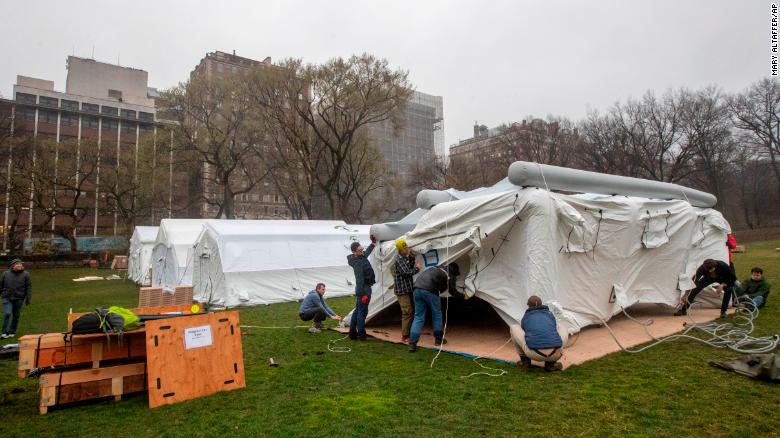
A Samaritan's Purse crew works on building an emergency field hospital equipped with a respiratory unit in New York's Central Park across from the Mount Sinai Hospital, Sunday, March 29, 2020.

Formerly head of the U.S. Food and Drug Administration, Dr.Gottlieb, now with the American Enterprise Institute. introduced a "road map in reopening" the United States in distinct phases. This, at a time when the infection rate in the U.S. is rising toward its peak, and at present stands at 164,121 infections and 3,153 deaths. U.S.President Donald Trump, conscious of the drain on American business spoke optimistically last week of the current situation in the pause of business-as-usual as the novel coronavirus cuts a swath through the U.S., with plans to launch by Easter.

Dr.Gottlieb and his colleagues expressed their expert opinion that various states have little requirement to be ordered to loosen restrictions by the White House. The recently released AEI report outlines steps that could be chosen once COVID-19 transmission comes under control in various regions, steps that were specifically linked to both the federal government and the states and health-care partners, public and private, working together for the common goal of restoring normalcy.

Fact check: Trump falsely denies saying two things he said last week
In the very midst of the pandemic's devastatingly-wide infectious rate, along with the deaths of so many Americans, a total of 100,000 to 200,000 deaths at peak is envisaged, and this toll is viewed by the president as a modest success in that government action has ensured that infinitely greater numbers of deaths -- some spoke of up to a million and beyond -- had been averted under his guidance. A stroke of good fortune whose personal perceptions and touted results are obviously not shared by all experts and commentators.

The reality is that a death toll spoken of by Dr.Fauci extends far beyond anything experienced by China, where the pandemic originated, and which has a population four times that of the United States. Even Italy's dread death rate and galloping infection rate that has swamped its hospitals and overwhelmed the capacity of its health-care community, which has seen a death rate over that which China experienced is set to be outpaced by the U.S.

Yet according to Dr.Fauci and Treasury Secretary Steven Mnuchin, discussions with the White House coronavirus task force led to President Trump's ultimate decision to set aside a quarantine for parts of New York, New Jersey and Connecticut, in stark contrast to the strict lockdowns seen in Singapore, Hong Kong and China itself which succeeded in halting the internal spread of the coronavirus. As a result, South Korea, China, Singapore and Hong Kong are returning to normal, stamping out embers of the virus, while looking out for recurrences.

The Navy hospital ship USNS Comfort passes lower Manhattan on its way to docking in New York, Monday, March 30, 2020.

Labels: , , , , , ,

() Follow @rheytah Tweet