Politic?

This is a blog dedicated to a personal interpretation of political news of the day. I attempt to be as knowledgeable as possible before commenting and committing my thoughts to a day's communication.

Tuesday, September 22, 2020

United States ... The Most COVID-Suffused Nation on Earth

"I do think that we're going to have a third act of this virus in the fall and the winter and it's likely to be a more pervasive spread in a broader part of the country."
"Hopefully this virus will start to dissipate in the summer [next year, so that the timing of vaccine availability] isn't going to make that much of a difference because the virus won't be transferring as readily by then."
(former) U.S. Food and Drug Administration Commissioner Scott Gottlieb 

"We need to hunker down and get through this fall and winter, because it's not going to be easy."
"The idea of 200,000 deaths is really very sobering, and in some respects, stunning. We do have within our capability -- even before we get a vaccine, which we will get reasonably soon -- we have the capability by doing things that we have been speaking about for so long, that could prevent the transmission, and by preventing transmission, ultimately preventing the morbidity and mortality that we see."
Dr.Anthony Fauci, immunologist, director, National Institutes of Health
 
"[Americans are in for] the worst fall, from a public health perspective, we've ever had [amidst concerns over a possible] twindemic [of COVID-19 cases alongside the seasonal flu overwhelming hospitals]."
Robert Redfield, director, Centers for Disease Control and Prevention
U.S. COVID-19
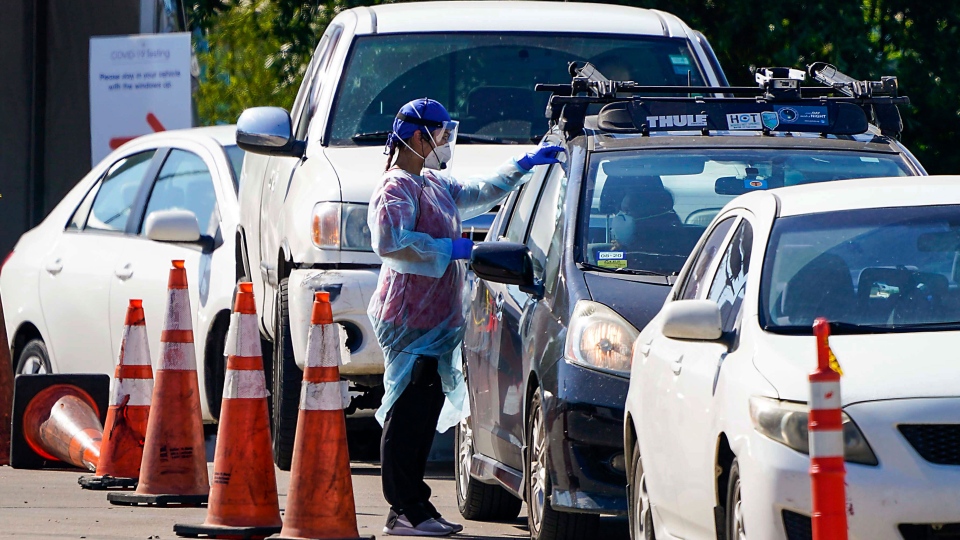
A healthcare worker interacts with motorists at a drive-thru COVID-19 testing facility in Dallas.  (Smiley N. Pool/The Dallas Morning News via AP)

The dismally expected mark of 200,000 Americans struck down by COVID-19 seemed to take no time at all from the time the SARS-CoV-2 virus arrived with a roar, plunging the United States into lockdown, devastating its economy, and necessitating closed borders in a hapless, too-late effort to control a disease whose course puzzled and continues to puzzle, the global medical community. Just as the stride and affect of the novel coronavirus has impacted the global community on a sweeping scale, the variations and complications of the hugely contagious virus grows more venomously intriguing the more that is discovered about its trajectory and outcomes.

From its initial impact centering on a handful of epicentres it has continued to travel and to grow without restraint as the medical community tries to second-guess its unfolding variations in symptoms and after-effects. Every time there seems to be a diminishing effect and hope grows that a level of control has been achieved, it flares anew, dashing hopes of recovery. Its impact and its spread continues unabated and while it smoulders and flares, thoughts turn to impending winter when people will be forced by weather conditions into interiors, leaving the relative safety of the outdoors.

An average of over 800 people daily succumb to the effects of the virus at the present time in the United States. In Australia, fewer than 15 cases are seen daily as is the case in Canada, Germany, Israel, Italy and the United Kingdom. All of whom have their own concerns at steadily rising cases of COVID. The U.S. reports close to 40,000 new infections dailym representing the highest case number in the developed world for the third-most-populous country in the world, even though new cases represent a 50 percent reduction from the July infection peak.
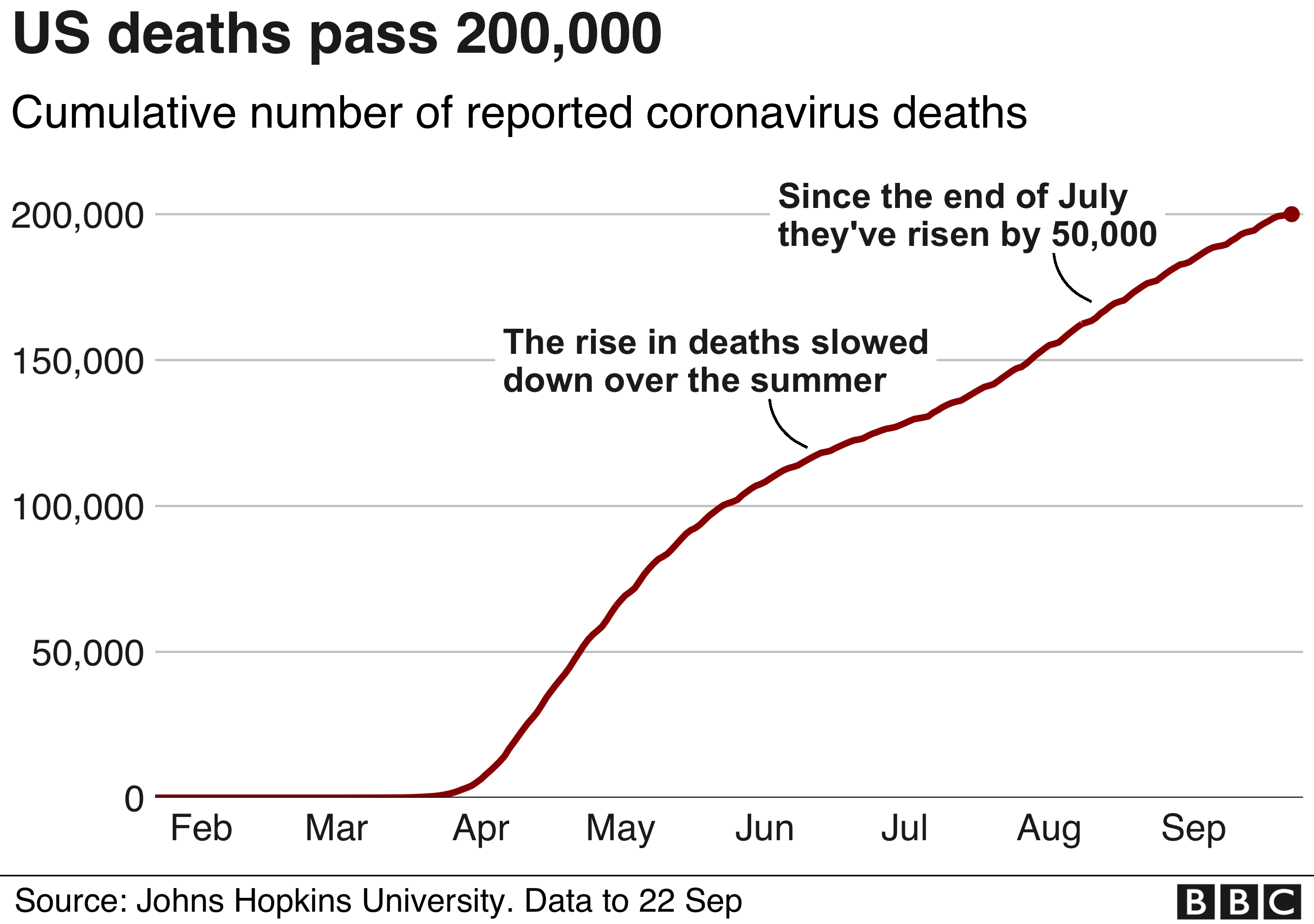
 
graph of cumulative deaths in US
 
The novel coronavirus has infected over 30.98 million people worldwide and of that number 958,453 have perished from its deadly effects. Over 210 countries and territories have reported infections in their populations since December 2019 when the first reports of mysterious respiratory cases were identified in Wuhan, China. In about 20 out of 50 states in the U.S. cases are on an upward trend. Former epicentres of New Jersey and New York where cases have declined for months are now reporting an increase in cases.

Former Food and Drug Administration Commissioner Scott Gottlieb speaks of his concerns over a third wave which might be more diffused and begin to spread in a wider swath across the country. And while he doesn't believe there will be a vaccine available until the end of the second quarter or the third quarter of 2021 for general inoculation, his professional experience clashes with that of the country's president who boasts with confidence that the nation will have a vaccine before year's end, things under control by April 2021, with an effective vaccination in wide use.

In Britain, the British government's chief scientific adviser Patrick Vallance, and Chris Whitty, chief medical officer for England have stated that the number of COVID-19 cases is doubling every seven days. "If, and that's quite a big if, but if that continues unabated ... you would end up with something like 50,000 cases in the middle of October, per day", warned Dr.Vallance. These numbers could result in over 200 deaths daily.
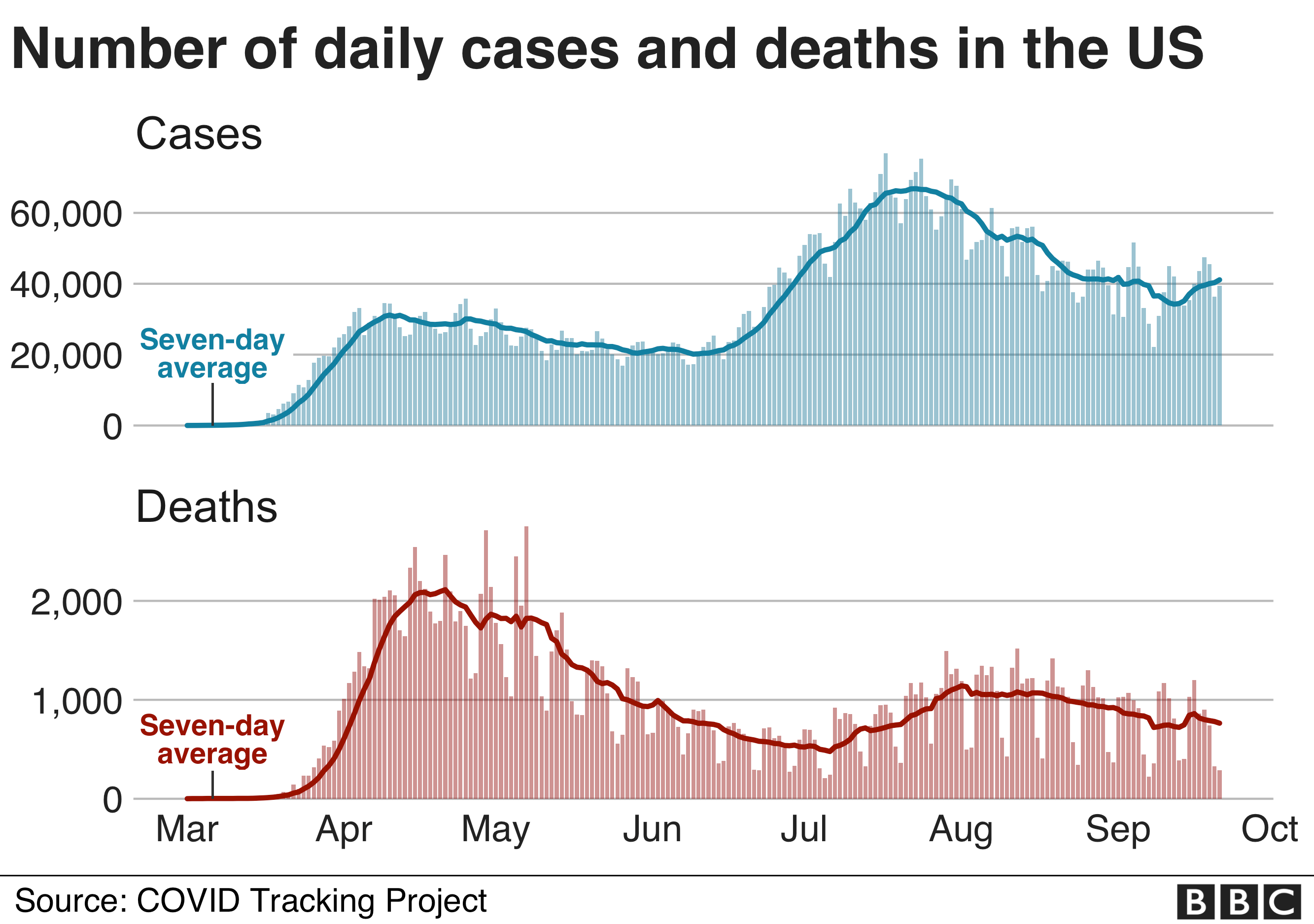
Graph showing number of daily coronavirus cases and deaths in the US

Labels: , , , ,

Saturday, July 11, 2020

Awaiting COVID's Second Wave With Bated Breath

"That [testing fewer symptomatic people] should not be confused with having a less severe disease present in the community."
"[A pandemic reveals society's nature]. It either exacerbates the disparities or it highlights the strengths."
"[Canadians, more than Americans] have embraced this ethic of communal responsibility. For the most part, people are on board with protecting other people, with wearing masks, with doing what's right for the community."
"That's not a message you see coming out of the U.S.A."
"It tells me we have the tools to contain this well."
"As long as the virus exists in the environment], it's going to find purchase and attempt to reassert itself. That's the way these things work."
Dr.Raywat Deonandan, epidemiologist, University of Ottawa

"This infection messes with me."
"Those I expect to do worse do well and those without traditional risk factors get admitted to ICU."
Dr.Jeff Powis, infectious disease physician, Toronto
Experts say lifting lockdown measures without a clear picture of where new cases are coming from, as Ontario and Quebec are doing, is cause for concern. (Evan Mitsui/CBC)

The SARS-CoV-2 virus in Canada is now recognized as being largely under control. That couldn't have been declared only two weeks ago, when doctors were run ragged attempting to save people who were presenting in "advanced respiratory failure", placing them on extra corporeal membrane oxygen machines the most extreme form of life support. "We've seen a dramatic drop off in the number of severe cases in the Toronto region", advised Dr. Niall Ferguson, head, critical care medicine, University Health Network, Toronto.

Still, Canada has lost close to 8,800 people. At present, however, the daily reported case and deaths have markedly diminished as has the numbers of individuals hospitalized. ICU admissions have been on the decline since the epidemic peaked in April. There has been a steep diminishing of transmission rates among the older demographic -- a slower decline in the 20- to 39-year olds, and with a corresponding rise in outbreaks in long-term care homes and among migrant workers.

This, while new infections are seen on a roll across the southern and western United States, where new daily records for deaths keep rising. According to epidemiologists this is a situation that was entirely predictable in the U.S. In Canada, the Deputy Chief Public Health Officer warns that should society slump into a relaxed attitude precipitately, the epidemic "will most likely rebound with explosive growth".
"Just because the fatality rate is incredibly high in people who are in their 80s or 90s does not mean the fatality rate is zero in their 40s, 50s and 60s."
"The overall story I see is that Canada has the resources and expertise to both contain COVID-19 and re-open schools and workplaces a the same time."
"I have a hard time with numbers, everybody has a hard time with numbers. It's hard o get your head around concepts like 0.5 percent of exponential growth at 1.1 -- what do these things mean?"
"Ninety-nine-point-five percent sounds pretty safe. But really, would you take a one-in-200 chance of dying? I wouldn't."
"It's very clear now, four months into the pandemic, that this is a serious illness that has resulted in great loss of life."
"In some ways [smaller incidence of infection among the elderly] that's unsurprising, because many older people know that they are especially vulnerable and so they're taking extra precautions."
Dr.Irfan Dhalla, general internist, vice-president Unity Health, Toronto

"In my opinion, the chance of transmission through inanimate surfaces is very small, and only in instances where an infected person coughs or sneezes on the surface and someone else touches that surface soon after the cough or sneeze [within one or two hours]."
Dr.Emanuel Goldman, professor of microbiology, biochemistry and molecular genetics, Rutgers University
A medical worker performs a mouth swab on a patient to test for Covid-19 coronavirus, in tent extension of the Rigshospitalet Hospital, in Copenhagen, Denmark, Thursday, April 2, 2020. THE CANADIAN PRESS/AP-Niels Christian Vilmann/Ritzau Scanpix via AP

The first wave of the global pandemic has struck and is now receding, as countries once desperately coping with an inrush of cases, seeing their hospital system begin to collapse under the sheer weight, now breathe a sigh of relief as the number of cases wane and ICU attendants catch their breath. On the other hand, expectations are high that another, second wave, is waiting in the wings. And perhaps another after that, and another yet.

The SARS-CoV-2 virus has amply demonstrated its lethal nature; in blood clots, sudden cardiac arrest, multi-organ failure on some affected people, while others have been infected and having exhibited none of the classic symptoms, go on to infect others. How to know, how to react if you don't know? Unknown to medical science is what increases risk of death.

A study of over 17 million people in England published in Nature this week verified that old age, and maleness are all hazards for COVID infection. Blacks and South Asians are two times likelier to suffer death related to COVID than are their white counterparts, and the reasons are as yet unknown. As with all other viral illnesses and conditions that sweep through communities, socio-economic underdogs are 1.8 times more likely to die from COVID than the least deprived.

Those suffering from diabetes, severe asthma, obesity, chronic heart or liver disease, dementia, reduced kidney function and autoimmune diseases like rheumatoid arthritis, lupus or psoriasis are as well linked with higher risk of death. COVID-19 disproportionately affects the vulnerable; those living in racialized groups, in poverty, in multi-generational families who live in cramped housing; those with low-paying essential-service employment.

People over age 60 represent 96 percent of deaths in Canada; age and  underlying health problems identified as risk factors. One drug only has been shown to keep people from dying from COVID; a steroid, called dexametasone that keeps the body's immune response to a foreign system circulating in the body from extreme reactions, with the steroid slashing ventilator-assisted patient deaths by one-third.


More people are surviving admission to ICUs and being placed on respirators. "They [China] were reporting  crazy things, like 90 percent mortality for people on ventilators", stated Dr.Ferguson. "We were able to rescue patients with ECMO when we needed to." No decisions required over which patients to route to ICU and who to leave to cope on their own were required, after all.

A recent paper published in the Canadian Medical Association Journal gave an estimate of less than 50 percent as representing the case rate for COVID-19 resulting in a fatality rate of around 1.6 percent. While the journal Nature reports a growing number of studies from various regions placing the infection fatality rate between 0.5 and one percent; five to ten people for every 1,000 infected, to die. The seasonal flu rate comes out to 0.1 to 0.2, identifying COVID as deadlier  and more infectious.

A favourable finding is that transmission by fomites (contaminated surfaces and objects) do not, after all, appear as serious a threat as first thought. A commentary published in the Lancet a week ago suggests most studies show large amounts of virus in excess of real-life scenarios must be present for infection to occur.

Labels: , , ,

Tuesday, June 23, 2020

Not All Cities Are COVID-Equal

"I think we can safely say that certain drivers, such as a dense way of living, as well as age structure, in particular, the share of the population living in nursing homes, will strongly continue to predict worse [COVID] outcomes."
"What we find is that large metropolis are vulnerable mainly for two reasons. First, they are places with a dense way of life. Second, in large urban areas it is very hard to create a disease-free bubble because there is always inflow and outflow."
"Any epidemiological model of infectious disease will tell you that one of the most important drivers of the spread of the disease is the infection rate. Obviously that infection rate depends on how many other people an infected individual bumps into every day [and] that'll be much larger if I use the metro than if I live on an isolated farm in the countryside."
"Taken together, being connected to many other people makes you vulnerable. Ironically, what is very beneficial in normal times for the economy, makes you vulnerable in these abnormal times."
Klaus Desmet, economist, Southern Methodist University, Texas
According to new research, certain cities become susceptible to the novel coronavirus infection rate much in excess of others as a result of complicating circumstances. In view of expectations of potential second and even third waves in the near future as SARS-CoV-2 reasserts itself, this research may be a critical tool for planning on the part of public health officials. Experts have been busy tracking the inexorable path of the coronavirus in view of the dread toll it has taken in Italy where close to 35,000 people lost their lives from its dread effects.

Germany, on he other hand experienced a quarter of the deaths that hit Italy, while New York City suffered the agony of experiencing the absolute worst global outbreak even as Los Angeles' death toll came out one-sixth the size of New York's. The greater Toronto and Montreal areas in Canada have accounted for over 66,000 of the approximately 100,000 cases in the entire country. According to Dr. Desmet, Canada's largest two cities' plight could be attributable to the very same forces that struck New York City, leaving it with a massive death toll.

coronavirus new york city
A patient is transferred from Elmhurst Hospital in New York, US, on April 25, 2020. Elmhurst Hospital Trauma Center In Queens Borough of New York City Continues Receiving Covid-19 Patients. (John Lamparski/NurPhoto via Getty Images)
A city's density represents a factor of huge proportions in the incidence of COVID transmission, with other factors such as population age, and distance to an international airport; all characteristics that the two economists posit are most likely to define the occurrence of future outbreaks. From their study it seems clear to them that waves of the disease will not necessarily hit all cities in an equal manner; leaving some cities to cope with persistent outbreaks and other will be left in a relatively unscathed state.

Should this hypothesis bear out with future incidences validating the proposed trend, health experts and municipal authorities will be able to aim their resources in those areas identified with the greatest susceptibility, confident that other areas will not become vulnerable in their turn to similar-sized outbreaks. Those areas less affected will have little need to impose stringent lockdowns and can confidently anticipate earlier reopenings without fear of overwhelming their health-care system.

Density levels come most readily to mind when weighing the susceptibility to infection of any city. Verified by a glance at the statistics identifying North America's most population-dense cities with heavy outbreaks of COVID-19. Several features of density were considered in the study; the share of individuals living in multi-unit housing structures, and the number of people representing each household, along with a breakdown of occupancy per square kilometre.

Multi-unit housing and the size of households are both recognized to be positively associated with cases and death levels; a primary feature of any future outbreak. Places with more people using public transit have worse COVID-19 outcomes, and more so in terms of the death rate. There was a clear correlation found in the United States between the distance of a city to the international airport serving it, and an early COVID-19 outbreak.

Higher infection rates were seen to be clustered around Toronto's international airport. Peel Region, home to Pearson International Airport, saw a rate of 328 cases each 100,000 population, representing one of the highest rates in Ontario, second to the city of Toronto itself, with 394 cases per100,000 people. In Calgary, where the airport remained open to international flights, infection rates were much higher than what Edmonton experienced, which has a considerably smaller airport located a further distance from the city, and not open to international travel.

covid-19-airport

Researchers discovered the more people over the age of 75 the more likely for fewer cases to emerge, the reasoning being that younger people are likelier to search out activities that tend to spread the virus, such as large social gatherings and events. In some situations, an older population, however, can lead to greater death numbers, when considering outbreaks at nursing homes where social isolation, an immune-hampered and chronic health-vulnerable population surrenders to a demonically dangerous virus.

And then there is the perennial issue of poverty, its associated poor health outcomes in indigent communities and unequal access to health services with their bearing on mortality rate for all reasons including COVID-19. Outbreaks were identified in Black and Indigenous and Hispanic communities with higher infectious rates. What the conclusion of the study seemed to point out is that many of the activities that make for a well-adjusted social community are those that now place people at an increased risk of diminished health and possibly death.

Covid Ambassadors, Free Face Masks Await Toronto Transit Riders
"This should come as no surprise: as with any other infectious disease, contact between susceptible and infected individuals is a key determinant of the spread of the disease."
"There is a randomness in locations that got the virus early. One important exception is the variable capturing distance to international airports with connections to the top five COVID incidence countries as of March 15."
"Places with a large share of retired individuals may feature fewer places [bars, stadiums] where the disease spreads rapidly."
"This finding [outbreaks at nursing homes with high death rates] is consistent with the idea that once a county is affected by the pandemic, its nursing homes can quickly become powder kegs, and account for larger shares of countrywide deaths."
"Overall, these results confirm concerns that the COVID-19 pandemic has a disparate effect on various racial groups."
Study Report: Economists Klaus Desmet and Romain Wacziarg, University of California, Los Angeles  Study on COVID numbers in large cities: Report

Labels: , , , , , ,

() Follow @rheytah Tweet