Politic?

This is a blog dedicated to a personal interpretation of political news of the day. I attempt to be as knowledgeable as possible before commenting and committing my thoughts to a day's communication.

Tuesday, February 11, 2020

Dangerously Cloistered Religion-Obsessed Minds

"[In order to] prevent future generations from having to suffer what they suffered [Yohanan and Shifra Lowen await a judgement against the Province of Quebec and Boisbriand Hasidic schools]."
"These illegal schools still exist and several hundred students attend them, in full view of government authorities."
"The plaintiffs finished their high school education without knowing about the St. Lawrence River of the theory of evolution."
Court motion

"When he left the community, he [Yohanan Lowen] could not speak French and could not speak English very well."
"They [the former Hasidic couple are not seeking damages but a declaratory judgement; they] don’t want this to be the case for children in Hasidic schools today, even in Montreal."
Lawyer Bruce Johnston
Clara Wasserstein and Yochonon Lowen arrive at the Montreal courthouse Monday. The former Hasidic Jews claim they completed their secondary education without knowing what the St. Lawrence River is or ever hearing about the theory of evolution. Graham Hughes / THE CANADIAN PRESS
Like any other people who leave a cult, finding its strictures and aversion to the greater society around them stifling and incompatible with a larger social contract, diminishing their pride in their ethnic and religious roots as a result of the severity of the constraints, and ultimately finding themselves unable to fit into the larger community in which they live and work; finding above all that the education they received as children ill-prepared them for life anywhere outside the community, a couple in Montreal who decided to leave an Orthodox Hasidic community has launched a court case.

Clearly the education they describe and which had undergone examination by provincial education authorities for its results in adequately preparing children to embark into the world as adults found the curriculum beyond wanting; inadequate and painfully close-minded. The children who graduated alongside the now-adult married couple were barely functional in either English or French, were almost, on graduation, illiterate and innumerate. They knew nothing about their immediate geography, much less world history past and present.

The couple appeared in Quebec Superior Court to seek a judgement against the Province of Quebec, accusing it of failing to ensure they and other Hasidic children taught in private parochial schools entirely in Yiddish, with no secular subjects on the curriculum whatever, were adequately prepared for responsible independence. The schools, moreover, had no license to recognition as educational institutes. The children attending them had no exposure to subjects in history, geography, science or art, much less the official languages of the country.

The couple was unprepared on graduation to integrate into Quebec society, despite being born in the province. Since leaving the Hasidic community in 2010 they have found it a struggle without possessing recognized high school diplomas, and equipped with the utterly lacking education they received at one of the Hasidic community's Boisbriand Hasidic schools in Montreal to qualify for employment anywhere. The kind of parochial school they attended should have been an after-hours addition to attending a regular public school where approved curricula would have formed the basis of their education.

Perhaps a good question to be put to this pair of rightly disaffected people is where lies the responsibility of parents within the Hasidic community who obviously felt their obligations to their children had been met when they received a distinctly sub-par education through this kind of schooling? Only fundamentalist fanatics might consider that as parents they have provided their children with the opportunity through a thorough, basic education to take their place in adult society when they have in fact, failed so spectacularly.

An educational assessment of 320 boys of the community found 280 among them acutely lacking in math and reading and writing in English. A youth protection agency was called in 2014 to assess a girls' school operated by the Hasidic community, discovering the students could speak English and received secular education at a somewhat lower level of difficulty than in comparison to other schools. A subsequent assessment of the boys' school found another situation altogether.

Of the boys, many among them educated in Yiddish only, were unable to speak or understand enough English to take tests without the help of an interpreter; in addition, speaking virtually no French whatever. Many of the boys were products of educational neglect; their knowledge identified as "below the minimum of what's needed to be functional and autonomous in Quebec society".

Once the families entered into an agreement with the school board to regularize education, the situation saw a marked improvement and by 2017 fewer than 100 of the boys were considered educationally "compromised", even while their education level was still below that of other students of their age group. By shielding children of the Lowy Hasidic community from 'contamination' by the social mores and values of the greater society, the community endowed their children with academic ignorance ill-preparing them for life in the modern world of today.
In order to protect the community from what he perceived as the moral decay of the outside community, Rebbe Lowy put together a set of by-laws "to govern the behavior of all the residents" of Kiryas Tosh.[7] To live in this community, residents need to abide by these by-laws.[7]
  1. No book, newspaper, or magazine is permitted in the buildings of the community, unless their content is in conformity to strictly Orthodox Judaism.
  2. All male members of the community must attend religious services, three times per day, at the synagogue.
  3. No radio, television, record, or cassette is allowed in the buildings of the community.
  4. No members of the community may attend the cinema or be present at any theatrical performance under the penalty of immediate expulsion.
  5. All women residing in the community must dress in accordance with the Orthodox laws of modesty, as follows:
  6. All dresses must be at least four inches below the knees, no trousers or panty-hose may be worn by women and girls 3 years of age or older.
  7. Married women's hair must be completely covered in public, by a scarf or by a wig.
  8. It is forbidden for unrelated men and women to walk together in the street.
  9. Men and women must be separated by a wall (at least 7 feet high), when attending any gathering of a social or religious nature.
  10. All food consumed in the buildings of the community must conform to the dietary laws of the Code of Laws and be approved by the chief Rabbi or his second in command.
  11. No car may be driven by an unmarried man.
  12. The members must submit any interpersonal conflict to the arbitration of a rabbinical court.
  13. The Sabbath must be observed in strict conformity to Jewish law.
  14. Male members of the community must study the Torah and other religious texts for at least two hours a day.
Teachers of secular subjects who come into the community must follow guidelines of their own:
  1. All textbooks and literature to be used by the students in class or at home... must first be approved by the principal.
  2. No stencil or photo-copy of any other book may be used without approval.
  3. Students are not permitted to go to the public library nor is the teacher permitted to bring into the school, for the students, any such books.
  4. No newspaper or magazine may be read in school or hung up. Students are not permitted to read the above at home either.
  5. No records or tape may be used in the classroom without approval.
  6. No extra subjects, books, magazine supplement or other information which is not on the required curriculum of the school may be taught.
  7. For extra credit work or for class projects, students should not be told to write away for such material. The teacher should supply them with the material with approval.
  8. No discussion on boyfriends.
  9. No discussions of reproduction.
  10. No discussion about radio, television or movies.
  11. No discussion on religion.
  12. No discussion about Women's Liberation
  13. No homework on Thursdays.

Labels: , , , , ,

Saturday, April 20, 2019

Twisted, Tormented Love

"Life may have been bad, but it made me strong. I fought to become the person that I am. I saw my dad change my mom. They almost changed me, but I realized what was happening."
"...I'm a fighter. I'm strong and I'm shooting through life like a rocket."
Daughter of California couple, Louise and David Turpin

"I cannot describe in words what we went through growing up."
"Sometimes I still have nightmares of things that had happened such as my siblings being chained up or getting beaten."
"That is the past and this is now."
"I love my parents and have forgiven them for a lot of the things they did to us."
Son of Louise and David Turpin

"I'm sorry for everything I've done to hurt my children. I love my children so much."
"They are very smart, amazing individuals. I hope they get all the education they need to make their dreams come true."
"They deserve only the best in life. I don't want any of them to be sad or depressed because of all of this."
"I want them to know that Mom and Dad are going to be OK. ... I really look forward to the day I can see them, hug them and tell them I'm sorry."

Louise Turpin, Sentenced to life in prison
David Turpin, right, and wife, Louise, left, listen to the judge, along with attorney Allison Lowe, during a courtroom hearing, Feb. 22, in Riverside, Calif. Their case was dubbed a 'house of horrors.' (Jae C. Hong/Associated Press)

"You have severed the ability to interact and raise your children that you have created and brought into this world."

"[The lives of the children] have been permanently altered in their ability to learn, grow and thrive." "You have delayed their mental, physical and emotional health. To the extent that they do thrive ... it'll be not because of you both but in spite of you both."
"The only reason that your punishment is less than the maximum time in my opinion is because you accepted responsibility at an early stage in the proceedings to spare your children from having to relive the humiliation and the harm they endured in that house of horrors."

Judge Bernard Schwartz, Riverside California court
There were no fewer than thirteen children in the Turpin household, ranging in age from 29 to a toddler of two years. A family where the father of the children -- living in a middle-class area of Perris, a city around 100 kilometers from Los Angeles -- a 57-year-old engineer for Lockheed Martin and Northrop Grumman, and mother Louise 50, a housewife, strictly controlled their children's lives. Neighbours, though rarely seeing the children, had no reason to suspect anything was amiss, the house seemed well tended and everything appearing normal.

Normal is not knowing your neighbours, not taking note of the strange absence in public of a dozen siblings who were seldom permitted to move outside the house, children controlled to the extent that they were given permission to shower only once yearly, children strictly kept in their rooms other than for meals; and that only one meal a day. There was nothing normal about this family or the lives the children led, not allowed to play as normal children do.

The one thing that was 'normal' in their lives were trips taken by the entire family to Las Vegas or Disneyland. Surely no self-respecting American family could forego a trip to Disneyland...? Abnormal was sleeping through the day and moving about at night for a short period, and this was their life. Until a teenaged daughter escaped through a window. A girl of 17 whose home-schooling failed to imbue her with the simple knowledge of her home address, what month it was.

But she did know that if she punched 9-1-1 into a a cellphone it would connect her to the outside world and there help could be had. Where a police dispatcher listened to her description of a lifetime of horrible and unbelievable abuse at the hands of loving parents. One of her siblings asked that a lighter sentence than the 25 years her parents were given, be considered because in her opinion "they believed everything they did was to protect us".

The oldest daughter completed third grade under her father's home tutelage for which the parents had filed paperwork with the state to ensure that everything was legal and beyond questioning. "We don't really do school. I haven't finished first grade", stated the 17-year-old whose  runaway escapade had resulted in the rescue of the children from their parents' house of horrors. When deputies arrived at the house they found a 22-year-old son shackled to a bed. Taking the place of two sisters just set free.

The Turpin children were underweight, malnourished and grime-covered, since bathing was not permitted but once a year. They lived in a home deep in filth, where the odour of human waste permeated. At their release from their lifelong imprisonment by their loving parents, the children informed their rescuers that they were regularly beaten, caged and shackled -- as punishment for failing to obey their parents.

Of the thirteen children in the care of these two people, only the two-year-old had been spared abuse. Despite which, on their release from the house which had been their prison all their lives, all thirteen were initially hospitalized. Their parents had 14 criminal charges laid against them to which they pleaded guilty. Prosecutors stated the two would in all likelihood be in prison for the remainder of their lives.

"The defendants ruined lives, so I think it's just and fair that the sentence be equivalent to first degree murder", explained district attorney Mike Hestrin.

As for the resilient children, they spoke of their love for their parents even while they described the dread abuse they had suffered.
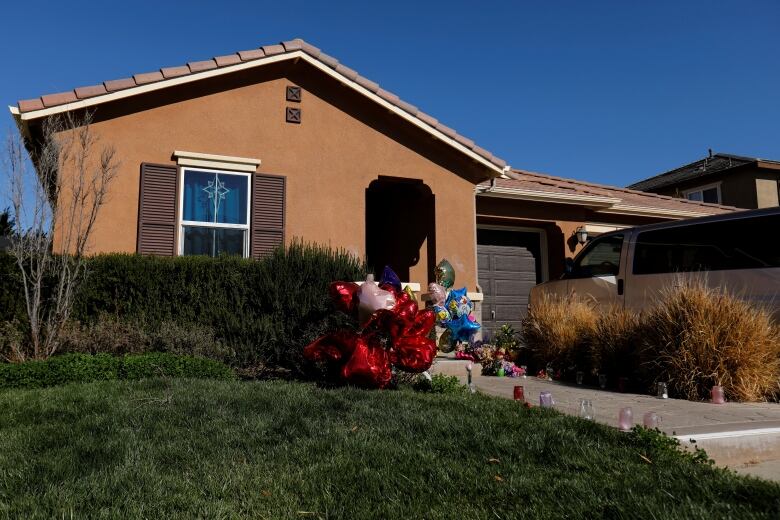
Balloons, stuffed animals and flowers are seen in the front yard of the home of David Allen and Louise Anna Turpin in Perris, California, U.S., January 24, 2018. (Mike Blake/Reuters)

Labels: , , , ,

Friday, July 11, 2014

Generational Dysfunction

How's this for a blueprint for wild dysfunction? Twelve children born to a violently abusing, alcohol- and drug-fuelled home environment. "My father has anger issues. Every little thing angers him. Sometimes he hit us with his fists, sometimes with brooms or mops." The eldest of that dozen children is now 26 years of age. His home is at the Attawapiskat First Nation reserve, located 150 kilometres north of Moosonee, Ontario.

He no longer has any close friends. They have died in accidents and alternately many have died as a result of drug overdoses. The man himself, Bernard Wheesk, smoked his first joint when he was eight years of age, drank alcohol for the first time at 12, and fathered a child at age 13 while in foster care. The young mother died in childbirth, the daughter lived until age seven when she died in an accident.

That litany of misery can happen anywhere to anyone.

It happens all too often to Canadian aboriginals, particularly those living on isolated reserves, where children's needs are neglected and they have little parental guidance, and youth suicides are horribly common.  Mr. Wheesk, now 26, has had a five-year intimate relationship with a woman who lives on the reserve. With her he fathered another four children. The children's mother subsequently broke her emotional ties with the father of those children.
Attawapiskat First Nation
Attawapiskat First Nation/Province of Ontario files

And just incidentally the Bank Council issued a resolution banning the man from the community. Before that, he had been flown with one of his two-month-old twins who was extremely ill, to the Children's Hospital of Eastern Ontario for treatment. The other twin had died before this event took place, and the mother of the children evidently blamed their father for the infant's death.

On arrival with his infant son at the hospital, in the winter of 2011, hospital staff placed the baby in an observation room, and arranged a reclining chair next to the baby's crib for his father. The baby was "frequently fussy, irritable, and at times cried vigorously for hours", according to hospital notes. The infant's father was repeatedly asked to care for his son.

The result was that twice the father squeezed his infant son with sufficient physical force to break the baby's ribs both on his chest and his back. A trial has just concluded, and Bernard Wheesk was sentenced to nine months in jail.  Before sentencing, a Gladue report was ordered, and Mr. Wheesk was interviewed for the process; one expressively within the criminal justice system for First Nation offenders.

"[Wheesk had suffered] physically, emotionally and mentally from a horrific, extremely dysfunctional family background. He had no adequate parenting upon which to model his own behaviour."
"Kevin's [infant son] injuries were serious ... requiring significant force to the child's rib cage. These injuries would cause significant pain."
Justice Jennifer Blishen
For First Nations individuals tried and convicted of crimes, the issue of extenuating (quasi-forgivable) circumstances cited give them a compassionate edge in responsibility for their actions, although in all fairness all human beings choose to act on their free will choices. His was horribly compromised by the treatment he was exposed to as a child.

Outside First Nations reserves these things happen too. Sometimes those who experience such devastatingly miserable upbringing conditions instead of emotional and caring support and guidance, are able to reform themselves and guide themselves somehow to a better position in life. Bernard Wheesk clearly was incapable of doing so.

He had twice assaulted a vulnerable, defenceless, ill child, and had never, evidently, demonstrated remorse for the pain his son experienced. Once released, he will be on probation for a three year period, and barred from seeing his children without Family Service agency approval.

Labels: , , , ,

Monday, December 02, 2013

Dual-Purpose Child Neglect

"Right now, it's getting worse. The cutbacks to group-care facilities is worse. We don't have the foster homes. Our population is expanding but our funding is actually decreasing, so the math isn't adding up."
"It angers me when the government waves its fist in the air and says we have the lowest corporate tax rate in North America, and there's no provincial sales tax. There's an outcome of not having revenue and it's not me, or you, who are the victims. It's this mother, sleeping in a graveyard."
Mark Cherrington, Edmonton youth worker
In Alberta, though aboriginal children represent a mere 9% of the province's children, they account for roughly 75% of those in care. That's a staggeringly disproportionate misalliance of population figures. Aboriginal children's needs are obviously greater than children in the general population outside of the reserves dedicated to 'traditional lifestyles' of Canada's First Nations. One doubts whether traditional lifestyles of aboriginals came replete with child neglect.

Mr. Cherrington was making reference to an incident he was familiar with; a 15-year-old single mother living a life of desperation, taking to sleeping in a graveyard with her baby in a carriage. A province that boasts of its low corporate tax rate encouraging of investment, but discouraging of revenue, hardly counterbalanced by the province's pride in not exacting a provincial sales tax. Easy living for those who are fortune, not so propitious for those who are not, with inadequate funds for social welfare strategies

The government has refused to mount an enquiry over the deaths of 145 children in foster care since 1999, a figure representing three times what was previously known to have occurred. And 78% of those children were aboriginal. Not all the deaths were investigated though many were held to have been from natural causes, but others weren't adequately tracked When some of those deaths were investigated, there was no monitoring procedure in place to track whether recommendations resulting from enquiries were ever implemented.
"There are thousands of successes that happen every day when a child in care is able to go to school after having a good night's sleep and breakfast in the morning. When a child gets to come home to a caregiver who's engaged in their activities and supports them to reach their potential."
Dave Hancock, Alberta Human Services Minister
That statement is true as far as it goes. But obviously more is required. Chronic underfunding of services meant to aid First Nations reserves deal with the problem of unmet children's needs, of children living with substandard care from their families, care so negligent that the children are deprived of their human potential, creating problems with acting out, violence, drug and alcohol use, disinterest in education, acute depression, and extremely high rates of suicide among the young and the vulnerable.

But it is not just the funding that is deemed to be inadequate. Money alone can not and will not solve the ills of dysfunctional families, and corrupt band councils administering revenue on behalf of the reserves. Situation that are depressingly prevalent within First Nations reserves. There are no solutions that seem to come readily to mind, to shock aboriginals out of their welfare dependence that leaves them disinterested in a life that is without individual challenges to advance self-interest through self-motivation.

The dreadful truth is, Canada is itself dysfunctional under the dreadful weight of failure to solve the dilemma of First Nations' dissatisfactions and demands. Treaties that have never been honoured and carried through to completion should be the first order of business for governments and First Nations. The Assembly of First Nations should be prepared to encourage its charges to become responsible and disciplined to succeeding in life and in the process grooming their children with love and support to take their rightful place in their country.

Both governments and First Nations Chiefs seem regrettably attached to continuing the status quo of funding of reserves and encouraging residents to remain there, isolated, unemployed, incompetent, disinterested parents, levelling accusations and counter-accusations, agreements that fail to meet expectations, exasperation and blame levelled at one another.

The AFN should begin through surrendering its love affair with managing tribal reserves and First Nations affairs in the image they wish to preserve, because it hasn't worked, it isn't working and it will not work.

Labels: , , , ,

Tuesday, October 01, 2013

Suffer The Children, in Vain

[She was] "happy, cheerful, eager to socialize with other children."
"She is becoming comfortable with printing her first name independently."
"If someone knows about the curriculum, they would know she's not mastering it."
Kindergarten teacher Odette Revoredo

"Your duty to report was not triggered because you did not have a suspicion?"
Toronto District School Board lawyer Wendy Lopez
Kindergarten teacher Odette Revoredo leaves 900 Bay Street after testifying in the Jeffrey Baldwin case in Toronto, Monday September 30, 2013. Revoredo taught Jeffrey Baldwin's older sister.
Peter J. Thompson/National Post     Kindergarten teacher Odette Revoredo leaves 900 Bay Street after testifying in the Jeffrey Baldwin case in Toronto, Monday September 30, 2013. Revoredo taught Jeffrey Baldwin's older sister. 
 
Jurors on the Ontario coroner's hearing on the death of Jeffrey Baldwin, a five-year-old child who died of progressive health failures due to ongoing starvation playing havoc with his tiny, weightless body, are being treated to some questioning by lawyers like Susan Fraser representing the provincial advocate for children and youth about Jeffrey's older sister, who at six years of age managed to survive the dreadful survival conditions they were exposed to by their maternal grandparents.

Pediatric nutritionist Dr. Stanley Zlotkin had already given testimony that because Jeffrey's older sister was allowed by her grandparents to attend school where children were given snacks, that it was the snacks that had managed to give the little girl a thin edge on survival denied her younger brother. Both children were loathed by grandparents whose criminal record recording child abuse should have been an alert that the court was mistaken in granting them custody of the two children.

And both children were treated to degrading, painful, miserable living conditions, bearing no resemblance whatever to how loving parents, grandparents or guardians might go about raising children, inflicting upon them instead dreadful deprivation and humiliation, ignoring their basic survival needs and failing utterly to socialize the children, treating them as outcasts, which they became within the bosom of a family whose living arrangements included other adults and children.

In the kindergarten class that the little girl attended, an educational assistant recalled the child as a "nice little girl who want to eat many snacks and followed me wherever I go", witness Helen Voikos said. The child, she explained, stank of urine which was the reason that other children avoided her presence. She had, she explained, discussed the matter with the class teacher, Ms. Revoredo, who failed to respond.

And because the kindergarten teacher did nothing to report any possible suspicions of child neglect at best, abuse as a worse-case suspicion, the assistant thought there was nothing else she could or should do. The teacher noticed, she said, how "very interested" the little girl was in food, anxiously gobbling up the snacks presented to her. Other children, she observed, also occasionally asked for seconds and thirds, not only this deprived child.

She was aware of "a distinct odour" emanating from the child which she attributed to "toileting issues", and knew as well that the little girl had missed a troubling number of school days, but felt the child "was away with a reason", and simply dismissed the issue, or even the combination of peculiarly troubling issues as not worth dwelling on. Let alone reporting to school or outside authorities.

Yes, there were some notable issues with "fine motor skills", where the child had to be assisted to hold a pencil. Coroner's counsel Jill Witkin pursued a course of questioning meant to draw out what the teacher knew and how she interpreted what she observed and became aware of. She had studied the teacher's notes on the report relating to the second-degree murder charge in Jeffrey's death and the forcible confinement of the boy and his little sister.

"It makes no mention of her academic and developmental challenges?" she asked the witness. "That's correct", responded the kindergarten teacher. And nor did her notes state anything controversial relating for example, to evidence of a forever-hungry child, reeking of urine, often absent from school. Ms. Revoredo simply stated under questioning that she had no reasonable grounds to suspect abuse or neglect.

And therefore it had never occurred to her that she had a duty and a responsibility as an intelligent human being to have some compassion for a clearly needy child requiring rescue from an intolerable situation that would kill her brother and almost dispatch her from life as well. Because she noticed nothing worth reporting. No grounds within reason to report suspected abuse or neglect.

Labels: , , , , , ,

Monday, September 09, 2013

Yemen: Eight Year-Old Girl Dies on her Wedding Night

Outrage as child bride dies from internal injuries after being married off to a man more than five times her age.

By Ari Soffer -- Arutz Sheva 7
First Publish: 9/9/2013, 9:04 PM

(Illustration) Yemeni girls in a refugee camp
Reuters
 
A girl of eight years old has died after suffering internal injuries on the night of her arranged marriage - to a man more than five times her age.

The young girl, named only as Rawan, died in the tribal region of Hardh in northwestern Yemen, according to the Kuwaiti newspaper Al Watan.

According to Gulf News, she died after suffering a tear to her genitals and due to severe bleeding.
There have been calls to arrest her family and husband, who was reportedly 40 years old, as activists demand an end to the practice of child marriages in the Middle East's poorest country.

Even some of those more sympathetic to prevailing cultural norms in the region voiced their disgust, with one blogger lamenting:

"Her family and her groom could have waited for some time before having this marriage. It was not fair at all and the marriage should not have happened even if some tribes believe that it is a good custom."

The issue of Yemeni child brides has gained growing prominence in recent years, amid international calls to end the practice. In July, the plight of one child bride-to-be made headlines after she recorded her dramatic escape from her family, along with a heartbreaking account of the struggle she and many girls like her regularly face.

According to the United Nations, one in nine girls in developing countries is married, often forcibly, by the age of 15. UN estimates state that if current trends continue, there will be approximately 14.2 million child brides by 2020.

Yemen is one of the worst offenders, where child marriages are seen as completely normal, the result of a combination of poverty, Islamic conservatism and a highly patriarchal society.

Tragically, though perhaps unsurprisingly, Yemen also has one of the highest rates of death at childbirth in the world.

Labels: , , ,

Wednesday, September 04, 2013

Going Forth With Healing and Prayers


"Of the 31 child-death and 25 critical-injury files closed in 2012, we can confirm that 56 percent and 84 percent respectively involved an aboriginal child or youth.
"We suspect that the percentage of deaths involving aboriginal young people may be significantly higher."
Saskatchewan Advocate for Children and Youth

From statistics available through provincial archives and the child-welfare systems, aboriginal children remain disproportionately represented in the child-welfare system. They are taken from their dysfunctional families because of neglect, because of abuse, because of unsupportable conditions in which no child should ever be immersed whose effect is to turn out twisted minds and socially-inversed adolescents who turn to drugs, alcohol and crime. (Accounting for the over-representation of aboriginal adults in Canadian prisons.)

They are, after all, patterned on the lifestyles of those closest to them; their parents, their extended family members, neighbours -- struggling with addictions and with the effects of violence directed toward one another. Aboriginals insist that their children must be placed for foster care within their own communities, so that their children will not lose their ancestral inheritance of custom, lifestyle, language, memory. In the process, many lose their lives.

There is huge sensitivity from those in authority to this issue, and pressures are brought by those involved in social welfare to honour the wishes of First Nations people. So aboriginal children are given to aboriginal communities to foster when their extended families appear incapable of raising the children as children should be raised with tender respect for their formative years, giving them emotional and practical support and encouragement to learn and succeed.

When there are victims and those who victimize them and they are both aboriginal, sympathy must be extended equally to both parties. The victim is a transitory victim of a corrupted soul enacting vengeance on one of their own; the victimizer cannot be held to blame, because his heritage, traditions, culture have been held in insufficient esteem by the invading Europeans who conquered the rightful inhabitants of the country.

Six-year-old Lee Allan Bonneau who lived and died last month on the Kahkewistahaw First Nation Reserve in Saskatchewan was in the care of a foster mother. He was "receiving services from Yorkton Tribal Child and Family Services, along with his family", evidently. The family receiving counselling that might conceivably aid them to grasp the concept that their severe familial and social dysfunctionality represented a sad abnormality in human relations.

And the child given to the care of an experienced aboriginal woman to help raise in normally functional surroundings. The night of August 21 while the little boy was playing alone just outside the band community centre, his foster mother was inside that same community centre, busy, playing bingo. It was established that he was last seen playing with some dogs at around 8:30 p.m. An hour and a half later his whereabouts were unknown.

He was discovered around 10:20 p.m. beaten and battered in a wooded area close by the reserve's community centre. His killer is under twelve years of age, and as such, under-age to be held criminally responsible under Canadian law. He cannot be criminally charged. According to RCMP Staff Sgt. Larry Brost, there is "no other person responsible" for the death of little Lee "than this child", who under the law cannot be publicly named.

And because the murderer of the six-year-old is under the age of twelve "that child is deemed to be in need of protection". The provincial government and the Yorkton agency will be co-engaged to jointly make decisions revolving around the young killer's welfare "to ensure he receives the treatment he requires", and in the process that "the community is safe". No blame, evidently, is to be attributed anywhere special.

"I thought about leaving this reserve because of the parties, the drug dealers, the drunk drivers", wrote Bobbi Alexson, a young man from the reserve. Bobbi Alexson happened to be among those who set out to look for little Lee the night he went missing. He has started a petition for peacekeepers to be present on Kahkewistahaw. He has posted messages on his Facebook page decribing the "terrible home" the reserve represents for children.

He hesitates to leave himself, though he wants to, because of his reluctance to leave his grandmother and children "in an environment that has lost (its) ways. I don't feel safe on my reserve, my home, and I know damn well you don't, either", he wrote on Facebook.

"This tragedy", feel provincial authorities, that has latterly befallen the reserve makes it imperative that a healing process go forward, prayers for example, lots of prayers.

Labels: , , , , ,

Monday, August 05, 2013

‘Vicious’ python kills two sleeping children, aged 5 and 7, after escaping from N.B. pet store

| | Last Updated: 13/08/05
The snake apparently escaped Reptile Ocean, an urban zoo in Campbellton.
Google Streetview   The snake apparently escaped Reptile Ocean, an urban zoo in Campbellton.
Two children are dead in Campbellton, New Brunswick after they were strangled to death by an escaped python while on a sleepover in an apartment over Reptile Ocean, an exotic pet retailer.
Both victims, aged 5 and 7, were reportedly brothers and on a sleepover with the son of Reptile Ocean’s owner, Jean-Claude Savoie.

NA0806_Python_C_RJ[3]

As soon as he heard about the tragedy, Tim Thomas, a former Reptile Ocean employee, said he called Mr. Savoie’s next-door neighbour and “best friend,” Mandy Trecartin, to find out what had happened.
“She told me straight up, it was her two children that died; I didn’t know what to say, I was in shock,” he said, adding that he last saw the two children on Sunday night.

The snake is an African rock python and is between 14 to 16 feet long, according to Mr. Thomas. Native to sub-saharan Africa, the species is non-venomous, but is known to devour whole antelopes in the wild.

Open since 1995, Reptile Ocean used to be a small zoo before it shifted its operations purely to retail and incorporated the property’s upstairs animal enclosures into an apartment for Mr. Savoie.
The snake occupied one enclosure, while the other two were used for crocodiles.

“How he got loose, I don’t know, because ever since Jean-Claude got full custody of his child, every cage had two locks on it, and one of them was a master lock and the keys to that were hung up in the laundry room,” said Mr. Thomas.

“Jean-Claude loved them kids and he would have never, ever put them in danger at all,” he added.
Global News reached Mr. Savoie by phone on Monday. In a five-minute interview posted to the network’s website he explained that the “vicious” snake, which was rarely handled, escaped through a ventilation system and fell through the ceiling of the children’s room.

Still in shock, he said he was baffled how the snake could have made its way through such a narrow pipe and said he discovered the children dead on Monday morning when he woke up to check on them.

“They were sleeping; they didn’t even open their eyes or nothing,” he said.

New Brunswick RCMP reported that they were called to the store’s Pleasant St. address just after 6:30 a.m. on Monday. The snake “is in RCMP possession,” according to a Monday statement by police.

Police did not confirm the names of the two children and said they have not determined whether any charges will be laid in connection with the deaths. ”That’s going to be part of the investigation,” said Cst. Jullie Rogers-Marsh with the New Brunswick RCMP.

The property, which is only one block away from Campbellton city hall, remained roped off as of Monday afternoon, according to neighbours. The bodies of the two boys are scheduled to undergo an autopsy on August 6.

“I can only assume the snake … constricted the one child, the other child I can only assume tried to help that child and got constricted into the whole mess,” said Bry Loyst, curator of Ontario’s Indian River Reptile Zoo, speaking to the National Post on Monday.

As Reptile Ocean’s Facebook page became barraged with criticism on Monday, an unknown page administrator replied that the incident was “a terrible accident without a meaning” and chastised commenters for jumping to conclusions.

“There is nobody to blame. The snake broke out of its enclosure. The enclosure locked. There was no negligence. This is a terrible accident,” reads a post written just after 5 p.m. local time.
By Monday evening, the page was shut down.

Labels: , , , ,

Monday, July 29, 2013

Life Interrupted

Newspapers convey the news. This is what they do. And the news is always replete with stories, small and large, of human tragedy. It is a human tragedy any time a life is lost. There is always a background story of the deceased being special, with very particular, outstanding personality traits that made them so beloved of those who mourn their deaths. Every life is special, every individual has their own very authentic character. And when, as happens all too often, a car load of young people finds death together in a tragedy, that is profoundly sad.

Crews work to pull a semi out of a pond that was involved in a collision with another vehicle near Lloydminster, Sask., on Saturday, July 27 2013. (Jason Franson / THE CANADIAN PRESS)

Six young people are now dead. They were friends. And they were out together on a Friday in July enjoying life. There were three boys and three girls, aged 13 to 17. On Friday afternoon they had gone together to a local gym. Later in the evening they were still together, and one of the boys telephoned his mother to inform her he was experiencing trouble with his car, a Pontiac Sunfire. His mother contacted a local gas station, asking that her son be extended credit for gas. 
 
She would stop by the following day and pay the bill. They had been at a friend's home in Lloydminster, a city close to the Saskatchewan-Alberta border, about 30 kilometres away from Marshall where they were calling from. The parents of one of the boys, 15 years of age, had agreed to an interview, despite their grief at their dreadful loss. 
 
"He was a good boy, never had to worry about him, was really never in any trouble", said the boy's mother tearfully anguished. "I didn't care as long as I knew where he was at." He had what she termed "free reign". He had proven responsible. If he was out drinking at a party he would always call his mother to come and pick him up. 
 
His father identified his fifteen-year-old boy. After unzipping the body bag that held his beloved child, he kissed him repeatedly. "I told him how much his sister and I would miss him. I couldn't leave him. I just wanted to bring him home with me. That was my little man", sobbed the boy's distraught father. But at 15 years of age, he was not a man, little or otherwise; he was a child.
 This is clearly a family that will be left to struggle with their loss for the rest of their lives. Multiply that five more times to include the other families of the other five young people whose lives were claimed in a horrible crash that left their vehicle submerged in a water-bloated ditch. Their families too will think incessantly of the smiles they miss so dreadfully, the infectuous enthusiasms, their children's future that no longer stretched before them.

RCMP received a call around 4:30 a.m. on Saturday. Evidently a semi-trailer rollover had occurred south of Lloydminster. The responders discovered the truck that had been hauling crude oil on its roof in the roadside slough. They manouvred the driver out of the truck, and discovered a teenager in the wreckage. Both were rushed to hospital. It took a little while for police to realize there were others left there, in the watery ditch.

They hadn't seen the Sunfire. It was completely submerged, completely out of sight. Then began the horrendous task of retrieving the bodies of the two other boys, and the three girls. Nor did the boy who had been taken to hospital survive his injuries. Further investigation found no alcohol in the car. The car, it appears, drove straight through a stop sign. And obviously, the driver of the semi-trailer must have desperately attempted to avert hitting the car.

Those niggling, nasty little details: six children age 13 to 17 out for the day together, having a good time presumably. Parents taking it for granted that their fifteen-year-old was perfectly capable of comporting himself well. Not turning a hair that at the age of 15 he was drinking alcohol at parties. They had taught him not to drink and drive. Youngsters 13 to 17 driving in the small morning hours.

Did none of them have parents that expected them to return home at a decent hour? Were none of those parents tearing their hair out with worry that their children were out somewhere long past midnight? Did none of them think that such young people needed discipline, structure and self-responsibility in their lives that would instruct them that they were expected to be home in bed at a certain hour?

The wreckage of a crash Lloydminster, Sask., is shown in this RCMP handout photo. Police say six people were killed after a car and a semi-tanker truck collided on Saturday morning. (RCMP)

Labels: , , ,

Friday, July 05, 2013

The Vulnerability of Children

Failing Children's Needs; Lacking Due Diligence

Family and friends attend a funeral for a two-year-old Milton, Ont., boy who died of heat-related causes after being left inside a car last week. The boy's maternal grandmother has been criminally charged in the death. Family and friends attend a funeral for a two-year-old Milton, Ont., boy who died of heat-related causes after being left inside a car last week. The boy's maternal grandmother has been criminally charged in the death. (Linda Ward/CBC)
"He was a boy who loved to talk about birds in the sky and whales in the water. He was a boy who would always pick a flower for his parents whenever he saw one."
He was a very little boy, not quite two years of age. His name was Maximus Huyskens; 'Max' his diminutive. And the loving phrase above was written by his grieving parents, appearing in an obituary notice.

A traditional Catholic mass was held for his funeral. A small white casket containing his remains before the altar. "We come here to share the sorrow with the parents, Marcus and Tamara. To show our support for them in their deep loss. The death of Maximus seems so senseless, so wasteful and so inconsistent with all we know", Reverend Peter Tuyen Nguyen said in sorrow for the family, during the mass.

This is a life-taking event that will forever diminish the quality of life of everyone related to the Huyskens family. Above all, it will cast an eternity of bleak, yawningly empty sorrow over the lives of the child's parents, his siblings and their extended family.

Children are not meant to die before they reach their second birthday, not in a country like Canada with all the advantages of economic, social and political stability, educational facilities and universal health coverage. But it does happen when accidents occur. Including when children have been  inadvertently placed in harm's way.

There is, according to a spokesperson at the Canada Safety Council, an estimated average of four to six deaths per year in Canada, attributable to children being left alone in a vehicle on hot summer days, where they asphyxiate from heat exhaustion. This is not a societal problem exclusive to Canada; it occurs anywhere the combination of children, cars and weather exist; anywhere in he world.

But it is in Canada where in the last week three children have died from extreme heat conditions, left to their own devices while distracted parents take their attention elsewhere. In Maximus Huyskens' case, it was his 51-year-old grandmother who had momentarily suffered a lapse, evidently forgetting his presence in the driveway of her home, left in a car.

She did not appear at the child's funeral. And the reason is obvious enough. Although her daughter may at some point forgive her forgetful mother, as a grandmother whose distraction led to the death of a grandchild, she will never forgive herself She will remain afflicted throughout her life with the tragic memory of the child whom her lapse in attention failed.

Ironically, the grandmother is deaf. During the funeral ceremony an interpreter translated the service into sign language. She was not present to take advantage of that courtesy. Nothing will ever now suffice to give her satisfaction in life. In her grief she will now also have to face a charge of criminal negligence in the death of her grandson.

Even as the funeral for the little boy took place, a three-year-old girl who had been left in a hot car in Edmonton died in hospital. That child's mother had no idea how her little girl managed to get inside the family SUV, parked in the driveway of their home. The little girl had been playing in front of her home with other children.
No charges will be laid in the death of a three-year-old who was found in a hot SUV
Tsi-Tsi Chitekedza, who died Tuesday in Edmonton

"It's a horrible tragedy obviously for the family. It's very difficult for the first responders ... and it's just another tragic reminder, we don't want to keep saying things over and over again -- but when it's sweltering hot outside, we need to make sure the kids are not anywhere near a vehicle", said Staff Sgt. Scott Jones at a news conference.

A day after Maximus Huyskens had been found, police in Markham, Ontario just outside Toronto converged on a commercial parking lot where they pried up a car window to rescue a two-year-old girl left inside a sweltering car. The child's mother was arrested for child abandonment, the child taken to hospital to ensure she would recover from her ordeal.

And on Wednesday police were called to South Edmonton Common where they found three children left unattended in a vehicle. Three little boys, ages six, three and 23 months were left unattended inside a parked vehicle. Their mother was charged with three counts of wilfully causing a child to be in need of intervention under the province's Child and Youth Family Enhancement Act.

The autopsy conducted in Maximus Huyskens' death confirmed investigators' belief his death was caused by exposure to high-level temperatures over an "extended period of time".

MEDICAL
  • Heatstroke occurs when a person's temperature exceeds 104 degrees F and their thermoregulatory mechanism is  overwhelmed
    -  Symptoms include :  dizziness, disorientation, agitation, confusion, sluggishness, seizure, hot dry skin that is flushed but not sweaty, loss of consciousness, rapid heart beat, hallucinations
  • A core body temperature of 107 degrees F is considered lethal as cells are damaged and internal organs shut down 
  • Children's thermoregulatory systems are not as efficient as an adult's and their body temperatures warm at a rate 3 to 5 times faster than an adult’s.
VEHICLE HEATING DYNAMICS
The atmosphere and the windows of a car are relatively “transparent” to the sun’s shortwave radiation (yellow in figure below) and are warmed little.  However this shortwave energy does heat objects that it strikes.  For example, a dark dashboard or seat can easily reach temperatures in the range of 180 to over 200 degrees F.
These objects (e.g., dashboard, steering wheel, childseat) heat the adjacent air by conduction and convection and also give off longwave radiation (red) which is very efficient at warming the air trapped inside a vehicle.

Labels: , , , ,

Grandmother charged in death of Ontario toddler

Grandmother charged in death of Ontario toddler who was left in sweltering car

Jake Edmiston | 13/07/05 | Last Updated: 13/07/05 3:04 PM ET
The casket of 2-year-old Maximus Huyskens is carried into Holy Rosary Catholic Church in Milton, Ontario, July 3, 2013. The boy died last week after being left in a hot car by his grandmother.
Tyler Anderson/National Post    The casket of 2-year-old Maximus Huyskens is carried into Holy Rosary Catholic Church in Milton, Ontario, July 3, 2013. The boy died last week after being left in a hot car by his grandmother.
Police have arrested the grandmother of a Toronto-area toddler, who died last week after he was left unattended in a parked car.

Halton Regional Police said 23-month-old Maximus Huyskens was in the care of Leslie MacDonald, his maternal grandmother, at the time of his death.

Ms. MacDonald, 51, is charged with criminal negligence causing death and failure to provide the necessities of life.

Funeral home staff in Milton, Ont., said the grandmother was not seen at a funeral for the boy on Wednesday.
thecutekid.com
thecutekid.com    Photo of Maximus Huyskens, the Milton toddler who died of heat exposure after being left in a car while in the care of his grandmother. 
 
At the funeral, Fr. Peter Tuyen Nguyen called the death a “freak accident” — the most “profoundly sad” incident to strike his Holy Rosary Catholic parish in Milton.

Kids and Cars, a non-profit child safety advocate, says an average of 38 children die in the U.S. each year after being left alone in cars. Based on the American statistics, Public Safety officials estimate an average of six deaths in Canada.

Temperatures reached 28 C in Milton last week, with temperatures inside the car rising to 50 C when the boy died.

But a Kids and Cars spokesperson said last week that the organization usually advocates for safety reform, not punishment.

“They live in an agonizing hell for the rest of their lives. It’s something you never forgive yourself for,” said Amber Rollins, who did not have intimate knowledge of the Milton case.

“No jail sentence or conviction is ever going to be more punishment than what they impose on themselves.”

While Det.-Sgt. John Mans said on Wednesday he could understand such a viewpoint, he also said the Halton Police homicide squad must remain “objective.”

The arrest is the second of its kind in the Toronto area in recent weeks.
Last Thursday, York Regional Police rescued a two-year-old girl from a car in a Markham parking lot. The child was taken to hospital as a precaution, and police arrested the mother and charged her with abandonment.

On Thursday, a two-year-old girl died in Toronto after she was left unattended in a bathtub. An Toronto Police investigation into the incident is underway.

In 2003, a Montreal father was charged with manslaughter after forgetting to drop his 23-month-old daughter at daycare and leaving his 23-month-old daughter in a vehicle for eight hours.

According to the Gazette, the manslaughter charge against Dominic Martin was eventually dropped after the Crown decided “there was no malice, no ill will, no intention…”

National Post

Labels: , , ,

() Follow @rheytah Tweet