
Politic?

This is a blog dedicated to a personal interpretation of political news of the day. I attempt to be as knowledgeable as possible before commenting and committing my thoughts to a day's communication.

Friday, August 22, 2014

Palestinian Refugees Forever

"[UNRWA: definition of "refugee"]: A person whose normal residence had been Palestine for a minimum of two years preceding the 1948 conflict and who, as a result, had lost both his home and means of livelihood."
United Nations Relief and Aid Works Agency for Palestine Refugees in the Near East (UNRWA)

"[Once a temporary organization, now a] huge welfare agency, prolonging its beneficiaries' dependence instead of giving them tools to become self-sufficient. The agency's funding of food rations to large numbers of refugees who were perfectly capable of providing for their own sustenance [is lamentable]."
James G. Lindsay, former legal advisor, general counsel for UNRWA
In this 1971 photo from the UNRWA archive, Palestinian refugees pose for a picture in the New Amman refugee camp in Eastern Jordan. (photo credit: AP/G.Nehmeh/UNRWA Photo Archives)
In this 1971 photo from the UNRWA archive, Palestinian refugees pose for a picture in the 
New Amman refugee camp in Eastern Jordan. (photo credit: AP/G.Nehmeh/UNRWA 
Photo Archives)

Founded in 1949 as a organization with a temporary mandate, to alleviate the plight of Palestinian refugees who fled Israel, its goal was inclusive of emergency relief and "the economic integration of the refugees in host countries." UNRWA funded development projects whose purpose was to employ those refugees whom UNRWA planned to "make them self-sufficient to a point where their names could be deleted from the relief rolls."

At that juncture UNWRA even crossed off its lists fraudulent applications, at that time held to be in the tens of thousands, by people making use of false births and duplicate registrations with variations on their names, to game the system and become "refugees" whose plight garnered them protection and support under the umbrella of the UN's refugee-aid system specific to the Middle East Palestinians.

And then reality set in. Arab states had no interest in accepting the Palestinian refugees as permanent registrants and citizens with all the rights inherent in that status, preferring to have the UN look after them as "refugees", a festering sore blamed on the presence of a Jewish State where those "refugees" insisted their own state was meant to be. Out with the development projects, because as it happened, many refugees had no interest in being resettled.

Which was when UNRWA transformed itself from a temporary function to a fairly permanent one.
And it changed its mandate somewhat in the process, opening itself up generously, funded by the West primarily, to treat homeless Palestinians who hadn't fled as refugees equally with those who had. Then the addition of less needy Palestinians who hadn't fled, hadn't lost their homes also received the coveted refugee status.

And that was inclusive of Palestinians who had lived always outside Israel, even if they had lived in the same home they, their fathers and grandfather had lived in. And while they were at it, they cast their refugee net even wider to include needy nomadic Bedouin and Arab villagers living in Palestine using fields for pasturage that became part of Israel, and those who had held jobs in Israel. UNRWA absorbed into the refugee designation some needy non-Palestinians from Lebanon for good measure.

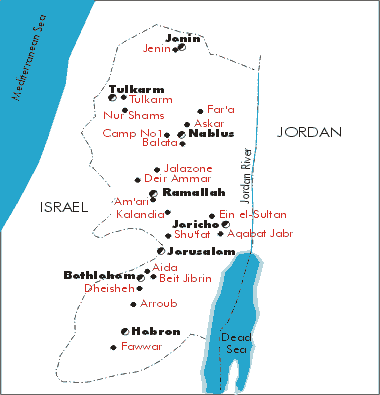
dalje.com   A minaret looms above the controversial Israeli separation barrier that surrounds the Aida Refugee Camp in Bethlehem, West Bank. February 5, 2012.

And then, generosity knowing no bounds, the requirement to be needy was dropped, as was that requiring continuous residence in the Palestinian territories after the 1948 war with Israel. Even a Palestinian who had migrated to Canada, deciding after awhile preferrence to be back in Gaza could resume refugee status and have all entitlements reinstated. The final absorption into refugee status was the inclusion of grandchildren and great grandchildren of refugees.

So UNRWA looked after its longevity by nurturing Palestinian "refugees" from their original official estimated number of 726,000 to the over five million refugees that official UNRWA recognizes to this date. All purportedly eager to return to their Palestinian homeland, where they may assume, UNRWA will continue to perpetuate itself and their endowments into perpetuity.

Should UNRWA, as it happens, write itself out of business its bureaucracy of 30,000, 90% of whom are Palestinians would be out of work. Clearly, that would be disastrous.
Back in 2000 Jean Chretien, then prime minister and his foreign affairs minister John Manley generously offered to resettle Palestinians in Canada. The response by Palestinians was to burn Manley in effigy in the West Bank and the statements of appreciation sounded something like this: "If Canada is serious about resettlement, you could expect military attacks in Ottawa or Montreal", according to the head of a Fatah militia.

"We reject any kind of settlement of refugees in Arab countries, or in Canada", stated the Palestine Liberation Organization. As they go on growing like Topsy; the United Nations Relief and Aid Works Agency for Palestine Refugees in the Near East, and the Palestinian "refugee" population, both.
Data thanks to Lawrence Solomon, StandWithUsCanada

Labels: , , , , ,

Tuesday, May 13, 2014

Quick-Fix Solutions/Wrist-Slaps

"It is difficult to reconcile Canada's well-developed legal framework and general prosperity with the human rights problems faced by indigenous peoples in Canada that have reached crisis proportions in many respects."
"Moreover, the relationship between the federal government and indigenous peoples is strained, perhaps even more so than when the previous special rapporteur visited Canada in 2003, despite certain positive developments that have occurred since then and the shared goal of improving conditions for indigenous peoples."
"There's a lot of misunderstanding on that [the UN's 2007 International Declaration on the Rights of Indigenous Peoples]. Everybody has a right to consent, but there's no instrument that says you have a right to block something unilaterally."
James Anaya, United Nations Special Rapporteur on the Rights of Indigenous Peoples
Mr. Anaya should know, he helped draft the declaration adopted by most UN member-nations. Canada signed on conditionally in 2010 to the spirit of the resolution which states the conviction that governments should obtain the "free, prior and informed consent" of its aboriginals before embarking on major projects which would serve to impact the land that aboriginals live upon, or have possession of, or have treaty interests in.

In theory, it was not a difficult choice to make; however, in introspective reality, Canada balked at signing the resolution initially, knowing full well that what appears on the surface to be a simple declaration of right and justice has an underlying foundation of complex realities capable of complicating and confusing the simple issue. The solution is not necessarily to submit to the directive in all instances.

On a week's visit to Canada's north last year, the UN special rapporteur interviewed some of the principals involved in his search for information, consisting primarily of First Nations leaders whose vested interest in having their share of natural resources realized, and their concerns over harms done to the environment they depend upon, protected; a position that anyone can recognize.

While not aspiring to provide specific recommendations (which was wise), he felt that the Government of Canada must ensure that First Nations' rights -- in areas such as salmon harvesting -- are not negatively affected by initiatives undertaken on a large scale by the federal government. Speaking of Enbridge's Northern Gateway project, supported by some, but not a majority of First Nations in British Columbia due to environmental concerns he demurred.

"In that particular case the government probably shouldn't go forward." His report, he stressed, was not to be viewed as a general insistence for a blanket First Nations veto on all prospective major resource projects undertaken by the government. NGOs and advocacy groups, he declared, took too free an interpretation of the declaration's assertion of governments obtaining support of aboriginals for projects potentially impacting upon them.

The outgoing Special Rapporteur on the Rights of Indigenous Peoples gave recognition to Canada's robust legal foundation dating centuries back that does indeed respect the rights of Aboriginal Peoples. He cited the Supreme Court of Canada's requirement that all levels of government consult with and take steps when possible to accommodate First Nations interests.

While at the same time chiding the federal and provincial governments for their limited record in resolving land claims, reducing poverty, improving education outcomes and tackling the controversial issue of missing and murdered aboriginal women and girls, over the part thirty years, he spoke of the issue from a one-sided perspective. The federal government does pay heed to this disturbing reality, one which has its base in the very violently abusive climate prevalent on reserves.

If an ongoing and generalized climate of belligerent demands and rejections were not a reality in relations between the government and First Nations peoples whose interests they genuinely hope to advance was not a distinct reality, life would be far less complicated and much more satisfactory for everyone concerned. But that climate of challenging and dismissing all initiatives that hope to benefit First Nations is a reality, and life is complicated by that fact.


The education bill, for which which Prime Minister Stephen Harper promised $1.9 billion in federal funds, was never beloved by the chiefs in the first place and is now on hold.
The education bill, for which which Prime Minister Stephen Harper promised $1.9 billion in federal funds, was never beloved by the chiefs in the first place and is now on hold. (Larry MacDougal/Canadian Press) 

Without doubt the UN's report on Mr. Anaya's conclusions gave great comfort for First Nations leaders who have just recently turned their bitter reflex-vitriol once again on both the federal government and their own national leader relating to the new First Nations Education Act, amended to include changes insisted upon by the Assembly of First Nations and then accepted by then-Chief Shawn Atleo, who was forced to step aside by the fury of his detractors.

"The Harper government continues to aggressively pursue a unilateralism legislative agenda that allows unsustainable resource development without meeting the government's legal and constitutional duty of consultation and accommodation on projects that impact our inherent title, rights and treaty rights", claimed Grand Chief Stewart Philip, president of the Union of B.C. Indian chiefs.

The adversarial position so beloved of First Nations leaders holds back any measure of advancement for First Nations within Canada.

Labels: , , , , ,

Saturday, April 12, 2014

Fecund or Infertile: The Choice to Conceive

"Patients ... are absolutely thrilled. [To afford IVF] some people are remortgaging their house, some people are not buying their house, some people are getting their inheritance from their parents early. It's a huge financial burden."
Gloria Poirier, acting head, Infertility Awareness Association of Canada

"It's the smart thing to do, in terms of cost savings and avoiding twins and higher-order multiples. And it's also the right thing to do because these people suffer from an illness ... Infertility is recognized as a disease."
Dr. Art Leader, Ottawa fertility doctor

"Doctors should practise good medicine. You should not be creating multiple births, and you cannot turn around and say to the government 'the only way for me to practise good medicine is for you to fund it.'"
Dr. Francoise Baylis, bioethicist, Dalhousie University, IVF expert
The Ontario Liberal government never did find it difficult to champion a mission it felt might resonate with voters that feel no amount of compassion for those unable to achieve their dreams is enough, including the metering out of huge sums of provincial tax funds for universal health care. So it has announced its intention to fund in-vitro fertilization [IVF] for those unable to conceive on their own.

This is a move, rather unsurprisingly, heralded by IVF specialists who have long lobbied government to follow the lead of Quebec. The decision to expend large sums of money to fund the process is a personal one, presumably well considered by those feeling it to be a sacrifice well worth the production of a child, and as such it should remain their judgement call. To bring the ordinary taxpayer into the equation represents feckless thinking.

Quebec notoriously receives over $6-billion in annual top-ups to its more meagre-than-most provincial tax coffers through GDP, so federal equalization takes from the so-called wealthier provinces and gives to the needy ones. Quebec has always been a needy province. It needs funding from provinces unable to themselves fund such social welfare items as half-fare university tuition, $7-a-day child day-care, and IVF funding, to name a few, to enable it to do so.

Ontario was once considered a wealthy province, enough so that it had no need of additional help from the federal government. It remains a sturdy engine of the Canadian economy but it has been hobbled latterly by the disappearance of factory jobs leading to straitened circumstances. Much exacerbated by a Liberal government that has wasted tax funding in breath-taking grabs of $1-billion a pop, with wastage from initiatives such as eHealth, Ornge, and cancelled gas plants.

And now the inheritor of the McGuinty administration, Premier Kathleen Wynne's administration, has decided that since it is emulating Quebec in grasping for federal hand-outs, it might just as well copy its IVF formula as well. Deb Matthews, Ontario Health Minister speaks of "going to be talking about fertility treatment and IVF and increasing access to them", offending those who insist taxpayers will be on the hook to solve a 'problem' engineered by for-profit fertility groups.

The province estimates it will take $85-million over three years to buy into the in-vitro industry to please those who want to conceive, but cannot. Quebec began funding IVF in 2010 with the proviso that one embryo only be transferred per "cycle", seeing the multiple birth rate drop to 7.9% from 30%. Saving, according to the experts hundreds of millions. Multiples risk birth complications and long-term health problems.

This is, of course, a personal decision, to spend large sums of money for IVF treatments that may or may not work, so people decide on multiple embryos being transplanted to ensure that at least one may take. If the doctors treating them were ethical, they would refuse to implant more than one, but then their business would suffer. Society is left to pick up the pieces in hospital-medical costs when the resulting babies require additional health-remediation treatment.

Dr. Baylis points out sensibly that fertility specialists should not be permitted to hold the medicare system "to ransom", by agreeing in exchange for medicare payment, to hold the line on embryo transplant numbers. The funding of fertility treatment, she points out, should not be seen as a priority given the huge demands on the medical system and the growing costs of administering it, from the cost of drugs, to hospitals and doctors' fees.

Fertility specialists have created a market and one they will be thrilled to expand to meet a growing demand from people taking advantage of the system offering to aid in conception. In Quebec $60-million annually has been spent providing treatment for 8,000 individuals, leading some doctors to question whether single mothers, same-sex couples and those with no medical infertility problems should be regarded as eligible.

Labels: , , , , ,

Tuesday, March 04, 2014

Protesting Exceptionalism

Israel has long had a problem with its ultra-Orthodox community refusing to be a real part of the entire nation of communities. The ultra-Orthodox contribute very little to the well-being and security of the state that protects them. Famously, they refuse to have anything to do with Israel's conscription to military service to ensure that young, fit and healthy Israelis are prepared to defend their country at a time of need. Men and women both must report for three years of military service once they reach the age of 18.

Christian youth watch an Israeli military exercise ahead of joining the Israeli army. Credit: Pierre Klochendler/IPS.

Only the ultra-Orthodox have been excused from duty, along with Israeli Arabs. Other minority groups like Kurds and Druze and Christian communities serve with distinction in the Israeli military as a commitment to their country's well-being. The government is taking steps to remedy this situation, and the response from Israel's ultra-Orthodox Jews has been to counter with a mass rally protesting conscription plans for their young men.

Ultra-Orthodox Jews protest in Jerusalem against any plans to end exemptions from military service.
Ultra-Orthodox Jews protest in Jerusalem against plans to end exemptions from military service. Photograph: Menahem Kahana/AFP/Getty Images
They insist that the new legislation represents a "war on religion" that "we will not join the military", because studying Torah is in and of itself a full-time occupation leaving no time for anything else for pious young men. The older men among them also feel that they are so busy studying they have no time to spare for working, as in earning a living for themselves and their broods. For the ultra-Orthodox do have broods, they bear more children than secular Jews.

It is one of the reasons, apart from keeping the faith alive that they have traditionally been excused from duty. Among the ultra-Orthodox lie the hope of expanding the Jewish population in Israel through natural means, apart from aliyah, the migration from the diaspora of Jews arriving to live in Israel, from other parts of the world. The ultra-Orthodox remain a thorn in the side of civil behaviour, insulting and assaulting those whom they deem are insufficiently pious.

The three major streams of the ultra-Orthodox; Lithuanian, Hasidic and Sephardi are agreed on this one thing; they will not accede to the impending legislation that is meant to alter their legal status. They see nothing amiss in the fact that they do not contribute in the most basic ways to their country's economy and security. Feeling quite entitled to receive massive amounts of social welfare to feed and house their large families.

Feeling that the country should be indebted to them for keeping religious Judaism alive through their zealous focus on study and interpretation of the law and in procreating. Yaakov Biton, a 28-year-old resident of the ultra-Orthodox city of Bnei Brak announced his presence along with his peers from his theological seminary "to show that we are not afraid of the criminal sanctions -- we are united."

Making up ten percent of Israel's eight million population, most of the ultra-Orthodox Haredi community refuse to work, claim their exceptionalism in their faith exempts them from any obligations beyond full-time study in religious institutions. Being a Jew of Orthodox persuasion does not stop other Israelis from serving their country and working to advance its interests.

A man of great religious devotion by the name of Benjamin Netanyahu, his brothers and his sons as well served in the IDF, and sought other means throughout their lives to advance the future of the country and secure the safety of its citizens.

Labels: , , , , ,

Wednesday, December 18, 2013

Financially Salving Irritations

"The chiefs are being heard. The educators are being heard. And that's really important -- that there be an expressed willingness on the part of the federal government to say to First Nations, 'We recognize that your rights are real."
"There is a sense among First Nations that we have to seize this moment. This is not about pressing or pushing this down the road. It is about moving on the clear plan that we have right now."
"So this is where the hard work absolutely begins. We've had governments unilaterally take decisions in the past. That's a pattern that has to be smashed."
"I feel like we're still in a moment of either collision or collaboration when it comes to natural resources. First Nations are not anti-development -- just not supportive of development at any cost."
"We are four percent of the national population, but we are in every corner of this country. We are adjacent to every natural resource, every pipeline that needs to be transported, every set of power lines that needs to be placed down. And there is no need for there to be a fear about sharing of wealth and resources with First Nations. It just must be done in full partnership."
Assembly of First Nations National Chief Shawn Atleo
Shawn Atleo Harper
Prime Minister Stephen Harper, Governor General David Johnston and National Chief Shawn A-in-chut Atleo meet in Ottawa Canada to hammer out a deal regarding Native issues January 24 2012. The Canadian Press / Jake Wright 
 
Right there, in those words that seem to teeter on the brink of political extortion, lies the perceived need to convince First Nations people to remain where they are, isolated and miserable, unemployed and financially dependent, as long as they grimly hold on to what is perceived as traditional lands, through life on aboriginal reserves. This is what respect for one's ancestors amounts to; the practical heritage value of selling to the highest bidder in reverse as it were.

Holding on to that land ownership as sovereign national symbols of Canada's First Nations and their prior claims to the lands settled by a progressive sweep of invading foreign colonialists assures that not only will the country that they are a part of -- but superior and apart from as well, with their own laws and initiatives, values and priorities -- pay them yearly stipends to allow for living with dignity, which is the aboriginal version of welfare, but natural resources must be justly shared.

Because of First Nations' refusals to integrate into the larger society that now is pluralist Canada, they have become, as it were, a law unto themselves. On reserves, signs of greeting that one is entering a sovereign territory, policed by native officers too cowed to bring law and order to their reserve, fearful of facing off against the better-armed 'warrior' contingent that is so fond of challenging the 'right' of the government to control them, set aboriginals quite apart from other Canadians.

First Nations living on reserves have great needs that must be met to ensure they live decently civil lives with all the first-world quality-of-life options available to them, from medical care, housing, welfare payments, education, transportation of food, potable water, with no need for any within the reserve to overly exert themselves, to earn a wage, see to upkeep of their homes, be responsible for the well-being of their children; the unfortunate reality.

Aboriginal Affairs is responsible for the well-being of First Nations who feel it is the responsibility of all Canadians to contribute to their welfare. And the plight of their living conditions in isolated and often primitive areas of the country where basic necessities are difficult to provide, serves as a conscience-prod to the greater Canadian community. Which has tired of the constant bickering between the AFN and government and simply wishes it would all go away.

Money in all transactions between the two is a sticking point. It is always a sticking point. Despite the huge sums of funding made available to the AFN and to reserves for various needs through all layers of government, it is never enough. And why that might be has something to do with the carelessness of administering funds that one never has to earn on their own, just as children have no idea how to conserve what they have and make the most of it. It also is involved with choosing to live in remote, inaccessible areas.

And the other part of the equation is random and ever-present corruption, of entitlements and of quietly claiming funding for personal options meant to be used for fundamental needs. Which is doubtless why on many reserves, members of the reserve who are not part of the governing clique often discreetly bring attention to the grubby acquisitiveness of the chief and council members, in the process robbing the entire population of their due.

"The areas of analysis include the potential misuse of the social-assistance funds to pay personal expenses of the chief and council; and the allegation that band members who are listed as social-assistance recipients never filed an application and never received social-assistance funds", reads one document relating to an audit conducted by Deloitte &Touche through a forensic audit of the Big Island Lake Cree Nation.

That audit came out of a complaint, an anonymous letter received from a band member, handwritten and dispatched in April 2011 relating to the abuse of federal funding. It spoke of band members "taking money from social assistance and other accounts". A second letter to follow the first read thusly: "Vehicles were bought, quads, horses and travel trailers, these were the things the chief David Sandfly bought and still spending on and we have no money for payroll or social assistance."

This type of all-too-common incident does not sit particularly well when it is published in the news. But Aboriginal Affairs and Northern Development has a ready and reasonable response:
"The department takes allegations of misuse of public funds in First Nations communities very seriously and will investigate allegations once they have been sufficiently substantiated. The forensic audit work involving this First Nation is ongoing and, as such, it would be inappropriate to comment further at this time."
"What will be released publicly will depend on privacy considerations. Audit work that reveals criminal activity is handed over to the appropriate policing authorities and is not publicly disclosed."

Labels: , , , , , ,

Monday, December 02, 2013

Dual-Purpose Child Neglect

"Right now, it's getting worse. The cutbacks to group-care facilities is worse. We don't have the foster homes. Our population is expanding but our funding is actually decreasing, so the math isn't adding up."
"It angers me when the government waves its fist in the air and says we have the lowest corporate tax rate in North America, and there's no provincial sales tax. There's an outcome of not having revenue and it's not me, or you, who are the victims. It's this mother, sleeping in a graveyard."
Mark Cherrington, Edmonton youth worker
In Alberta, though aboriginal children represent a mere 9% of the province's children, they account for roughly 75% of those in care. That's a staggeringly disproportionate misalliance of population figures. Aboriginal children's needs are obviously greater than children in the general population outside of the reserves dedicated to 'traditional lifestyles' of Canada's First Nations. One doubts whether traditional lifestyles of aboriginals came replete with child neglect.

Mr. Cherrington was making reference to an incident he was familiar with; a 15-year-old single mother living a life of desperation, taking to sleeping in a graveyard with her baby in a carriage. A province that boasts of its low corporate tax rate encouraging of investment, but discouraging of revenue, hardly counterbalanced by the province's pride in not exacting a provincial sales tax. Easy living for those who are fortune, not so propitious for those who are not, with inadequate funds for social welfare strategies

The government has refused to mount an enquiry over the deaths of 145 children in foster care since 1999, a figure representing three times what was previously known to have occurred. And 78% of those children were aboriginal. Not all the deaths were investigated though many were held to have been from natural causes, but others weren't adequately tracked When some of those deaths were investigated, there was no monitoring procedure in place to track whether recommendations resulting from enquiries were ever implemented.
"There are thousands of successes that happen every day when a child in care is able to go to school after having a good night's sleep and breakfast in the morning. When a child gets to come home to a caregiver who's engaged in their activities and supports them to reach their potential."
Dave Hancock, Alberta Human Services Minister
That statement is true as far as it goes. But obviously more is required. Chronic underfunding of services meant to aid First Nations reserves deal with the problem of unmet children's needs, of children living with substandard care from their families, care so negligent that the children are deprived of their human potential, creating problems with acting out, violence, drug and alcohol use, disinterest in education, acute depression, and extremely high rates of suicide among the young and the vulnerable.

But it is not just the funding that is deemed to be inadequate. Money alone can not and will not solve the ills of dysfunctional families, and corrupt band councils administering revenue on behalf of the reserves. Situation that are depressingly prevalent within First Nations reserves. There are no solutions that seem to come readily to mind, to shock aboriginals out of their welfare dependence that leaves them disinterested in a life that is without individual challenges to advance self-interest through self-motivation.

The dreadful truth is, Canada is itself dysfunctional under the dreadful weight of failure to solve the dilemma of First Nations' dissatisfactions and demands. Treaties that have never been honoured and carried through to completion should be the first order of business for governments and First Nations. The Assembly of First Nations should be prepared to encourage its charges to become responsible and disciplined to succeeding in life and in the process grooming their children with love and support to take their rightful place in their country.

Both governments and First Nations Chiefs seem regrettably attached to continuing the status quo of funding of reserves and encouraging residents to remain there, isolated, unemployed, incompetent, disinterested parents, levelling accusations and counter-accusations, agreements that fail to meet expectations, exasperation and blame levelled at one another.

The AFN should begin through surrendering its love affair with managing tribal reserves and First Nations affairs in the image they wish to preserve, because it hasn't worked, it isn't working and it will not work.

Labels: , , , ,

() Follow @rheytah Tweet