Politic?

This is a blog dedicated to a personal interpretation of political news of the day. I attempt to be as knowledgeable as possible before commenting and committing my thoughts to a day's communication.

Saturday, June 01, 2024

The International Court of Justice Ruling on Israel

"The measure [that Israel comply with 'its obligations under the Genocide Convention'] is a qualified one, which preserves Israel's right to prevent and repel threats and attacks by Hamas, defend itself and its citizens, and free the hostages."
"Why would a State that has the intention to destroy a group provide tents, humanitarian aid and field hospitals? Why would they issue warnings and build humanitarian zones?"
Justice Aharon Barak, Judge on ICJ bench

"Egypt, which shares a border with Gaza and controls part of both the Rafah and Kerem Shalom crossing facilities, plays a key role in facilitating aid delivery through the Rafah crossing. Without Egypt's cooperation, Israel alone cannot 'maintain open the Rafah crossing' which would render the Court's current order, which is directed at Israel but not Egypt, impracticable."
"It is plausible that additional hostages in captivity remain in the area, which is why Israel has declared its intention to locate and return them, dead or alive, to their families. this is a right that the Court cannot deny Israel or the hostages."
"Regrettably, the wording of the Court's directive ... is susceptible to ambiguity and could be misunderstood or misconstrued as ordering an indefinite,  unilateral ceasefire, thereby exemplifying an untenable overreach on the part of the Court."
Dissenting ICJ Judge Julia Sebutinde
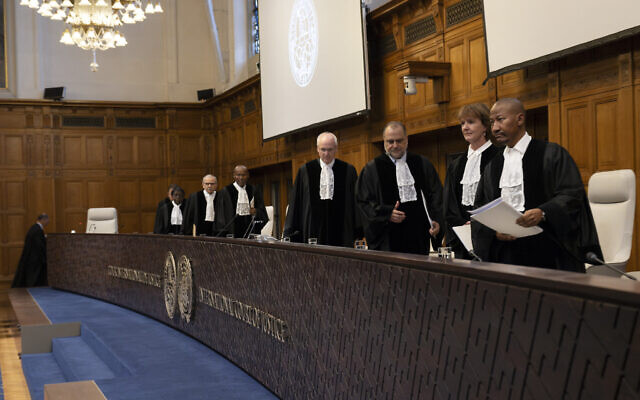
https://static.timesofisrael.com/www/uploads/2024/05/AFP__20240524__34TR37F__v1__HighRes__NetherlandsSafricaIsraelPalestinianConflictIcj-640x400.jpg
Judges arrive at the International Court of Justice (ICJ) to rule on South Africa's request on a Rafah and wider Gaza war ceasefire, in The Hague, on May 24, 2024 (Nick Gammon / AFP)
 
Many from within the international community in analyzing the ruling against Israel in its Gaza intervention have interpreted that ruling by the International Court of Justice as a direct order to the Jewish State to put an immediate stop to its military Rafah operation. The recent airstrike by Israel targeting two Hamas terrorist leaders was complicated by their small precision bombs igniting stored Hamas munitions in a warehouse a short distance from a tent camp to explode and start a massive fire killing scores of Palestinians as well as the two targets. 

Prompting Joseph Borrell, head of the European Union foreign ministers group to state: "Unhappily, what we have seen in the immediate hours, is that Israel continues the military action that it has been asked to stop". He is, however, wrong in his interpretation, a shocking misalignment of reality for someone in the position that he holds, but readily understood in the aura of the present time when Israel's 'allies' against a sadistically savage terrorist group hold Israel to a standard they would themselves never aspire to.

Analyzed and correctly interpreted the International Court of Justice ruling is conditional, ambiguously so. Among the judges on the ICJ deliberative bench was a former president of the Israeli Supreme Court, Judge Aharon Barak whose insights disrupted the South African case brought against Israel. Judge Barak's introduction of clarity and reality steered the deliberative conclusion of the ICJ's directive despite concerns over the conflict-fallout welfare of ordinary Palestinians. 

"There are no more words to describe the horrors in Gaza. Almost daily we are confronted with gut-wrenching accounts of victims and survivors and images of unimaginable suffering", was the plaint of South African Judge Dire Tladi. One is constrained to wonder whether this same anguished judge waxed so eloquently despairingly over the many abhorrent videos displayed with pride of accomplishment by Hamas operatives documenting for posterity the sadism they brought to raping, torturing and slaughtering Israeli children, women, the elderly and infirm, and those they took as  sex-torment hostages.
"[The majority decision “requires Israel to halt its military offensive in the Rafah Governorate only in so far as is necessary to comply with Israel’s obligations under the Genocide Convention."
"Israel is not prevented from carrying out its military operation in the Rafah Governorate as long as it fulfills its obligations under the Genocide Convention."
"As a result, the measure is a qualified one, which preserves Israel’s right to prevent and repel threats and attacks by Hamas, defend itself and its citizens, and free the hostages."
Israeli Justice Aharon Barak
In reminding Israel, in its ruling of its obligation to comply with the Geneva Convention, the panel failed to acknowledge that Israel is, in point of fact, complying completely with the Geneva Convention which holds that a state is completely within its international rights of self-defense in militarily seeking to destroy any other entity or country that has demonstrated amply its intention of destroying the country it has unilaterally attacked.

The court focused on 'plausible intent' under the Genocide Convention; an issue that Justice Barak addressed, pointing out that "no show of intent whatsoever" existed on Israel's part; the opposite in fact was demonstrated with Israel's military using every means at their disposal to minimize their attacks against Hamas terrorists resulting in 'collateral' damage. The International Court of Justice was concerned by the need for emergency aid reaching Gaza's civilian population. 

"As a result of these [previously court-ordered] increased efforts, thousands of food trucks have entered Gaza; multiple large bakeries have reopened; greater amounts of animal fodder have been able to enter the Strip; water pipelines have been repaired and water pumps supplied with fuel; millions of litres of fuel have been able to enter Gaza; and clothing, hygiene and sanitation supplies have been supplied to Gazan civilians", assured ICJ dissenting Judge Sebutinde.
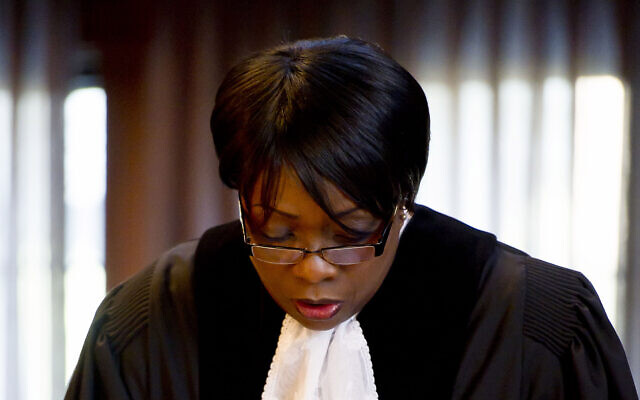
 
https://static.timesofisrael.com/www/uploads/2024/01/20120312_ceremony-02-1610-640x400.jpg
Ugandan Judge Julia Sebutinde makes her solemn declaration as a new member of the ICJ in the Great Hall of Justice of the Peace Palace in The Hague, March 12, 2012. (ICJ)

The ICJ in its ruling ordered Israel to "maintain open the Rafah crossing" for the entry of humanitarian aid, ignoring the reality that the crossing is controlled by both Israel and Egypt. A gross oversight on the part of the international court spurred to action and to condemn Israel was the inescapable omission of any mention of the threat that Hamas poses; much less any attention given to the plight of the Israeli hostages. Judge Sebutinde correctly noted the ICJ's bias against Israel.
 
https://static.timesofisrael.com/www/uploads/2024/01/20240111-192-5-3-640x400.jpg
Retired Supreme Court President Aharon Barak sworn in as Israel’s appointee to the bench at the International Court of Justice in The Hague, January 11, 2024 (ICJ)
"I am not oblivious to the increasing suffering in Gaza. The key to ending this war lies in the hands of Hamas."
"Hamas has started the war and can finish it by releasing the hostages and by fully respecting the security of the State of Israel and its citizens."
Israeli Judge Aharon Barak

Labels: , , , ,

Monday, January 29, 2024

Living In An Orwellian World

"[The fact that the court was willing to discuss the genocide charges was a] mark of shame that will not be erased for generations."
"We will continue to do what is necessary to defend our country and defend our people."
Israeli Prime Minister Benjamin Netanyahu
https://www.washingtonpost.com/wp-apps/imrs.php?src=https://arc-anglerfish-washpost-prod-washpost.s3.amazonaws.com/public/L4PXYZ4HF7BAFSFV4W4GLQ3GZM_size-normalized.jpg&w=916
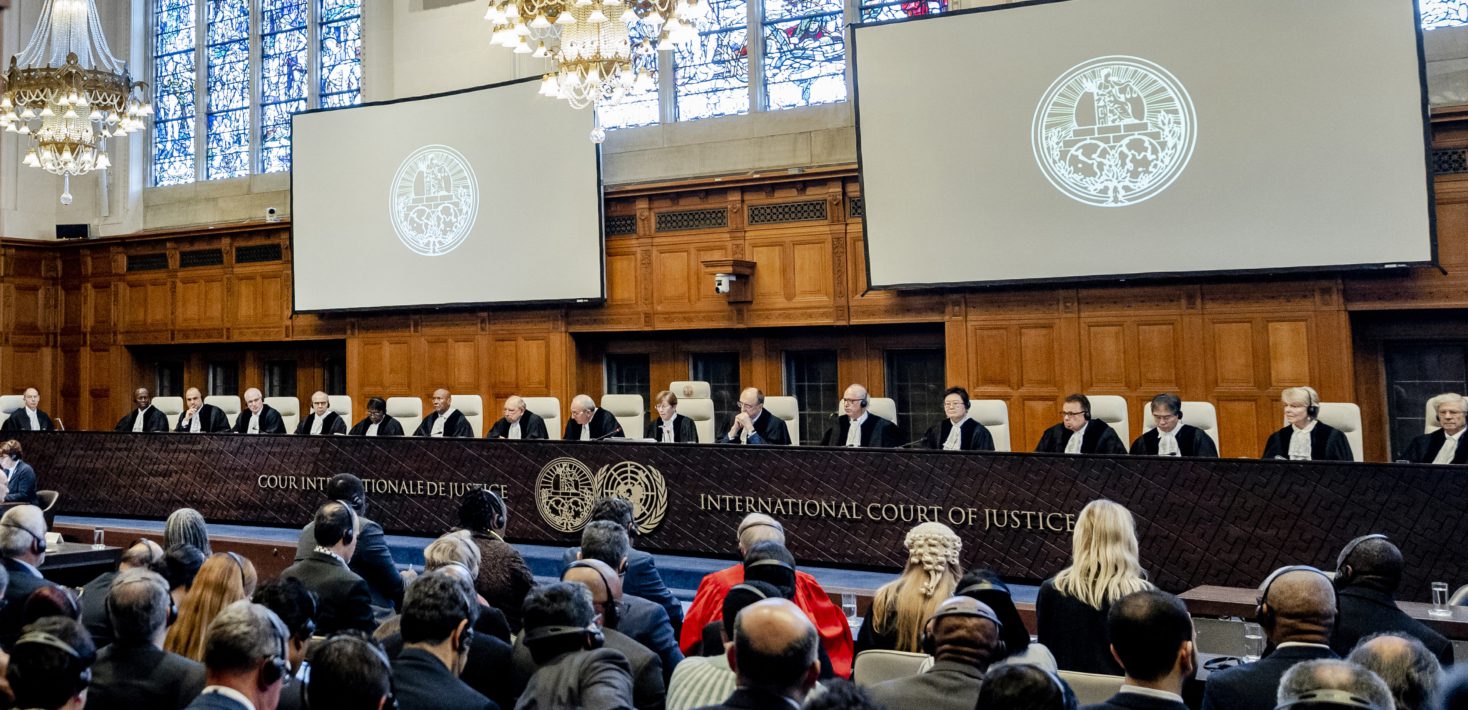
Judges of the International Court of Justice are seen while ruling on a request by South Africa on behalf of Gaza on Friday. (Remko de Waal/EPA-EFE/Shutterstock)

The Convention on the Prevention and Punishment of the Crime of Genocide established in 1948 represented a determination to ensure that the crimes of the Holocaust would never be repeated. The crime of genocide requires proof of intentional destruction "in whole or in part, a national, ethnical, racial or religious group". When the Third Reich destroyed the lives of six million Jews in a deliberate, state-planned eradication of Europe's Jews, it was the very quintessence of genocide. The intent was there, the outcome spoke for itself. 

Israel saw its founding that same year of 1948. It exists today as a bulwark against another Holocaust. Finally, Jews had a reborn national territory of their own established on a small portion of their original ancestral land. And that nation developed a military for the obvious purpose of defending itself and Jews from another attempt at genocide. The International Court of Justice delivered its provisional response to South Africa's claim of genocide perpetrated by Israel on Gaza, on the very memorial date of the Holocaust.

Could anything be more spectacularly grim and ironic? Israel, by the metric of the court consenting to hear the case and adjudicate it well into years ahead before reaching a final decision even while failing to order Israel to retreat from Gaza, has been held in suspicion of genocide, marking it as the fifth country to face the charge of genocide in the ICJ. As in the United Nations itself, it is always the human-rights-abusing nations that hold Israel to account for violations of human rights. 
 
Israel's violation can be seen in the fact of its existence, in the indisputable fact that it exists only because it defends itself.

Sudan committed an intended genocide in Darfur. And when its president and the head of the Sudanese military were condemned by the ICC as war criminals the Organization of Islamic Cooperation and the Arab League paid no mind. Syria's Bashir al-Assad has been accused by the United Nations itself of having killed 300,000 of its own citizens. Today he is in good standing in the Arab League. Iran threatens genocide against Israel, has done so openly, former President Ahmadinejad openly declared at the UN General Assembly Iran's intention to destroy Israel.

Open displays of of rampant antisemitism and the celebration of the Hamas terrorist bloody rampage through southern Israel on October 7 have taken place in huge rallies throughout the Western world. A world that stands by and merely observes 'pro-Palestinian' calls in gatherings on city streets calling for another intifada, calling for a Palestine 'from the river to the sea', calling for 'gas the Jews'. These are akin to the rallies and the vicious propaganda that presaged the Holocaust.

How can any rational mind support a charge of genocide against Palestinians by Israel, when the populations of both Gaza and the West Bank have risen steadily at a rate not seen elsewhere in the world? Of a people considered by the United Nations to be refugees. Whose leaders gather huge sums of funding from the international community free to plunder and amass personal wealth. And for Hamas to build a network of offensive tunnels while amassing a huge cache of weaponry. 
 
The target is Israel. The intent is there, the attacks are deadly. 

In Israel, 20% of the population is comprised of Palestinians. They have citizenship, a quality of life denied Palestinians in the West Bank and Gaza, while their leaders accumulate personal riches and deny proper administration of the territories that would allow the Palestinian people to prosper, have proper employment and live satisfying lives instead of being fed non-stop malicious lies about a neighbour hoping at some time to be able to relax its military vigilance.

https://cdn.vox-cdn.com/thumbor/_3HCvWopPBNu_qqXzZ73hhmYrzM=/0x0:6000x4000/1220x813/filters:focal(2520x1520:3480x2480):format(webp)/cdn.vox-cdn.com/uploads/chorus_image/image/73087714/1955382983.0.jpg
Pro-Palestinian demonstrators gather outside the International Court of Justice in the Hague, the Netherlands, on January 26, 2024.
Nikos Oikonomou/Anadolu via Getty Images

Labels: , , , , ,

Sunday, January 28, 2024

Failing to Validate South Africa

"In my respectful dissenting opinion the dispute between the State of Israel and the people of Palestine is essentially and historically a political one, calling for a diplomatic or negotiated settlement."
"It is not a legal dispute susceptible of judicial settlement by the Court."
"This case is complicated by the fact that in the context of an ongoing war with Hamas, which is not a party to these proceedings, it would be unrealistic to put limitations upon one of the belligerent parties but not the other."
Judge Julia Sebutinde, Ugandan ICJ court member
Julia Sebutinde
Judge Julia Sebutinde

"[Israel must also take] immediate and effective measures to enable the provision of urgently needed basic services and humanitarian assistance to address the adverse conditions of life faced by Palestinians in the Gaza Strip."
"The Court is acutely aware of the extent of the human tragedy that is unfolding in the region and is deeply concerned about the continuing loss of life and human suffering."
International Court of Justice
After due consideration and hearing of legal arguments from all perspectives the ICJ did not call for a ceasefire in Gaza and for the IDF to withdraw. The Ugandan judge sitting on the International Court of Justice, along with 16 others, was the only judge to have voted negatively on all of the six provisional measures set out by the IJC. Even the Israeli justice on the court voted positively for several of the rulings. Justice Sebutinde felt none of the rulings represented total fairness and voted accordingly. 
 
She has become a heroine to Israelis, an outcast to the government of Uganda and a much detested personage to Hamas and its South African supporters.
 
Uganda is a country that produced two quite notable individuals, whose ethics, morals and perspectives couldn't be more distant from each other; while both distinguished themselves as Ugandans, one, Idi Amin its former President, did so by disrepute, not only hosting Palestinian plane hijackers at Entebbe airport in a collusion against Israel where a daring raid rescued the Jewish passengers and led to the death of the raid leader, Benjamin Netanyahu's brother, but he also expelled Asian/Indian minorities of long-standing residence in the country.
 
A country that was also capable of producing a keen and highly respected legal mind who gained a different kind of notoriety when she defied her own country on a previous occasion. Her actions at the IJC had a response from Uganda’s ambassador and permanent representative to the United Nations, Adonia Ayebare, who issued a statement to the effect that:
"Justice Sebutinde’s ruling at the International Court of Justice does not represent the Government of Uganda’s position on the situation in Palestine."
"She has previously voted against Uganda’s case on DRC [Democratic Republic of the Congo]. " "Uganda’s support for the plight of the Palestinian people has been expressed through Uganda‘s voting pattern at the United Nations." 
While Israel's actions in Gaza in response to Hamas's savage assaults against southern Israel where over a thousand people were murdered, hundreds taken hostage, an untold number of women raped, mutilated and murdered, children killed along with the elderly and entire families scorched to death when their homes were torched, over ten percent of the 3000 young Israeli music lovers at the Nova Music Festival were killed by fanatical psychopaths, the actions of the Hamas terrorists were never taken into account by the Court. 

South Africa's charge to the Court of Israeli genocide deliberately side-stepped the genocidal intent of the rulers of Gaza. To ascribe intent of genocide to Israel, on the very eve of Holocaust Remembrance represents the apex of moral failure. October 7, its outcome and its aftermath represented a repeat of a loathing for a people so reprehensible that it led to genocide; to ascribe that intent to the inheritors of the Holocaust must be accounted a crime unto itself.

The single issue that gave credit to the Court was its statement that it was "gravely concerned about the fate of the hostages" abducted by Hamas, calling for "their immediate and unconditional release". Creditable, but barely; treated as an aside to the main issue of holding Israel suspect of genocide.
Any focus on a two-state solution where there is but one side of the issue prepared for dialogue and to reach a useful solution acceptable to two parties in the absence of the second, is a fallacy.

ICJ President Joan Donoghue (C) speaks at the International Court of Justice (ICJ) prior to the verdict announcement in the genocide case against Israel, brought by South Africa, in The Hague on January 26, 2024. The UN top court on January 26, 2024 ordered Israel to allow humanitarian access in Gaza, handing down a landmark decision in a case that has drawn global attention. Israel must take "immediate and effective measures to enable the provision of urgently needed basic services and humanitarian assistance to address the adverse conditions of life faced by Palestinians," ruled the court in its highly anticipated verdict.
Getty Images
"It was brought to the attention of the Court that South Africa, and in particular certain organs of government, have enjoyed and continue to enjoy a cordial relationship with the leadership of Hamas. If that is the case, then one would encourage South Africa as a party to these proceedings and to the Genocide Convention, to use whatever influence they might wield, to try and persuade Hamas to immediately and unconditionally release the remaining hostages, as a goodwill gesture."
"I have no doubt that such a gesture of goodwill would go a very long way in defusing the current conflict in Gaza."
"Unfortunately, the failure, reluctance or inability of states to resolve political controversies such as this one through effective diplomacy or negotiations may sometimes lead them to resort to a pretextual invocation of treaties like the Genocide Convention, in a desperate bid to force a case into the context of such a treaty, in order to foster its judicial settlement."
"It is clear that a permanent solution to the Israeli-Palestinian conflict can only result from good-faith negotiations between Israeli and Palestinian representatives working toward the achievement of a just and sustainable two-state solution. A solution cannot be imposed from outside, much less through judicial settlement."
Judge Julia Sebutinde

Labels: , , ,

() Follow @rheytah Tweet