Politic?

This is a blog dedicated to a personal interpretation of political news of the day. I attempt to be as knowledgeable as possible before commenting and committing my thoughts to a day's communication.

Saturday, June 17, 2023

An Epic Odyssey

Cantor Moshe Kraus
"I sang it, and unbelievable, he [Commandant Josef Kramer, the Beast of Belsen] cried. I couldn’t believe it, he can cry."
"That murderer, that nothing–I don’t have the words—‘murderer’ is a compliment for him. For him, killing a person was like killing a fly."
"If he was going for a walk and saw a Jew, he would shoot him. He would go to see if the bullet hit right in the middle [of the forehead]. And if it wasn’t in the middle, he said a very nasty word."
"When they hanged him, I cried. He saved my life. And I can’t forgive [myself] till today why I cried."
Moshe Kraus, Holocaust survivor, Cantor
The first of nine children born in Uzhhorord, then a border town in Czechoslovakia, now part of Ukraine, his parents were Hasidic Jews. When he was all of eight years old, one Saturday Moshe raised his voice to sing Shabbat songs with the men in his village. "My amazing alto singing voice had been discovered", he remarked of the silence that followed his singing, he wrote in his autobiography, The Life of Moshele Der Zinger: How Singing Saved My Life.
 
The Jews of eastern Europe soon became aware of a "wunderkind" among them as he began travelling widely to sing on Shabbat and to give concerts. At age 18 he was hired as the chief cantor of Sighet, a Hungarian town with five synagogues. In his choir another young man sang with whom he would become lifelong friends; Peace activist and novelist, Holocaust survivor and Nobel Peace Prize winner Elie Wiesel. At 19 Cantor Kraus was appointed chief cantor of Budapest.
 
Moshe Kraus had received professional training at the Vienna Conservatory where he happened to be on November 1938 during Kristallnacht, the pogrom that launched Nazi Germany's agenda of murderous Jewish persecution that would ultimately result in the genocidal annihilation of six million of Europe's Jewish population. He witnessed Vienna's main synagogue in flames. 
 
At the start of the Second World War, Jews were deported even as rumours began circulating that Jews were being slaughtered by the Nazis. He was deported in 1943 for slave labour in a Serbian copper mine, the Bor Labour camp. He spent nine months of labour there before he was sent to a coal-mining camp in southwestern Poland, Katowice. He was next shipped to Bergen-Belsen in northern Germany.
 
In Bergen-Belsen he became prisoner A855. There, at age 21, already experienced widely throughout Europe as a highly regarded cantor, he sang to his fellow prisoners to try to raise their spirits, to produce a diversion from the misery that life had become -- however briefly a relief from the reality of starvation, disease and death. His repertoire turned to popular Jewish songs of the day. "I began to go from barrack to barrack, singing, singing, singing", he explained. 
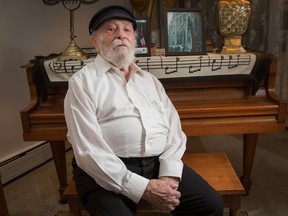
 
Moshe Kraus cantor
A 2017 file photo of Moshe Kraus, a well-known cantor in the Jewish community in Ottawa. Photo by Wayne Cuddington /Postmedia
 
He spoke six languages, among them German. When his performances reached the ears of the camp commandant, SS Capt. Josef Kramer, he was brought before the man who demanded to know whether he could sing in German. Responding that he was familiar with the songs of a popular Austro-Hungarian tenor, Cantor Kraus sang two of Joseph Schmidt's songs. "Would you believe it? This murderer -- he could kill a man like nothing -- he cried!"

He was henceforth to return on Sundays to sing, and in exchange Cantor Kraus was rewarded with scraps of food, a situation that he credited with saving his life, allowing him to survive the deadly Bergen-Belsen. Even so, conditions at the camp by early 1945 rapidly deteriorated as prisoners from other camps were moved west to Bergen-Belsen. Little food was available and soon typhus, dysentery and tuberculosis spread.

By the time British forces liberated Bergen-Belson on April 15, 1945, Cantor Kraus weighed 77 pounds. He remembers a British soldier picking him up, shouting, "Victory! Victory!" And then he woke up in a hospital. Following his recovery he went to work for a Jewish relief organization, returned to Bucharest to search for his family where he found that his father, mother and five of his siblings had perished. He moved to British-mandate Palestine, joined the Israeli army, and learned to assemble and disassemble tanks.

He also was invited to become the Israel Defense Forces first chief cantor for the next four years. From there he sang at major synagogues in Antwerp, Johannesburg, Mexico City and Ottawa. In his travels he gave concerts in places from Glasgow to Istanbul, Miami to Leningrad. An extraordinary man who lived an extraordinary life in extraordinary times. 
 
His life ended on May 29, at age 100, when he died in Ottawa where he was cantor at the city's oldest synagogue, Congregation Beth Shalom, and where he and his wife Rivka had lived since 1975.
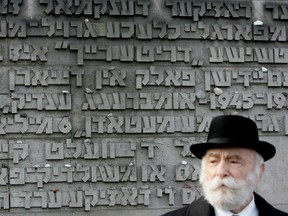
Moshe Kraus Bergen-Belsen
Moshe Kraus, a survivor of the Bergen-Belsen concentration camp during the Second World War, stands outside the Bergen-Belsen Memorial before it was officially opened in October 2007. Photo by NIGEL TREBLIN /AFP/Getty Images
 

Labels: , ,

Thursday, March 29, 2018

Delivering His Own Destiny

"[My grandfather’s] total destruction was complete. He lost his name, his home, his wealth, his status, everything he had and he barely, barely, by unique feat of almost unbelievable fortune, planning and ability, managed to save probably amongst a handful of patriarchs, 14 members of his direct family – children, grandchildren, including me – away from the Holocaust and brought us as nameless refugees living off charity in Switzerland."
"We were taken to a gym [at the Engineering Department, University of Toronto]. And in the gym were trestles, wooden tables set with all kinds of milk, chocolate milk, regular milk, ice cream, hot dogs, hamburgers, doughnuts. … [Back home] hunger was tangible. … The whole thing became a totally unreal, surreal experience."
"I arrived in this place [Canada] not speaking the language, not knowing a dog. This is a country that does not ask about your origins; it only concerns itself with your destiny."
Peter Munk, Canadian extraordinaire, 1927 - 2018
Peter Munk speaks in Toronto in this 1994 file photo.
Roger Hallett/The Globe and Mail
Born in 1927 in Budapest, Peter Munk was destined to make his debut on the world stage many years later. He was privileged at birth, born into a wealthy Jewish family. Like all European Jews, including those in Hungary, their lives and their fortunes became forfeit when Nazi Germany invaded and occupied one country after another, setting up the institutional machinery whereby Jews would be rounded up and transported (with the assistance of local police) en masse to slave camps, concentration camps, death camps.

When the German military occupied Hungary in June of 1944 the Munk family was, along with all other Jews shoved into the confines of boxcars, trains heading for Germany, accompanied by Nazi SS guards to ensure none of the 1,500 Jews in that transport including the Munks managed an escape. The Munk family train was marooned eventually in Bergen-Belsen for weeks. But where most trains that entered the camp carried Jews who would be summarily exterminated in its gas chambers, this train sat there, waiting.

Awaiting the results of negotiations to determine whether and who among them might be allowed to escape death. Finally, families on board that transport were spared death, for vast ransoms had been paid to Nazi Germany through the auspices of the U.S. Jewish community. The Munk family itself surrendered gold, bank notes and jewellery to convince the German authorities to allow them to save themselves. And in August, 1944 the entire family arrived safely Switzerland.

And there, sixteen-year-old Peter Munk went on a tangent of boyish recreation; "I went on long skiing holidays with friends up in the mountains", he told a biographer. "I made enough money of my own to pay for tea dances and entertain all the dates I wanted". Until his father told him "This can't go on. You're going to dances instead of promoting your career". His mother who had been divorced from his father before the Hungarian occupation and was not with the family had been sent to Auschwitz. She survived her ordeal.

And convinced her son from Budapest, where she had returned after the war, to go to Canada where an uncle lived. And so in 1948 he sailed from Liverpool to Halifax and went on to Toronto where he attended high school, learned to become proficient in English and finally won acceptance to engineering at the University of Toronto. His uncle gave him tuition money and the young man wasted it. But then took a job picking tobacco to earn back his tuition.

He ended up being a spectacularly natural businessman. He built and controlled Barrick Gold Corp. which became the world's largest gold producer. And he also built a real estate empire, TrizecHahn Corp. Prior to that, in 1958 he and a partner in Toronto established Clairtone to build high-fidelity equipment distinguished by their sleek, Scandinavian-style wood cabinets, endorsed by none less than Frank Sinatra, Hugh Hefner and Sean Connery.

While this man acquired his business acumen, his reputation and great wealth, hob-nobbing with royalty, celebrities and entrepreneurs of great renown, he was also busy disposing of some of his riches. He is known to have been responsible for charitable donations to a total of over $200-million. He did observe, however, that this amount would be dwarfed in the future through his will when the time came for it to be probated.

His generosity funded the Peter and Melanie [his second wife] Munk Cardiac Centre at Toronto General Hospital, the Munk School of Global Affairs at the University of Toronto, and the semi-annual production of the Munk debates, featuring high-profile, distinguished guest speakers.

One of his biographers, Peter C. Newman, another alumnus of the University of Toronto, and himself a man of Jewish European parentage, born in Vienna, Austria, had emigrated to Canada in 1940 as a Jewish refugee from Nazi-occupied Czechoslovakia.

Summing up what motivated Peter Munk, Newman wrote: "His motives aren't as innocent or uncomplicated as making money. It's restitution, redemption, revenge -- the three great Rs in Peter Munk's life."

FILE - Barrick Gold Corporation Chairman Peter Munk leaves the annual general meeting of shareholders in Toronto May 2, 2012.   REUTERS/Mike Cassese
Barrick Gold Corporation Chairman Peter Munk leaves the annual general meeting of shareholders in Toronto May 2, 2012.  REUTERS/Mike Cassese

Labels: , , , , ,

Monday, July 11, 2016


March of the Living -- Auschwitz-Birkenau

Wilhelm Brasse took some 40,000-50,000 photographs inside Aushwitz for the Nazis including these shots of Czeslawa Kwoka after she was beaten by a guard
Wilhelm Brasse took some 40,000-50,000 photographs inside Auschwitz for the Nazis including these shots of Czeslawa Kwoka after she was beaten by a guard
Never shall I forget that night, the first night in camp, that turned my life into one long night seven times sealed.
Never shall I forget that smoke.
Never shall I forget the small faces of the children whose bodies I saw transformed into smoke under a silent sky.
Never shall I forget those flames that consumed my faith forever.
Never shall I forget the nocturnal silence that deprived me for all eternity of the desire to live.
Never shall I forget those moments that murdered my God and my soul and turned my dreams to ashes.
Never shall I forget those things, even were I condemned to live as long as God Himself.
Never.
Elie Wiesel, Night
Jewish virtual library -- Hungarian Jews arrive at Birkenau

"The United Nations was the institution the world set up to implement 'never again'. Its historical tutor is the Holocaust. Yet it seems hardly to have been an eager pupil. What was never supposed to happen again has [happened] again and again and again."
"Consider some of the events that have occurred around the world since then, notwithstanding the most sophisticated development of international law, treaties and conventions the international community has ever known, all stating that rights abuses will not be tolerated."
"[It is time to ask] the hard questions about the United Nations."
Justice Rosalie Silberman Abella, Supreme Court of Canada, Nuremberg Symposium, Jagiellonian University, Poland

The Holocaust survivors in their late 80s, like 88-year-old Nate Leipciger, 15 when  he first arrived to Birkenau was informed his life expectancy in the camp would be four months. He keeps attending the March of the Living to speak with the young travellers who arrive there to see living history, to tell them what had happened to him and to so many others who did not survive the unspeakable ordeal of an organized blueprint to put him and all other European Jews to death. "We lost our humanity", he tells them.

Elie Wiesel, in his seminal book Night, describes in agonizing detail just how it was that he too felt he had lost his humanity. The struggle to survive against the impervious will of the Third Reich to destroy the Jews of Europe meant surviving the most extreme cruelty and deprivation, torment and violence that was ever devised to destroy a people's will to live so that when death came to those aware of it, it was a release.
Jewish virtual library -- The unaware last walk to the gas chambers at Birkenau

"I'm a Jew", says Holocaust survivor Bill Glied at Majdanek, another former Nazi death camp, "because I believe that all human beings are created in the likeness of God and therefore all racism is foreign to me ... because I have an obligation to help and be hospitable to strangers, to visit the sick ... and most of all, to make peace between people". This, from a man whom fate had exposed to the most devastating humiliation; the knowledge that the world did not much care what happened to him and his people during the Holocaust.

The genocide that succeeded in obliterating six million European Jewish lives should have led to "a desperate and unquenchable thirst for enforceable international norms that make human rights abuses intolerable", Madam Justice Abella informed those listening to her address in Krakow at ancient Jagiellonian University. No one pretends any longer that the United Nations, born of the League of Nations taking its inspiration from the Holocaust to provide a global forum for world peace, is capable of doing what it still pretends to represent.

The august world body has become a profit-oriented business, an immense bureaucracy providing employment to elites from across the globe, with handsome salaries and boundless opportunities to burnish their credentials, while member-states form their political/ideological cliques creating further divisions rather than the cohesion focused on human rights and liberties and where control rests with the international community's most egregious human-rights abusers.
71st session of the United Nations General Assembly in New York (Source: ArmRadio)

Labels: , , , , ,

Monday, January 13, 2014

Hero of Israel

"Arik was, first and foremost, a warrior and a commander, among the Jewish people's greatest generals in the current era and throughout its history. I think he represents the generation of Jewish warriors that arose for our people upon the resumption of our independence."
Israeli Prime Minister Benjamin Netanyahu

"These are tears of pain and parting but also joy in a way for him since now he can finally rest. He was a leader you could count on, someone you could trust. He looked into the future, relied on the experience of the past and had the courage to make tough decisions and carry them out.
Anat Amir, 44-year-old Israeli

"I saw and felt firsthand the strength he gave the soldiers. He was the one who pushed ahead and provided the spirit.
"He was one of the greats. When the history of Israel is written, he will be in the first row."
Norman Zysblat, 64, crossed the Suez Canal in 1973 under Sharon's command

Ariel Sharon gestures during a visit to an army lookout in Tovlan in the Jordan valley January 3 2001.
In a way, it took eight years for the man to die. Put another way, perhaps it could be said he had died eight years ago. To the shock and consternation of a nation, hoping that he would recover from the massive stroke that left him on life support, he never did recover. On the other hand, his son Gilad thinks otherwise, and he most certainly must know his father far more thoroughly than anyone else: "He was the one who decided when he would go", said Gilad Sharon.

From his service to the nation as a military man under the country's first Prime Minister David Ben-Gurion, to service with Israel's military under all succeeding leaders of the fledgling nation continually under violent threat by its neighbours, Ariel Sharon knew Israel and its precarious situation as few others would have, battle-scarred and intent on preserving a homeland for the world's Jews, whom the world had abandoned during its most dire time of existential need.

The return to Zion after the horrors of the Second World War and the full revelations of the Holocaust was an imperative to restore Jewish hope for the future of its continued existence. An ethnic, social, cultural religious group of people persecuted throughout antiquity and into modernity had an obligation to save itself from oblivion. Nature has instilled in every living creature the imperative to survive, and to use every means in their self-protective arsenal to do so.

For Jews, it meant the diaspora would consider re-assembling itself, and returning back to the geography from which it had been dispersed by ongoing conflict through exposure to dominating cultures of greater power, though not greater resilience to endure than that which Jews demonstrated throughout the millennia. But when one foul ideology of Nazi fascism was successful in destroying the lives of an impossible six million of a relatively small ethnic group with no other country championing its human rights to exist, the message was clear enough.

Handout Reuters, Ariel Sharon left, Moshe Dayan right, military operation, September 11, 1956

And it was a message that most Jews take seriously; few more so than did Ariel Sharon, dedicated to the continuation of the State of Israel, its defence and security and by extension that of all Jewish presence. He proved his mettle at an early age and went on demonstrating his courageous resolution through conflict exploits matched by few others for his country; only Moshe Dayan comes to mind. His boldly intelligent capability as a military leader came to the fore during the Yom Kippur war. All that stopped him and his troops from marching on Cairo were the blandishments of the international community.

When the Palestine Liberation Organization unceasingly engaged in cross-border attacks from Lebanon, after it was expelled from Jordan for engaging in just such terrorist attacks against Israeli targets, it was clear that the Israel Defence Force would be compelled to persuade Lebanon that it would be better off in the absence of the PLO within Lebanon. Many Lebanese didn't need much in the way of persuasion; the presence of Palestinians in their country was not appreciated, particularly because of the Palestinian sense of entitlement to Lebanese territory.

Bad blood between the Lebanese Christian Phalange and Palestinians led to conflict, and led also to the massacres that took place at two Palestinian refugee camps, Sabra and Chatila.  The Phalangists and the South Lebanese army entered the two refugee camps and committed atrocities there, slaughtering men, women and children mercilessly, in revenge for the PLO attempting to displace Lebanese from the land. Israel did succeed in having the PLO militias disarmed and exit Lebanon, but Lebanon refused to take responsibility for the atrocities and cast blame on Ariel Sharon for failing to foresee the inevitability of a massacre and taking active steps to prevent it.

Ariel Sharon, in his political life, believed passionately that Israel was the homeland of the Jewish people and that it was there that they would and should find their future and along with it, security. As a devout Jew he also believed that Jews should have access to their most sacred religious sites. Yet the site of the Temple Mount upon which had been built two successive ancient temples, the Temples of Solomon, had been off limit to Jews under Jordanian rule. When East Jerusalem fell defensively to the IDF, in yet another Arab attack in 1967, Jews were finally free to pray at the Wailing Wall.

Muslims had built upon the site of the ancient Jewish temple and declared the Temple Mount to be the site of their own holy sanctuary, the place from where the Prophet Mohammed was said to have ascended to Paradise mounted on a white steed. When Ariel Sharon attempted to visit the Temple Mount in 2000, he said "every Jew has the right to ascend onto the Temple Mount", where the al-Aqsa mosque now stands on what Arabs call the Noble Sanctuary. His presence infuriated Palestinians and was said to have been the provocation that began the Second Intifada; a ruse.

All these and succeeding conflicts between Israel and the Palestinians made Ariel Sharon a loathed figure to the Arab world. Where he was both 'respected' and feared. In the Arab world if someone is feared he is respected. Force of arms and steadfast courage, and certainly not accommodation has currency in that culture. A man of firm faith and true conviction, Ariel Sharon knew his mind and preferred it to the counsel of others. He was a man of vision and enterprise.

Israel will miss him as it laments his passing.

Labels: , , , , , , ,

() Follow @rheytah Tweet