Politic?

This is a blog dedicated to a personal interpretation of political news of the day. I attempt to be as knowledgeable as possible before commenting and committing my thoughts to a day's communication.

Thursday, August 27, 2020

Governing Wisely in a Time of Crisis -- or Courting Bought Votes?

Distribution of CERB: Estimating the Number of Eligible Young People Living with Parents

"We're now sitting in August. We've had two extensions of CERB [Canada Emergency Response Benefit] with no change in eligibility. So if we're making that argument in April [government claiming its focus in aiding the population was on getting the money out the door as quickly as possible], I think it's a very different dynamic than five months later."                                                                      "There's a whole lot of people who don't need assistance or whose need is much less, who are not only getting assistance, but they're actually being made better off than they were last year."                                                                                       "We have a world class Department of Finance and I just have to believe that they were raising some concerns about the degree to which the approach we were using on so many of these new programs, was actually going to get money to people who needed it."                                                                                              "I don't know the rationale to send money to seniors who have household income of up to $200,000. We're not getting enough money to that single mom or single dad, who is in extraordinarily difficult circumstances. At the same time, we're giving money to people who again, I just think at best, their need is questionable."      Jason Clemens, executive vice-president, Fraser Institute (think tank) 

When the Canada Emergency Response Benefit was rolled out it was ostensibly and for all purposes meant to give badly needed financial assistance to the many Canadian workers who lost their employment as a result of the country shuttering schools, businesses and all commercial enterprises with the exception of pharmacies and grocers, as essential industries for obvious reasons. Questions soon began to arise when word got out that there was no caution and no oversight over the applicability of registrants for the CERB. And those administering the program were specifically told not to look too deeply into the applications to find issues of incompatibility with guidelines.
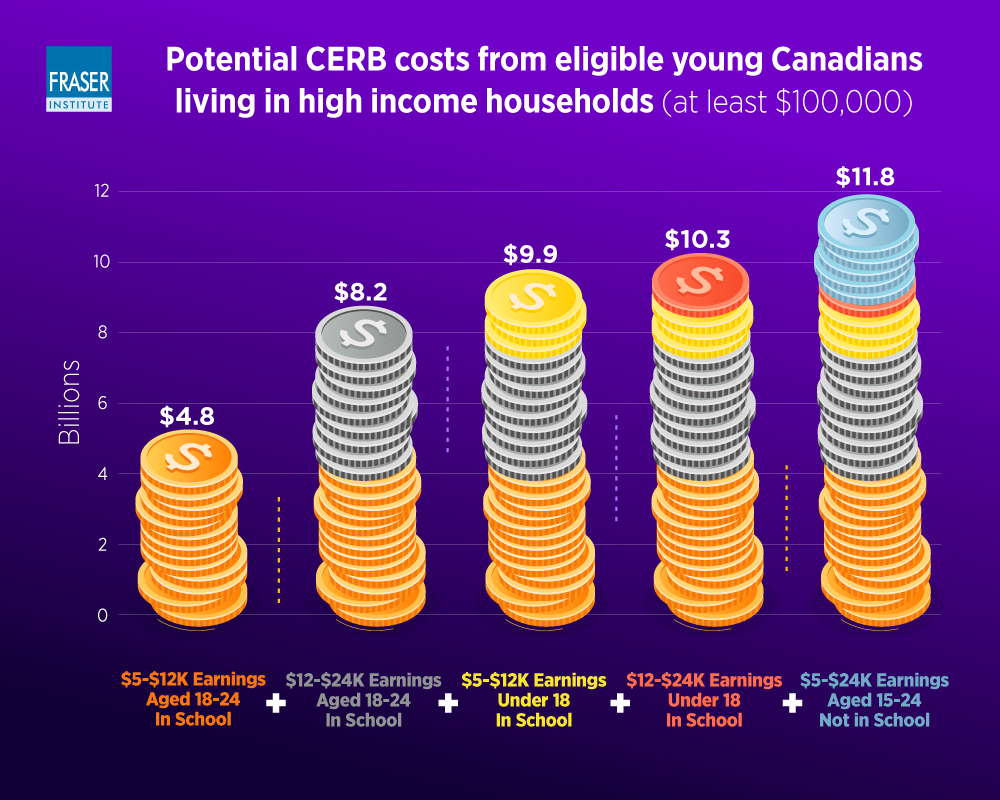
Infograph, Fraser Institute

In fact, whenever such applications clearly reflected that the applicant did not fall into the category of entitlement to receive the relief payments, instructions were to approve them regardless. Including thousands of applications that had been flagged as ineligible. In service to the greater issue of providing relief funding to people who needed it. That at some future date an investigation into entitlement under the guidelines would be undertaken, and any who had applied inadvertently or with the intention of defrauding the system, would be held to account, the incorrectly received funding to be returned to government coffers.

The newly released study by the Fraser Institute estimates that up to $22.3 billion may have been disbursed to people who would not have qualified for the CERB; those who had no real need of funding in the presence of the novel coronavirus and its unemployment fallout. CERB was one of several programs that the government had issued as an emergency measure to help Canadians cope with the extraordinary new world they found themselves in; laid off from permanent or part-time or temporary work with bankruptcy staring them in the face.

According to the study, $81.6 billion in COVID recession spending has been remitted to students, parents and seniors, along with people who found themselves peremptorily out of work when stores, restaurants and other small businesses closed as a result of the pandemic. CERB to the rescue. A program that seemed to make sense at its introduction, first launched in April when the country was in its second month of shutdown. Then came two extensions, with no change to the program such as revisiting eligibility rules.

Photo by Peter J. Thompson/National Post

Jason Clemens, coauthor of the Fraser Institute report, used Statistics Canada data in his analysis to determine the number of people who were classified either as dependent children or spouses in families with incomes in excess of $100,000. Had any of the people making application to receive CERB earned at least $5,000 in 2019, then lost income as a result of CERB, they would be seen to qualify for CERB. The study estimated a maximum of $11.8 billion may have gone out to  young people with part-time jobs, who are dependents in families with household incomes over $100,000 annually.

That is with the assumption a part-time income in 2019 was lost or had hours reduced in 2020 and those people applied for CERB. Another $7 billion could have been sent out to spouses in circumstances quite similar, living in families earning over $100,000 annually. Government could have chosen to make relatively simple, common-sense changes to the application form to disqualify people who were dependents where there was no diminished family income.

The top-up payments for seniors who receive the Old Age Security (OAS) pension and the Guaranteed Income Supplement, also went under the microscope in the study. Government, stated Mr. Clemens should have forwarded that funding to GIS (Guaranteed Income Supplement) recipients only [as without the GIS they fall under the poverty line], since the benefit was meant to specifically aid low-income seniors. The reality being that a senior couple can conceivably have a $260,000 annual income and still qualify for OAS.

Poor CERB targeting wastes billions
Fraser Institute

Labels: , , , ,

Friday, May 11, 2018

Provocation and Response

"We will not let Iran turn Syria into a forward base against Israel."
"There are many radical Islamists, but Iran is the only one which is really [implementing its ideology across the region and into Africa.]"
"If Iran hits us with a drizzle here, we will hit them with a downpour there."
"If we get rain, they'll get a flood. I hope that we ended this chapter and that everyone understood."
Israeli Defense Minister Avigdor Liberman
An Israeli soldier is seen next to signs pointing out distances to different cities on Mount Bental next to the Syrian border on Thursday.   Lior Mizrahi/Getty Images

"Whoever hurts us, we will strike at him sevenfold."
"Whoever prepares to hurt us, we will act to strike him first."
Israeli Prime Minister Benjamin Netanyahu

"It is the right of any country in the region, among them Israel, to defend itself and destroy the sources of danger."
Bahrain Foreign Minister Khalid Al Khalifa

"Wherever Iran has confronted its enemies, it has advanced; we have gained our power through difficult battles."
Brig. Gen. Hossein Salami, head, Iran's Revolutionary Guard Force 

"Iron Dome [Israel's missile interceptor system] intercepted the rockets. There are no injuries and no damage was caused to IDF positions."
"The Quds Force paid a heavy price last night. We have seen a demonstration of the IDF's intelligence and airpower capabilities."
IDF spokesman Brig. Gen. Ronen Manelis
Syrian TV reported the attack
Syrian TV reported the attack Credit: Getty
With the use of 28 warplanes, Israel fired  some 60 missiles in a response airstrike to a series of 20 rockets fired out of Syria across the border of the Golan Heights into Israel. Ten surface-to-surface tactical missiles were launched as well by the IDF on Syria. These are not details provided by the Israeli Defence Forces authorities, but by the Russian Defense Ministry. Russia figures large now in the Middle East. Moscow has ties with Israel, with Iran, with Syria.

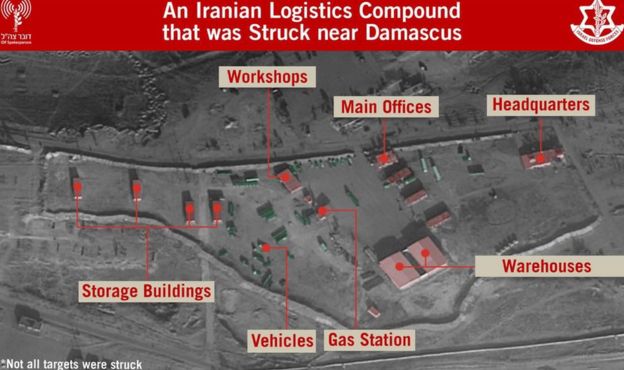
Israel Defense Forces images of targets struck in Syria

Under Russian President Vladimir Putin, Israel maintains close ties and a special appreciative warmth with Russia. And Benjamin Netanyahu visits with Vladimir Putin surprisingly frequently to ventilate Israel's concerns over Russian arms sales to Syria, providing an avowed enemy of Israel with technologically advanced weaponry which Israel will be facing sooner rather than later. Moscow's support of Syrian President Bashar al-Assad also brings it close to Iran.

So there is a conundrum in that Israel, hugely dependent on the United States for support and provision of advanced weaponry, is also dependent on America's most adamantly belligerent competitor on the world stage for dominance, with China breathing hot and close behind, though Russia seeks a military competitive edge while China's concerns are mostly mercantile.

Israel, as a result, takes care to launch its attacks on Syria, largely targeting Iranian military bases as well as Syrian ammunition caches, with the full knowledge of Moscow. So it undertakes these warning shots with care and Russia takes care not to interfere in a matter which it must regard as regional, to be settled by regional actors, even if it arms two-thirds of those actors.

Israel has blamed the Quds Force of the Iranian Revolutionary Guards for targeting Israeli army positions with 20 rockets, and Iran has responded by denying that it was responsible for the rockets, pointing the finger of responsibility on the Syrian military. Since the Islamic Republic of Iran appears to be orchestrating Syrian moves as well as establishing itself in permanent military bases in a partial occupation of Syria, it is their responsibility nevertheless and Israel delivered an indelible message.

According to Jean-Pierre Filiu, professor of Middle East studies at Sciences Po, Paris School of International Affairs, his analysis of the recent clashes, their import and outcome where both adversaries are placed in a situation which neither relishes but one has provoked nevertheless, escalation will not be pursued, but the events will lead to the "consolidation of new 'red lines' tacitly endorsed by Israel and Iran".

But it is Israel placing Iran on notice. And it is Iran forcing Israel to make that move. One where Iranian intelligence facilities and logistics compounds, a military base and other emplacements, along with munition storage warehouses of the Quds forces at Damascus International airport were targeted. Along with Syrian anti-aircraft batteries.

According to the Syrian Observatory for Human Rights, based in London, at least 23 people were killed in the Israeli strikes which Iranian media described as "unprecedented", which might also go a long way to describing Iranian conquests in Syrian, Lebanese, Iraqi, Gazan and Yemeni territories in its expansive claims for Shiite hegemony. Alongside its plans to destroy the State of Israel.
"The blistering Israeli assault was by far the most intensive Israeli action in neighboring Syria since the civil war broke out there in 2011. Israel has largely tried to stay on the sidelines, but has previously acknowledged carrying out over 100 airstrikes over the past seven years, most believed to be aimed at Iranian weapons shipments bound for the Hezbollah militant group."
Report: The Associated Press
Syrian missile launcher struck by Israeli missile
The Israel Defense Forces released video of an air strike on a Syrian missile launcher   Israel Defense Forces  

Labels: , , , , , ,

() Follow @rheytah Tweet