
Politic?

This is a blog dedicated to a personal interpretation of political news of the day. I attempt to be as knowledgeable as possible before commenting and committing my thoughts to a day's communication.

Thursday, August 27, 2020

Governing Wisely in a Time of Crisis -- or Courting Bought Votes?

Distribution of CERB: Estimating the Number of Eligible Young People Living with Parents

"We're now sitting in August. We've had two extensions of CERB [Canada Emergency Response Benefit] with no change in eligibility. So if we're making that argument in April [government claiming its focus in aiding the population was on getting the money out the door as quickly as possible], I think it's a very different dynamic than five months later."                                                                      "There's a whole lot of people who don't need assistance or whose need is much less, who are not only getting assistance, but they're actually being made better off than they were last year."                                                                                       "We have a world class Department of Finance and I just have to believe that they were raising some concerns about the degree to which the approach we were using on so many of these new programs, was actually going to get money to people who needed it."                                                                                              "I don't know the rationale to send money to seniors who have household income of up to $200,000. We're not getting enough money to that single mom or single dad, who is in extraordinarily difficult circumstances. At the same time, we're giving money to people who again, I just think at best, their need is questionable."      Jason Clemens, executive vice-president, Fraser Institute (think tank) 

When the Canada Emergency Response Benefit was rolled out it was ostensibly and for all purposes meant to give badly needed financial assistance to the many Canadian workers who lost their employment as a result of the country shuttering schools, businesses and all commercial enterprises with the exception of pharmacies and grocers, as essential industries for obvious reasons. Questions soon began to arise when word got out that there was no caution and no oversight over the applicability of registrants for the CERB. And those administering the program were specifically told not to look too deeply into the applications to find issues of incompatibility with guidelines.
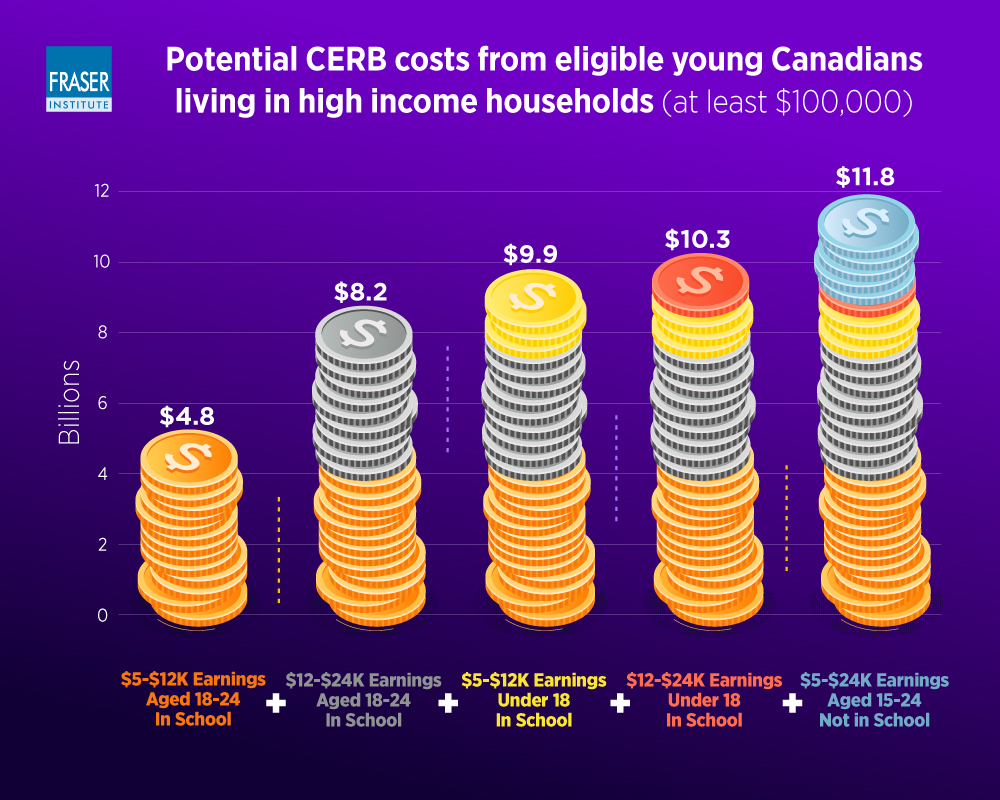
Infograph, Fraser Institute

In fact, whenever such applications clearly reflected that the applicant did not fall into the category of entitlement to receive the relief payments, instructions were to approve them regardless. Including thousands of applications that had been flagged as ineligible. In service to the greater issue of providing relief funding to people who needed it. That at some future date an investigation into entitlement under the guidelines would be undertaken, and any who had applied inadvertently or with the intention of defrauding the system, would be held to account, the incorrectly received funding to be returned to government coffers.

The newly released study by the Fraser Institute estimates that up to $22.3 billion may have been disbursed to people who would not have qualified for the CERB; those who had no real need of funding in the presence of the novel coronavirus and its unemployment fallout. CERB was one of several programs that the government had issued as an emergency measure to help Canadians cope with the extraordinary new world they found themselves in; laid off from permanent or part-time or temporary work with bankruptcy staring them in the face.

According to the study, $81.6 billion in COVID recession spending has been remitted to students, parents and seniors, along with people who found themselves peremptorily out of work when stores, restaurants and other small businesses closed as a result of the pandemic. CERB to the rescue. A program that seemed to make sense at its introduction, first launched in April when the country was in its second month of shutdown. Then came two extensions, with no change to the program such as revisiting eligibility rules.

Photo by Peter J. Thompson/National Post

Jason Clemens, coauthor of the Fraser Institute report, used Statistics Canada data in his analysis to determine the number of people who were classified either as dependent children or spouses in families with incomes in excess of $100,000. Had any of the people making application to receive CERB earned at least $5,000 in 2019, then lost income as a result of CERB, they would be seen to qualify for CERB. The study estimated a maximum of $11.8 billion may have gone out to  young people with part-time jobs, who are dependents in families with household incomes over $100,000 annually.

That is with the assumption a part-time income in 2019 was lost or had hours reduced in 2020 and those people applied for CERB. Another $7 billion could have been sent out to spouses in circumstances quite similar, living in families earning over $100,000 annually. Government could have chosen to make relatively simple, common-sense changes to the application form to disqualify people who were dependents where there was no diminished family income.

The top-up payments for seniors who receive the Old Age Security (OAS) pension and the Guaranteed Income Supplement, also went under the microscope in the study. Government, stated Mr. Clemens should have forwarded that funding to GIS (Guaranteed Income Supplement) recipients only [as without the GIS they fall under the poverty line], since the benefit was meant to specifically aid low-income seniors. The reality being that a senior couple can conceivably have a $260,000 annual income and still qualify for OAS.

Poor CERB targeting wastes billions
Fraser Institute

Labels: , , , ,

Monday, August 17, 2020

Instilling Confidence?

"It's preparing for -- something could happen to this virus, who knows? Something could change."           "We don't know the seasonality of this virus. It's continued throughout the summer, that's for sure, but what if it demonstrates a certain type of acceleration under certain conditions?"     "We are over-planning beyond what we had for the previous wave and  think that's the prudent thing to do."                             "This planning scenario is to get all of our partners up and down the health system to over-plan."                                                                                                                              Dr.Theresa Tam, Chief Public Health Officer, Canada

With fall approaching, federal health authorities anticipate an expected peak with a potential to temporarily exceed the coping capacity of the public health-care system, contemplating a surge of new cases of SARS-Cov-2 virus to erupt. Canada went into immediate lockdown back in March; five months on there has been a gradual, sequential re-opening of society inching toward normalcy. But this is still summer, where people tend to seek out-of-doors relief from sequestration.

With the arrival of fall, people will be moving indoors. Returning to office jobs to work in place, and with schools re-opening, students returning to a completely altered classroom with fewer students and distanced seating arrangements along with mandatory use of masks for the older elementary grades and beyond. With all this in mind, the federal government has been planning for a "reasonable worst-case scenario".

That sounds more ominous than it does 'reasonable', in the interests of prudence, but this is the reality of a situation where a new virus with frequent deadly outcomes able to spread like wildfire across the globe has altered life everywhere and uncertainty of the future and the changes in the virus itself and how those changes will impact those it infects will turn out. 

Federal health officials across the country are preparing for the potential of outbreaks capable of surpassing the greatest spikes the virus demonstrated it was capable of in March and April. That preparation and the possibility it portends taxes the imagination and defies preparations that are anticipated to be potentially inadequate to the task.


A certain amount of confidence should exist, given Canada's poor state of preparedness as the coronavirus roared into action back in March, with authorities stating that the country is in better shape with its preparations than it was back then. On the other hand, health experts are contemplating the planning it will take for the eventuality of concurrent outbreaks of seasonal influenza, and other respiratory illnesses, together with a newly rampant COVID-19.

The world is living in interesting times. The year 2020 will not readily be forgotten. The coming fall and winter may pose even greater problems in managing a trio of oncoming health threats. According to data released several days back, the number of cases that may erupt by August 23 could reach up to 127,740 with deaths coming in at a total of 9,115. "Peaks and valleys" of outbreaks may continue until January 2022; a possibility that is fearsome in and of itself.

To maintain the epidemic on a "slow burn", according to Dr.Tam, encouraging the population to continue following best public health practices while building up capacity within the health system speaks to the best possible strategy. This, while being aware of a need to swiftly ramp up response measures should case numbers spike.

The capacity to make certain people who are infected identified and quarantined as soon as possible is critical, as a measure to control and halt large outbreaks. Which feeds into the pilot launch of the COVID Alert app where two million people in Ontario alone, of a total provincial population of 14 million have downloaded the app to the present time.

Labels:

Tuesday, March 24, 2020

Gender Differences in Emotional Responses to Impending Danger

"Having done a little bit of research myself, looking at gender differences when it comes to risk perception, there's a fairly clear literature that says that men are just less likely to perceive risk as acutely as women."
"Men are much less likely to be worrying, but they're also less likely to be staying home, not going out and not interacting with other people -- basically not doing social distancing -- than women."
"That 30 to 44-age group across the board, whether men or female, are the most worried about this. So I think it is partly a parental driver. I think that parental instinct in young dads, it reflects that huge gap between those two  younger cohorts."
"We can't assume that these messages from public health agencies are actually getting through to everybody. It's hard to persuade people until  you're personally affected by it. And by then it's too late."
David Coletto, CEO, Abacus Data

While groceries and pharmacies and other designated essential public services are slated to remain open in Ontario and Quebec, all other non-essential enterprises have been ordered to close. Both governments have indicated they are prepared to enforce those closures should there be pushback from those involved, in the greater interests of protecting the public at large from the spread of the infectious novel coronavirus.
"This is not the time for half-measures. This decision [to close all schools and universities among other public institutions] was not made lightly and the gravity of this order does not escape me, but as I have said since day one, we will and we must take all steps necessary to stop the spread of COVOD-19."
Ontario Premier Doug Ford
"I am going to make sure that we continue to follow all recommendations of public health officers, particularly around staying at home wherever possible and self-isolation and social distancing", reiterated Prime Minister Justin Trudeau, himself remaining in self-isolation, while his wife is recovering from the novel coronavirus she contracted while on a trip to the U.K. The federal government's latest revelatory update of 1,474 coronavirus cases in Canada, with 20 people dead, is sobering.

The survey revealing the vast difference between the attitudes of men and women to the gravity of the spread of COVID-19 indicates that 49 percent of women respondents are very worried, with 29 percent somewhat concerned about the outbreak, while 30 percent of men are very worried and 33 percent are somewhat worried. And while 25 percent of women are either a little or not at all worried, 37 percent of men fall into that same category.

Notably, men are less likely to take the advice of health officials to self-isolate in a push to mitigate the effects of the pandemic. The poll also highlighted a difference between baby boomers and young people, each accusing the other group of being the most intransigent over following public health advice. Both young men and older men resist health advice and the need to self-isolate. And then there is the group of men aged 30 to 44 who have seriously absorbed the virus warnings.

So while forty percent of men age 30 to 44 years are very worried, a number double that of men aged 18 to 29 who feel similarly, the former age demographic is linked to their status as fathers of young children. That there are large groups of people for whom the presence of an unknown and dangerous infectious virus sweeping through populations feel unconcerned is worrisome indeed. As is the anecdotal stories of young people assembling in large groups and partying, defying reality.

People walk and cycle
In this file photo, people walk and cycle on the seawall between English Bay and Sunset Beach, in Vancouver, on Sunday, March 22, 2020. THE CANADIAN PRESS/Darryl Dyck

Labels: , , , ,

() Follow @rheytah Tweet