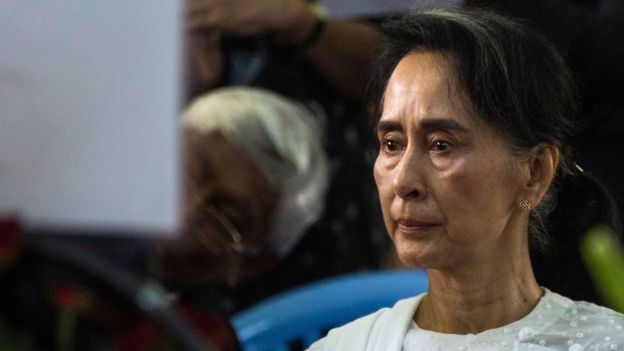
Politic?

This is a blog dedicated to a personal interpretation of political news of the day. I attempt to be as knowledgeable as possible before commenting and committing my thoughts to a day's communication.

Tuesday, November 18, 2025

Bangladesh "Biased and Politically Motivated"

https://i.cbc.ca/ais/0c602a90-d39b-4ba7-904e-1a47dac0d9a2,1723134966169/full/max/0/default.jpg?im=Crop%2Crect%3D%280%2C0%2C1919%2C1079%29%3BResize%3D620 
 
"[The ruling had come from a] rigged tribunal [established and presided over by an unelected government with no democratic mandate]."
"They are biased and politically motivated."
"In their distasteful call for the death penalty, they reveal the brazen and murderous intent of extremist figures within the interim government to remove Bangladesh's last elected prime minister, and to nullify the Awami League as a political force."
"I wholly deny the accusations that have been made against me in the ICT. I mourn all of the deaths that occurred in July and August of last year, on both sides of the political divide. But neither I nor other political leaders ordered the killing of protestors. ... I was given no fair chance to defend myself in court, nor even to have lawyers of my own choice represent me in absentia." 
https://i.cbc.ca/ais/9885fb38-c19e-4827-8697-19e70569b113,1763371418574/full/max/0/default.jpg?im=Crop%2Crect%3D%280%2C31%2C594%2C334%29%3BResize%3D860Bangladesh former Prime Minister Sheikh Hasina  
"Our tribunal was developed in line with the Nuremberg trials. It has met all international standards."
"No one can point to anywhere where those standards have not been met."
"Their defense lawyer was given enough time to come up with the response. He could not take instruction from the accused as they are fugitives."
"If they had been present, they could have given their testimonies and provided further witnesses, and they would have been given further time as per the law."
Chief Prosecutor Mohammad Tajul Islam   
Hundreds of people are shown at a distance standing and walking around the interior of a large room in a building.
Anti-government protesters are shown inside Sheikh Hasina's palace in Dhaka on Aug. 5, 2024, after she was toppled. (K M Asad/AFP/Getty Images)
 
As angry crowds stormed her palace in 2024, Bangladeshi Prime Minister Sheikh Hasina fled to India for haven, when critics accused her of jailing political rivals, enacting harsh anti-media laws and overseeing human rights abuses, killing opposition activists among them. According to the United Nations, some 1,400 people -- mostly students in revolt -- were killed in the months of July and August of 2024.
 
She was sentenced to death by a Dhaka court finding her guilty on three counts of crimes against humanity, including incitement and orders to kill, along with inaction to prevent atrocities from being played out. Hasina, charged chief prosecutor Tajul Islam, was "the nucleus around whom all the crimes (were) committed", during the popular uprising. 
 
Months of testimony detailing mass killings said to be ordered by Hasina were heard during her trial. The trial, Sheikh Hasina stated, was in fact, a "jurisprudential joke". Audio tapes of Hasina purportedly directly ordering security forces to "use lethal weapons", were also played in court by the prosecution. There are additional outstanding cases involving the former Bangladeshi leader, involving her daughter Saima Wazed who became a senor UN official, and her niece Tulip Diddiq, a British lawmaker. 
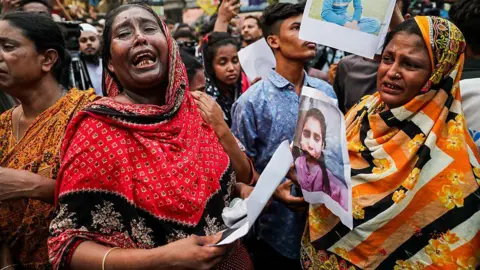
 
Getty Images Two tearful women in the foreground holding on to photographs of their loved ones printed on paper. A larger crowd has gathered behind them, many of them also clutching onto photographs of their relatives
Grief-stricken relatives hold on to photographs of their loved ones still missing after a fire blazed through a garment factory in Bangladesh   Getty Images
 
Hasina's regime presided over a time of rapid economic expansion for Bangladesh, driven in large part by Bangladesh's garment export industry, during her second time as the country's leader in 2008. An industry that was plagued with reported human rights violations in the garment factories, and occasional fires that killed many workers trapped in buildings lacking proper fire exits and basic fire-prevention protocols.
 
At one time considered to be one of the world's poorest countries, the Bangladesh economy grew over six percent annually since 2009, and by 2021 surpassed India's per capita income. "The prospect of Sheikh Hasina mounting a political comeback in Bangladesh now appears very slim", commented International Crisis Group analyst Thomas Kean following the death verdict for the 80-year-old former leader. 
"After the uprising, we might have had a process of justice and peace and reconciliation. We didn't have that. We've had the same as before. We call it accountability, but it's more like political revenge."
"What really matters is, many people think that this is a kind of justice and that no other kind of justice was going to be achieved."
Naomi Hossain, development studies professor, University of London's School of Oriental and African Studies 
https://media.cnn.com/api/v1/images/stellar/prod/gettyimages-1553913077.jpg?c=16x9&q=h_653,w_1160,c_fill/f_avif


Labels: , , , ,

Saturday, December 24, 2022

S.O.S. Save Our Souls! Is There No One There???

"I last spoke with the boat's captain on December 18 and he told me that at least 17 people on board had died due to a lack of food and water."
"They have only been able to drink water when it rains."
"Please tell me, I just want to know if my family is alive or dead. We all want to see our families, that is all we request from the world. Just help us."
Sham Shur Alom, Rohingya refugee in Malaysia

"Several reports indicate dozens of people have already died during this ordeal, while survivors are hungry and thirsty without access to food and water and suffering from sickness."
United Nations' refugee agency 

"Father, please send a boat or I will jump into the ocean. I can't tolerate the pain and struggle anymore. There is no food or water to drink. People are drinking salt water. People are close to dying and mental breakdown. They're going to bite each other."
"Baba. I don't know why I am here. My teeth are dry from the lack of drinking water. Please do whatever is humanly possible for you."
Mosharrof Ullha, to his father Ata Ullha, Rohingya, Cox's Bazar Refugee Camp, Bangladesh
"We urge the Government of India to urgently coordinate and cooperate with other regional governments on the search and rescue operations of Rohingya refugees who are currently stranded in Indian waters with no medical support, food and water"    Amnesty India

The world of the unwanted homeless is ever on the move, hoping to find surcease from their stateless status, their unwanted presence, their suffering and their timeless dilemma. They aspire to live, to have a future, they are not economic migrants but refugees. As it happens, refugees who are Muslim, whom the Myanmar military expunged violently from the country where they were living. Originally from Bangladesh, the Rohingya lived for generations in Myanmar. But Buddhism and Islam oppose one another.
 
Living for years since their expulsion from Myanmar on the border in Bangladesh in an immense squalid refugee camp teeming with refugees whom no one wants responsibility for, there are those who dream of escape, of finding a new life and opportunity elsewhere in the world where they will be accepted, where human aspirations to belong and to succeed in life can be found. And in following that dream they sacrifice themselves to chance and fortune, and sometimes lose.

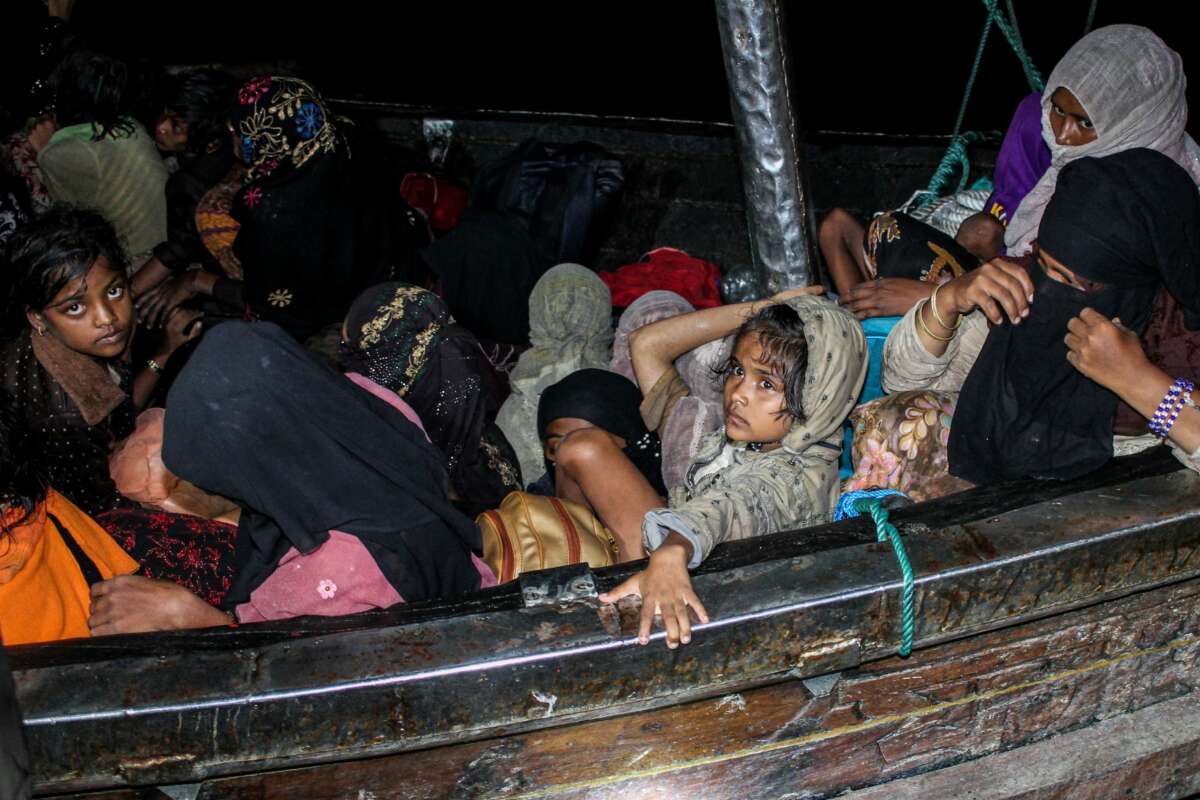
A boat stranded for close to three weeks in the Indian Ocean is desperate for rescue. So far a dozen of the Rohingya refugees populating the wooden craft open to the air, directionless, have died. With no humanitarian intervention from nearby nations fears are that more people will die in the next few days. And the unthinkable, that the  hopeful refugees on board will all perish from neglect by those who could mount a rescue. Indonesia, the nation with the largest Muslim population globally has seen fit not to respond.

Predictably, India, with the world's third largest minority population of Muslims has no wish to acquire more people of the faith its own majority Hindu population is hostile to. Late November saw the open wooden boat set off from Bangladesh for Malaysia, yet another majority Muslim population, with over 150 asylum seekers aboard. On December 4 its engine failed, leaving the vessel to drift at sea, its food and water supplies steadily diminishing.

Most of the people on the ship had set out to meet family in Malaysia, anxious to flee the sprawling Cox's Bazar refugee camp in Bangladesh with its hundreds of thousands of hopeless people languishing there for the past five years. The boat captain refused to allow those who have managed to make contact with the boat by satellite phone, to speak with their relatives. Open to the elements, conditions on the boat are unspeakably urgent.

The Indian navy and coast guard say no information about the adrift ship has reached them; wide-spread media coverage of the crisis aside. "We have no information about the issue",  a spokesperson for the Indian navy responded, to a query. To the present, it is believed that approximately two thousand Rohingya refugees have opted to risk a sea voyage in 2022 as conditions in the refugee camps both in Myanmar and Bangladesh continue to deteriorate.

Although Sri Lanka's navy rescued a boat of 104 Rohingya a week ago, other nations have no wish to encourage the mass flow of people by intervening to offer support. Bangladesh, the Muslim country from which the Rohingya originated has not seen fit to integrate them back into its society as a Muslim-to-Muslim responsibility. Nor have Indonesia or Malaysia recognized their religious responsibility to embrace fellow Muslims.

Rohingya refugees sit on a wooden boat as Indonesian officials conduct evacuation at the Krueng Geukueh port in Lhokseumawe, Aceh, Indonesia, on December 31, 2021.
"Many more will die soon if they are not rescued, due to dehydration."
"We have approached the Indian coast guard and the Thai and Indonesian governments."
"None of them responded."
Mohammed Rezuwan Khan, Rohingya refugee, Cox's Bazar

Labels: , , , ,

Saturday, May 29, 2021

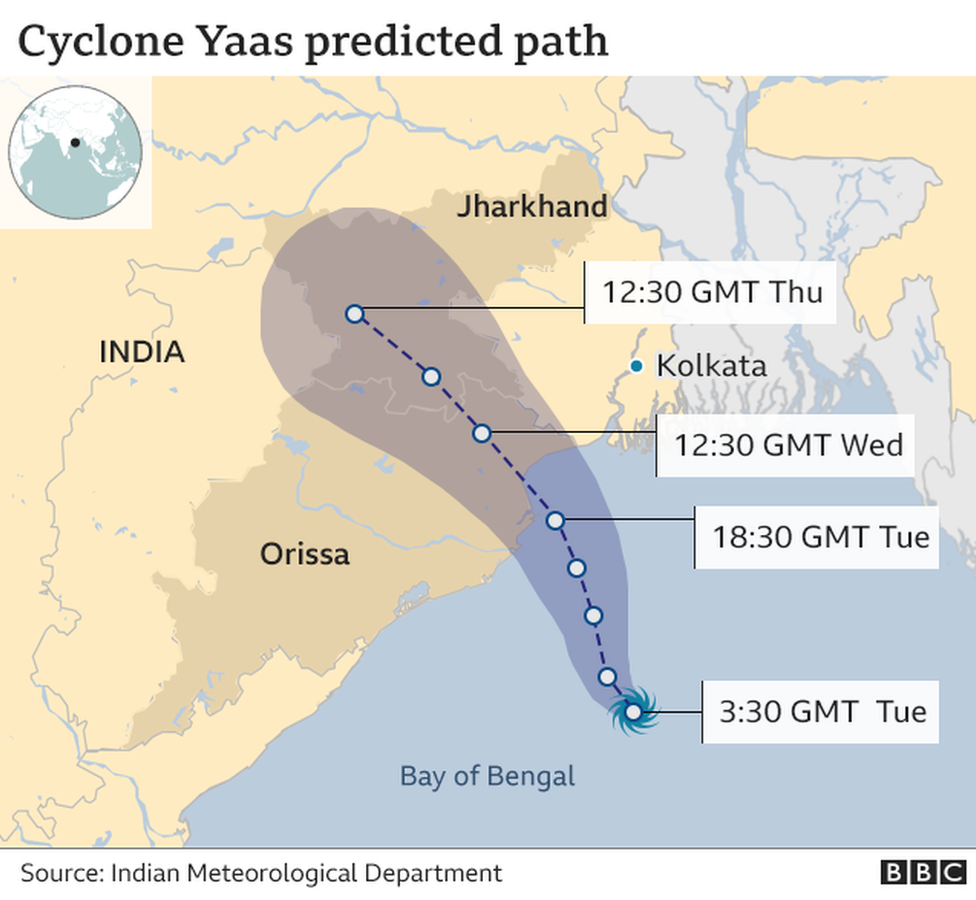
The Devastation of Cyclone Yaas

"[The] north coast of the Bay of Bengal is more prone to catastrophic surges than anywhere on Earth," 
"[The Bay of Bengal is a] textbook example [of the worst kind of places for storm surges to develop - shallow, concave bays where water is pushed by the strong winds of a tropical cyclone. This gets concentrated as the storm moves up the bay]."
Bob Henson, meteorologist and writer with Weather Underground
 
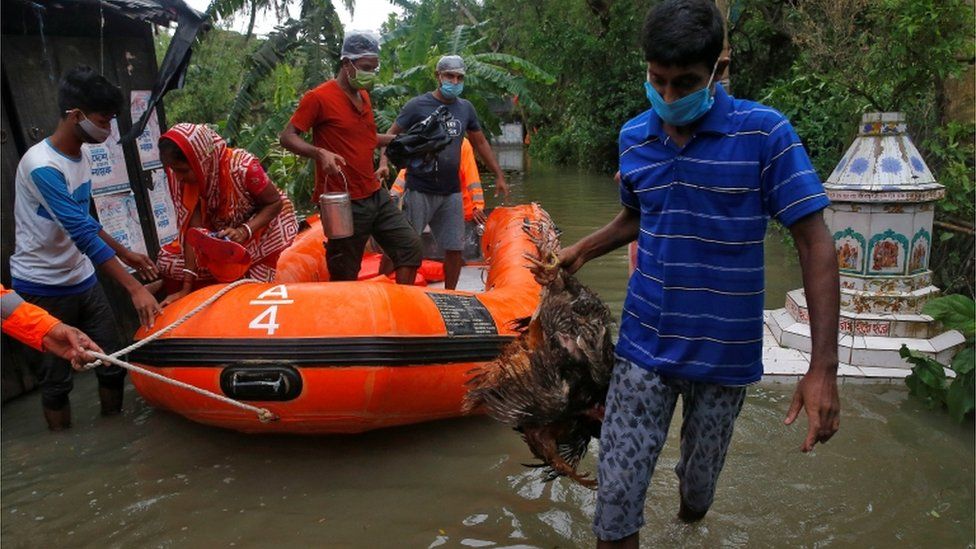
Authorities evacuate vulnerable people as Cyclone Yaas approaches India's eastern coast
India evacuated more than one million people in coastal areas   Reuters

India and Bangladesh, both trying to cope with surging COVID-19 cases and deaths, were given another wild ride of nature to add to their worries. Indian hospitals and crematoria may be working overtime in a desperate bid to control the wicked surge of infections, but they also had no option left to them but to deploy rescue crews to meet the needs of huge numbers of people in eastern India and Bangladesh who could not be left to their own devices to struggle against the deadly threat of a wild cyclone.
 
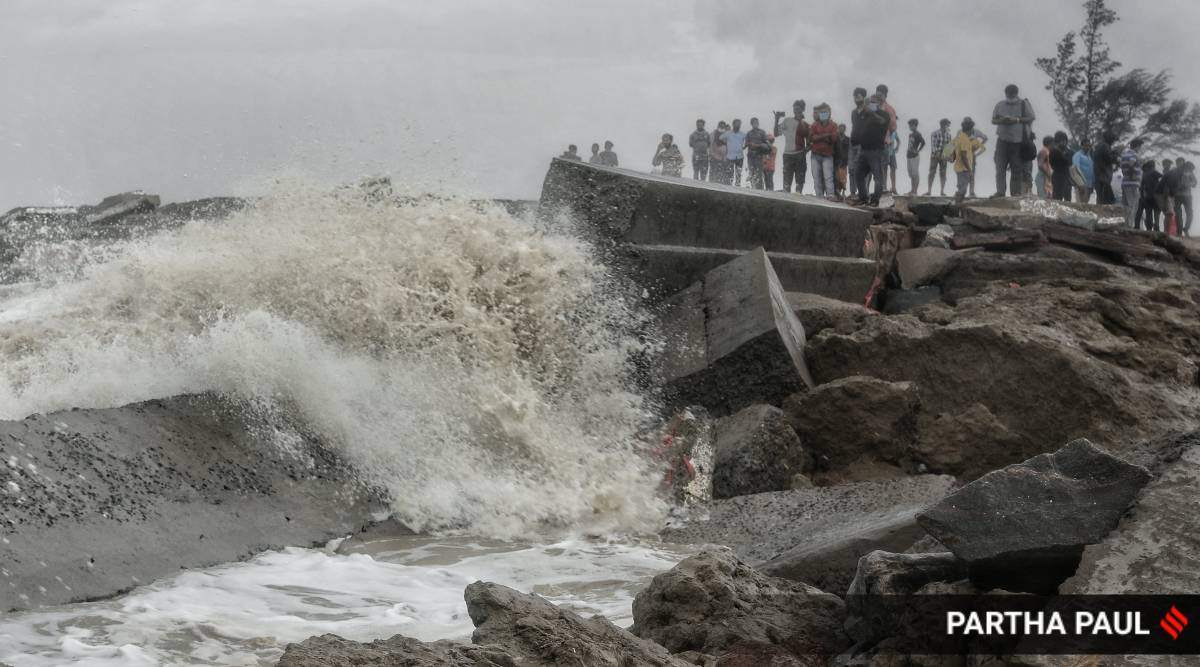
As matters turned out, now that the cyclone that unleashed huge storm surges and heavy rains that hampered rescue work has passed, 150,000 people have been left homeless. Low-lying coastal areas were deluged and they're now uninhabitable. Cyclone Yaas moved inland from the Bay of Bengal with wind gusts of up to 149 km/h, with tidal surges whipped up in West Bengal state, India, and in Bangladesh, next door.
 
An embankment breached at Shankarpur in East Midnapur, West Bengal during Cyclone Yaas

Heavy rain poured into parts of West Bengal where fresh inundations of sea water drowned coastal villages. "Restoration work will be difficult unless the weather improves", noted Bankim Hazra, West Bengal state minister. In Sundarbans delta, West Bengal, stretching into Bangladesh, some 25,000 homes constructed of traditional mud houses were destroyed, leading to 150,000 people left without shelter, stated Mr. Hazra.

This was the second violent storm to target India in the space of a week, arriving just while the country struggles with its second deadly wave of coronavirus infections that India's health network is struggling to cope with. A half-million people sheltered in relief camps in West Bengal, where state officials have been mindful of the necessity to reduce the risk of yet another virus spread. "Flood shelters have quarantine rooms for those showing symptoms of COVID-19 like fever, sore throat, body ache", stated medical officer Dr.Indranil Bargi, in Gosaba.
 
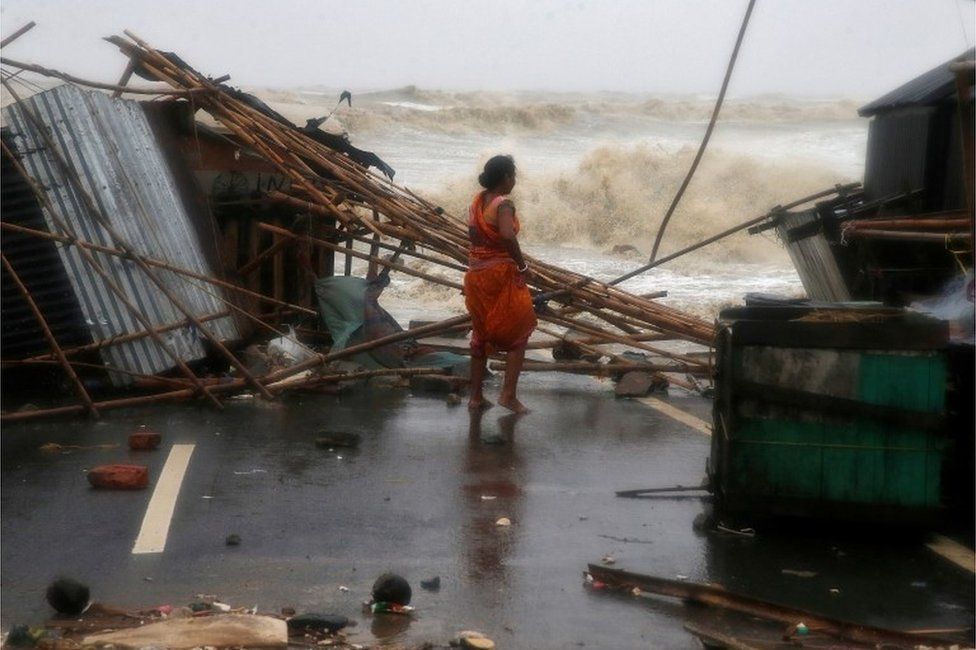
A woman stands next to her stall damaged by heavy winds at a shore ahead of Cyclone Yaas in Bichitrapur in Balasore district in the eastern state of Odisha India, May 26, 2021.
Orissa bore the brunt of the storm   Reuters


Anyone testing positive stands to be taken to safe homes established in government offices and schools. There was another shattering 211,298 new infections in India on Thursday, the world's highest daily rise, yet half the daily infections India recorded earlier in the month. 27.37million speaks to the overall case load. And a staggering 325,235 deaths were reported, according to data from India's health ministry. And even that huge number is recognized as an underestimate, according to experts, a gross underestimate of the actual toll.

In Bangladesh, flooding of villages as a result of torrential rains and tidal surges spells out the picture there. "I have never seen a tidal surge rising to this level. It flooded many villages and washed away houses. Many people are marooned", district of Khulna official Humayum Kabir explained.

Cyclone Yaas predicted path
 

Labels: , , ,

Friday, June 15, 2018

Enabling Evasion of Justice

"Chowdhury has been convicted of a crime of great significance for the people of Bangladesh ... "
"The information sought is necessary to enable the Government of Bangladesh to assess its policy options and the basis of negotiations with the Government of Canada."
Federal Court application, Torys LLP, Toronto

"In September 2015, these issues were discussed in a meeting between Prime Minister Justin Trudeau and Bangladesh's Prime Minister Sheikh Hasina Wazed ..."
"As a result of that meeting, a further meeting of Canadian and Bangladesh officials was held in April 2017."
Application for Judicial review

"In those discussions, the Government of Bangladesh has emphasized the significance of the assassination of Sheikh Mujibur Rahman -- the worldwide effort on the part of the Government of Bangladesh to bring Chowdhury and the other fugitives from that assassination [and coup] to justice, and the importance of obtaining Canada's co-operation to uphold the rule of law and avoid becoming a safe haven for people who have committed crimes abroad."
Mizanur Rahman, High Commissioner to Canada, Bangladesh High Commission
Bangladesh’s Sheikh Mujibur Rahman, the country’s founding father, who was killed along with most of his family members in a military coup in 1975. AFP/Getty Images

Canada's legal system extends protection to people living in Canada, even when government agencies attempt to remove people who have been denied status in the country by allowing them to speak of their Canadian "Charter Rights", and enabling them under Canadian law to challenge official decisions for their removal, through a series of judicial appeals that can take years to revolve through the justice system, so that even people who have been accused, tried and found guilty of murder find safe haven in Canada.

One such case is that of Nur Chowdhury who with a number of other men in their native Bangladesh conspired to assassinate Bangladesh's first president, gunning him down, alongside most of his family in August of 1975. A trial ensued in 1998, where 15 men stood trial and were convicted in Sheikh Mujibur Rahman's murder. His daughter, all these years later was elected the leader of Bangladesh and she is determined that all her father's murderers face justice.

Of those brought to trial and in the wake of appeals, there were three acquittals, five of those found guilty were executed in 2010. The urgent goal of seeing that one of the men known to have personally fired the firearms that killed the current Bangladeshi Prime Minister's father remains unresolved. Though convicted in absentia, Nur Chowdhury has so far eluded punishment for his crime. He has been living in Canada since 1996, while Bangladesh urges the government of Canada to extradite him in the name of universal justice.

This month a new Federal Court application was filed for the purpose of forcing the federal government to publicly disclose Chowdhury's legal status at the present time; at the very least release his status data to the government of Bangladesh. This is a man whose refugee claim had been rejected by Canadian authorities as a result of his role in the assassination. And he continues to evade deportation because of the Bangladesh court handing down a death sentence for his crime.

The Supreme Court of Canada has made it illegal for Canada to deport those who on their return to their country of origin are likely to be tortured or executed, since Canada has long since abolished the death penalty itself. A loophole in the law states that in "exceptional circumstances" the ban on deportation under these circumstances could be lifted.

The largest English-language newspaper in Bangladesh reported the Bangladesh Prime Minister's press secretary reporting that during he G7 meeting that took place in Quebec recently Sheikh Hasina "called for Trudeau's personal initiative for immediate extradition of the self-confessed killer, one of the two assassins who directly shot Father of the Nation Bangabandhu Sheikh Mujibur Rahman dead". Trudeau is reported to have "expressed his compassion to Sheikh Hasina", informing her that "Canadian officials were quietly engaged in dealing with the issue".

Justin Trudeau's commiseration is somewhat lacking in commitment, it would seem, since government authorities have declined to share information on the current immigration status of the man Bangladesh wants returned to face justice, including whether he had been granted a pre-removal risk assessment representing a formal mechanism exempting anyone from deportation.

When Bangladesh's High Commissioner to Canada wrote to Immigration Minister Ahmed Hussen with the request that he be apprised of Chowdhury's risk assessment status, the request was denied on the grounds that Chowdhury had a reasonable expectation of privacy, and that Canada and Bangladesh have no formal agreement on information sharing. When Commissioner Rahman responded that a special information sharing agreement be negotiated, privacy grounds were cited to rebuff him once again.

Which caps off a decade of 'discussion' between the two countries in an effort to resolve this issue of such great importance to Bangladesh and to which Canada has been rather shabbily responding.

Nur Chowdhury, now living in Canada, was convicted in absentia of killing Bangladesh’s first president, Sheikh Mujibur Rahman.File

Labels: , , , , ,

Wednesday, September 06, 2017

Terrorists and False News

"Stop the violence. Today we have seen pictures of small children killed by Burma's security forces. Over the last several years, I have repeatedly condemned this tragic and shameful treatment."
"I am still waiting for my fellow Nobel Laureate Aung San Suu Kyi to do the same. The world is waiting and the Rohingya Muslims are waiting."
Malala Yousafzal, Pakistani Nobel Peace Laureate

State security forces have been killing men, women and children. They have been slitting throats, there have been beheadings."
"Soldiers have opened fire on groups of people and then set the bodies on fire, including children."
Matthew Smith, chief executive, Fortify Rights humanitarian group

"[The situation in Rakhine is] really grave [marking time for Suu Kyi to] step in."
"The de facto leader needs to step in -- that is what we would expect from any government, to protect everybody within their own jurisdiction."
Yanghee Lee, UN special rapporteur on human rights in Myanmar
Myanmar's State Counsellor Aung San Suu Kyi attends the funeral service for the National League for Democracy (NLD) party's former chairman Aung Shwe in Yangon on 17 August 2017.

AFP/Getty Images:  Myanmar's de-facto leader Aung San Suu Kyi said tensions were being fanned by fake news
Under Myanmar's military junta rule it seemed to the outside world to represent a sad and sorry situation that the Rohingya were persecuted, but it was fully anticipated once the military stepped back and a democratic election resulted bringing the world-famed human-rights campaigner Aun San Suu Kyi to the executive administration of the nation, steps would be taken to protect this religious and ethnic minority. Instead, they continued to be viewed as despised interlopers with no legal status.

Rohingya families have lived in Rakhine for generations, yet they remain, in the view of the Buddhist majority and the government, illegal migrants whose presence is unwanted. Without citizenship rights in Myanmar the 1.1-million Rohingya require permission to travel outside their established villages, as well as needing to acquire official permission to even marry among themselves.

The most recent outbreak of violence, caused by an armed Rohingya group, the Arakan Rohingya Salvation Army, that attacked a military base resulted in the army invading villages and burning down the homes of the Rohingya living there, forcing them to move on to avoid being killed. Pushed out of their traditional towns and villages, Rohingya, fleeing death have crossed into neighbouring Bangladesh.
A Rohingya man carries an elderly woman from a boat
Photo: More than 120,000 Rohingya have fled to Bangladesh due to the violence. (AP: Bernat Armangue)

All they possessed is gone, they are famished and have no resources to maintain life. Smugglers were paid for passage across the Naf river between Myanmar and Bangladesh, leaving the refugees with nothing to support themselves with. The new government of Suu Kyi could have restored the Rohingya with the citizenship that the military junta had stripped them of, but did not.

Myanmar's National League for Democracy appears to support freedom and democracy for Buddhist Burmese, but sees it being of little value to Muslim Rohingya. They are thus stateless, with close to 400,000 searching for haven in Bangladesh now living in squalid refugee camps. The "clearance operations" to flush out insurgents from Rohingya villages has flushed out innocent civilians with nowhere to go, no resources to sustain them.
An expert said the objects pictured being held by an activist are PMN1 antipersonnel devices.
Photos of a Rohingya man holding mines on the Myanmar side of the border were sent to CNN by activists and examined by a mine expert, who confirmed that the two objects are PMN1 antipersonnel devices

The government of Myanmar insists it was the insurgents themselves who set fire to their own houses and took to slaughtering Buddhists in the western state of Rakhine, while the starving refugees speak of targeted shootings by Myanmar troops who warned them to leave, if they valued life. In their desperation to flee they faced danger crossing the border into Bangladesh as well, thanks to the explosives the Burmese military has planted there.

But this is all, of course, 'fake news'.

rohingyas flee myanmar stout pkg_00031313
Rohingya Muslims flee violence in Myanmar

Labels: , , , ,

Monday, June 05, 2017

Canadian Prosecution of Hate Crimes

"We are not aware of the issue."
"If someone is wanted in a foreign country, our government needs to know."
Senior Bangladeshi official, diplomatic mission, Ottawa, Canada

"[An Interpol red notice requesting arrest was posted]...However, each member country decides for itself what legal value to give a red notice within their orders and therefore the ability to arrest and extradite a subject in a given country is not a guarantee."
St.Harold Pfleiderer, RCMP spokesman

"I recall that it took a very long time for the Attorney General of the day to give the OPP permission to proceed with those charges."
"[The Canadian government should] give immediate priority [to Hossain's arrest]. The charges against him are extremely serious."
"I am extremely disappointed that to date Hossain has not been brought to justice."
Julian Fantino, former OPP commissioner, former federal Conservative cabinet minister

"[I left Canada] in order to organize a revolution and attempt to begin promoting and pushing for a full-blown genocide against the Jewish-owned nations of the Western world."
"[An] extermination program] is required to stop Jews from labelling Muslims as terrorists]."
"I will never stop promoting and attempting to facilitate and organize multiple genocides against the Jews and their allies until Jewish power is permanently decimated."
"Daesh have you forgotten your duties to target Israel and important Jews yet?"
Salman Hossain, Bangladeshi-Canadian, Dhaka, Bangladesh
Handout
Salman Hossain at the gym in a luxury Dhaka hotel: Handout

The Ontario Provincial Police conducted an investigation of 32-year-old Hossain, a former resident of Toronto, which resulted in the man being the first individual Canada has ever charged with advocating genocide. The charges stem from July of 2010, when the OPP stated it would do "everything in our power to bring him to justice". He has never been arrested, irrespective of the five counts that if found guilty in a court of law could see him sentenced to sixteen years in prison.

Before he could be arrested, however, the man fled Canada for his native Bangladesh where he appears to live a life of ease and continues his mission to promote genocide, to destroy the presence of Jews wherever they live. Last September, a video was circulated on You Tube featuring Hossain witnessing men slitting a goat's neck and he comments: "This is how the evil Yahud (Jews) and their helpers and slaves need to be executed when caught and punished worldwide."

Hossain had originally come to the attention of Canadian intelligence ten years earlier when he posted Internet messages urging that "Muslim militants" should attack Canada. Because of his online actions the Canadian Security Intelligence Service and RCMP began to investigate this man. Yet he continued advocating for extremist violence, focusing in particular on Jews, continually calling for their "extermination".

At the time, the Attorney-General of Ontario hesitated to approve hate crime charges, claiming Hossain was no longer posting his hate speeches, and was being rehabilitated. His campaign, however continued with his calls for the Jewish populations of North America and Europe to be "exterminated". He was expelled from York University in 2010, when he fled the country once police opened another investigation and charges were still pending.

Labels: , , ,

Monday, August 29, 2016

The Canadian Jihad Connection

Bangladesh raid Police officers are seen during a raid which saw Dhaka cafe attack 'mastermind' Tamim Ahmed Chowdhury and three other suspected militants killed at a militant hideout in Narayanganj, near Dhaka, Bangladesh on August 27, 2016. Police had named the Canadian-Bangladeshi, who led the 'New JMB', as the one who orchestrated the July-1 attack on the upscale Holey Artisan Bakery and O' Kitchen restaurant in Dhaka's diplomatic zone, killing 20 hostages, including 18 foreigners. (Suvra Kanti Das/Newzulu.com)

"People who knew him say he was a quiet guy. Not much else is known about him at the moment."
Professor Amarnath Amarasingam, post-doctoral fellow, Resilience Research Centre, Dalhousie University

"This is a significant progress for our counterterrorism drive because Tamim was responsible for collecting finances and later distributing them, recruiting and radicalizing members of elite families."
Monirul Islam, chief, Bangladesh counterterrorism unit
Tamim Ahmed
Tamim Ahmed Chowdhury / Shaykh Abu Ibrahim Al-Hanif

Over fifty terrorist attacks were carried out in Bangladesh by Islamist extremists over the past several years, as secular bloggers and publishers were being killed by assailants wielding machetes. Foreigners, gay rights activists and minority religious group members have met similar fates. A Hindu priest, Ananda Gopal Ganguly had been en route to his temple to conduct a prayer service, when three men on a motorcycle approached from behind and hacked him to death.

A young man whose parents arrived in Canada in 1970 as immigrants from Bangladesh and who himself became a naturalized Canadian citizen who graduated from the University of Windsor with a degree in chemistry in 2011, renamed himself from Tamim Ahmed Chowdhury (30 years of age), to the more suitable-for-his purposes Shaykh Abu Ibrahim Al-Hanif, leader of a new branch of terrorists in Bangladesh, Jamaat-ul-Mujahideen Bangladesh.

Islamic State featured him in their propaganda publication Dabiq as being the "emir" of its Bangladesh branch. This would be the branch that the government of Bangladesh denies has any presence in the country, as an ISIL affiliate. But it seems that Islamic State has well infiltrated the country. And Al-Hanif referred to Hinduism as a "filthy, cow-worshipping religion" whose followers he was prepared to "slaughter" as long as they refused to convert to Islam; specifically his very brand.

Now, according to Bangladesh authorities, Chowdhury was involved as a guide with the attackers of the upscale, popular cafe that took place last month targeting foreigners in a terrorist assault. The jihadis were identified as scions of Bangladeshi wealthy, connected families. And the realization took place among authorities that young, well-educated Bangladeshi men from socially-connected and wealthy families were being recruited into Islamist jihad.

Tamim Ahmed Chowdhury is now being recognized as the leader of the terrorist group who had been responsible for recruiting those men, and who had given them safe haven, and who had plotted with them to embark on deadly attacks in Bangladesh. He will no longer be busy undermining peace and security in the country, however, although there is little doubt there will be someone eager enough to pick up where he left off.

He left off when the Bangladeshi counterterrorism unit launched an attack near Dhaka to confront the terrorists. When an exchange of gunfire ensued, Chowdhury was shot dead, killed by the special operations team. The police uncovered grenades, pistols and AK-22 assault rifles at the apartment where Chowdhury and his associates had been found. And they anticipate in days to come that more useful data will be uncovered to aid them in their determination to rid the country of jihadists.

Bangladeshi authorities understand they are facing an influx of Bangladeshi diaspora men committed to jihad, radicalized abroad and prepared to return home to Bangladesh to 'liberate' their home country through jihad. Britain and Canada each have a particularly large Bangladeshi diaspora; an estimated one thousand Bangladeshi Canadians live in Windsor alone. And according to the local imam: "The Bangladeshi community here condemns this, we hate this, and we don't like this."

Now, Dhaka authorities have no need to dispense the $25,000 reward they had announced for the capture of Chowdhury and another man, Syed Mohammad Ziaui Haque, who led the local militant group hacking to death bloggers and intellectuals in the country who deplored viciously militant Islam, since they have themselves dispatched that particular threat; unfortunately given the trajectory in Islam with the growing popularity of violent jihad, there will likely be more to come.

Labels: , ,

Wednesday, June 08, 2016

The Canadian-Bangladeshi ISIL "Emir"

"He is from Windsor. People who knew him say he was a quiet guy. Not much else is known about him at the moment."
Professor Amarnath Amarasingam, Dalhousie University Resilience Research Centre
AFP PHOTO/Tauseef MUSTAFA
AFP Photo

"[Hinduism is a] filthy, cow-worshipping religion [whose faithful unwilling to submit to Islam should be] slaughtered."
"We let our actions do the talking. And our soldiers are presently sharpening their knives to slaughter the atheists, the mockers of the Prophet and every other apostate in the region [Bangladesh/Pakistan/Afghanistan/India]."
"[Bangladesh awaits IS action to] liberate the region. [Targeted killings in Bangladesh ] brought hope to the Muslims in Bengal after a lengthy pause in jihad in the region. They saw that with the help of Allah, a small number of mujahidin with limited means are able to target and intimidate the various sects of kufr [infidels] in any part of the region despite all the false claims of supremacy attributed to the taghut [rebel] forces and designed to intimidate the believers."
"Bengal is an important region for the Khalifah and the global jihad due to its strategic geographic position. Having a strong jihadi base in Bengal will facilitate performing guerrilla attacks inside India."
Shaykh Abu Ibraham Al-Hanif, aka Tamim Chowdhury, Bangladeshi-Canadian

"Targets of the so-called IS include a wide spectrum of people -- Hindu, Christian, Buddhist or Baha'i leaders."
Zayadul Ahsan, journalist, Daily Star, Beirut

"Soldiers of the Caliphate were able to carry out a security operation in the killing of a polytheist Hindu priest by slaughter."
"The knives of the mujahedin will continue to cleanse Bangladesh from the filth of the polytheists and apostates."
Islamic State of Iraq and the Levant declaration
Ananda Gopal Ganguly, bicycling to his temple to conduct a prayer service Tuesday never made it to his destination. Three men on a motorcycle hacked him to death. "He left home this morning saying that he was going to a Hindu house to offer prayers. Later, farmers found his near-decapitated body in a rice field", explained local deputy police chief Gopinath Kanjilal. In the same week a Christian grocer and the wife of a police officer of the anti-terrorism unit were assassinated.

Al-Qaeda celebrates each of these deaths in Bangladesh accomplished by their local affiliate headed by Al-Hanif who left Guelph, Ontario to pursue deadlier pastures in his native Bangladesh. Sectarian killings in the country are on the rise. The ISIL propaganda magazine online, Dabiq identifies Al-Hanif as its Bangladeshi branch "emir", and he takes that title and his dedication to jihad seriously indeed. Some of the jihadis in his branch are Syrian war veterans.

The Muslim-majority country of Bangladesh with its 156-million population is seeing religious extremism on the rise. There have been attacks on journalists, bloggers and religious minority figures. And although the threat posed by the Islamic State is critically real and penetrating, the two major political parties don't appear to be disturbed about the situation. The ruling secular Awami League is more interested in stemming any increase in influence the Bangladesh Nationalist Party may attain.

Infusions of foreign aid and the presence of non-governmental organizations have helped the poverty- stricken country to make significant gains in child mortality and maternal health ameliorations. But the country's abysmal record on human rights, specifically guaranteeing rights of religious, ethnic and other minorities remains pallid. The concern of exterior sources looking in is that the country could emerge as an epicentre of Islamic radicalism.

And that spells trouble for the region with its close proximity to other large Muslim populations in South and South-east Asia for the potential destabilizing consequences outside the country itself. Religious zealotry is growing everywhere in the Muslim world, and it is hastened by the appeal of the Islamic State caliphate. Should they gain the leverage they anticipate, their presence and growing influence would have disastrous effects in West Bengal and Assam, in India.

Bangladeshi Awami League
Muslim zealots enforcing their jihadist mindset would inevitably spur Hindu radicals to respond. Violence would be assured. The regime of Sheikh Hasina Wajed has done nothing to put an end to the kind of zealotry that has victimized many of her citizens. She and her regime are more fixated on the religious party, the Jamaat-i-Islami, involved in the 1971 genocide and only last month a Jamaat leader was sent to the gallows for the slaughter of Bengalis during the civil war.

Free thinkers, gay rights activists, intellectuals considered to be atheists, have all been targeted by ISIL. A series of attacks on Hindu temples have taken place and priests killed, as have been Buddhist monks; hacked to death. While publicly decrying these events Sheikh Hasina declared"If anybody thinks they have no religion, OK, it's their personal view ... But they have no right to write or speak against any religion. ...When  you are living in a society, you have to honour the social values, you have to honour others' feelings."

Effectively giving righteous cover to the killing of those whom ISIL claims mocks Islam and its Prophet.


Labels: , , ,

Sunday, April 28, 2013

A Vision of Hell

Now that fire has been introduced into the equation, and heat and misery, death and pain and suffering as well, the verisimilitude is complete: the site of the former eight-story building called Rana Plaza was hell on Earth. Desperate cries for help and rescue from the collapsed building, the overwhelming odour of decay and death, the stifling heat and humidity, none of it persuaded rescuers that their mission was hopeless; it all spurred them on to greater effort.

And day by day they rescued the injured and the traumatized, finding groups of ten, twenty, even 40 people anxiously and painfully awaiting rescue, fearing all the while that the rubble that surrounded them would cause yet another collapse, for some were on the fourth floor of the building. Incredibly, the garment factories that existed within the complex employed altogether over three thousand workers. It has been estimated that 2,200 people have been extracted from that living hell. Close to 400 died.
Crowds gather at the collapsed Rana Plaza building (© Reuters/Andrew Biraj)
Reuters/Andrew Bira
"They are alive, they are trapped, but most of them are safe. We need to cut through debris and walls to bring them out", explained fire service inspector Shafiqui Islam of those who survived. Searching through the building, he offered water and juice packs through holes in the structure to those desperately awaiting rescue. Many so badly injured and weak there were only hours lingering for them to be rescued alive, and not eventually dug out, lifeless.

It was feared, and with good reason, that if rescue could not be effected within short order the survivors, even those not injured, would be at risk of death as a result of daytime temperatures up to 35C during the day. As rescuers crawled through the rubble, hearing the desperate cries of those trapped within, the thousands of anxious people gathered outside the building shouted and rallied and desperately awaited news of relatives. And then a rescuer's drill sent a spark causing a fire.

The firemen had another emergency mission before them, to put out the fire. And it was done in twenty minutes' time.  Those gathered outside were joined by thousands of workers from hundreds of other textile factories across the industrial zone that Savar is, marching to protest poor safety standards in their country. The protests were largely peaceful, though vociferous, but some protesters smashed dozens of cars in the fury of their anguish and anger.

Police had explained that cracks in the building had caused them to order an evacuation on Tuesday, a safety order obeyed by the bank located in the building, but ignored by the factory owners who insisted their workers come in as usual and continue to operate as though nothing was amiss and nothing threatened their safety. And the factories were operating as usual when the building suddenly collapsed the following day.

Suddenly, local officials discovered that numerous construction violations had occurred. The building owner had been given permission to build a five-story building. He had taken it upon himself to illegally add another three stories. Corruption reigns supreme. And the hand over of bribes to corrupt officials works wonders, imperilling the lives of the wretched poor and disentitled.

Police and the government's Capital Development Authority filed negligence charges against the owner, and he is now in custody, as are some of the factory owners. Mr. Rana, the owner of the eponymous building is identified as a local leader of the ruling Awami League's youth front; political connections can never hurt any cause.

Low wages, and non-existent labour standards all help to make Bangladesh a powerhouse magnet for western and internationally global brands of wearing apparel. Bargain basement prices, bargain basement assurances for safety and security for vulnerable workers, too poor and dependent on dreadful working conditions to provide food for their families.

Labels: , , , ,

Friday, April 26, 2013

Dhaka building collapse: 'Large group' found alive

BBC News online - 26 April 2013
Bangladeshi soldiers stand in the rubble at the site of a building that collapsed Wednesday in Savar, near Dhaka, Bangladesh, 26 April 2013 Hundreds of people are still missing amid the rubble of the Rana Plaza building
Bangladeshi rescue workers say a large group of people has been found alive inside a garment factory on the outskirts of the capital, Dhaka.

Rescuers had dug tunnels and located as many as 50 people trapped at various places on the third floor of the building, one report said.

A fire official told AFP he hoped to dig the survivors out by Saturday.
Officials say Wednesday's collapse of the eight-storey Rana Plaza building killed at least 307 people.
The disaster has sparked large protests in Dhaka.
  
Excitement spread among hundreds of volunteer rescue workers as loud speakers summoned ambulances to the site, says the BBC's Rakib Sumon at the scene.

At least 23 survivors had been located in one air-pocket of the collapsed building, while two more groups were located close by, bringing the total to as many as 50, says our reporter.

He adds that teams from the army, the fire service and border guards had been drilling holes through concrete walls and pushing through oxygen cylinders and water bottles in an attempt to keep those trapped alive until they could be freed.
Police fired teargas and rubber bullets at protesters, who are angry at poor safety standards in factories

Although some 2,200 people have been rescued from the Rana Plaza building in Savar since it collapsed suddenly on Wednesday morning - with more than 40 being rescued in the last 24 hours - hundreds of people are still missing.

Officials say the companies based in the building employed 3,122 staff, but it is not known exactly how many were inside at the time of the collapse.

Prime Minister Sheikh Hasina called for special prayers for the victims to be held across the country on Friday.

Earlier, police said that at least 10,000 people had joined protests calling for the arrest of the building's owner and for the government to improve conditions for garment workers.

Police used tear-gas and rubber bullets to break up the crowds, who had blocked roads, torched buses and attacked textile factories.

The owner of the building, according to police, ignored warnings about cracks appearing earlier this week. He is said to be in hiding, but Sheikh Hasina has promised that he will be punished.
Billion-dollar companies
 
Bangladesh has one of the largest garment industries in the world, providing cheap clothing for major Western retailers which benefit from its widespread low-cost labour.

Graph showing the growth in the number of people employed in garment factories in Bangladesh
But the industry has been widely criticised for its low pay and limited rights given to workers and for the often dangerous working conditions in garment factories.

Primark, a clothes retailer with a large presence in Britain, confirmed that one of its suppliers was on the second floor of the Rana Plaza, and said it would work with other retailers to review standards.

Labour rights groups say the companies have a moral duty to ensure their suppliers are providing safe conditions for their employees.

"These are billion dollar companies. They have a huge amount of power to change the way that building safety is accepted here," Gareth Price-Jones, Oxfam's country director for Bangladesh, told Reuters.

Labels: , , , , ,

Wednesday, March 20, 2013

The United States and the European Union, on the other hand, advocate democracy – a term about which Bangladeshis used to dream, but which they now fear could bring about the same harsh cost as in Tunisia, Libya and Egypt.
Bangladesh has been suffering a deadly conflict between the progressive forces led by iconless youngsters, and the fundamentalists led by Jamaat-e-Islami, the largest religious political party.
There is currently an uprising of progressive youths of Dhaka, especially university students, bloggers, and artists demanding capital punishment for some leaders of Jamaat-e-Islami: those on trial before an international criminal court for their actions during the Bangladesh war of independence in 1971, when they collaborated with Pakistan in massacring a large number of civilians.

The conflict has disclosed the strength of radical Islamist power in the country. On February 5, 2013, a movement triggered in downtown Dhaka by bloggers, students and youths in a non-violent protest was immediately supported by large number of Dhaka residents, intellectuals, journalists and the allied parties of the ruling government, who -- by singing, dancing, and depicting different works of art -- demanded banning the religious parties from the state politics. But tens of thousands of Islamists, led by Jamaat-e-Islami and its student wing, were prepared to counter the movement violently and protest holding the trials.

Since the start of the uprising by the progressive front, two meritorious bloggers were hacked to death and three have been seriously injured. Eyewitnesses stated that the killers were bearded, and wore religious attire.

On 22 February, after Friday religious services in over 250,000 mosques across the country, tens of thousands of radical Muslims came out, protesting. "The bloggers are atheists, and they insulted our Prophet." In course of the demonstrations, they vandalized more than a dozen Hindu temples and dozens of houses of the minority Hindus, and they attacked policemen and law enforcement officials.

They used women and children as human shields to fight against the law enforcement agencies; there were more than 19 killed . On 28 February, to protest against the death penalty for one of the top leaders of Jamaat-e-Islami, the Islamists called a countywide strike. In a wave of violence that erupted across the country, 33 people, including four policemen, were killed, and scores were injured.
On 3 March, Jamaat-e-Islami's followers used a photoshopped image of the leader's face on the moon, and assembled locals through repeated announcements on loudspeakers from many mosques of a rumor that the Jamaat leader's face was seen on the moon and that it is holy duty of Muslims to save him from the tribunal court's verdict.

More than 20 people, including two policemen, were killed. In other violence and attacks by the Islamists in last 30 days, more than 100 people, including members of Jamaat, and 16 policemen, have died. Currently, banned Islamist groups such as Hizb-ut-Tahrir, Harkautl Jihad, and Hizb-ut-Tawhid are operating alongside Jamaat-e-Islami.

Jamaat-e-Islami was formally established from the thoughts of Mawlana Abu Ala Moududi, a strong advocate of the Wahhabi movement in British India. The party's objective has been to establish an Islamic state, governed by Sharia Law. The party was banned after the victory of Bangladesh over Pakistan in 1971. In 1975, however, in a coup, some military officers assassinated the founding father of the country, enabling the chief of the army at that time to seize power, and Jamaat-e-Islami to resume political activities again in Bangladesh.

The party's support is rapidly increasing. In the parliamentary election in 2008, it garnered only 5 out of 300 parliamentary seats. But in an apparent backlash, after the secularist forces won the majority to govern, Jamaat gained momentum. Now almost all the Madrassas [Islamic religious schools] are controlled by Jamaat-e-Islami and other ultra-Islamist groups -- and they are gaining vast support across the country. The Jamaat party also now has immense die-hard support in UK -- numbering in the thousands -- where the party chief, Golam Azam, now held in custody, has been exiled for years. According to Chris Blackburn, a UK based political intelligence analyst, the Jamaat-e-Islami controls influential religious organizations in UK, so the trend of fanaticism within these communities will probably rise at a greater rate than in Bangladesh.

Blackburn also stated that the Jamaat of Bangladesh has been repeatedly linked to terrorist organizations: the majority of the leaders Jamaat-ul-Mujahideen Bangladesh(JMB) and Jagrata Muslim Janata (JMJB) have histories of involvement with Jamaat and its student wing, Islamic Chatra Shibir.

Blackburn continues in the report that in 2004, Russian security agents from the Federal Security Bureau assassinated Zelimkhan Yanderbiyev, the former vice president of Chechnya, in a car bomb attack in Doha, Qatar. They believed he was meeting with wealthy Middle Eastern figures to collect funds for jihad, and that he was recipient of Jamaati funds to wage war on Russia. Jamaat-e-Islami is listed by Russia's Supreme Court as a leading financier and supporter of terrorism.

Not only Britain, Pakistan, Saudi Arabia and some of the gulf countries have impenetrable relations with the Jamaat leaders: John L. Esposito, a professor of International affairs at Georgetown University, disclosed in his book, The Future of Islam, how Saudi Arabia developed close ties with major Islamic movements such as the Muslim Brotherhood and Jamaat-e-Islami. Many pro-Saudi media outlets, such as Al Jazeera, Saudi Gazette, Ikhwan, and Muslim Observer also blindly support Jamaat-e-Islami.

The United States and the European Union, on the other hand, advocate "democracy" -- a term about which a large number of Bangladeshis used to dream, but which they now fear could bring about the same harsh cost as in Tunisia, Libya and Egypt.

Related Topics:  Mohshin Habib

Labels: , , , ,

() Follow @rheytah Tweet