The Khalistani Rebellion
"We don't want any violence. We don't want any violence from pro-Khalistan forces or the Indian side.""We are saying, let's give votes a chance ... We are fighting for our own political opinions to be heard."Gurpatwant Singh Pannun, Sikhs for Justice"They're using Canadian territory for activities which could jeopardize India's security and interests.""If the [Canadian government can do something about the referendum] and try to prevent it, that would be useful because it only creates a bad atmosphere and incites violence against India and Indians."Manish, Indian High Commissioner to Canada"Secessionism amongst Sikhs has been very much in retreat in India itself.""My sense is that there aren't serious tensions between Hindus and Sikhs.""The main attacks that Hindus or Muslims or Sikhs have faced have come from white nationalist groups -- racist groups -- attacking all of them equally as people of colour."Dr. Narendra Subramanian, political science professor, McGill University
 |
| Trudeau and then-Defence Minister Harjit Sajjan, left, met with Chief Minister of Punjab Amarinder Singh in Amritsar . (Sean Kilpatrick/Canadian Press) |
Relations between Canada and India, long friendly, have become somewhat strained in the last several years. Jagmeet Singh, the leader of Canada's third political party, the New Democratic Party (NDP) is a Khalistan proponent and supports the referendum being carried out on Canadian soil. Harjit Sajjan, now Minister of International Development was formerly Canada's Minister of Defence, and a supporter of a Sikh homeland in the Khalistan movement to separate the Indian Punjab from India to become a Sikh-autonomous region.
When Prime Minister Justin Trudeau visited India in 2018, his manner of dress was bizarre enough to draw the amazed attention of Indians; the Trudeau family costumed themselves throughout the trip in flashy outfits not even Bollywood stars would appear in. At a reception, the appearance of a former Khalistani convicted of attempted murder of a visiting Punjabi official to Canada, proved an embarrassment to Canada, and a provocation to Narendra Modi's government.
A former premier of British Columbia Ujjal Dosanjh, himself a Canadian Sikh, had years ago been savagely beaten by Sikh separatists for his public condemnation of the separation movement. A British Columbia Sikh newspaper editor who had also been critical of the movement was murdered by Sikh separatists. And Canada's worst terrorism event took place when in the mid-1980s Khalistani terrorists placed bombs on Air India Flight 182 flying from Canada to India, killing all 329 aboard.
There are 800,000 Sikh Canadians comprising 2.1 percent of the Canadian population, a huge diaspora. In 2019 the Statistics Canada total for all Indo-Canadians came to 1,008,995. By no means does the total, whether Hindu or Sikh support the separatist movement of Sikh nationalists. After the Air India bombing, the Khalistan movement receded to a degree in its provocations. At the present time, however, another movement has arisen calling for a referendum on separatism among the global diaspora of Indian Sikhs.
 |
| Khalistan Referendum in Canada (Source: Twitter/@Azhar Javaid) |
Called the Punjab referendum, it asks people of Sikh origin their opinion of the Sikh-majority Indian state of Punjab separating, fulfilling the dream of Khalistan. Canada has become one amongst the first to hold votes, organizers claiming that over 100,000 people participated in the balloting near Toronto a month ago. A group calling itself Sikhs for Justice is careful to point out theirs is a peaceful exercise in free will. A situation that New Delhi sees as an abhorrent attempt against its territorial integrity and sovereignty.
Whatever the outcome of the referendum it has no legal status; it is not binding, and completely unofficial. Its organizers hope to strike a 'moral' victory to enable it to apply international pressure on India. Voting on the referendum began in the U.K. a year ago, went on to Italy and Switzerland, and a second round resumed in Brampton, just outside Toronto a month ago. It is destined to move to Montreal, Edmonton, Calgary, Vancouver, Surrey and Abbotsford early in the coming year before travelling to the United States.
With the balloting complete, its organizers hope to be able to present a compelling proof to the United Nations that Indian Sikhs have a moral and traditional heritage right to their own geography independent of India to be self-governed by Sikhs alone. The ghostly horror of the partition of India and Pakistan, and Pakistan and Bangladesh in 1948 comes to mind. India's reaction to the movement has been predictably condemnatory.
The truly curious thing about the entire situation is that separation appears to be entirely led by the expatriate Indian Sikh community. Within India, Sikhs, particularly those living in the Punjab, appear rather less than interested in separating, more than a little comfortable with the status quo. Indian Sikhs appear not to be influenced by the strenuous, disruptive efforts of the diaspora to impose upon them a state they're not asking for.
And what is passing strange, is the fact that their peers populating the globe in foreign countries as citizens of those countries, expend time, energy and political will in expounding their vision of a dire need for an exclusionary homeland, one where neither they nor their descendants will cleave to and live within. In Canada, a rift is appearing between Canadian Hindus and Canadian Sikhs. The former becoming targets of the latter.
Liberal Member of Parliament Chandra Arya last month accused "Khalistani extremists' of painting graffiti on the BAPS Shri Swaminarayan Mandir temple in Toronto. In July, a Rutgers University report warned of an explosion in "Induphobia:" online. The source not Sikhs, but white supremacists, Islamists and Iranian trolls sowing division.
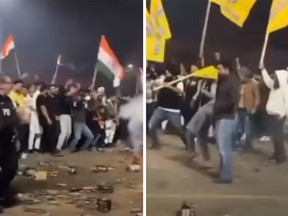 |
| A crowd waving Khalistan flags faced off with nationalists brandishing the Indian flag in a Mississauga, Ont., parking lot on Diwali. Police watched as the two sides yelled and set off fireworks, but there was no violence. Photo by SherePunjabRadio AM600 /YouTube |
Labels: Hindus, India, Indian Diaspora, Referendum, Separation, Sikh Khalistan, Sikhs
posted by Pieface | 9:36 PM
|
0 comments


_resources1_16a08521e2d_medium.jpg)