This is a blog dedicated to a personal interpretation of political news of the day. I attempt to be as knowledgeable as possible before commenting and committing my thoughts to a day's communication.
"Most scientists studying the origins of COVID-19
have concluded that the SARS-CoV-2 virus probably evolved naturally and
infected humans via incidental contact with a wild or domesticated
animal. But a few persistent voices, including respected microbiologist
and biosafety advocate Richard Ebright, PhD, continue to highlight
circumstantial evidence suggesting that SARS-CoV-2 escaped from a
biohazard laboratory in Wuhan, China. Such an escape might have occurred
via accidental infection of a lab worker who came into contact with the
isolated virus, an infected lab animal, or animal waste.
For now, we cannot definitively rule out either origin story—a lab
accident or a natural animal-to-human transmission. Determining the
origins of this pandemic is unlikely to help current efforts to treat
and cure the disease. It could, however, be an important determinant for
efforts to prevent future outbreaks."
"Most arguments in favor of the lab accident theory are based on
geography. Wuhan, the site of COVID-19’s first reported cases in late
2019, is also home to two of China’s most advanced biological
laboratories. The Wuhan Institute of Virology (WIV) has come under
special scrutiny because it hosts China’s only biosafety level 4 lab
facilities."
"Ebright, a former Howard Hughes Medical Institute investigator and
current laboratory director at Rutgers University, is the most prominent
scientist espousing the possibility of a lab escape. He raised biosafety concerns
about WIV when it opened in 2017, as did Tim Trevan, founder of CHROME
Biosafety and Biosecurity Consulting. Ebright has long opposed the
expansion of preventative research into dangerous pathogens, and he
views the possible lab escape of SARS-CoV-2 as strong support for that
position."
Genetic Engineering & Biotechnology News
"It certainly couldn't have been Wuhan ... surely another person brought it in. Or surely it came from some other product brought from outside."
"There were just certain conditions for it to appear here."
Chen, wet-market vendor, Wuhan, China
"The first cluster of cases was there, so at least it would be of interest to find out the origin of those and put forward a few hypotheses, like whether it's more likely from the wild animals or perhaps points to a human super-spreader."
Jin Dong-Yan, professor of virology, University of Hong Kong
"There is new evidence to show that China locked down all domestic
traffic internally by end January 2020 but pushed to open foreign travel
till end March. Data from Tom Tom traffic index, a traffic location
site that covers 416 cities across 57 countries show that as a result of
this strategy, China, intentionally or otherwise, was able to lockdown
its cities unknown to the world. While this reduced the spread of the
Corona virus within China, China’s aggressive foreign travel policy lead
to a virus explosion worldwide."
Sandip Sen, The Economic Times, April 30, 2020
"
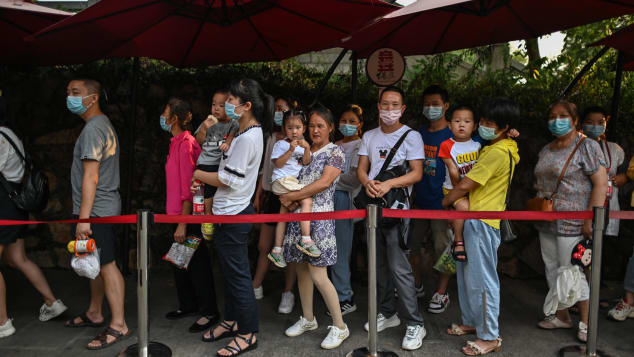
Tourists wearing face masks line up outside the Yellow Crane Tower in Wuhan, China on September 3.
HECTOR RETAMAL/AFP/AFP via Getty Images
The Huanan Seafood Wholesale Market in Wuhan, China where vendors set up their wares in small stalls was a popular place for individuals to shop as well as local restaurant owners who would start their day by passing through the market to pick up fresh-caught fish and bring it back to their restaurants to begin the day's menu preparations. Most Asian cities have such live markets, Tokyo, Japan has a large celebrated market, Ueno district's Koromon market, where crowds of shoppers converge on the market to sample live fish. These markets are part of the food culture, a part of daily shopping life.
On December 31, 2019, four cases of a mysterious type of pneumonia appeared at local Wuhan hospitals and were linked to the Huanan market and overnight it was no longer open for business, taking shoppers by surprise the following morning. A month later, the city went into a strict 76-day lockdown on hours' notice, barring people from leaving their homes. A severely restrictive move that represented the start of a hugely successful gambit to control the new virus's spread. Hubei Province itself was border-shuttered to the rest of China.
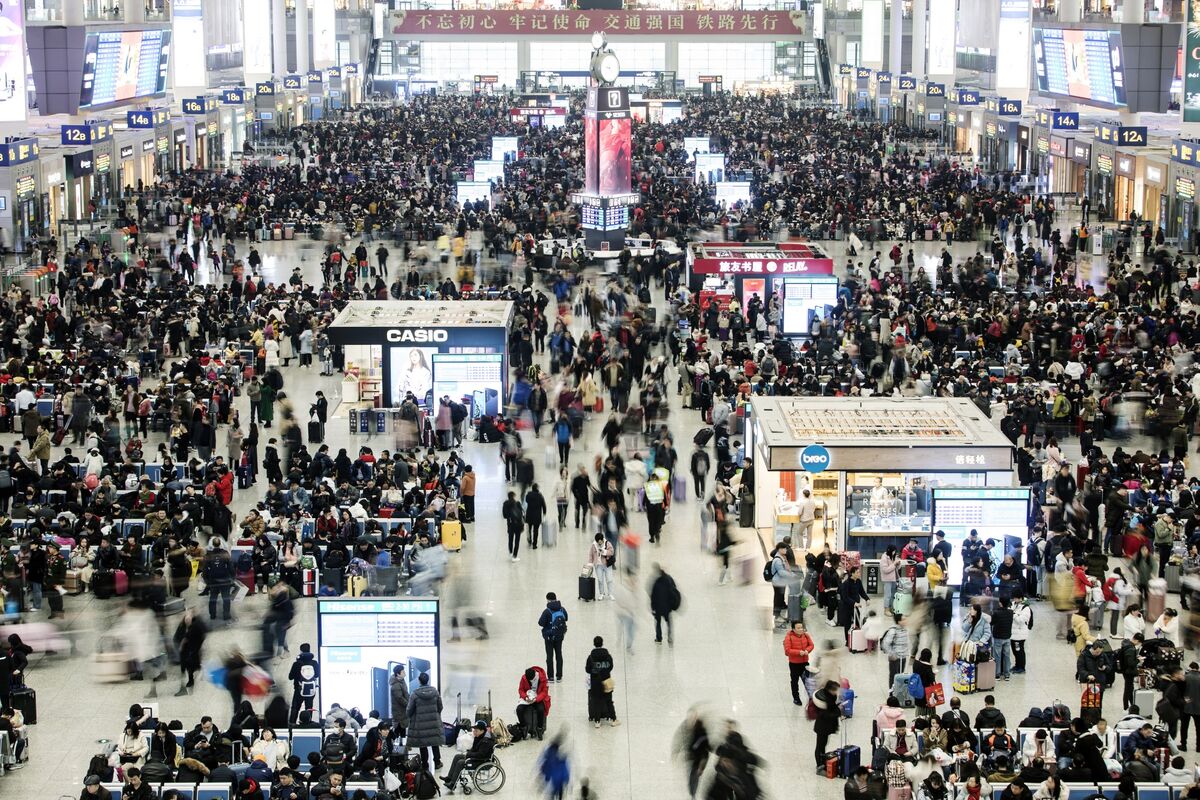
Travelers walk through the main hall of the Hongqiao Railway Station in Shanghai on Jan. 18.Photographer: Qilai Shen/Bloomberg
On the other hand, China kept its national borders open so Chinese could celebrate the Lunar New Year as usual, and the population spread out in its customary holiday travel pattern as millions of Chinese travelled back to their home cities and provinces in a tradition as important to the Chinese as Christmas is to Westerners. A massive human migration takes place as individuals travel back to
their hometowns. People in China are estimated to make close to 3
billion trips over the 40-day travel period, or Chunyun, of the Lunar
New Year holiday. It's estimated that 5 million people left Wuhan, the epicentre of the pandemic before the travel ban of January 23, 2020. An estimated million Chinese went abroad, to Europe and elsewhere during that period.
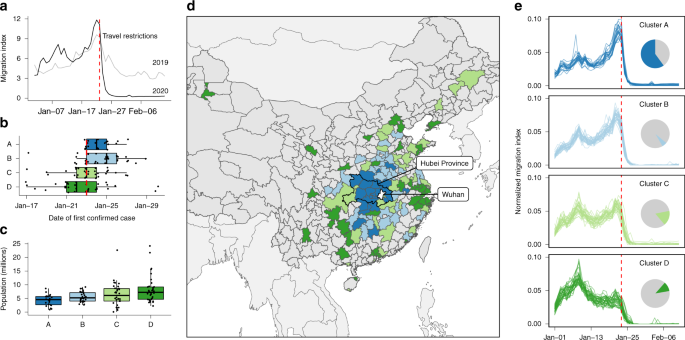
The disease spread rapidly throughout China and to neighbouring countries. Despite the aberration of the massive migration for the Lunar New Year celebrations, China and its neighbours then cracked down on their populations, enacting draconian social distancing laws and total lockdowns. Their success in bringing the internal spread of the disease following a massive infection rate in China which led to hastily built hospitals to handle the load and patients being isolated in massive temporary quarters with cots lined up one after another in proximity to one another, did succeed in eventually quelling the massive outbreak.
Which then spread to Europe, devastating the continent which is now grappling in desperation with its second and third waves of the domineering recurring nightmare. Globally, over one-and-a-half million people have died of the effects of SARS-CoV-2. Initially, Beijing had bristled at the global community's attempts to close their borders to Chinese visitors, claiming the move was clearly racist in nature; even the World Health Organization supported China's umbrage, chiding the rest of the world for their reaction. The United States now hosts a ravaging beast of a pandemic.
When both Beijing and the WHO came under criticism, particularly from the U.S. administration, both bridled and responded they had each acted with alacrity to stem the tide of the viral contagion, acting with due respect and regard to public safety globally. China took further umbrage when the virus was referred to as the China virus, and the WHO came up with a neutral designation for the scourge. To their credit, Chinese scientists released to the world at large the genetic sequence of the virus, enabling scientists elsewhere to get on with research to find a vaccine against the virus.
In Wuhan, the city is once again 'normal'. But the wet market remains closed, the stalls shuttered. The origin of the virus remains a topic of fierce political and scientific enquiry. Beijing circulated the claim that the virus originated elsewhere, in Spain or Italy, and was then brought to China where it surfaced to appear as the origins of the virus. Residents of Wuhan certainly don't believe the virus really originated there, but was brought to the city by travellers. When a second wave erupted in China, a strain of the virus brought back by Chinese returning from trips abroad again, it gave impetus to the notion that the virus originated abroad.
Beijing and the United States continue to spar with one another along with other countries, accused by China of bias against the Chinese. Even yet, a team of World Health Organization experts has still to visit Wuhan to gather information. Origin-tracing efforts, warn health authorities in China and elsewhere, could take years and in the end inconclusive results may be yielded. More recently Chinese diplomats and state media claim their belief the market was not the origin of the virus but the victim of the disease, which originated somewhere other than China.
According to experts the market is critical to any investigation, unlikely to be dismantled even though the bulk of the research would rely on samples sored immediately following the outbreak. Access to the market area is heavily restricted. The bustling building with its hundreds of stalls sectioned off into areas for red meat, for seafood, and for vegetables is now quiet and abandoned. Local government has placed traditional Chinese paintings over the semi-permanent blue barricades the area is encircled by. Wooden boards line the interior stalls and windows.
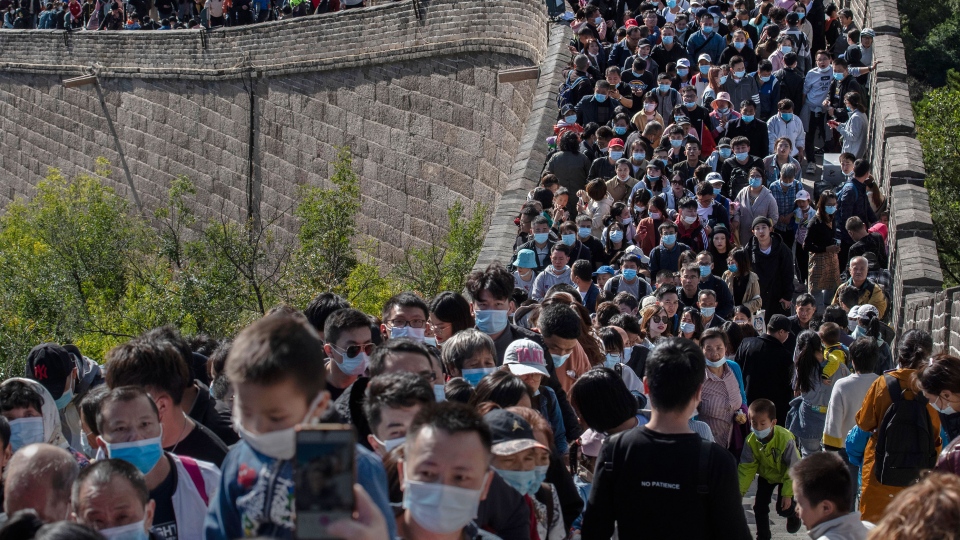
Chinese tourists crowd together on the Badaling section of the Great
Wall of China in Beijing on October 4, 2020. (Kevin Frayer/Getty Images)
"A report issued by a Shanghai-based online travel agency said people from over 100 Chinese cities had booked to
travel to nearly 500 destinations across over 90 countries and regions."
"Thailand, Japan, Indonesia and Singapore are among the most popular
destinations while Nordic countries, the United Arab Emirates and Spain
have seen the fastest growth of Chinese visitors".
"Traveling schedules covering cultural sites or winter sports that can
be enjoyed by a big family are the most popular choices, indicating
that Chinese are willing to enjoy high-quality travel experiences."
"Lvmama, another Shanghai-based online travel agency, said in its
latest report that more convenient transport, easier visa application
procedures and Chinese people's upgrading demand for leisure were major
factors in China's booming outbound tourism."
"In 2018, 140 million Chinese traveled outbound, marking a
year-on-year increase by 13.5 percent, according to the China Tourism
Academy."
XinhuaNet, December 13, 2019
Wuhan has not reported any new locally transmitted cases of COVID-19 since May. A local restaurateur speaks of the market's closure and public panic over the safety of imported seafood, increasing the cost of ingredient procurement substantially. Above the empty, closured market, shops reopened in June selling optometry equipment and eye-ware. Guards at the upper entrance to the market take temperatures, warning that no videos or photos may be taken inside the building. "Maybe some people have some bad feelings about it, but now it's just an empty building ... who feels anxious about an empty building?" a shop assistant remarked.
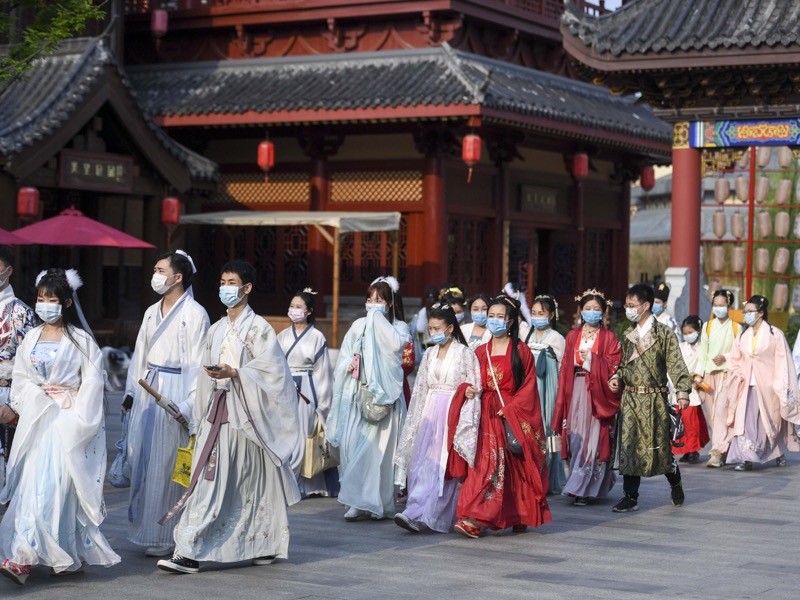
People at a heritage theme park in Hunan province in China, wear face masks and traditional dress.Credit: Yang Huafeng/China News Service/Getty
The Imponderable Dichotomy of an Incorrigible Outlier Administration on COVID
"The USSS [United States Secret Service] is taking all necessary precautions and putting anyone who is
considered close contact in quarantine."
"There has been zero impact on the mission. Staffing levels are high
enough to manage."
"The Secret Service maintains well-established protocols inclusive of
testing, conducting contact tracing related to confirmed and suspected
exposure, and immediately isolating of any employee who tests positive
for COVID-19."
"This program ensures that
every precaution is taken to keep our protectees, employees, families,
and the general public, safe and healthy."
United States Secret Service Official
It
was unclear how the Secret Service officers contracted the virus. Many
had traveled to campaign events in the final weeks of the election,
according to people briefed on the matter. Credit...Doug Mills/The New York Times
Over 130 Secret Services officers assigned to protect the White House and President Trump on his travels have been ordered to isolate or to go into quarantine, either as a result of their having tested positive for the novel coronavirus or that they have had contact with others infected with COVID-19. There has been no official public announcement, but three unauthorized insiders in the Secret Service who are familiar with agency staffing recently divulged details of the situation.
The situation has led to ten percent of the agency's core security team having been sidelined, the spread believed to have been linked in part to a series of campaign rallies held by President Trump in weeks prior to the November 3 election. Although the three insiders spoke freely to some news media in interviewed they spoke on condition of anonymity on a matter whose very nature represents a breach of security. There is irony in the outcome of Secret Service officers assigned to protect a president coming to harm by actions of that president.
The Secret Service's presidential security unit has been struck particularly hard, echoing in part the growing numbers of White House intimates, prominent Trump campaign allies and officials who have fallen like dominoes following campaign events at which many of those attending habitually spurn mask-wearing. Judd Deere, speaking for the White House, emphasized that the administration takes "every case seriously" referring questions to agency officials who themselves declined comment, as they would.
President Trump held to a tough, efficient and gruelling campaign schedule that led to five campaign stops each on the last two days of the campaign. At each of which events five disparate groups of Secret Service officers were deployed; each group comprised of 20 to several dozen officers tasked to screen spectators and secure the perimeters of the president's events. By comparison, his challenger made two campaign stops, requiring Secret Service protection in smaller numbers.
Following the example of Donald Trump, White House staffers typically eschew the wearing of face masks. Leading the agency to examine whether some of the infections among their officers might have resulted from positions right around the White House itself. On some occasions Secret Service officers have emulated the staffers at the White House, and not themselves taken to wearing masks.
A U.S. secret service agent stands guard as US President Donald Trump
speaks during a rally at Prescott Regional Airport in Prescott, Arizona
on Oct. 19, 2020.A U.S. secret service agent stands guard as US
President Donald Trump speaks during a rally
About a thousand, three hundred Secret Service officers are deployed in guarding the White House and the residence of the vice-president, just as they also are tasked with security for presidential trips out of town, and at official events. As a result of the pace of the frenetic activities related to the election campaign, the team had been under performance stress. Now that the number of officers has been so significantly reduced, the overworked team is in further stress.
A blue-ribbon panel struck in 2015 had identified overworked Secret Service officers as a key factor contributing to White House security breaches. This, needless to say, predates Donald Trump's time in office. It is undeniable that the president's penchant for underplaying the serious nature of the SARS-CoV-2 contagion in the greater interests of maintaining the economy has influenced those members of the vast American public who trust and admire him not to themselves wear protective face masks.
He has routinely made light of the medical community's urging to the public to practice social distancing, hand hygiene and mask-wearing, jeering at those who trustfully follow those instructions while himself insouciantly defying such namby-pamby instructions, even after he had himself been struck with COVID. Many tens of thousands of Americans, needless to say, were not as fortunate as he was, to receive the most expert professional medical aid for a speedy recovery.
His influence continues to instruct his followers to defy medical advice in precautionary measures at a time when the United States has become the centre of the worst global outbreak of COVID.
President Trump hinted he may 'fire Fauci' after the election, to the cheers of the audience at a campaign rally in Florida. Associated Press
Matters, however, are never as simple as they appear to be. While he has been a backward influence in the U.S. on necessary precautions the public should adhere to in an effort to protect themselves and their neighbours from the global pandemic threatening life on a heretofore unseen scale in living memory, his administration has also been responsible for shaping events to the extent that a U.S. pharmaceutical giant in collaboration with a German company has developed the first efficient and safe vaccine for COVID.
It was his administration's early, sustained focus on development of a vaccine as public policy that spoke to good governance, a reflection that modern medicine could ultimately find a way out of a global threat. Operation Warp Speed; government in partnership with the private sector worked expeditiously to accelerate, develop, manufacture and distribute a vaccine. The expedited regulatory processes, the $2 billion of federal funds pre-purchasing 100 million doses benefited the discovery of Pfizer's vaccine.
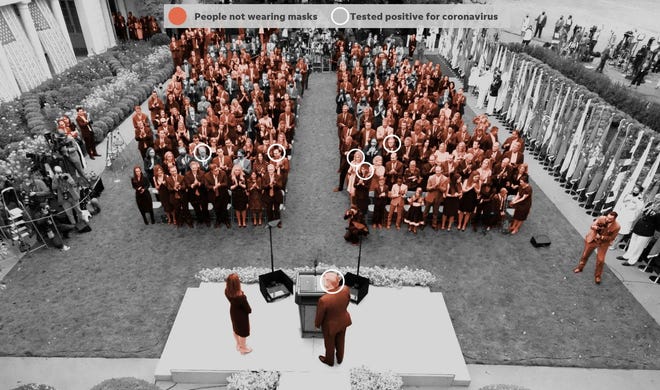
Graphic of positive people at Rose Garden event, October 2 Javier Zaccarina
"It [intervening early and more aggressively in those whose COVID-19 condition is heading toward a bad outcome] also gives us an opportunity to have really frank and honest conversations with substitute decision makers and loved ones." Dr.Douglas Fraser ICU physician, lead researcher, Lawson Health Research Institute
"They're testing really aggressively in Australia and they're just not finding cases. As far as we know people don't transmit influenza virus unless they have symptoms. It would be almost societally unacceptable right now to be walking around with those kinds of symptoms. And that's when you're transmissible for flu. We would expect there to be much more prompt isolation of cases of infectious influenza [than usual]."Dr.David Buckeridge, professor, School of Population and Global Health, McGill University
"[The southern hemisphere's experience is, in some ways] a good reflection that all of the good public health measures that people are continuing to practise, the hand-washing, the physical distancing as much as possible, the use of non-medical masks and so on, that help prevent or limit the transmission of COVID-19, would also work equally well for other respiratory infections, including influenza."Dr.Howard Njoo, deputy chief public health officer, Canada
Getty Images
"Why are critically sick COVID-19 patients clotting"?, posed one of the more puzzling questions doctors grappled with. And now, thanks to the research of a team of scientists in London, Ontario, led by Dr.Douglas Fraser, the answer has arrived. The body's immune system, responding to an invasion of the novel coronavirus, churns out enzymes shearing off minuscule sugar-coated hairs leaving blood vessels to become inflamed and exposed, causing platelets to grab, causing tiny clots in the lungs and in the body.
Apart from which the identification of six molecules that seem to predict who is at the highest risk of death with severe COVID-19 to alert doctors when to intervene might result in a scenario guiding doctors to intervene at an earlier date in the disease's progression and more aggressively in recognition of those people destined to have a very serious outcome, with increased risk of death. And those breakthroughs were attributable to the research work of Dr.Fraser and his colleagues who identified the critical six molecules predicting who is at the highest risk of death.
Should similar research with corroborative results support the claims for these two research projects, the results of the two studies may lead to improved treatment for a new disease on the cusp of converging with an old familiar one. The collision of COVID and flu is on everyone's mind with the approach of winter and traditional flu season. Some, like Dr.Howard Njoo, take comfort in the fact that Australia is experiencing a relatively mild flu season, hoping that this will become the norm everywhere, this year of SARS-CoV-2.
"Influenza is predictably unpredictable", Dr. Mark Loeb, professor of pathology and molecular medicine at McMaster University observed. "Almost nothing is known" about co-infection with flu and COVID-19, wrote U.S. epidemiologists Michael Osterholm and Edward Belongia reporting in Science. They note that most people are vulnerable to the pandemic virus and should a surge in COVID-19 occur in the fall, overlapping with a surge in flu, the resulting stress on hospitals could become catastrophic. The hope would be that the number of those infected with each virus will tend to peak at different times, not simultaneously, reducing the strain on the medical system.
The potential of a "twindemic" looms as a possibility, creating unique challenges in having the vaccine administered in a timely manner to an awaiting population. In May, a Pollara survey of 1,912 Canadians saw 57 percent claiming they would "definitely" or "probably" get a flu shot, an increase from 45 percent over last year. With many buildings remaining shuttered, fewer office flu clinics will be available. The question of sufficient PPE for vaccinators in pharmacies and other places also presents as a dilemma.
The Public Health Agency of Canada is urging provinces and territories to think outside the box to arrive at working strategies, including multiple, smaller clinics; administering inoculations outdoors in parking lots or drive-thru clinics; mobile clinics in vans or buses, fly-in teams in remote and isolated communities; all measures that could presage the day if and when COVID-19 vaccines become available. This year's flu vaccine has been tweaked from last year's but sufficient information has not yet emerged to determine which circulating strain will be dominant this fall and winter.
The risk of a dual or co-infection of flu along with COVID-19 is there, it is a risk, particularly to those with underlying illnesses. Early testing will be critical to enable doctors to know what they're dealing with; whether flu or COVID. Symptoms overlap, while treatments differ; a matter of testing early, diagnosing, for identifying which is which "will be an essential component for public health surveillances".
Dr. Loeb points out how critical it is that people continue to practise social distancing. "On the other hand there's a lot of return-to-normal activities such as school" which could make it increasingly difficult to contain both the flu and COVID. "We're seeing a spike in infections just as schools are opening up. Schools will send children home if the school is unable to determine whether a child hasCOVID-19 versus a cold or flu. For many families that means parents will have to try to work from home", observed Dr.Steven Taylor, professor and clinical psychologist at the University of British Columbia.