Politic?

This is a blog dedicated to a personal interpretation of political news of the day. I attempt to be as knowledgeable as possible before commenting and committing my thoughts to a day's communication.

Thursday, September 01, 2022

An Extraordinary Man of His Times

"Politics is more and more turning into an imitation of democracy. All power is in the hands of the authorities and the president."
"The economy is monopolized. Corruption has taken on colossal proportions."
Former Soviet Leader Mikhail Gorbachev, 2013 statement
 
"It is still difficult to say how the procedure [funeral of former Soviet leader Mikhail Gorbachev] will take place. It depends on the wishes of relations and friends."
"[He] sincerely wanted to believe that ... a new romantic period would start between the renewed Soviet Union and the collective West.Those romantic expectations failed to materialize."
"The bloodthirsty nature of our opponents has come to light, and it is good that we realized that in time."
Dmitry Peskov, Kremlin spokesman

"[Gorbachev was a] man who in six years destroyed our homeland and betrayed the whole socialist camp."
"Did he know what he was doing? No, he didn't."
"But he saw war -- more than one -- and each of them is on his conscience, because they were all the result of the breakup of the great Soviet Union."
Vladimir Solovyov, Russian talk-show host, Moscow
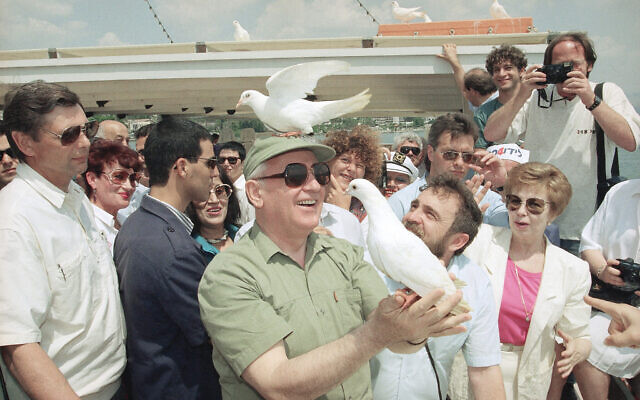
A peace dove sits on the head of former Soviet President Mikhail Gorbachev on Monday, June 15, 1992 as he sets another bird free during a leisure trip on the Sea of Gallilee, Israel. (AP Photo/Jerome Delay)

As far as the current Kremlin leadership is concerned, former Soviet  leader Mikhail Gorbachev failed his nation in a bid to alter the strait-jacketed near-tyrannical rule of the Soviet Union, to transform it into a communist-style democracy to give its citizens greater personal freedoms, to open the USSR to warmer working relations with the West, to re-start the economy on the model of capitalism to bring the USSR into the late 20th century.  

For bringing the Cold War to an end, for passively standing by while former satellite countries in Eastern Europe abandoned Mother Russia's stranglehold to declare themselves sovereign nations while shedding the mantle of communism, for opening Russia to improved relations with the West, Mikhail Gorbachev enjoyed wildly approving ratings within the international community. In his own Russian community he was loathed and criticized as a traitor to the nation.

In his later years he spoke about his intentions as opposed to the trajectory he had unwittingly unleashed leading to his formal 1991 declaration dismantling the Soviet Union. Explaining he could not possibly have risked igniting internal conflict by calling on his military to put down an insurrection of satellite states abandoning the forced collective. The very presence of a nuclear stockpile gave him pause for thought should a conflict ensue. So he stood by and watched his beloved USSR implode.

But the reforms he initiated in promoting multi-candidate elections, freeing political prisoners, allowing Russians to travel outside their country, inviting international investments in Russian industry and stimulating economic reforms, all had a liberating effect on the country. Still, the reality was that all these initiatives failed to produce the speedy economic results Russians were led to expect such a transition would result in.

Reviled in Russia, celebrated as a great historical figure of his time globally, Mikhail Gorbachev's death at 91 from a long illness has left the question whether he will be honoured as all past leaders have been, by a state funeral. And the answer appears to be that a state funeral will be bypassed for this man who did so much in his time to change the outcome of Russia's empire and its immediate relations with the West. Established protocol will be denied him.

Two things: given his reputation in Russia as a leader whose actions bordered on perceived 'treason', and given Russia's current state of complete estrangement from its Eastern European neighbours and the sanctions imposed by the West related to the Russian invasion of Ukraine and its bloody results; the expectation that the usual state ceremony would attract the presence of international world leaders paying homage to the recently departed is unrealistic.

The obvious reality is that Russians regard their former leader as an enemy of their nation, one who destroyed and dismantled the Soviet system, ending Russia's powerful period in history as a great empire, leaving the nation broken and millions of people living in a period of economic turmoil and deprivation, means he deserves no regard as someone special to Russia. And Russians now have their strongman-preference leader restored, in Vladimir Putin.

A leader who has invested himself in reversing all the reforms toward democritization of Russia that Mikhail Gorbachev worked so assiduously toward. Still he managed to pay a kind of back-handed homage to his penultimate predecessor: "[Gorbachev was a] politician and statesman who had a huge impact on the course of world history. He deeply understood that reforms were necessary. He strove to offer his own solutions to urgent problems."
 
Initially, Mr. Gorbachev supported Vladimir Putin during his early rule, viewing him as a democrat committed to continuing to pursue necessary reforms in Russia. Eventually sharp criticism followed in 2011 in angry denunciation over fraudulent elections and the announcement by Mr. Putin he planned to return to the presidency, provoking mass protests in Moscow. 

In his later period of retirement from political life Mr. Gorbachev stated that his decision to step down instead of contesting the dissolution of the Soviet Union was motivated by a desire to avoid bloodshed. Mr. Putin, on the other hand, has brought Russia to war in his two decades in power no fewer than five times. Mr. Gorbachev is not known to have issued any public statements regarding Russia's invasion of Ukraine, since by that time he was severely ill. But it must have been the cause of great personal pain.
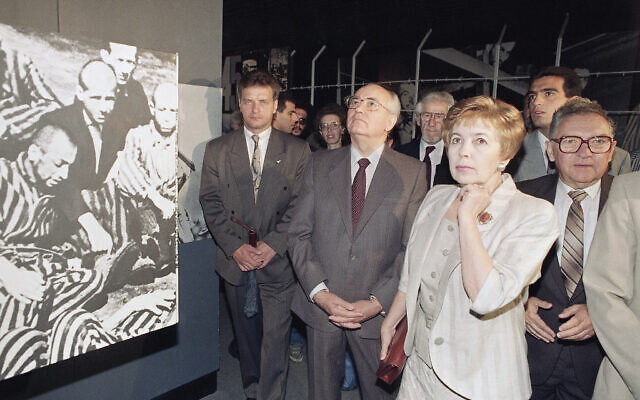
Former Soviet President Mikhail Gorbachev, center, and his wife Raisa, right, visit Yad Vashem, Israel's Holocaust museum and memorial, in Jerusalem, Tuesday, June 17, 1992. (AP Photo/Jacqueline Arzt)

Labels: , , , , ,

Tuesday, December 21, 2021

The Beginning of the End of the Soviet Union

"A great empire, a nuclear superpower, split into independent countries that could co-operate with each other as closely as they wanted, and not a single drop of blood was shed. It wasn't a tragedy at all. We decided to shut the prison of nations. There was nothing to feel contrition for."
"All versions of the union treaty boiled down to the restoration of the old ways or to Gorbachev's proposal of a new structure where he still would be the boss."
"Kravchuk [Ukraine's Leonid Kravchuk] was focused on Ukraine's independence. He was proud that Ukraine declared its independence in a referendum and he was elected president on December 1, 1991."
"Gorbachev told me in a mentor tone: 'Do you know what the international community would say?' And I responded that I do know. By that time the conversation with [U.S. President] Bush already started and I was hearing it. I said that Yeltsin was telling Bush about it and he [Bush] was reacting in a positive way."
Stanislav Shushkevich, 86, Republic of Byelorussia (Belarus) 

"What they so hastily and stealthily did in Belavezha was like a plot to kill an injured but still living person by dismembering it."
"The striving for power and personal interests prevailed over any legal arguments or doubts."
Mikhail Gorbachev, 90, former USSR president

"The Ukrainian independence referendum and the subsequent decision by the Ukrainian Supreme Soviet to disavow the 1922 treaty on creation of the USSR put a political and legal completion to the process of disintegration."
"Yeltsin and Shushkevich first tried to persuade Kravchuk to maintain some form of union, but after the referendum, he wouldn't even like to hear that word."
Sergei Shakhrai, top Yeltsin aide
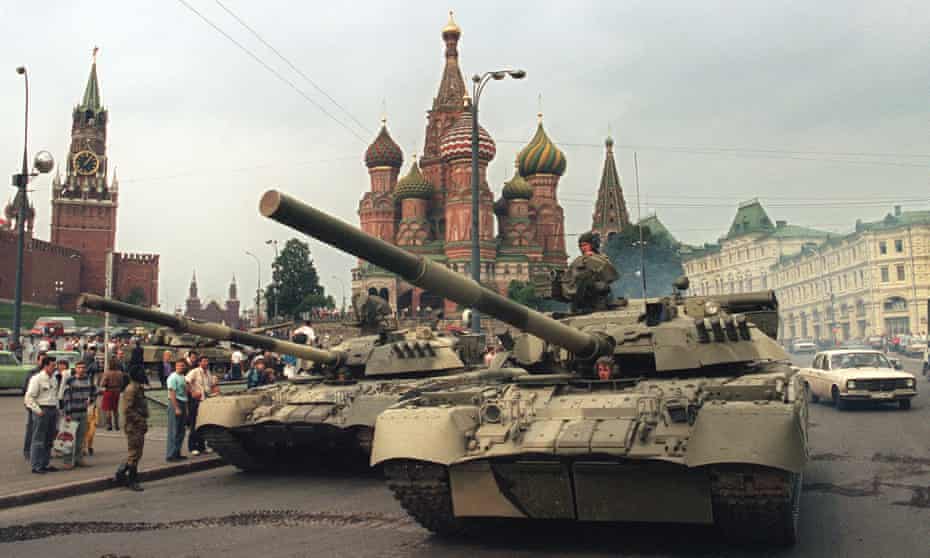
Soviet tanks near the Kremlin in August 1991
Soviet tanks near the Kremlin in August 1991 after an attempted coup against Mikhail Gorbachev. The deal signalling the USSR’s demise was signed months later. Photograph: Dima Tanin/AFP
 
The beginning of the end was heralded unintentionally by former general secretary Mikhail Gorbachev when he introduced the Soviet Union reformation concepts of glasnost and perestroika, the political movement within the Communist Party of the Soviet Union (CPSU) during the 1980s, whose revelation became a worldwide sensation, that the USSR was opening up as Mr. Gorbachev tried to ease tensions between the Soviets and the West. He was a passionate reformer, one critical of the excesses of Stalin, like Nikita Khrushchev before him.

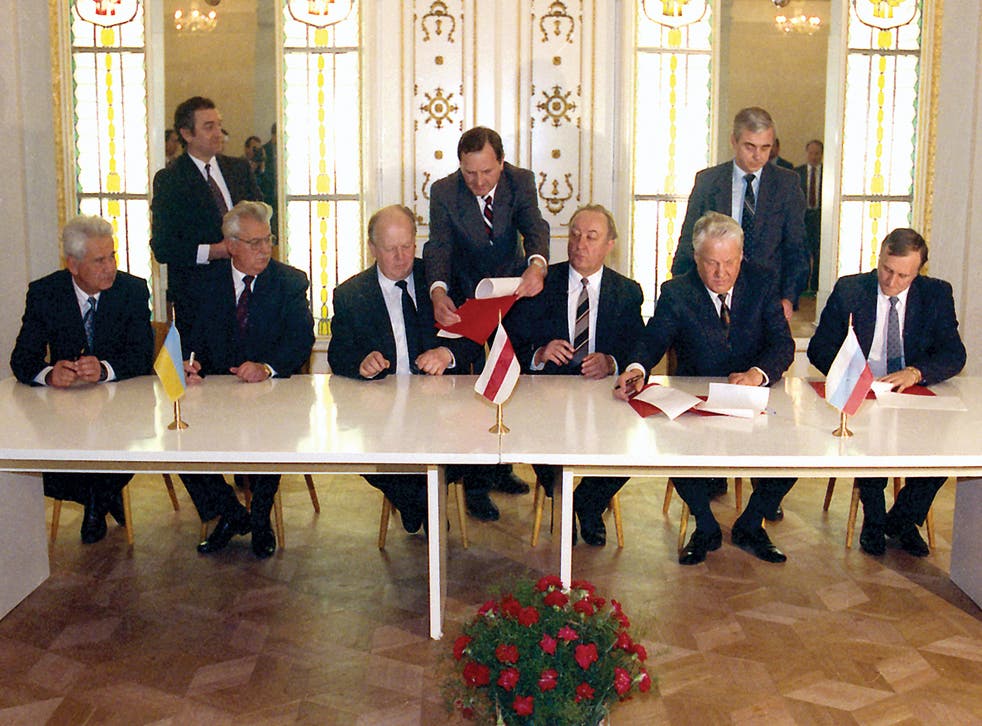
With the first crack of solidarity within the union, three Slavic republic leaders on December 8, 1991 met at a hunting lodge, a dacha in Viskuli, Belavezha forest to declare "the USSR ceases to exist as a subject of international law and as a geopolitical reality". Boris Yeltsin of Russia, Leonid Kravchuk of Ukraine and Stanislav Shushkevich head of the republic of Byelorussia took pride in co-signing the agreement, producing a "diplomatic masterpiece" of dissolution.

Eight other Soviet republics swelled the alliance two weeks later, thus terminating the authority of Soviet President Mikhail Gorbachev. The former Soviet republics revolving like satellites around the sun of Moscow, was no more. In his memoirs, the former president was bitter about the 1991 agreement destroying his own efforts to save the USSR from collapse with a new "union treaty" among the republics. 
 
The rebuttal from Shushkevich pointed out that he and the other leaders felt Gorbachev's plans to resurrect the union was pointless. Latvia, Lithuania and Estonia had already seceded and the backdrop of the failed August coup against Gorbachev had seen his authority eroded, an encouragement to other republics to seek their own independence. 
 
The three schemers, Shushkevich, Yeltsin and Kravchuk were accompanied by a few senior aides when they arrived at the Viskuli lodge. The atmosphere was later described as tense with the realization that the stakes were high including the risk they were taking of arrest on charges of treason should Gorbachev be so inclined. Eduard Shirkovsky, head of the KGB also at the hunting lodge had assured Shushkevich no threat to their safety existed. 

Gorbachev had decided against moving against the plot fearing bloodshed in a volatile situation at a time the loyalties of the Soviet army and law enforcement were split. "If I decided to rely on some armed structure, it would have inevitably resulted in an acute political conflict fraught with bloodshed", he later wrote, blaming Yeltsin for spearheading the Soviet collapse, ambitious to take over the Kremlin.

Ukraine had declared its sovereignty after the August coup that had weakened Gorbachev's authority. The previous week Kravchuk had been elected Ukraine's president in a vote that gave full support to its independence from Moscow. At the hunting lodge Kravchuk was forcefully determined, rejecting a revamped version of the Soviet Union. 

Describing the collapse of the Soviet Union as "the greatest geopolitical catastrophe of the 20th century", Vladimir Putin continues to to state his conviction that Ukraine unfairly inherited historic areas of Russian heritage with the demise of the USSR. Russia's response ultimately was to annex Crimea and back ethnic Russian Ukrainian rebels in eastern Ukraine, leading inevitably to the current Russian buildup of troops along the border with Ukraine.

Russia Soviet Collapse Anniversary
"Modern Ukraine is entirely the product of the Soviet era."
"We know and remember well that it was shaped -- for a significant part -- on the lands of historical Russia."
"It's crystal clear that Russia was effectively robbed."
Russian President Vladimir Putin

Labels: , , , , ,

Sunday, August 25, 2019

Pick Your Version : Rewrite History

"August 23 will mark 80 years since the signing of the Molotov-Ribbentrop Pact between the Soviet Union and Nazi Germany that sparked World War II and doomed half of Europe to decades of misery. The Pact contained the secret protocol which effectively carved up Eastern Europe into spheres of influence."
"This is why on this day proclaimed by the European Parliament as a European Day of Remembrance for Victims of Totalitarian Regimes we remember all those whose deaths and broken lives were a consequence of the crimes perpetrated under the ideology of Nazism and Stalinism."
"Pain and injustice will never fall into oblivion. We will remember."
Joint statement: Estonia, Latvia, Lithuania, Poland, Romania

"Naively calculating that the war would pass them by, the Western powers played a double game. They tried to steer Hitler's aggression eastwards."
"In those conditions, the USSR had to safeguard its own national security by itself."
Russian foreign minister Sergei Lavrov

"The Soviet Union made massive efforts to lay the groundwork for a collective resistance to Nazism in Germany, made repeated attempts to create an anti-fascist bloc in Europe. All of these attempts failed."
And when the Soviet Union realized that it was being left one-on-one with Hitler's Germany, it took steps to avoid a direct confrontation, and the Molotov-Ribbentrop Pact was signed."
Russian President Vladimir Putin, 2015

"Putin is saying that annexation of the Baltic states, aggression on Poland, aggression on Romania, on Finland, all of this was not a big deal, a natural part of history, and that is a problem."
"We should ask ourselves why we commemorate all these historical events. Not because these politicians are historians."
"We do it to send a message to our contemporary society about what is right and what is wrong."
Slawomir Debski, political scientist, historian, Director, Centre for Polish-Russian Dialogue and Understanding
German Nazi Foreign Minister Joachim Von Ribbentrop (L), Soviet head of state Joseph Stalin (2nd L) and his Foreign Minister Vyacheslav Molotov (R) are seen on 23 August 1939 in Kremlin in Moscow during the signing of the Treaty of Non-aggression between Germany and the Union of Soviet Socialist Republics, making the outbreak of war virtually inevitable.AFP/Getty Images

They certainly deserved one another's company, the Black Widow Spider and the Deadly
Scorpion. A pact to ensure they agreed as they attacked and invaded their neighbours in Eastern Europe, a pact to divide the spoils, a pact to make certain that one would not turn on the other. And then, of course, it was set aside, and Nazi Germany set upon Communist Russia, two ideologies, fascism and communism at supposedly opposite ends of the political spectrum, but in reality uncannily alike in their despotism and carnage of the human spirit.

Representatives of Nazi Germany and the Soviet Union met in 1939 as a preliminary to World War II. The non-aggression agreement complete with an agreeable formula to loot Europe and divide the spoils between them. Poland, which had undergone so many invasions and entitled 'ownerships' that it could vie with Afghanistan as a wearily war-torn nation, to be shared between them while the fate of Estonia, eastern Finland, Latvia, Lithuania and parts of Romania ceded to the open maw of the USSR.

Germany, however, did not appear to be looking for a rival as a world power prepared to overwhelm the world, but a temporary rival it could appease for a time before adding it to its list of conquests. While Russia felt content to absorb its neighbours in the near-abroad in its tentacle grasp, leaving Germany to get on with its invasion of Western Europe. Hitler's sinister deadly plans for the Final Solution merely in its initial stages would face no objections from Stalin.

Hitler's troops hit Poland, and then Stalin's. And soon the Baltic states were annexed to Moscow's grand plan of absorbing the east, establishing the Union of Soviet Socialist Republics, satellite states loyal without choice to Russia's persuasive force. All this history now revealed in living colour in a new exhibition presenting the fateful pact as a normal business agreement between two political entities, two countries with the best interests of the continent in their rear view mirror, ever closer.

For many years the existence of such a pact was described as a fabrication by Russia until the 1980s when Russia finally agreed, yes, the protocol was real, but as real as any compact between two nations potentially useful to each other would be. And the pact undergoes a not-too subtle transformation as a self-protective measure by the USSR defending itself against the seemingly evident potential of West's eventual pact with Hitler that would target Russia.

German Chancellor Angela Merkel has her own interpretation, condemning the secrecy of the pact yet explaining: "Molotove-Ribbentrop Pact is difficult to understand without considering the additional secret protocol. (Agreement on dividing the spoils of invasion and occupation). With that in mind, I think it was wrong, it was done illegally", she stated; 'illegally'?
"Contrary to allegations that the agreement between Stalin and Hitler triggered #WWII in fact the USSR was practically the last geopolitical actor forced to sign an agreement with the Nazi Germany #TrueHistory."
Russian mission to the Organization for Security and Cooperation in Europe
Britain's perfidiously cowardly appeasement through then-British leader Neville Chamberlain was the closest the West ever got to an 'agreement' with Nazi Germany. And an infuriated British political establishment made quick work of his "peace in our time". "You were given the choice between war and dishonour. You chose dishonour and you will have war", Winston Churchill informed Chamberlain predictively.
Britain’s Prime Minister Neville Chamberlain is photographed signing the Munich Treaty as Hitler’s secretary Martin Bormann (R) looks on on September 29, 1938 in Munich. AFP/Getty Images  

Labels: , , , , ,

Thursday, December 07, 2017

Portrait of a Confident, Self-Contained Autocrat

"Putin’s views and policies align with Russia’s centuries-long perception that it has always been betrayed by the West. Russian tyrants have sought unchallenged power stemming from an inferiority complex and messianic vision of Russia as a nation unlike others. A Good Tsar can keep the country safe from those who would take advantage of its weaknesses. In such a state of constant fear of betrayal, Russia requires a powerful leader to ensure the maintenance of nationhood and vigilance. Real democracy is a threat. Indeed, Putin foments chaos overseas and invents stories of foreign danger, in turn selling himself as a strong leader who can protect his country from outsiders. The population is willing to trade transparency, political involvement and leaders who pilfer from the nation’s coffers in exchange for stability and safety."
"But despite appropriating the symbols of Russian mythology, Putin is not a classic Russian ruler. He is something new. He is a fabrication. He is playing a role. He is KGB through and through. His policies and public actions are contrived to brand himself as a tsar in order to better consolidate and hold power. His effort to adopt the mantle of an all-powerful leader of a mythical 1,000-year Russian state is nothing but a conscious and cynical effort to maintain his hold on power. Like despots the world over, he fears his people. He knows that he can no longer count on a booming economy and rise in the standard of living to ensure their support, and instead, he has clutched onto blood-and-soil nationalism."
John Sipher, Financial Post
Russian President Vladimir Putin at the Kremlin in Moscow on March 17, 2015. (Sergei Ilnitsky/AFP/Getty Images)
He was not to the manor born. But he conscientiously and assiduously groomed himself to the manner he was not born with, but achieved, despite having been raised in poverty to working class parents. A start in life that will never leave his consciousness. Not that he could blame his factory-worker parents when he was born in 1952 in Leningrad. Too late to recall the 900-day siege of Nazi Germany during the Second World War, but he would be intimately aware of the suffering the city, now St.Petersburg, persisted through.

Poverty is a degrading condition and he can recall the communal apartment with a toilet accessed down a long hallway shared by many families. By his own account, his boyhood was distinguished by his "hooligan" activities. His aggressive tendencies were channelled toward becoming adept in the martial arts, his favourite sport pursued well into middle age. No doubt he felt that kind of physical discipline would aid him in the future when he planned to seek out his destiny as a professional intelligence agent with the KGB. On graduation from the law faculty of Leningrad University in 1975 he did just that.

Working in counter-iuntelligence where he monitored foreigners in Leningrad, he earned his beginner's stripes, then moved on to a post in Dresden where the KGB worked with the East German Stasi, Ministry for State Security, ensuring that the East would remain clasped in the bosom of the USSR, a captured satellite, post WWII. His return from Leningrad saw his resignation from the KGB which had backed the abortive coup attempt to dislodge Soviet leader Mikhail Gorbachev, who had famously derailed the Soviet Union, but perhaps not intentionally, aiming only for more openness and partial integration with the West.

Putin had achieved a high degree of success, but not visibility, when he was head of the Federal Security Service, a successor to the KGB. But it was when the hapless, jolly-drunk Russian President Boris Yeltsin mysteriously chose an unknown Vladimir Putin as one of his succession of prime ministers that the man's future began to unfold in earnest. Once Yeltsin resigned, Putin fortuitously became acting president and immediately issued his formula to guide Russia into the future: "I want to warn that any attempts to go beyond Russian law ... will be decisively repressed." 

Russian law, formally instituted, or casually implemented by this man has been decisively made his own. The macho image of another Russian leader was revealed, an image applauded by most Russians who like their leaders emphatically tough and resolutely rough. Vladimir Putin invented and re-invented himself, first as a leader who would turn the nation back to Soviet-style communism, then as the leader who would sculpt the country into a cohesive whole of nationalist pride and reliance on their leader to maintain stability, build the economy, restore pride and defeat outside interference in Russia's affairs.

He played musical chairs with the constitution which forbade more than two turns at the presidency when he and Dmitry Medvedev cooperated between themselves for the greater good of bypassing the law, exchanging the presidency for the prime ministerial position while continuing to lead from that position, only to switch back again after serving the separating term to once again attain the presidency, but only after Medvedev succeeded in altering the constitution in his boss's interests, at Putin's behest.

Tangling with and taming the Chechen menace, sending his military into Ukraine and restoring the Crimea to Russian possession, Russia's adored strongman has an 80% approval rating among Russian voters; not, perhaps in Moscow, but in the great outer reaches of the country with the largest geographical reach in the world. Lucky Russia, their redoubtable president has showered his admirers with the good news he intends to run again for the presidency. In so doing, Russia will continue its defiance of international normatives and sinister reactions to political criticism, with full Kremlin support.

Labels: , , , ,

Saturday, February 11, 2017

The Russia of Today

"The Soviet Union broke up without a civil war, thank God. But huge empires always go down with a lot of noise. The process is not over. It will be many years before all the damage can be undone."
"Now, it's like the Soviet era is a phantom pain."
Yevgeny Roizma, 54, historian, mayor, Ykaterinburg, Russia

"It wasn't the collapse of the Soviet Union that was the problem. It was the economic dislocation. It created an economic depression that was far harsher than what was experienced in the United States in the 1930s [Great Depression years]."
Michael McFaul, U.S. ambassador to Russia, 2012 to 2014

"Putin thinks the state is legitimate because it is the state."
"He has a philosophical belief that popular revolutions against state power are always illegitimate, and always end in tears."
Alex Kliment, Russia specialist, Eurasia Group
Spasskaya Tower's chimes
Since the 15th century the Kremlin's towers and walls with their characteristic design have been and continue to be a symbol of Moscow and Russia.    Photo  by Sergey Semenov, Stas Sedov

That last observation may partially explain why and how it is that Vladimir Putin suffers no pangs of conscience in aiding Syria's president, Bashar al-Assad in his 'war on terror' against his own civilian Sunni population with the use of the most obscenely extreme military measures meant to maim, murder and mayhem. And nor has Mr. Putin been the slightest bit perturbed that his own warplanes have bombed and demolished hospitals, clinics, schools and other public institutions in Aleppo.

Perhaps the stupendous trauma of suddenly plummeting from world power status on the dissolution of the Soviet Union, to the status of a stumbling, lone nation abruptly assailed with a loss of global prestige, self-confidence, and economic stability, knocked humanity out of the consciousness of the man who now rues the fall of the Soviet empire, and engages in actions emulating and leading toward a restoration in part of what had been, to the alarm of former satellite nations.

"It was only  a few minutes' walk away [from their home] and it didn't open until 6 a.m.  Most days there would be a long line. If I was in the first ten, we would get cottage cheese or sour cream If not, only milk", explained Alexander Andreev, 64, recalling the end of Soviet normalcy when chronic food shortages erupted, in central Russia. He would be awoken by his wife at 5 a.m. to stand in a lineup outside a store near their home.

"I cried so much", 54 year old Tatiana recalls. "I was worried about the children. We were constantly adding things to the food to make it go further. Now, within reason, we can buy anything. Different kinds of cars. We can travel. We don't want to go back." 

Not go back to a time when everyone was equal and to each worker was apportioned the same living wage, irrespective of their personal commitment in industry and production? The talented and productive earning precisely what those who preferred malingering would, in the spirit of community and socialist fairness? When private dachas, luxurious vehicles and champagne and caviar represented the singular pleasures available to Party leaders? And no one starved unless they lived in Ukraine...?

And now, what now? Has the birthplace of equal inopportunity been vastly altered with the fall of the USSR? A 2016 Credit Suisse global world report tells us that of the world's unequal countries, Russia ranks at the highest level, with 75 percent of the nation's wealth in the control of the richest one percent;echoes of a familiar plant elsewhere. That while in 1991 no billionaires existed in Russia, while at the present time 77 billionaires with a combined net value of $289 billion are on the list of Forbes' richest people globally.

"It's becoming harder and harder to speak out against the crimes [human rights abuses endemic in the ex-Soviet Central Asian "Stans" and it is worse now than it's been at any point since Soviet times", according to Svetlana Gannushkina, 74, a mathematician, and formerly a Russian lawmaker who is currently a human rights lawyer, a woman held in such high esteem that she is named as a potential Nobel Peace Prize winner. "In Chechnya "there is no law, no constitution, only the order of [Chechnya leader] Ramzan Kadyrov", she states.

In the Russia of today, opposition politicians who contend against Vladimir Putin are charged with questionable criminal offences and languish in prison if they are not murdered first. In the Russia of today, news media are shut down, journalists are killed or imprisoned. In the Russia of today, Vladimir Putin's old KGB cronies are the elites, the preferential treatment they enjoy enriching them beyond their wildest dreams.

In the Russia of today, Vladimir Putin's palatial palace enshrines his indomitable position as imperial Czar. In the Russia of today, former satellite nations shiver in apprehension, as Mr. Putin manipulates relations with Georgia and Ukraine, ripping away portions he covets, and eyes the Baltic countries. Who weeps for Russia now?

Cathedral Square, the Ivan the Great Bell Tower
During the Mongol-Tatar invasion, the Kremlin was destroyed and then rebuilt. But only in the middle of the 14th century, during the rule of the Grand Prince Dmitry Donskoy, the Kremlin's wooden walls and towers were replaced by structures from local white stone. It was from that moment on that Moscow was referred to as "Moscow made of white stone" ("Moskva belokamennaya")

Labels: , , ,

Tuesday, January 17, 2017

Rising From Frustrated Impotence to Global Power

"Yes [Putin] is authoritarian, yes he uses extralegal methods to put down opposition and dissent, but it's small potatoes to what our allies do on a daily basis."
Norman Pereira, Russian historian, Dalhousie University

"The Russian mantra is that Russia is a great power [which is actually somewhat dubious -- land mass and nuclear weapons aside], and the Kremlin has been able to project that image on the international arena."
Jeanne Wilson, Russian foreign policy expert, Wheaten College, Wheaten, Illinois
Vladimir Putin answers questions from the press at the October 2016 BRICS Summit. Wikimedia Commons/Kremlin.ru
Kremlin.ru

"Due to the consequences of the Ukrainian crisis, the new Concept now includes a special point that covers Moscow’s readiness to oppose any attempt to using human rights as an instrument of political pressure and interference in the internal affairs of any state in order to unseat legitimate governments."
"Over the past four years, Russia has taken a number of steps to limit various organizations activities on its territory. For example, a law on “foreign agents” was passed, according to which any organizations that are engaged in political activity, operate on the territory of the Russian Federation and receive funding from abroad will be registered in a separate list."
"These organizations are required to provide a report on their activities and on the composition of their governing bodies twice a year. In addition, large sums of transferred money are also to be controlled. Besides that, the activity of the United States Agency for International Development is now completely prohibited in Russia."
The National Interest
Russia was bereft of its friends and allies, all of whom hastily dissolved their relationship with Russia on the dissolution of the Soviet Union. The former satellites of the USSR took little time in abandoning the sinking ship of the grimly controlling nation that assured them that all were equal under the aegis of the USSR, even while they were being manipulated and forced to abandon any thought of reverting to their previous status as autonomous sovereign nations, held firmly in the grip of a superpower.

While Russia was left to mourn the sudden collapse of its eastern European empire, the freed nations got on with being who they were untrammeled by the status they had so long chafed under, as appendages of Russia. Finding itself alone, little wonder Moscow was bitter and resolved to get on with its own future, stumbling badly on the way before recovering itself as a reinvented Greater Russian Federation. Made all the more greater by availing itself of parts of Georgia and Ukraine.

The Kremlin's assertiveness in world affairs signalled a resolve to return to the days of USSR influence as a reborn world power. One which, despite a flailing economy still focused on re-building its military arsenal and deploying its troops in what it considered to be troublespots where a Russian presence could guarantee growing influence and prestige. Succeeding where others failed, as for example, Syria. That their president chose to invest in the military despite economic problems at home sat surprisingly well with most Russians.

Their pride and their honour, after all, were being restored. They too, like their president, yearned for a return of their influential past where pride and honour resided; easy enough to forget the hardships and disappointments and fears of the past, as though the threat of the Siberian gulag never existed. Of course, influence was still there, in the permanent Security Council seat alongside China, France, Britain and the United States, where Russia could exercise its censure options alongside China, its uneasy partner in roguishness.

As for Russia's destabilizing effect in eastern Europe, one could convincingly argue that this is Russia's neighbourhood, the near-abroad, so that the presence of NATO, reassuring the Baltic states that they would be defended against Russian incursion is as popular with Russians as a Russian presence in Canada would be to the United States; similar in fact to the Russian presence in Cuba, abutting the United States and we know what happened then in nuclear diplomacy.

Russia never managed to doff the mantle of  'Cold War enemy status' despite a brief initial love affair that never solidified with the United States when George W. Bush declared that looking deep into Vladimir Putin's eyes he could see someone he would have no problem getting along with. Obama and Putin have no such love affair. And that is a matter that may change in the very near future when Obama is no longer in the Oval Office and a Putin-collegial Trump will be.

Fort Russ News

Mr. Obama's expulsion of 35 Russian diplomats as an expression of piqued retaliation for alleged Russian interference in the American election which failed to secure Hillary Clinton the presidency to ensure the prolongation of the Obama doctrine in foreign affairs was coolly received by Mr. Putin of whom Mr. Obama once said: "The truth is, actually, Putin, in all of our meetings, is scrupulously polite, very frank", but which failed to result in a cementing of good relations between the two seems on the cusp of turning full circle.

If Vladimir Putin was able to convince his American counterpart that working together on the Syria file by sidestepping red lines and failing to arm Syrian rebel groups sufficiently to allow them to successfully challenge the vicious brute who presented himself as the only alternative in Syria to terrorism by slaughtering a half-million of his own people as terrorists, the incoming American president should be putty in his hands.


Labels: , , , ,

Thursday, July 21, 2016

Glastnost's Hero

"I keep saying that Russia needs more democracy. I think if democracy is firmly rooted, if it is based on elections, if people have the chance to elect leaders at regular intervals, I think that is what we need."
"That is the basis for stability in foreign and domestic policy."
"We hear, even from people close to Putin, statements that emphasize authoritarianism, that emphasize decisiveness and that suggest that democracy can only be achieved far into the future. He considers himself deputy-God, I don’t know for what matters, though."
Mikhail S. Gorbachev, former Russian president

"Some love him [Mikhail Gorbachev] for bringing freedom, and others loathe him for bringing freedom."
Dmitri Muratov, editor, Novaya Gazeta
Mikhail S. Gorbachev at his office in Moscow last month. Credit James Hill for The New York Times
He is, after all, an elder statesman. He was a breath of fresh air in his day, a man unafraid as the last president of the Soviet Union, to see a future where his beloved country parted with its love affair with Communism and opened its mind to democracy, a political ideology that proved its value, whereas communism failed abysmally to produce the egalitarianism and social benefits its progenitors promised.

Mr. Gorbachev is a patriot, wishing only what he could imagine would be best to advance his country into a well-designed and prosperous and fair future, a distinct departure from the past. Little did he imagine that his successor would mentor a former KGB operative who would become a facsimile of the dictatorship that ruled and ruined the Soviet Union. Yet he saw it in him to agree with the annexation of Crimea from Ukraine.

Where Mr. Gorbachev took steps to introduce his country to democratic ideals in slow motion and Mr. Yeltsin was eager to be liked and to usher his transformed country onto the world stage, his alcoholic stupors stifled his capacity to adequately judge the character of the man he was grooming to take his place. And now, Russia has its President-in-perpetuity, who yearns to return the country to the good old days of hegemonic rule.

Mr. Gorbachev has just celebrated his 85th birthday with his wide circle of friends and admirers. It is doubtful that Vladimir Putin was present, or even invited, since it is equally doubtful each has much to say to the other. Vladimir V. Putin does not take kindly to his critics. "He [Putin] began suffering from the same disease from which I used to suffer: self-assuredness", commented Mr. Gorbachev, generously, during an interview.

Yet, where the comparison comes in is elusive to the mere onlooker; Mr. Gorbachev's perspective is that of an insider. An insider all too aware of his vulnerability to prosecution as a critic of the state and more critically, of its strong man. Civil liberties are not so assured in Russia as they might have been when Russia was still adapting to its change in fortunes.

There is a slight edge of bitter denunciation not without cause, when Mr. Gorbachev speaks of the manner in which a newly-dissolved Soviet Russia was regarded by the West. Not that there weren't useful initiatives, when the West saw it as their collective responsibility to help Russia clean up its shambolic nuclear sites.

But there was a casual dismissiveness in the relationship between the West and Russia that hadn't existed when the U.S. and the U.S.S.R. were considered the world's superpowers. A Russia attempting to re-acclimatize itself and reeling in economic distress was left to its own devices and perhaps regarded with a level of scorn unbecoming to nations with a regard for world stability.

That NATO and the European Union in particular overlooked the dignity of Russian pride, to jostle toward the prospect of social annexation of once-dependent Soviet satellites was viewed by Russia as both insult and assault. "There was a mood of  triumphalism at the end of the Cold War that was shared by many", said Mr. Gorbachev with regret and condemnation.

But the celebratory, congratulatory and joyful mood at his birthday party must have been of some solace to him personally. Toasts  went the rounds as the ambassadors of the United States, Germany, France and Israel saluted the man whose birthday it was, a man of uncommon integrity and honesty, grit and determination, whom fortune abandoned when death took his wife Raisa far too soon, giving him his "greatest loss" in life.

Labels: , , , , ,

Sunday, December 20, 2015

Restoring Stalin

"Of course, we have started to look at Stalin in a more favourable light."
"Why now? Maybe it's because the situation in the world isn't the best. We need strength. We need something to unite us."
Sergei Zaborovsky, tour operator, Military Historical Society
In storage, Gori, Georgia

"Stalin wasn't an angel -- far from it -- but he looked after the safety of his citizens."
Lydia Kozlova, director, Khoroshevo museum

"They're hearkening back on something great that can never be recreated. Even when I was a young child under [Soviet leader Leonid] Brezhnev, I remember hearing, 'If only Stalin was here'. If the director of the shop sold spoiled produce, 'If only Stalin was here'. If there was a line at the clinic, 'If only Stalin was here'. 
"But there was no such person who did this. They're thinking of a mythical Stalin."
Leonid Kavtza, history teacher, Gymnasium 1543, Moscow

In fact, the Communist ruling elite in the Soviet Union never much wanted for anything material. It was everyone else who struggled to be able to find heating for their homes, food for their pantry. Misery of want visited everyone. Collective farms produced dismal crops. Manufacturing enterprises turned out poor-grade products. From each according to his ability, to each according to his needs may have sounded noble, taking into account human need and character, but it was a hollow ruse.

When people were guaranteed the same miserable recompense that barely enabled them to scrape by, irrespective of what they were engaged, medicine, law, farming, manufacturing, street sweeping, teaching, the incentive that human beings need to motivate them to make an effort was lacking. And with that incentive lacking people simply made little effort to 'do their part' to ensure that the whole worked efficiently and well.

But nostalgia and sentimental recall are also strange human characteristics; we tend to look upon the past as golden years, while regarding the present as inferior to what went before. What went before was privation, was fear, was being ostracized, was massive social purging, was Siberian justice, was greed and ambition elevating the few and misery assailing the many.

Millions died in Stalin's USSR, of deprivation and starvation. The Russian people, on the one hand, suffered enormously but in retrospect their collective memory has faded in the fondness of what some believe was a better time. And so, Soviet leader Josef Stalin has been resurrected as a respected father of the nation. The current hugely popular father of the nation Vladimir Putin, has certainly had a hand in this refurbished vision of a benevolent dictator from Georgia.

Stalin has morphed from malevolent to benevolent, someone who did the best thing possible for Mother Russia. The suffering of the Russian masses in defense of their country under the Nazi juggernaut also no doubt served to preserve a spirit of shared hardship. The Communist Party is the beneficiary of sanctifying the memory of a mass murderer whose intrigues and orders played tyrant to the masses.

The negative view of Stalin has declined from 43 percent in 2001 to 20 percent at the present time. Museums dedicated to his time and statues of the noble man have become popular all around the country with the approach of the 70th anniversary of the Great Patriotic War. The politically-inspired executions, the gulags, the Holdomar that Ukraine bitterly recalls and ethnic minority deportations speak of a past that the current population has little memory of nor wish to recall.

Russian enterprises and individuals that oppose the refurbishment of Stalin's reputation are officially condemned as "foreign agents". According to Lev Gudkov, director of the independent Levada Centre, acknowledging that the Soviet system was criminal would lead to a "complete collapse of identity" on the part of many Russians, who would prefer by far to have pride in the past, however the reality is distorted to merit that pride.

Labels: , , ,

() Follow @rheytah Tweet