Politic?

This is a blog dedicated to a personal interpretation of political news of the day. I attempt to be as knowledgeable as possible before commenting and committing my thoughts to a day's communication.

Sunday, November 29, 2020

The Middle East Chess Game

"[The meeting with Netanyahu] aimed to highlight that MbS [Mohammed bin Salmon] is more willing than his father to take steps toward normalization without first reaching a two-state solution."
Neil Quilliam, Associate Fellow, Chatham House think tank
"We have supported normalization with Israel for a long time, because we are the authors of the 2002 Arab Peace initiative, which envisioned complete normalization with Israel."
"But there is one very important thing that has to happen first, which is a permanent and full peace deal between the Palestinians and Israelis that delivers a Palestinian state with dignity within the 1967 borders to the Palestinians."
Prince Faisal bin Farhan Al Saud 

"[Iran has exploited a 2015 nuclear deal with world powers] to intensify its expansionist activities, create its terrorist networks, and use terrorism. [This had produced nothing but[ chaos, extremism, and sectarianism."
"A comprehensive solution and a firm international position are required. Our experience with the Iranian regime has taught us that partial solutions and appeasement did not stop its threats to international peace and security."
"We support the efforts of the current US administration to achieve peace in the Middle East by bringing the Palestinians and the Israelis to the negotiation table to reach a fair and comprehensive agreement."
"This terrorist organization must be disarmed."
Saudi Arabia’s King Salman bin Abdulaziz
King Salman reiterated the need for a Palestinian state [File: Waleed Ali/AP]
"[There have been reports about differences within the royal family, particularly between King Salman and Crown Prince Mohammed bin Salman, on whether Saudi Arabia will follow others in the region and normalize ties with Israel.] So this was an opportunity to publicly before the world reiterate Saudi Arabia’s long-standing position … that there needs to be two states – an independent state of Palestine with its capital East Jerusalem."
"That’s a clear re-affirmation of Saudi Arabia’s stand and a real rejection of the current efforts to push Arab states to normalize with Israel. That was critically important."
Hillary Mann Leverett, former US official, CEO, political risk consultancy STRATEGA
The meeting between Israel's prime minister and the crown prince of Saudi Arabia messages both allies and enemies of the deep commitment the two countries have forged for the mutual concerns of containing the Islamic Republic of Iran's ambitions. The covert meeting that took place last Sunday in the Saudi city of Neom, publicly denied by Riyadh perhaps for several reasons, one being that King Salman had no prior notice of the impending meeting, conveyed a message to incoming President-elect Joe Biden. Allies of the U.S. are closing ranks, and they're focusing on future U.S. relations with Iran. 

No other Israeli leader has ever been in the position that Benjamin Netanyahu finds himself within, given current events in the region with softening attitudes evinced by Arab Muslim countries toward their Jewish neighbour whose support they all seek in their commonly-shared caution about the intentions of their Persian neighbour exploiting sectarian divisions, supporting and financing terrorist groups, fomenting regional problems, aspiring toward attaining nuclear weapons.

The covert visit had the effect of emphasizing the depth of concern shared by both Israel and Saudi Arabia about Iran, demonstrating just how serious opposition to Tehran is responsible for arranging a strategic realignment of countries in the Middle East in support of their common interests. "It's very important to create the axis which isolates Iran", explained Israeli cabinet minister Tzachi Hanegbi, commenting on the meeting.

The fear all now share with the clear understanding that the Trump administration is preparing to vacate the White House and President-elect Joe Biden is that is prepared to adopt Iran policies reflecting those practised during the U.S. presidency of Barack Obama which had the effect of straining Washington's connections with its traditional regional allies. Mr. Biden has made clear that he intends to rejoin the international nuclear pact with Iran that the U.S. under President Trump left in 2018.

Mr. Biden visualizes working with allies in strengthening the terms of the agreement should Tehran resume strict compliance. Which is expecting a lot, since it became clear soon after the 2015 agreement was signed by all concerned parties that strict compliance to the terms was never on Tehran's real-time agenda. Iran's network of armed Shi'ite militias across the Arab world, from Iraq to Syria and Lebanon and into the Gulf and Yemen, is alarming to its Sunni Muslim neighbours.

Saudi Arabia is particularly concerned with the Houthi rebels from Yemen, backed by Tehran attacking Saudi oil installations. On Israel's part, a silent war against Iranian forces through air raids in Syria on Lebanese Shi'ite paramilitary Hezbollah, on Iran's Revolutionary Guard Corps, and the focus on disrupting supplies of weapons shipped across the country, is ongoing. At the meeting on Sunday U.S. Secretary of State Mike Pompeo was present, along with the chief of Israel's Mossad.

Mr. Pompeo's active prompting of Gulf  relations with Israel, helped in formalizing Israel's already warm relations with the United Arab Emirates, Bahrain, and eventually Sudan in normalizing relations with Israel. He has continued his efforts to persuade other Arab nations that it is in their best interests for a variety of reasons to join suit, with the expectation that more will follow. Saudi Arabia's position on normalization hinges on King Salman, adamant that a peace treaty with the Palestinians take place.

"Normalization ... is a carrot to get [Biden's] focus away from other issues, especially [Saudi] human rights", suggested a foreign diplomat in Riyadh. The death on Friday of Iran's chief nuclear scientist may have been planned to put a spanner in the works of Mr. Biden's plans to resume the nuclear deal with Iran, and if so, it will have been worth the condemnation on the part of other nations looking in from the outside, none of whom have to overly concern themselves about the malign, disruptive and violent plans of a near neighbour.

Labels: , , , , , ,

Tuesday, September 01, 2020

The Abraham Accord

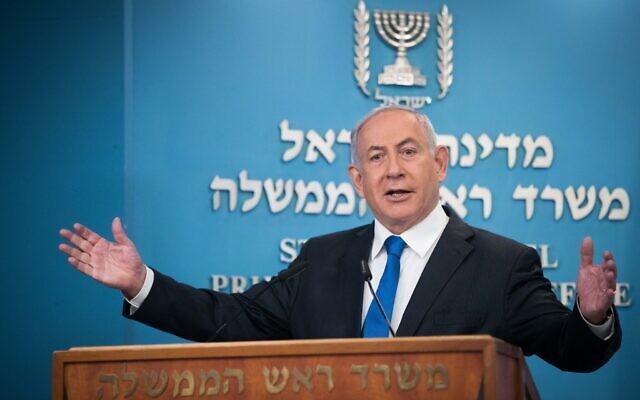
Prime Minister Benjamin Netanyahu discusses the Israel-UAE normalization deal at the Prime Minister's Office in Jerusalem, on August 13, 2020. (Yonatan Sindel/Flash90)
 Benjamin Netanyahu, Jerusalem, August 13, 2020. (Yonatan Sindel/Flash90)

"That's what peace for peace looks like."           "It will be a warm peace because it will be based on co-operation in the realm of economics with an entrepreneurial economy like ours with vast economic capabilities, with big money looking for investment channels."  Israeli Prime Minister Benjamin Netanyahu

"Peace is not an empty word used to normalize crimes and oppression. Peace is the outcome of justice."                                                                                     "Peace is not made by denying Palestine's right to exist and imposing an apartheid regime. Apartheid is what Netanyahu means by 'peace for peace'."               Palestinian politician Saeb Erekat

Erekat made those bitter accusations with a straight face. Mostly because he believes what he's said. That Israel, a Jewish state founded on historical heritage geography for a global ingathering to ensure that Jews will never again be subjected to pogroms or genocidal horror without defences, is an Apartheid state. A Jewish state within which citizenry has been extended to 20% of the population who are not Jewish; Arabs, Druze, Kurds, Bha'i, Christians and others who make Israel their home.

The Palestinian Territories, on the other hand, are Judenrein. Should Jews wander erroneously into Palestinian territory their lives would be forfeit. That's terrorism, that's racism, that's Apartheid. Israel's sequential governments over the past 70 years have never denied statehood to the Palestinians. Over the years one effort after another to bring Palestinian authorities to the bargaining table, making painful concessions to satisfy their demands, have failed.

For the quite simple reality that the Palestinian negotiators on behalf of their vision of 'Palestine from the river to the sea' envision Israel gone; their agenda is the denial of Israel's right to exist, the polar opposite of Erekat's mendaciously fallacious claim. Those viperous accusations resonate, however, in a Palestinian population that has been inundated and steeped in such reversals of truth from childhood to adulthood.

Israel previously signed two other peace agreements; one with Egypt the other with Jordan. Peace, in the absence of war when the two Arab nations understood they will never extirpate Jews from their very own heritage geography and in a sense of practicality accepted Israel's enduring presence. Friendly relations? Never; cold, distant and combative. Egypt's President al-Sisi a notable exception in his realization that Egypt has much to gain, along with his belief that Islamic scholars should be more responsible in their edicts.

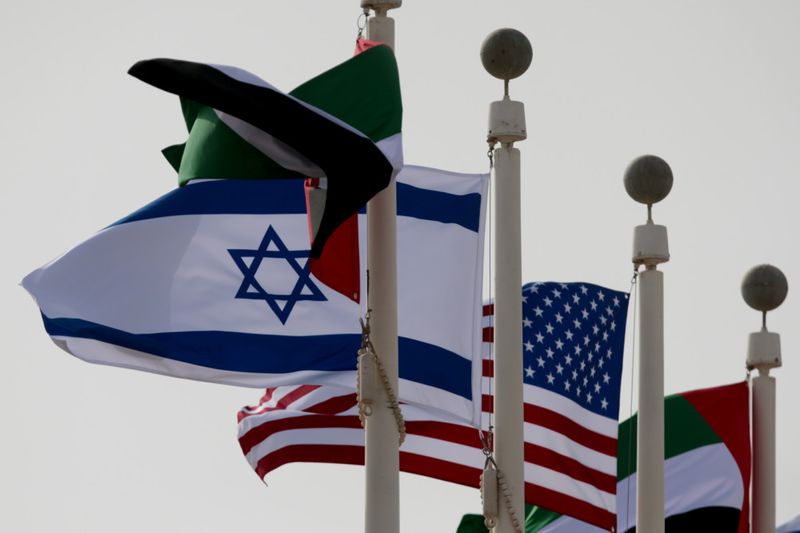
Copy of 2020-08-31T122604Z_158584456_RC20PI9XLURP_RTRMADP_3_ISRAEL-EMIRATES-USA-1598878552643
Israeli, U.S., Emirati flags, Abu Dhabi International Airport REUTERS

The United Arab Emirates' willingness to sign a peace agreement with Israel ventures into different society-to-society territory, extending warmth, helpfulness and a wish to explore deeply useful relations between the two nations. An attitude reciprocated by Israel in enthusiasm and exuberance to be finally accepted, with the hope that more Sunni Arab nations will follow the UAE's lead. Israel possibly retains a modicum of uncertainty while the UAE appears to have none in their surrender to the inevitable whereas Israel has been the subject for all of its modern-day existence of neighbourly hostility and violence.

The Palestinian Authority reaction to the words of friendship passing between the UAE and Israel, sincere, authentic and of great relief to both great nations, is 'disappointment' leading to the usual Palestinian malice against those it believes have abandoned its 'cause' of avoidance of 'normalization' with Israel, since normalization is code for acceptance and there is no acceptance by the PA rulers of Israel as a Jewish state established in perpetuity. And in their 'disappointment' Palestinians violently reject what they cannot change, cast insults and vicious recriminations.

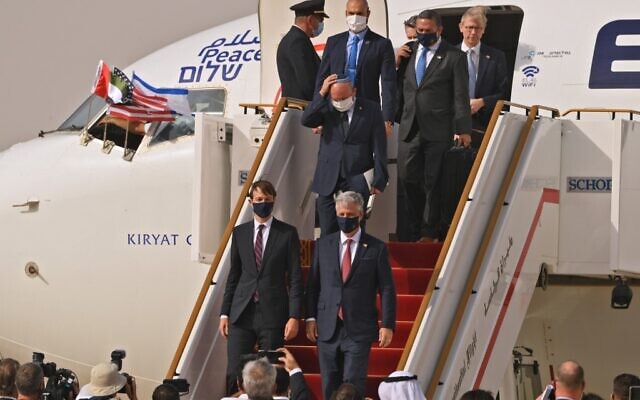
US Presidential Adviser Jared Kushner (left) and US National Security Adviser Robert O’Brien () disembark from the El Al’s airliner, which is carrying a US-Israeli delegation to the UAE following a normalization accord, upon landing on the tarmac on August 31, 2020, in the first-ever commercial flight from Israel to the UAE at the Abu Dhabi airport. Behind them is Israeli National Security Adviser Meir Ben Shabbat. (Karim SAHIB / AFP)

Israel and the UAE are on track henceforth to discuss matters such as economic, scientific trade and cultural cooperation; openly heartfelt with a view of enriching each culturally and socially, and expanding trade to advance their future prospects for prosperity together, banishing forever fears of negative hostility. The Palestinians seek to build upon the framework of hostile relations with Israel and to extend that hostility to all those abroad who sympathize with the deliberate rancid, racist charges against Israel's intentions.

As for Hamas, the usual rote rejection of all things Israeli from a terrorist group whose mandate is to achieve the destruction of the Jewish state in emphasizing that the ground-breaking flight from Israel to the UAE, the El Al plane flying through Saudi airspace with permission, a catastrophe for Palestinians, that the flight represents a "stab in the back of the Palestinian people, a prolonging of the occupation and a betrayal of the resistance of the (Palestinian) people", declared Hamas.

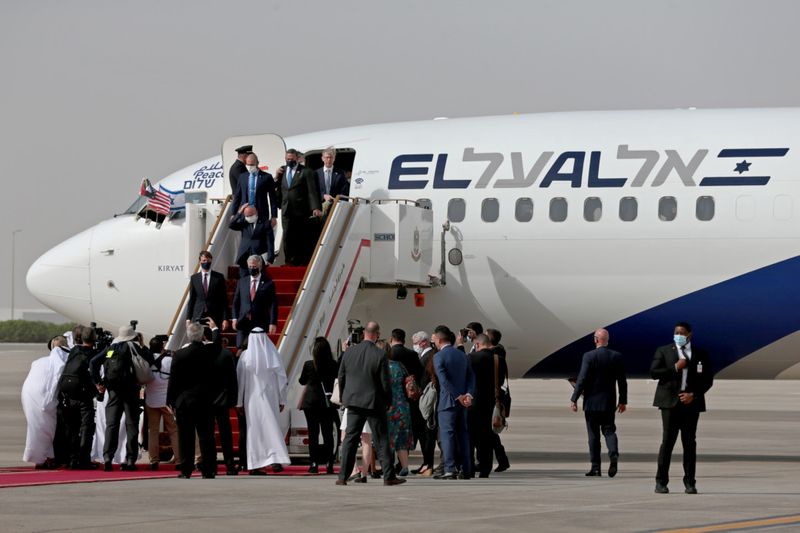
Copy of 2020-08-31T122842Z_283411955_RC20PI9S82AU_RTRMADP_3_ISRAEL-EMIRATES-USA-1598878529367
US President's senior adviser Jared Kushner, US National Security Advisor Robert O'Brien and Israeli National Security Advisor Meir Ben-Shabbat disembark a plane upon landing at Abu Dhabi International Airport Image Credit: REUTERS

Lifting the 'occupation' would be simple enough. The need for Israeli military personnel to be forever on alert would be nullified by the simple act of renouncing the intention to destroy Israel. By surrendering to the reality of a nation that will not be dislodged from its historical roots. By laying down the arms that Hamas has assembled in a vast cache against the final assault on Israel to destroy it as intended. Without the need to constantly be on guard in the defence of its citizens and its territory, the IDF would withdraw its presence, and the 'occupation' ceases.

Without the will and determination to bargain for peace the Palestinians are once again and forever declaring their intention to destroy Israel, not live alongside it peacefully and with prospects for a prosperous future for both peoples. Meanwhile the UAE must cope with its own trials brought on by its decision to befriend Israel. Two people were killed in Abu Dhabi when a KFC and Hardee's restaurants were blown up; the symbolism clear enough; U.S. franchises in UAE territory; targets for vengeance by those dissatisfied with the current trend toward peace.

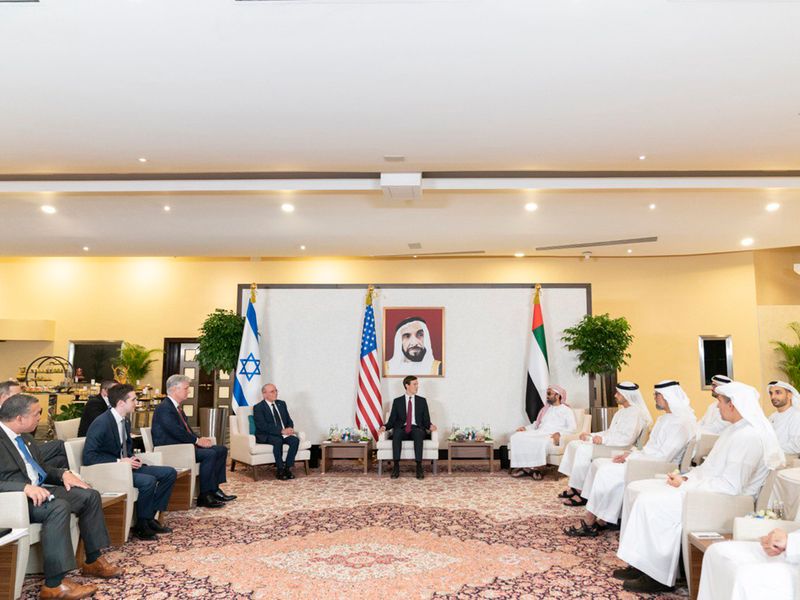
200901 Delegation
The US-Israel delegation is received. Image Credit: WAM

Labels: , , ,

Sunday, April 06, 2014

Options for Mid East talks: Carrying on, interim deal, or a turn to the Saudi-UAE-Egyptian bloc

DEBKAfile Exclusive Report April 5, 2014, 7:25 PM (IDT)
UAE Crown Prince Gen. Sheikh Al Nahyan
Palestinian leader Mahmoud Abbas, nearing 80, has proved time and again in the last two decades that he will never put pen to paper on an accord for ending the dispute with Israel. If he really wanted an independent Palestinian state, he could at any time have followed the path to self-determination chosen by David Ben Gurion, when he declared Israeli statehood on May 14, 1948 in Tel Aviv. Had Abbas (known mostly as Abu Mazen) formally convened an assembly of Palestinian community and institutional leaders at the Palestinian parliament building in Ramallah and proclaimed statehood, there would have been very little Israel could have done.

But that is not his way and never has been, because for him Palestinian independence is no more than an abstract slogan which must never come to earth.

In 1995, Abbas and the dovish Israeli politician Yossie Bailin jointly drafted a document, which later carried their names, offering  a formula for resolving the Palestinian-Israeli dispute – except that he never signed it. He couldn’t bring himself to this commitment, because it conflicted with his fundamental principles and put his political survival at risk.

Today, too, the rise of a Palestinian state would end Abbas’s career as Palestinian leader. He holds sway over the six West Bank towns which passed to Palestinian Authority control without a legal mandate. The last Palestinian elections in 2006 gave his Fatah party only 48 seats compared with 76 netted by the rival Hamas.

Israel, the United States and Europe therefore respect as their legitimate Palestinian partner for peace negotiations a figure who is unelected and whose rule is buttressed by seven Palestinian security battalions, which America and Europe agreed to bankroll to the tune of $2 billion, after the cutoff of Arab aid. Another three battalions are due to be added to the force.

So Abu Mazen keeps up the masquerade of striving for Palestinian independence and staying in the talking shop for two purposes: It keeps him in power by dint of international recognition, and donations continue to roll in to feed his corrupt regime and cover the payroll of his security force.
Not much is left to trickle down to the ordinary Palestinian family.

To buy a small measure of street credibility, Abbas must show the people that he is the only leader able to force Israel to release Palestinians from long prison sentences. He achieves this by making this his price for not walking away from the table.

So long as the money flows in and Palestinians are sprung from Israeli jails, no voices are raised in circles that count in Ramallah against the corrupt practices eating away at the regime.

Abbas therefore ranted and raved when Israel’s cancelled the fourth batch of 26 Palestinian prisoners due to be released March 30, to punish him for sending applications to 15 UN agencies and conventions for membership to bypass the negotiations. Israel also hit back at Abbas with a threat of sanctions – some directed against his personal business interests.

US Secretary of State John Kerry's hard work as would-be peacemaker was not just thrown back in his face but drew criticism at home from his colleagues in the White House and State Department. He tried Thursday to speak to both Israeli and Palestinian leaders in what was described as a desperate bid to bring the two sides back to the negotiating table.

The US Secretary rebuked both the two leaders equally for engaging in “tit-for-tat” tactics, but he knew exactly which side had caused the rupture. Kerry must by now realize that Abu Mazen’s history of withdrawing from any fruitful dialogue for peace made this outcome inevitable. Had he gone for interim accords, which he never considered, rather than final solutions, he might have bought a few years' lull in the dispute, although this too would have come apart over the same Palestinian dynamic.
In the past, Abu Mazen had to contend with only one effective dissenting voice. It came from his bitter rival, Mohammed Dahlan, who ended up quitting his comfortable berth on Palestinian Authority and Fatah councils in Ramallah and going into exile. There, too, he landed on his feet.
Some 30 years younger that Abbas, Dahlan has been a persona non grata for Israel as former Gaza strongman and innovative terrorist.

He is problematic on at least three more counts:

1. Seven years ago, he extracted from the US government a huge sum – estimated at $1 billion – for promising to rid the Gaza Strip of Hamas rule. He never delivered and refused to refund the money.
That is one US count against him. In addition, he has thrown in his lot with Saudi Arabia and the United Arab Emirates and their offensive against Obama administration Middle East policies.

2.  Because of his unbridled criticism of Mahmoud Abbas and calls for his removal, Dahlan is on the run from his enemies who have sworn to destroy him.

3.  Dahlan has managed to win the sympathy and patronage of powerful Gulf rulers. With their help, he established himself three months ago in Cairo within the Egyptian strongman Abdel-Fatteh El-Sisi’s inner circle of advisers on the Palestinian question. This explains why Abbas gives Cairo a wide berth.

The Palestinian renegade gained this position through the influence of UAE Crown Prince Mohammed Bin Zayed Bin Sultan Al Nahyan, who is one of El-Sisi’s most generous bankers and who stands at the forefront of the Saudi-UAE life-and-death campaign against the Muslim Brotherhood.

The talk of Ramallah this week was not the breakdown of talks, which surprised no one there, but interest in the way the Palestinian fate could be profitably drawn into the Saudi-UAE-Egyptian war on the Muslim Brotherhood and its offspring Hamas – away from the American ken. Abbas’s rival Dahlan is shaping up as facilitator.

This trend appears to have been picked by some Israeli government and intelligence circles, judging by a comment heard from Foreign Minister Avigdor Lieberman Wednesday, April 2, during an office party on Passover Eve. He remarked that the ball is now in the Palestinian court. “Irrespective of the negotiations, Israel has found an attractive political horizon in such places as the Arab oil emirates and Saudi Arabia,” he said, adding: “If Abu Mazen is willing to follow us in that direction, fine. If not, we don’t need him.”

This comment suggested that Israel has thoughts of linking up with the emerging Saudi-Egyptian-UAR bloc and bringing the Palestinian issue on board.  Whether or not these thoughts crystallize into hard policy, they hint at an alternative Israeli approach to the Palestinian question.

Labels: , , , , , , , ,

Sunday, March 09, 2014


UAE backs Saudis on Brotherhood blacklist

Al Aribaya -- 9 March 2014
UAE Minister of Foreign Affairs Abdullah bin Zayed al-Nahyan (R) and Saudi Minister of Foreign Affairs Saud al-Faisal. (File photo: Reuters)
The United Arab Emirates announced its support of neighboring Saudi Arabia's decision to label the Muslim Brotherhood a terrorist organization, deepening Gulf Arab pressure on the group.

The UAE government will cooperate with Saudi Arabia to tackle “those terrorist groups through liquidating all forms of material and moral support,” the Western-allied Gulf federation's foreign ministry said in a statement, according to WAM news agency.

"The UAE will not spare any effort to bolster the cooperation with brothers in Saudi Arabia to tackle those terrorist groups through liquidating all forms of material and moral support in all circumstances," the foreign affairs ministry said in the statement.

"The significant step taken by the KSA in this critical moment requires concerted efforts and joint collective work to address the security and stability challenges that threaten the destiny of the Arab and Muslim nation," the statement added.

Saudi Arabia blacklisted on Friday the Muslim Brotherhood as a terrorist organization, Al Arabiya News Channel reported, citing a royal decree.

The kingdom also designated the kingdom’s branch of the Shiite movement Hezbollah and Syria-based militant groups the Islamic State of Iraq and Syria (ISIS) and the al-Qaeda linked al-Nusra Front as terrorist.

Egypt was the first Arab country to label the Brotherhood terrorist in Dec. 2013, after accusing it of carrying out a series of bomb attacks in Cairo

Labels: , , ,

() Follow @rheytah Tweet