
Politic?

This is a blog dedicated to a personal interpretation of political news of the day. I attempt to be as knowledgeable as possible before commenting and committing my thoughts to a day's communication.

Wednesday, October 27, 2021

Exquisite Concerns of Canadian Justice Over the Rights of Convicted Terrorists

"The Board has considered the technology available at the time of your offences and the one in place today that could be used by terrorist groups. As such the Board is of the opinion that your internet usage and communication must be monitored."
"Everyone has a reasonable expectation of privacy in the contents of their devices, and as a parolee, you have a reduced expectation of privacy."
"A broad search of your devices as described above may reveal more information than is reasonably necessary for the monitoring purposes of the special condition."
"In the case the Board did not explain how the broad search power of your devices reflected a proportionate balancing of your right to be secure against unreasonable search and the statutory mandate of the CCRA [Corrections and Conditional Release Act."
Parole Board of Canada
As the proven mastermind behind a bold and far-reaching terrorist plot to attack key government institutions by a group named the Toronto-18, Shareef Abdelhaleem was imprisoned on a 'life sentence' with no chance of parole for ten years, after being found guilty as charged. He was the master architect of a plot to detonate truck bombs in 2006, to blow up the Toronto Stock Exchange, a military base, and the Canadian intelligence group CSIS. Plans to storm parliament, take hostages and behead the prime minister all fell under his leadership.
"[Continuing to allow him only one device] was more aimed at making the surveillance more convenient for Correctional Service of Canada as opposed to addressing legitimate concerns about public safety."
Abdelhaleem complaint filed with Parole Board
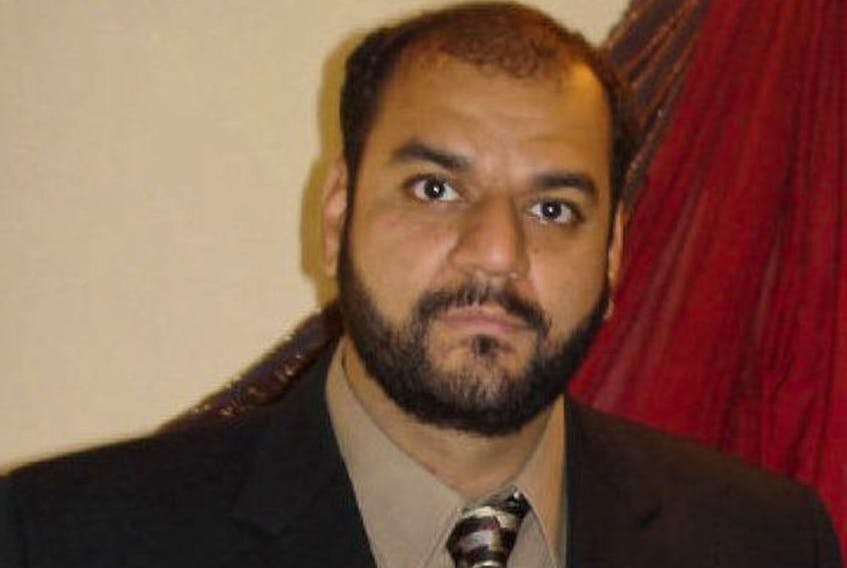
Muhammad Shareef Abdelhaleem.
Muhammad Shareef Abdelhaleem

Granted day parole almost a year earlier, he was effusive in his praise over the decision reached by the Parole Board to release him from prison and allow him to be reintroduced into broader society. There were some constraints imposed upon him, primarily in communications, permitting him one computer device and allowing oversight by the Parole Board in surrendering his password. Living at a halfway house, his initial euphoria over being freed from prison has now given way to a complaint about those restrictions.

Abdelhaleem feels entitled to having those restrictions loosened to permit him more internet freedom and greater computer access; clearly unhappy he has been denied unlimited internet access and limited to either a mobile phone or a computer. The last of the 18 terrorists to be convicted in 2011, this Canadian Islamist who once led a plot to murder fellow Canadians and bomb key government institutions feels he has been hard done by in a country that equates life imprisonment with ten years' incarceration.

Before he became a jihadist he was involved in developing computer software, drove a BMW convertible and bought expensive name-brand garments for himself. Searching for a little more purpose and excitement in his life he found it in fundamentalist Islam that embraces jihad. From a life of freedom and the opportunity to do as he wished, to a decade of incarceration as a terrorist speaks of an ideological conviction born of uber-devout religious devotion.

Abdelhaleem argues that his transformation from ordinary citizen to jihadi terrorist owed nothing to internet communications. That there was no role played by computer communications in his radicalization. Instead, people he came in contact with attending mosques introduced him to the martyrdom glories of jihad and it was there, in mosques, where he was recruited to fame and glory in defending Islam against the infidels he lived amongst.

And though the Board made note of the fact that technology had undergone massive changes since the terrorist who worked as a software engineer left that occupation for the bloodier field of jihad, its use, they point out, has changed as well. The advent of mobile phones, encrypted communications, and radicalization via the internet play a vital role in the terrorist recruitment grand plans for the future.

Even while acknowledging all that and faced with the urgent request (demand) that justice prevail in his case by permitting him freer access to this problematical world of terrorist provocation, the Board concerns itself with ensuring they do not rule on the matter before them in a way that could potentially abrade his Charter Rights guarantees "to be secure against unreasonable search or seizure".

Toronto 18 terrorist plot member Shareef Abdelhaleem, who received a life sentence in 2011, denounced the “blatant injustice” done to him.
Toronto 18 terrorist plot member Shareef Abdelhaleem, who received a life sentence in 2011, denounced the “blatant injustice” done to him. Photo by Alex Tavshunsky/File


Labels: , , , ,

Sunday, May 30, 2021

Anatomy of an al-Qaeda Convert Rejecting ISIL

"When it came to the targets the thinking was that one of them was economic and one of them was security and the other one was military."
"I was aware that people were going to be hurt but it seemed at the time that I was so focused on the symbolism of the act. Because I'm not a violent person it is easier to think of a bomb where you don't see the victims versus a close-up attack where you do physically have an intimate or a close contact with the victims."
"At some point I contemplated, unfortunately adding shrapnel to increase the casualty rate. So that's disgusting."
"The plan to construct three truck bombs was a little bit too complicated. Near the end, the technical issues became too much."
"Every time there was an obstacle, I kept doubling down and I kept going forward. I did have the intent. I would have tried something."
"I look at prison as a blessing and, in a way, I see the life sentence as a blessing too, because going to prison was the best of all possible outcomes, given how radicalized I was at the time and how determined I was to go through with it."
"Prison was very good for me because it was the only way I could be saved."
Zakaria Amara, 35, one of 18 arrested June 2, 2006 in a homegrown terrorist ring, Toronto
Zakaria Amara, one of the "Toronto 18" who were arrested in a shocking anti-terrorism probe in 2006.
Just as well that Zakaria Amara is so grateful that arrest, trial and sentencing took him to prison, avoiding martyrdom and Paradise. He and  his fellow conspirators were apprehended, with the help of an 'inside' informer who benefited handsomely for his undercover work, revealing a plot to wreak havoc in Canada in revenge for the Canadian military dispatched as part of NATO in a U.S.-led invasion of Afghanistan to root out Osama bin Laden and his al-Qaeda operation, sheltered by the Taliban.

Zakaria Amara and his Islamist colleagues, the infamous 'Toronto 18' -- whose plans included blowing up truck bombs, storming Parliament to behead the prime minister, blowing up the CBC, and Canada's premier intelligence-gathering service CSIS, among other targets -- were quite ambitious in their conspiratorial organization to teach Canada and Canadians that Islamism is not to be trifled with. The greater the number of victims, particularly those in high places, the more resonant their message.
 
In gratitude for the unexpected attention on the part of Canadian Muslims living the good life in Canada, Canadian justice handed Amara a life sentence for his thwarted ambitions. As the leader of the terrorist plot, he has decided, it would seem, that his happiness at being incarcerated is now dwindling and he would at this juncture, prefer being released from prison after having served 15 years of his life-in-prison sentence. After all, he points out, he is remorseful.

While al-Qaeda's agenda was appealing to him and his cohorts, including the spectacular victory over the World Trade Towers, the Pentagon, striking terror into the hearts of Americans, he explained to a hearing of the Parole Board of Canada that ensuing news of the atrocities committed by the Islamic State of Iraq and the Levant gave  him pause for second thought. Did he really want to be aligned with these lunatic psychopaths? Re-evaluating his direction to reject his radical beliefs, he felt himself prepared for release from prison.

His verbal passion in appealing to the Board for due consideration and trust in his newfound sincerity rejecting violent Islamism had him in tears, thanking his supporters in the Muslim community; his family, his daughter, nine months old at the time her father was arrested. For three hours he addressed the Board, acquainting them with his transformation from jihadist to thoughtful and sober mature man intent on occupying a place in Canadian society he had so impetuously forsaken as a young and impressionable fervent Islamist.

"In my heart", he explained, he had praised Osama bin Laden, a loyalty he maintained while in prison. From prison he maintained contact with members of the notorious Canadian-Egyptian Khadr family whose paterfamilias had been a financial supporter of bin Laden and close friend in their mutual campaign against the West. The Parole Board hearing took place at the medium security Warkworth Institution in Ontario, where he spoke of being overwhelmed by his ambition to succeed in the terrorist plot he headed up.

He spoke of his determination to forge ahead with the many-pronged attack on Canadian institutions and government figures. Had the plot not been revealed to police, had he not been arrested, he would have persisted until reaching a successful conclusion. Convicted in 2010, he was designated to the Special Handling Unit in Canada's highest security prison in Quebec. There he mingled with other Islamist extremists, and there his sentiments and values grew in strength, flourishing in a setting that set him on a course to eventually seek completion of his Islamist mission.

And then came Islamic State, his attention fixated on the group's relentless gathering of territory in Syria and Iraq to form their Caliphate, addressing the world with sophisticated public relations material of gruesomely violent exploits in capturing journalists and other Western figures to suffer horrendous torture and death for the camera. The barbarous celebration of atrocities committed by psychopathic Islamist murderers became a recruiting tool bringing in enthusiastic ISIL volunteers for jihad from the Middle East, North Africa, Asia, Europe and North America.

He, on the other hand, was so revulsed by ISIL in contrast to his championing of al-Qaeda, that his Islamist faith faltered. "A lot of things have changed", he assured the hearing. The actions of ISIL had him re-evaluating his ideology. ISIL "came on the scene and were doing all kinds of horrific things", that he "couldn't stomach". Obviously, he said, there was something wrong with his world view and since, he has been "building a new house" for himself. Cut ties with radicals with whom he no longer has anything in common ideologically.

Given parole, he would stay at a halfway house in downtown Toronto. Granted parole, he would undergo a deradicalization program, complete post-secondary education. He wanted to become a professional social worker. Just as it seems that all Muslim extremists aspire to be engineers, those who reform themselves from jihadist sentiments appear to aspire to become social workers. As though to expunge from their subconscious any possible further twinges urging toward jihad by turning themselves toward public good, in support of the social weal.

On his own initiative, good soul that he is, he self-started his rehabilitation with sporadic and informal conversations with imams, conversations with institutional parole officers, while reading extensively and speaking with 'reputable members of the community'. All, all to no avail. Wasted, his effort in writing a 102 page-letter to the Board, setting out his thoughts and experiences and aspirations for the future, as a completely reformed good Canadian citizen. 

For despite his earnest demeanor and pleading stance, his conscientious relaying of the truth, his sincere pledge to become a responsible member of society, his admirable ambition to join the cadre of social workers who aid those in society whom ill fortune has struck, the Parole Board denied him the parole he sought, following deliberation of an hour's duration. One Parole Board member complained that the board was unable to adequately assess the progress Amara had made while imprisoned, given a lack of objective programming.

In the end, the consensus was that those at the hearing felt the risk to public safety remained, a risk that was unmanageable without reliable, adequate further intervention to steer this self-reformed former terrorist beyond his first choice, of punishing Canada for its role in ousting bin Laden from Afghanistan, and for its part in the Western-based coalition to lead Afghanistan toward peace and security, helping to fend off the constant Taliban resurgences. 
 
All now to no avail, as the Taliban is set to resume its former violently brutal Islamist command of Afghanistan. A metaphor for rescuing Amara from his passionate love affair with jihad.


A courtroom evidence photo from the Toronto 18 case, released on Oct. 20, 2009, shows electronic equipment. The group was accused of a plot to create explosions at various Canadian sites. (Canadian Press)


Labels: , ,

Thursday, December 10, 2020

From Terrorist to 'Model Citizen' : Past Error in Judgement

"I'm just so thankful. You will not be sorry."
"I know that you're taking a risk and this is going to be highly mediatized, but in front of all these people and in front of God -- I know I said I was not a religious man, but I do believe in God -- I will not disappoint you."
"You will never hear from me again."
Shareef Abdelhaleem, member of 'Toronto 18' terrorist group
Now 45 years of age, imprisoned for the past 14 years, Abdelhaleem has been granted six months of day parole so he may study in Montreal.There, in an enclosed facility, he will be living for that period. It was noted that the halfway house that had accepted him as a resident later withdrew its support. No reason for that withdrawal was given, but it should have been. Similarly, the Correctional Service of Canada did not recommend this man's release from prison, yet at the hearing, the Parole Board of Canada took its own advice, assenting to parole.

Cautionary conditions accompany that parole; Shareef Abdelhaleem  must not associate with anyone involved in crime or radicalized activity. He must not travel to Toronto without permission from parole officials, and must not accept a position of responsibility "In any spiritual or religious activities or groups that share the same beliefs, this includes the mosque", enumerated the parole board. As well he was ordered to take part in de-radicalization treatment and was limited to ownership of a single cellphone and one SIM card which parole officials were to be given access.

A total of 18 people were arrested in sweeping national security raids in that took place in 2006. They stood accused of plans to detonate powerful truck bombs at key financial, military and intelligence targets. The group had formulated other plans, to storm Parliament, the CBC, to take hostages, and to behead the prime minister. A series of plans which, when revealed publicly sent a deep shiver of shock through the Canadian community.

A young Muslim-Canadian had infiltrated the group to gather human intelligence and evidence, alerting the RCMP to details of the plot, plot rehearsals and where the explosive materials could be found. He was a paid informer without whose cooperation much of the information that ended up in court might never have been gathered. While those of the 18-member terrorist group that were tried and convicted were imprisoned, the young informer completed his university education and is now a professor of terrorism studies at a Canadian university.

Shareef Abdelhaleem was the last of the Toronto 18 to be tried and convicted, named a "key architect" of the bomb plot, given a life sentence without opportunity for parole for a decade ('life sentence' under Canadian law). At his hearing, he stated that he had spent those 14 years in prison ruminating on the actions that brought him to that state. He had been a software developer earning well, spending it all. He drove a BMW convertible, and spent thousands on clothing. "I felt like my presence in the universe had no meaning."
 
"I felt like an overgrown, fat pig whose main purpose in life was to consume more, more, more. And I looked at the whole world around me and there is disasters and suffering." Which was when he decided to take Islam more seriously and began attending mosque, where he met Zakaria Amara, the ringleader of the plot. "He presented what I now think is a ridiculous plot to try to change the world. It seemed like a very fast way to bring about change. It seemed like the right thing to do, I hate to say, back then. Definitely the wrong thing to do from all angles; moral, political, practical, anything. Thank God we were stopped", he said.
 
He may have spent that 14 years in prison carefully rehearing precisely all the notes he had to hit to impress a parole board. He thinks, he went on, of the people of Toronto who woke to read the newspapers "and thought their city was under attack". He feels particularly bad for those who worked in the targeted buildings and read that they might have been victims of a deadly plot. Interesting he could empathize, but would have proceeded with the plot had the opportunity not been interrupted.
 
His time in prison was unpleasant, he said, describing how socially isolating it was for him, shunned by his plotter companions, (who presumably continued to cling to their terrorism obsession, while he did not?)  refusing prison culture and shunned by other prisoners as well, as a result. He had been assaulted physically on several occasions. And never had he made any attempt to radicalize, to convert, or to influence other inmates negatively. The parole hearing took place remotely, audio only. 
 
Temporary release from Cowansville Institution.  
Adrian Humphreys/National Post
There had been a previous parole hearing, at which time his request for parole had met with denial. That was when he was asked if he remains a terrorist, and responded "Not any more, I would rather die than reoffend", leading the questioner to further ask whether he was making reference to martyrdom or suicide attacks. "No, no, it's just an expression, that's not what I meant", he hastily said. On this second parole hearing, he promised: "I will be the model citizen"
 
That, he promised to be, for to remain in prison would be to 'wither away', a condition  to be avoided at all costs; he would prefer a dreadful illness be visited upon himself rather than to reoffend -- he promised.

Labels: , , , , , , ,

() Follow @rheytah Tweet