Politic?

This is a blog dedicated to a personal interpretation of political news of the day. I attempt to be as knowledgeable as possible before commenting and committing my thoughts to a day's communication.

Wednesday, September 17, 2025

The Failed Canadian Justice System

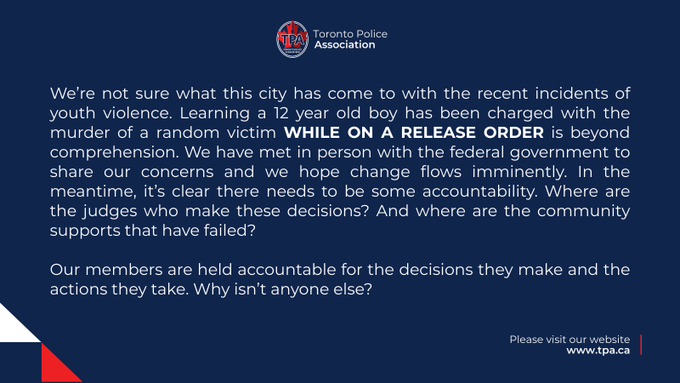
"Where are the judges who make these decisions?"
"Our members are held accountable for the decisions they make and the actions they take."
"Why isn't anyone else?" 
Toronto Police Association
 
"What we expect from the Crown -- what you and the public should expect -- is that the Crown is a zealous advocate for justice."
"Unfortunately, so far, we have not seen that in this case."
Megan Hankeich, executive director, legal services, Edmonton Police Service
 
"This decision is not only profoundly disrespectful to Constable Scott's family and colleagues, it is a slap in the face to every police officer who puts their life on the line each and every shift to keep our communities safe."
National Police Federation 
 
"...This incident comes just days after RCMP Members in Nanaimo apprehended a subject who was threatening residents with a machete while also out on bail, as well as a drive-by shooting in Coquitlam last week believed to involve suspects known to police."
National Police Federation
https://pbs.twimg.com/media/G06TDlgWUAALXCs?format=png&name=small
 
"Catch and release" justice has infuriated Canadian police agencies for years, and the situation has more latterly become a full-blown crisis of crime and criminals being let off the hook of responsibility by a lenient system of justice. Police do their jobs, trying to protect the public from sociopaths, psychopaths and the criminal elements that invariably infect every society, only to see soft-on-crime judges rule that those committing serious crimes are still eligible for bail and release. While prison parole boards opt for parole and early release for those committing themselves to terrorizing whole communities.
 
Appeals by police services to the federal government to harden bail for repeat offenders have fallen on deaf ears. The previous Conservative government had imposed hard bail conditions for criminal offenders, only to see follow-up Liberal legislation reverse the decisions made by their predecessors. Rising crime rates led to the Conservative move in an effort to make sociopaths understand there are consequences to their violent actions. Since the Liberal softening of consequences crime rates have soared in Canada.
 
https://smartcdn.gprod.postmedia.digital/nationalpost/wp-content/uploads/2025/04/canada-justice-victims-rights-prisons-serial-killer-murder-violent-crime-main.jpg?quality=90&strip=all&w=1200&h=675&type=webp&sig=v0pjLCix4twYxdHIYPYgsg
In the past decade, identity-based justice and a distaste for punishment has created a regime that allows chronic offenders to walk free  Tristin Hopper, National Post
 
The Toronto Police Association was infuriated in a case where a 12-year-old on a release order took part in the beating death of a homeless man in Toronto. In Edmonton, police slammed Crown prosecutors for their failure in pursuing murder charges for a woman who killed an eight-year-old Indigenous girl. The child's whereabouts were unknown in 2023, missing from her Alberta home until her body was discovered in the back of a pickup truck stuffed into a hockey bag.
 
Crown prosecutors agreed to a 'solution' where the accused killer of the girl would plead guilty to manslaughter thus avoiding a murder prosecution. Provincial officials were called by Edmonton police to annul the agreement; while details of the case had been placed under a publication ban shield, outraged police threatened to publicly disclose key details of the case if the plea agreement proceeded. 
 
Two months ago the Parole Board of Canada released a convicted police-killer 17 years into his 25-year capital sentence. Convicted of first-degree murder for the 2007 shooting death of RCMP Constable Douglas Scott in Kimmirut, Nunavut, Pingoatuk Kolola was given an early release. Constable Scott was the sole police officer in Kimmirut. His death resulted in eliminating single-member detachments in northern communities. The parole board can approve unescorted prison releases or day parole, despite first-degree mandatory 25-years incarceration.
 
In the face of rising crime rates, Canadian police have all but abandoned traditional agreement on Canadian justice policies; they are now more vocal in calling for measures to tighten bail and release conditions for chronic offenders; it is their job as professional defenders of the public weal to view public safety and security as society's first order of business. Their end of the justice system is rooting out crime, apprehending offenders and turning them over to the justice system. Closure cannot be found when the justice system simply releases chronic offenders with no imposed penalty, leading to re-offence.
 
https://i.cbc.ca/1.6703944.1672871913!/fileImage/httpImage/image.jpg_gen/derivatives/original_1180/const-grzegorz-pierzchala-with-a-dog-in-a-canoe.jpg?im=Resize%3D805
OPP Const. Grzegorz Pierzchala was killed in action two days after Christmas, around 2:30 p.m., while responding to a black truck in the ditch near Hagersville, Ont. (Submitted by Bill Dickson)
 
The 2022 murder of Ontario Provincial Police constable Grzegorz Pierzchala and its outcome was the initial spur to Canadian police calling for justice reform in a loud, collective voice. Shot and killed during a routine roadside check by a chronic offender with a lengthy history of violent offences, Constable Pierzchala's murderer was given bail owing to his Indigenous background. Justice Harrison Arrell who presided over the case cited an "obligation" to consider that the accused was "a status Aboriginal"
 
The response was police agencies calling out for tightened bail conditions; a reversal of Liberal changes that saw judges such as Arrell required to consider the "marginalized" identity of criminal defendants in their final judgements. According to OPP commissioner Thomas Carique, strict bail conditions would have resulted in victims like Constable Pierzchala being spared their lives.
 
A year ago, the National Police Federation addressed the "catch and release" format so regularly employed by the justice system, calling for its cessation following horrific stranger attacks in downtown Vancouver when a man with over 60 documented police interventions slashed two random pedestrians, killing one, severing another's hand.
 
"Over the last two years, we've seen serious incidents related to our bail system that have put the lives of police service members and our communities in danger", pointed out Mark Baxter, president, Police Association of Ontario, his statement co-signed by the Ontario Provincial Police Association. This, following a routine police check in Toronto where an all-out gang shootout occurred. Leading three Ontario police associations to call for "immediate action" on bail reform. 
 
Police unions in Toronto, Surrey, B.C., and Peel Region in Ontario accused the Liberal government of ignoring a deadly gun crime situation, driven by illegal firearms smuggled into Canada from the United States. "What difference does your handgun ban make when 85 percent of guns seized by our members can be sourced to the United States?" they asked, responding to then-prime minister Justin Trudeau self-congratulating the success of his government's gun bans, and a "freeze" on sale or transfer of legal handguns. 
 
https://smartcdn.gprod.postmedia.digital/nationalpost/wp-content/uploads/2025/04/canada-justice-victims-rights-prisons-killers-murder-police-pierzchala.jpg?location=full_width&quality=90&strip=all&w=1200&type=webp&sig=tX40z2DzgvBJlNgeQDwTBg
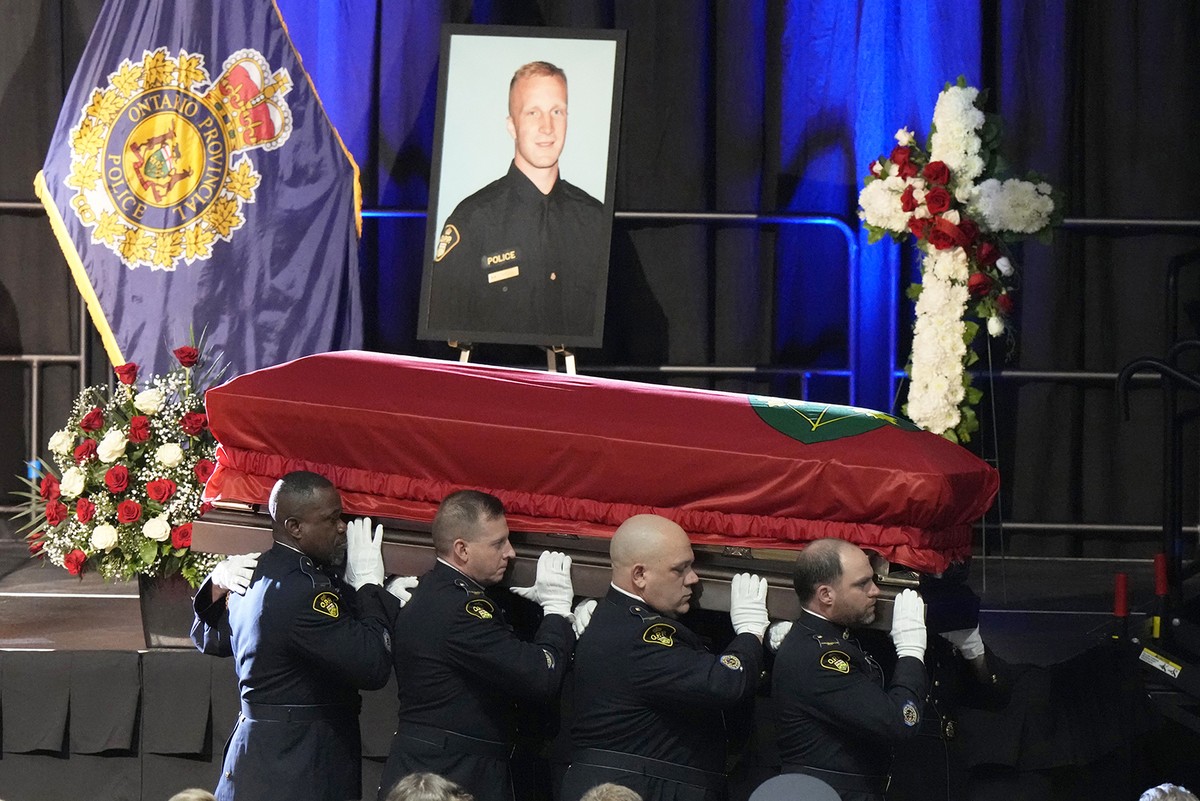
Pallbearers carry the casket of OPP Const. Grzegorz “Greg” Pierzchala after his funeral in Barrie, Ont. on Jan. 4, 2022. Randall McKenzie, the man charged with first-degree murder in the young officer’s death, was deemed violent, unpredictable and likely to reoffend — yet was out on bail. Photo by Frank Gunn/The Canadian Press
 

Labels: , , , , , , ,

Wednesday, October 27, 2021

Exquisite Concerns of Canadian Justice Over the Rights of Convicted Terrorists

"The Board has considered the technology available at the time of your offences and the one in place today that could be used by terrorist groups. As such the Board is of the opinion that your internet usage and communication must be monitored."
"Everyone has a reasonable expectation of privacy in the contents of their devices, and as a parolee, you have a reduced expectation of privacy."
"A broad search of your devices as described above may reveal more information than is reasonably necessary for the monitoring purposes of the special condition."
"In the case the Board did not explain how the broad search power of your devices reflected a proportionate balancing of your right to be secure against unreasonable search and the statutory mandate of the CCRA [Corrections and Conditional Release Act."
Parole Board of Canada
As the proven mastermind behind a bold and far-reaching terrorist plot to attack key government institutions by a group named the Toronto-18, Shareef Abdelhaleem was imprisoned on a 'life sentence' with no chance of parole for ten years, after being found guilty as charged. He was the master architect of a plot to detonate truck bombs in 2006, to blow up the Toronto Stock Exchange, a military base, and the Canadian intelligence group CSIS. Plans to storm parliament, take hostages and behead the prime minister all fell under his leadership.
"[Continuing to allow him only one device] was more aimed at making the surveillance more convenient for Correctional Service of Canada as opposed to addressing legitimate concerns about public safety."
Abdelhaleem complaint filed with Parole Board
Muhammad Shareef Abdelhaleem.
Muhammad Shareef Abdelhaleem

Granted day parole almost a year earlier, he was effusive in his praise over the decision reached by the Parole Board to release him from prison and allow him to be reintroduced into broader society. There were some constraints imposed upon him, primarily in communications, permitting him one computer device and allowing oversight by the Parole Board in surrendering his password. Living at a halfway house, his initial euphoria over being freed from prison has now given way to a complaint about those restrictions.

Abdelhaleem feels entitled to having those restrictions loosened to permit him more internet freedom and greater computer access; clearly unhappy he has been denied unlimited internet access and limited to either a mobile phone or a computer. The last of the 18 terrorists to be convicted in 2011, this Canadian Islamist who once led a plot to murder fellow Canadians and bomb key government institutions feels he has been hard done by in a country that equates life imprisonment with ten years' incarceration.

Before he became a jihadist he was involved in developing computer software, drove a BMW convertible and bought expensive name-brand garments for himself. Searching for a little more purpose and excitement in his life he found it in fundamentalist Islam that embraces jihad. From a life of freedom and the opportunity to do as he wished, to a decade of incarceration as a terrorist speaks of an ideological conviction born of uber-devout religious devotion.

Abdelhaleem argues that his transformation from ordinary citizen to jihadi terrorist owed nothing to internet communications. That there was no role played by computer communications in his radicalization. Instead, people he came in contact with attending mosques introduced him to the martyrdom glories of jihad and it was there, in mosques, where he was recruited to fame and glory in defending Islam against the infidels he lived amongst.

And though the Board made note of the fact that technology had undergone massive changes since the terrorist who worked as a software engineer left that occupation for the bloodier field of jihad, its use, they point out, has changed as well. The advent of mobile phones, encrypted communications, and radicalization via the internet play a vital role in the terrorist recruitment grand plans for the future.

Even while acknowledging all that and faced with the urgent request (demand) that justice prevail in his case by permitting him freer access to this problematical world of terrorist provocation, the Board concerns itself with ensuring they do not rule on the matter before them in a way that could potentially abrade his Charter Rights guarantees "to be secure against unreasonable search or seizure".

Toronto 18 terrorist plot member Shareef Abdelhaleem, who received a life sentence in 2011, denounced the “blatant injustice” done to him.
Toronto 18 terrorist plot member Shareef Abdelhaleem, who received a life sentence in 2011, denounced the “blatant injustice” done to him. Photo by Alex Tavshunsky/File


Labels: , , , ,

Friday, August 13, 2021

Protective Justice for Whom?

"They talk about the privacy interests of these guys, but these are notorious crimes, they're public crimes. There's nothing private about this."
 "In my view, when people convicted of first-degree murder apply for parole and are asking to be relieved from the consequences of their life sentence and their criminal acts to be released into the public, they waive their privacy rights."
"All of a sudden, Paul Bernardo comes up and says, 'Well, I want out, I've been rehabilitated, I'm good'. Why should the public be denied the full evidentiary record that he and the parole board rely upon to make that decision?"
"We just have to take the parole board's word that they're doing it correctly. Well, that's not how the freedom of the press and freedom of speech works in a democratic society."
"The way to hold government institutions accountable is by transparency and openness and we think that this is a principle of fundamental importance."
Tim Danson, veteran Toronto lawyer representing families of victims and the Toronto Police Association 
Feds fight victims' families over killers' privacy - PressReader
Tim Danson, representing the Mahaffy and French families, talks with Kristen French's parents Donna and Doug after a parole hearing for Paul Bernardo.  Ian MacAlpine/The Whig-Standard/Postmedia
 
The case of Paul Bernardo is one of a horrific predatory sexual sadist, a man whose night-time prowls resulted in the rapes of a rising number of victims, raising fear levels to a high decibel of terror in Ontario in the early 1990s of a serial rapist on the loose. He went on to kidnap, rape and murder schoolgirls Kristen French, 15, and Leslie Mahaffi, 14, tormenting them before murdering them. then went on to cause the death of his wife Karla Homolka's 15-year-old sister, with his wife's help. He is serving a life sentence and has repeatedly sought parole.

The second case that Mr. Danson is representing is that of Craig Munro who in 1980 with his brother were robbing a Toronto bar, when Constable Michael Sweet attempted to intervene. The brothers shot the policeman in the chest and left him to agonizingly bleed to death, while he pleaded for medical help, while being mocked by Munro. Munro was given temporary prison absences in 2012, was caught smoking crack while at a halfway house and hiring a prostitute; he too has bid for parole.

Families of the murdered people attend each of these parole hearings determined to see that the killers of their loved ones are denied the parole they seek. When preparing themselves for the parole hearings, the families requested information on the two inmates from the Parole Board of Canada and the Correctional Service of Canada, but were refused access to the information. They turned for intervention to the Federal Court, only to have the federal government oppose their move.

During ordinary court trials, documents given a judge or jury and allied evidence meant to weigh the guilt or innocence of an accused is routinely publicly released. Occasionally third party personal information is redacted or a publication ban placed on victim information, but evidence heard in open court is generally available to be scrutinized. "It shouldn't be any different in parole hearings", pointed out Mr. Danson reasonably.

Lawyer Danson delineated inmate records of those under supervision; serving life sentences and dangerous offenders requesting release, to be available for public scrutiny. However, he spoke to deaf ears. Justice Glennys McVeigh failed to accept the arguments the families of the victims put forth. This week her decision was released, supporting government lawyers who fought to maintain secret records rather than release them to the families. One of the government's arguments was that the inmates involved failed to give their consent for release of the information.

Justice McVeigh dismissed the constitutional right to the information claimed by the victim families, reasoning it was her impression that parole board hearings, not judicial or quasi-judicial proceedings did not merit being treated as if they were. And nor did she accept that the open court principle of presumption of openness would apply to parole hearings. To add insult to injury, the federal government feels the families must pay government legal costs for the privacy of the killers; $19,142.27.

The government rationale per their lawyers being that the families were not in pursuit of public interest litigation but rather a personal pursuit: "Their personal motivation is to use the information sought to make statements to the parole board", went the government argument. A point of view that runs completely counter to what the public good represents; when the judicial rights of one are denied, it extends outward to the entire community.
 
Karen (Sweet) Fraser, left, widow of Toronto police constable Michael Sweet, and their three daughters attend a 2010 press conference to announce changes they wanted to the parole system after Sweet’s killer was granted unescorted prison absences.
Karen (Sweet) Fraser, left, widow of Toronto police constable Michael Sweet, and their three daughters attend a 2010 press conference to announce changes they wanted to the parole system after Sweet’s killer was granted unescorted prison absences. Photo by National Post file photo

"I was very surprised the government asked for costs -- my clients have suffered enough."
"I think it's going to end up in the Supreme Court of Canada."
Tim Danson, reputed veteran Toronto lawyer

Labels: , , , , ,

() Follow @rheytah Tweet