Politic?

This is a blog dedicated to a personal interpretation of political news of the day. I attempt to be as knowledgeable as possible before commenting and committing my thoughts to a day's communication.

Saturday, May 02, 2026

The Diversity Armed Forces of Canada

"As a result of these changes, CFLRS [Canadian Forces Leadership and Recruit School] is experiencing significant changes in candidates' basic capabilities and increasing pressures on staff and instructors." 
"For many candidates it is the first time that they have lived with members of a different sex and for some it is also the first time they have been expected to treat women as their peers."
"Older candidates from certain cultural backgrounds are also more likely to experience friction when responding to younger CFLRS instructors due to cultural hierarchies based on age." 
"[An early foreign-origin-heavy French platoon was] plagued by allegations of racism from candidates against staff but equally candidates against other candidates and constant infighting between cultural blocks within the platoon -- i.e., Cameroonian candidates against those from Cote d'Ivoire."
"[On the English side, platoons with heavy permanent resident members] suffered from low fitness levels."
National Defence, Canadian Forces Leadership and Recruit School report 
 
"[The military is currently working on an] onboarding tool [to explain the institution's ethos and culture to candidates'."
"On French [officer] platoons, where permanent residents have made up 50 - 80% of all candidates, there have been more emotional responses, with francophone staff openly raising the question of whether it is appropriate for officer commissions to be granted to non-Canadian citizens."
Commodore Pascal Belhumeur, spokesman, Department of National Defence 
https://i.cbc.ca/ais/2cb94163-8029-46e9-b6ef-eca5d7c0569d,1777586498182/full/max/0/default.jpg?im=Crop%2Crect%3D%280%2C233%2C4472%2C2515%29%3BResize%3D860
Recruits on a field course sweep for dropped belongings during basic military training (BMQ) at the Canadian Forces Leadership and Recruit School in Saint-Jean-sur-Richelieu, Que., on April 29, 2024. (Evan Mitsui/CBC)
 
Through Canada's recruiting of non-citizens for the Canadian Military enabled by an experimental drive to increase the active participation of Canadian Armed Forces personnel, a January internal report highlights that the lowering of entrance standards has brought with it somewhat predictable complications, where recruits fail at greater rates, reflecting those changes to recruit practices dated from late 2024. 
 
New changes to the Canadian Armed Forces recruitment process:
  • Restrictions on candidates with certain health and mental health issues lifted;
  • More permanent residents permitted to join;
  • Security screening reduced
  • Old aptitude test  dropped
The tight restrictions of 2022 which permitted permanent residents to join the Armed Forces were relaxed in 2024, resulting in close to 800 recruits, in months following the change; in 2025, 1,400 permanent residents were recruited. Among permanent resident candidates instructors note poor English and French skills, along with problems emerging with new male recruits accepting the presence of women as military peers. In basic training surveys included complaints of "inter-candidate cultural frustration", the major concern linked to a lack of respect for women.
 
https://smartcdn.gprod.postmedia.digital/nationalpost/wp-content/uploads/2026/04/0425-na-forces-survey.jpg?quality=90&strip=all&w=564&h=423&type=webp&sig=e8aWndFNTf1w0vnZyybMqA
"That sort of behaviour is absolutely not tolerated in the Canadian Armed Forces"; any members engaging in such behaviour are removed "if it comes up", according to Commodore Pascal Belhumeur. A higher attrition rate is viewed as an assurance that preventive mechanisms are in play. Overall, the rate of basic training completion dropped from 85 percent to 77 percent in the first three quarters of 2025, according to the report.
 
Greater numbers of candidates are ordered to repeat a course, where previously the numbers were lower, ranging from four to eight percent, whereas in 2025 that repeat-course number was 15 percent. In 2023, 62 percent of candidates retaking a course saw medical reasons as the cause; another 15 percent for failing practical evaluations (i.e., drills, weapons and fitness); while another two percent retook a course for failing academic evaluations on topics from sexual misconduct to navigation theory. 
 
https://i.cbc.ca/ais/3da4d72a-9e3f-4b4b-9eeb-07c14f33ce48,1777587393903/full/max/0/default.jpg?im=Crop%2Crect%3D%280%2C0%2C5433%2C3622%29%3BResize%3D796
New recruits carry duffles full of kit during basic military training (BMQ) at the Canadian Forces Leadership and Recruit School, in Saint-Jean-sur-Richelieu, Que., on May 1, 2024. (Evan Mitsui/CBC)
 
Only 45 percent of candidates ordered to retake courses in the 2025 fiscal year saw medical reasons as the cause, with 27 percent for failing practical evaluations, and seven percent for academic failures. A higher number of mentally unwell recruits who signed as a result of the lowered entry bar, are mentioned as well in the report. As well, 15 percent of permanent resident candidates failed the initial fitness test; that number was 8 percent among citizen candidates, including newly naturalized citizens. 
 
The basic training success rate for citizens among officer candidates is 85 percent, and 88 percent for permanent residents. One early French officer platoon was comprised 83 percent of permanent residents, half of which were foreign-born recruits. Non-citizen enrolment in the average French officer course is 57 percent ,while amongst English officer platoons permanent residents take up about 30 percent typically, comprising about 25 percent on average, of course enrolment. 
 
More troubling, according to the report, some candidates had been resident in Canada for a mere three months, finally corrected with the imposition of a three-year residency requirement for all candidates. Despite the higher attrition rate among candidates and the increase in cultural and competency problems, the new standards for recruitment, according to the military still resulted in a net-positive impact, since recruitment numbers have increased notably. 
 
 https://i0.wp.com/www.canadianaffairs.news/wp-content/uploads/2025/10/Screen-Shot-2025-10-22-at-2.18.06-AM.png?resize=780%2C454&ssl=1
"I think the Canadian Armed Forces that we are recruiting is a representation of Canadian society now."
"If you look at the number of Canadians that are foreign-born and the number of people who we're bringing into the Canadian Armed Forces, I think we are representative of the Canadian demographic."
"[Recruitment is competitive -- and the military is] proud to reflect the diversity of Canadian society."
"It's absolutely worth it. We went from 63,000 to over 68,000 people in uniform because of the change that we've done, and we've done this in a way without dropping the training standard."
Commodore Pascal Belhumeur 

https://i0.wp.com/www.canadianaffairs.news/wp-content/uploads/2025/10/Screen-Shot-2025-10-21-at-3.56.26-PM.png?resize=780%2C662&ssl=1 


Labels: , , , ,

Monday, July 17, 2023

Canada's Commitment to Ukrainian Refugees

"We are waiting to hear what the government decides will be the new, July 15 and onward parameters for Ukrainians to come to Canada."
"Even though there's a very large number of people who have applied -- over a million people have applied thus far -- there's still potentially some that haven't or whose situation may change and might need a temporary refuge."
"Our view is that there should be open work permits for anybody who continues to apply to come to Canada, as well as some supports in terms of services and language."
"Nobody knows how long the war will go and how long people will be watching this situation to see if they can go home or not."
"Were looking forward to clarity, because that will help people make choices and decisions."
Ihor Michalchyshyn, executive director, Ukrainian Canadian Congress 

"[The Immigration Department is] continuing to assess how our immigration programs can best support Ukrainian nationals, now and in the future, including potential new pathways to permanent residence."
"[In the interim, there are] a number of existing pathways that support transitions from temporary to permanent residence."
Isabelle Dubois, spokesperson, Canada Immigration
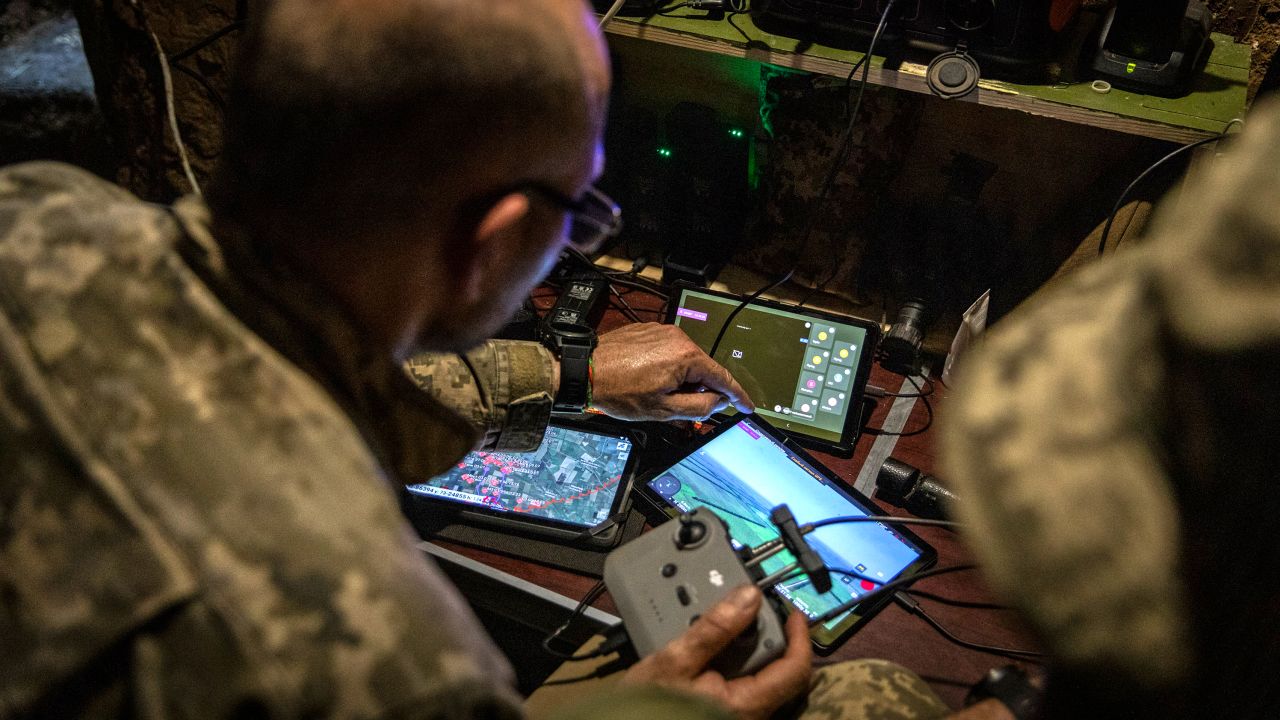
A soldier  is seen controlling a drone for surveillance in the basesment at an undisclosed position in the Zaporizhzhia region of Ukraine.
A soldier is seen controlling a drone for surveillance in the basement at an undisclosed position in the Zaporizhzhia region of Ukraine. Alex Chan Tsz Yuk/SOPA Images/Sipa USA/AP
 
Over a million Ukrainians have applied and more than 800,000 visas have been approved though only some 21 percent of visa holders have arrived in Canada. Those who have already been granted visas will still be able to come to Canada until the end of March 2024. Applications for temporary emergency visas offered to Ukrainians are expected to close in the near future, with no official decision yet announced whether Canada is prepared to offer long-term refuge for Ukrainians fleeing Russian occupation in their country.

The emergency visa was launched in the wake of the February 2022 Russian invasion, leading millions of people to flee the conflict in their homeland. Available to an unlimited number of Ukrainians, the visa allows those who arrive in Canada to work and study for three years on a temporary basis until their future plans have solidified. Those who have arrived in Canada with the use of the emergency visas are considered temporary residents, without refugee status.

The application process was extended in March, but the extension period came to an end on the weekend of July 15. Settlement services reserved for refugees and other permanent residents to Canada were extended to Ukrainians as a reflection of their unusual conflict-driven circumstances. Canada's Immigration Minister suggested a month earlier that Ukrainians could make application through traditional immigration streams during the period the government takes to consider its long-term plan.
 
Canada, Japan, the U.S. and other NATO countries pledged weapons and training as part of security guarantees to Ukraine. Prime Minister Justin Trudeau says it is meant to send a message to Russian President Vladimir Putin that Canada supports Ukraine and will continue to do so. Still from video
 
Over 6.3 million Ukrainian refugees were recorded by the United Nations Refugee Agency. Over five million have been estimated as displaced within Ukraine itself. One of the five permanent United Nations Security member-nations is itself responsible for an unwarranted invasion of a neighbouring country, and in the process of planning to absorb its territory into the greater Russian Federation, has committed a litany of egregious war crimes against the civilian population. Rather emphasizing the dormant status of the UN as a world community dedicated to peace.

A long-awaited government plan to offer permanent residency to Ukrainians with family ties to Canada promised over a year ago, has never been acted on. Canada has a large expatriate Ukrainian community of Ukrainian-Canadians who are themselves fully engaged in raising funds to support the citizens of Ukraine who have been forced from their homes, supplying them with food, medicine, fuel, and other emergency necessities, along with non-lethal military-grade aid to the Ukrainian military. The 1.4 Ukrainian-Canadians make up a sizeable voting bloc the Liberal government would do well not to disappoint.

Several people carrying luggage walk through an airport.
Ukrainian nationals fleeing the ongoing war in Ukraine arrive at Trudeau Airport in Montreal on May 29, 2022. A new immigration pathway being launched by the federal government opens up permanent residency to Ukrainians living in Canada with one or more family members. (Graham Hughes/The Canadian Press)
"We're hoping and waiting and we're overdue to hear from the federal government about a family reunification pathway."
"That's something we are eager to hear more about, because there have been people bringing their parents and siblings over."
"The sooner that Ukraine wins the war, the sooner peace and normality can resume and this massive refugee crisis will come to an end."
Ihor Michalchyshyn, Ukrainian Canadian Congress
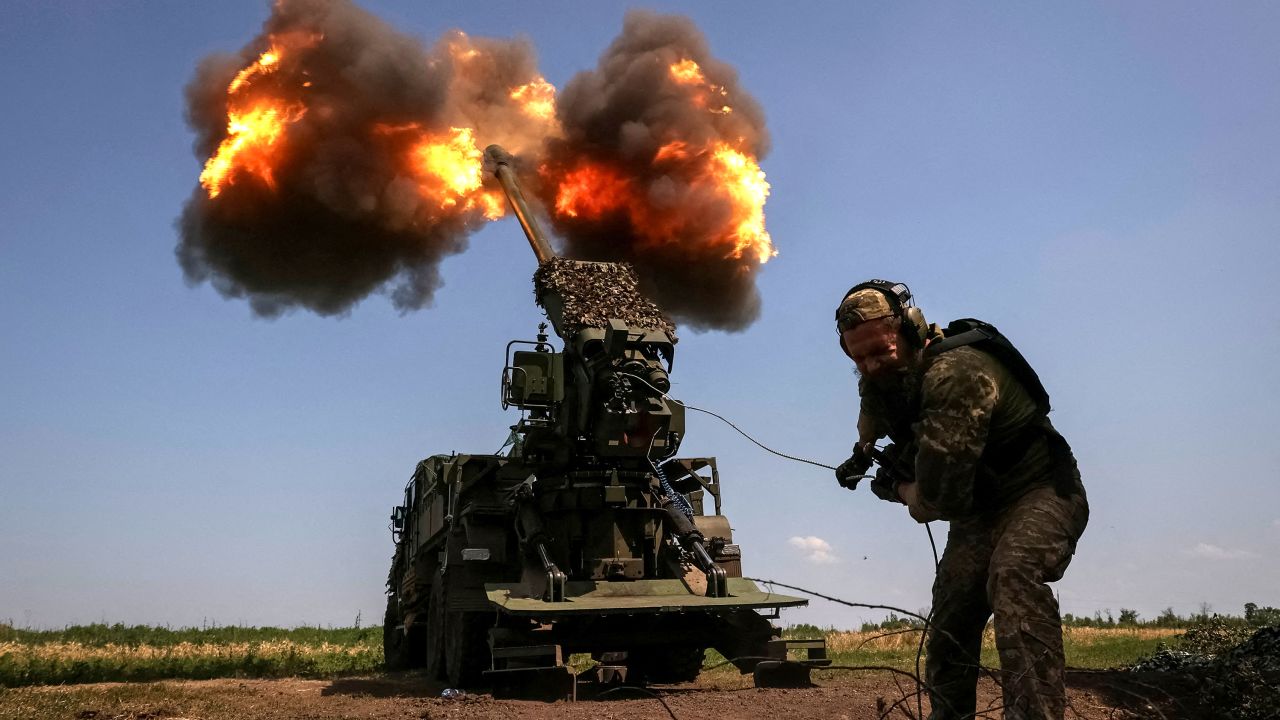
A Ukrainian serviceman fires toward Russian troops at a position near the city of Bakhmut in the Donetsk region of Ukraine on July 5.
A Ukrainian serviceman fires toward Russian troops at a position near the city of Bakhmut in the Donetsk region of Ukraine on July 5.  Sofiia Gatilova/Reuters

Labels: , , , ,

() Follow @rheytah Tweet