Politic?

This is a blog dedicated to a personal interpretation of political news of the day. I attempt to be as knowledgeable as possible before commenting and committing my thoughts to a day's communication.

Tuesday, March 14, 2023

ICC Prosecution for War Crimes

 
What is a war crime?  Even war has rules.
  • The definition of war crimes are set out in treaties called the Geneva Conventions along with other international laws and agreements.
  • Military forces cannot deliberately attack civilians -- nor the infrastructure that is vital to their survival.
  • Some weapons are banned because of the indiscriminate or appalling suffering they cause -- such as anti=personnel landmines and chemical or biological weapons.
  • The sick and wounded must be cared for -- including injured soldiers,who have rights as prisoners of war.
  • Serious offences such as murder, rape or mass persecution of a group are known as 'crimes against humanity' or in some circumstances, 'genocide
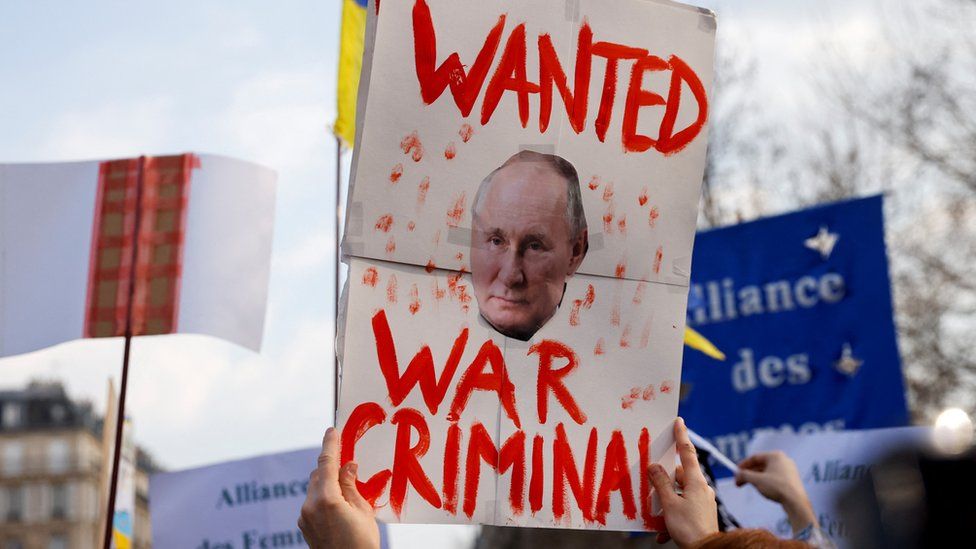
A protester in Paris holds a sign accusing Vladimir Putin of war crimes
Reuters

Russia and its president have been referred to the International Criminal Court repeatedly, in reflection of the crimes against humanity committed by the Russian military as a whole and by Russian servicemen in episodes of vicious brutality, including torture, rape, looting, murder. It was inevitable, given Russia's violent invasion of Ukraine, and witnessed, photographed and first-person accounts of crimes committed by Russia that the International Criminal Court would be involved in prosecuting the perpetrator of barbarism in a conflict of territorial expansion.
"We see clearly a pattern, I think, in terms of the number, scale and breadth of attacks against the power grids of Ukraine. And we need to look at why that’s taking place; are they legitimate targets or not; and whether or not they are targeted for other reasons." 
"Children cannot be treated as the spoils of war."
"There seems to be a lot of damage in Ukraine, and it may well be it is part of a policy and part of a plan and we need to get to the bottom of it and see whether or not there is criminal responsibility and if there is we have an International Criminal Court that has jurisdiction to look into it."
"As a prosecutor we are officers of the court. We are not here to get a round of applause by a conjuring trick. Whenever we do move, [people] should have confidence that this is not a political process."
ICC Chief Prosecutor Karim Khan

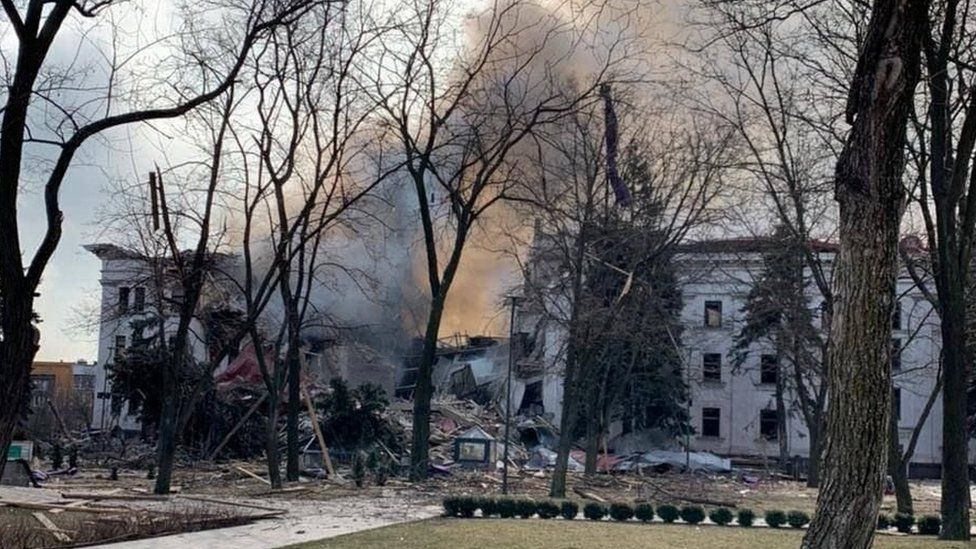
A view shows Donetsk Regional Theatre of Drama destroyed by an airstrike
Mairupol theatre after the air strike    Reuters

The International Criminal Court has announced its preparation to initiate the arrest of Russian officials for their role in forcibly deporting children from Ukraine and for deliberately targeting civilian infrastructure. An unnamed source stated that arrest warrants could include the crime of genocide, expected to be served in the "short term" should the court prosecutor request be approved by a pretrial judge at the court based at The Hague.

Just as Russia, with its permanent seat on the United Nation Security Council vetoes any sanctions the other Security Council members, with China supporting Russia, bring forward, it is a foregone conclusion that it will use its weight at the UN to reject any such arrest warrants naming any Russian officials. An international war crimes prosecution would have the ultimate effect of pushing Moscow down a steeper diplomatic isolation incline. Russian officials named would theoretically find it difficult to travel abroad.

Dial back to the vicious assaults by the Sudanese military and its government on Sudanese Darfurians inspiring the International Criminal Court to prosecute the Sudanese president Omar Al Bashir and its head of military for 'genocide, war crimes and crimes against humanity committed in  Darfur, Sudan, since 1 July 2002' and the spectacle of Al Bashir travelling abroad to attend meetings of the Arab League where his presence was accepted and none there made a move to arrest him.

Moscow predictably denies deliberately targeting Ukraine's civilian infrastructure, insisting its attacks are merely intended to reduce Kyiv's fighting capacity. Russia feels it was completely legitimate to bring thousands of Ukrainian children to Russia as a humanitarian campaign meant to protect orphans and abandoned children from the conflict zone. Kyiv clarifies the situation, that thousands of Ukrainian children were deported to be adopted into Russian homes or placed in Russian camps and orphanages.

Exposed exclusively to a Russian education and ambience, given Russian passports, taught to be Russian and to reject their Ukrainian heritage, nationality and culture, the children are expected to consider themselves Russian. The genocvide convention of the United Nations defines 'forcibly transferring children of one group to another group' to be one of five acts prosecutable as genocide. 
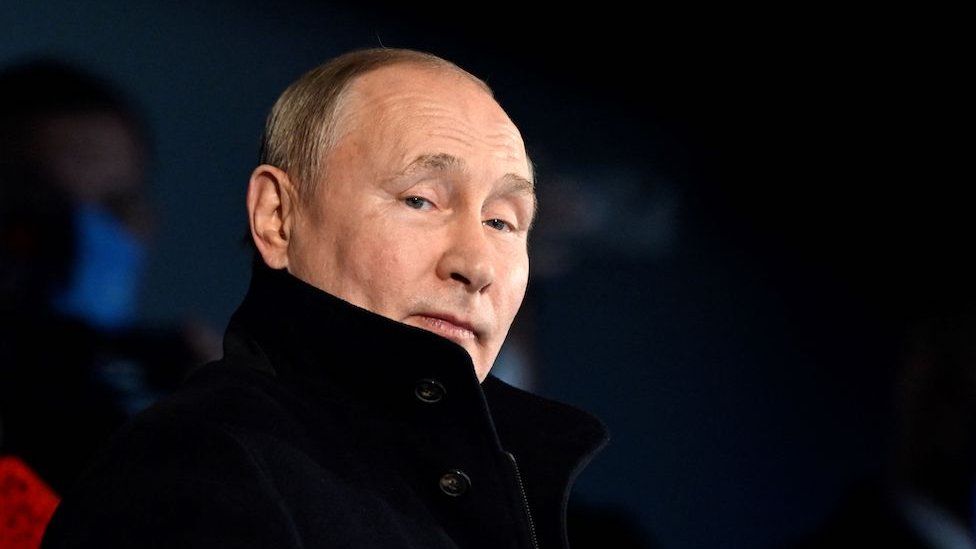
Vladimir Putin
The ICC can bring a prosecution against political leaders for "waging aggressive war". This covers an unjustified invasion or conflict not undertaken in self-defence.   Getty Images

Kyiv had taken its own prosecution action previously, conducting a few war crimes prosecutions of individual Russian soldiers accountable for incidents such as killings or rapes in occupied Ukraine territory. The prospective ICC prosecution would elevate the charges while targeting officials responsible for policies and not just the minions perpetrating such war crimes on the ground.

Russia is itself mindful of its diplomatic isolation, currying closer relations with those countries willing to overlook its barbaric war in Ukraine. The most senior and important to Moscow of which is Beijing. China's President Xi Jinping is on the cusp of visiting Russia, responding to a long-standing invitation. Just the kind of friendly support that President Vladimir Putin most appreciates at this vexing time from a powerful ally.

Rumour has it that President Xi may plan to speak by video link to Ukraine's President Volodymyr Zelenskyy. Beijing has made overtures in the past to bring Moscow and Kyiv to peace talks, but Beijing doesn't make the rules and Moscow insists that Kyiv accept all the territorial gains that Russia feels it is entitled to, and for Ukraine to disarm, and disavow joining NATO. Unlikely prospects.

Beijing has just pulled off a diplomatic coup in persuading Saudi Arabia and Iran to set aside their long-standing polarizing issues which has brought them into conflict by proxy, in Syria and in Yemen. Iran, resenting Saudi Arabia's role as custodian of Mecca and Medina, aspiring to hold that role itself, the two nations, the Sunni-Islam Kingdom of Saudi Arabia and the Shiite Islamic Republic of Iran have agreed to restore diplomatic relations. Whether they will put a halt to battlefield hostilities is another matter.

"We do not recognize this court; we do not recognize its jurisdiction."
Vladimir Putin’s spokesperson, Dmitry Peskov
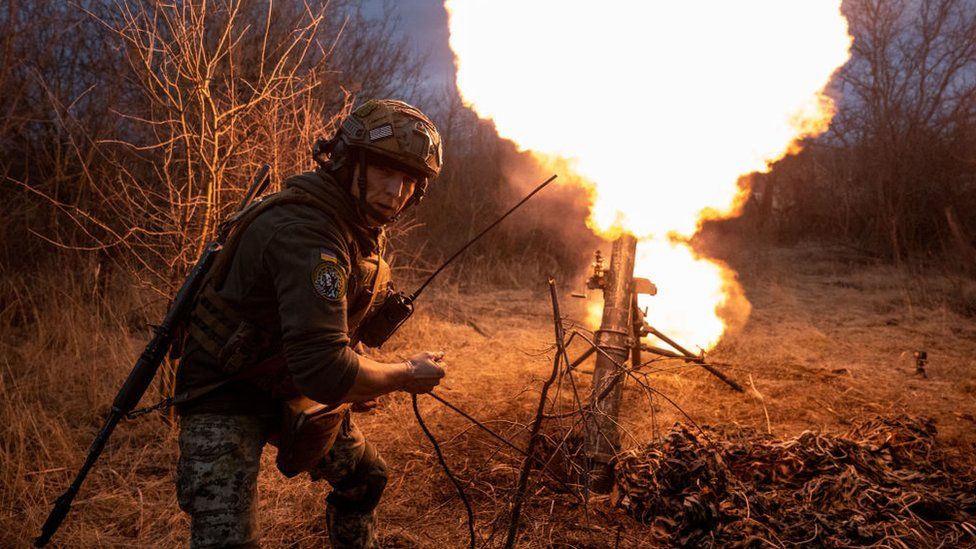
A Ukrainian soldier fires a mortar in Bakhmut
Getty Images


Labels: , , , ,

Sunday, May 24, 2020

Summer COVID Quarantine

"[At the medical conference with four thousand present] everybody is shaking hands."
"Please RT if you want to make this [fist bumps] a social norm. I shared the article on the North American spread of the novel coronavirus in February], and then I started fist bumping, everybody. But even people who saw the article, friends, instinctively kept reaching out for my hands."
"It's that habit we built our entire life in our culture. Shaking hands is the way you connect with somebody."
"Over time, it decreases the probability that we'll be able to comply [due to the 'profound burden of extreme physical and social distancing']."
"[People] are irritated their life is disrupted -- you have a thousand different little reasons why any individual might be experiencing fatigue with all of these things." 
"We'll learn new norms about how to socially interact, in small groups, spaced out, with masks on, in ways that allow us to get our basic human and social and mental health needs met, while reducing the infection rate."
Jay Van Bavel, professor, social neurologist, New York University
Children and teens gather around an instructor during Royal Ontario Museum's summer camp in 2019. The future of the camp this summer is uncertain, as the museum is closed. (Kiron Mukherjee)
It was still winter when the World Health Organization finally took the step of declaring the SARS-CoV-2 virus that causes the novel coronavirus that the WHO named COVID-19, to be a global pandemic, placing the world on notice that extraordinary precautions and bold and sometimes unpleasant steps in declaring an emergency with regulations to match, came into our lives. Social distancing was, albeit unpleasant, somewhat more doable, in the cold winter months. And we've had months of extraordinary caution, while the virus roared through one country after another.

Worldwide over five million cases of COVID have been diagnosed, causing severe enough symptoms to shock medical professionals and flood hospitals with hundreds of thousands of very ill people requiring life-saving measures that mostly aided recovery, and too frequently ended in death. The elderly and the health-impaired were particularly targeted by the predatory virus, and in one country after another, long-term care institutes and homes for the elderly were devastated.

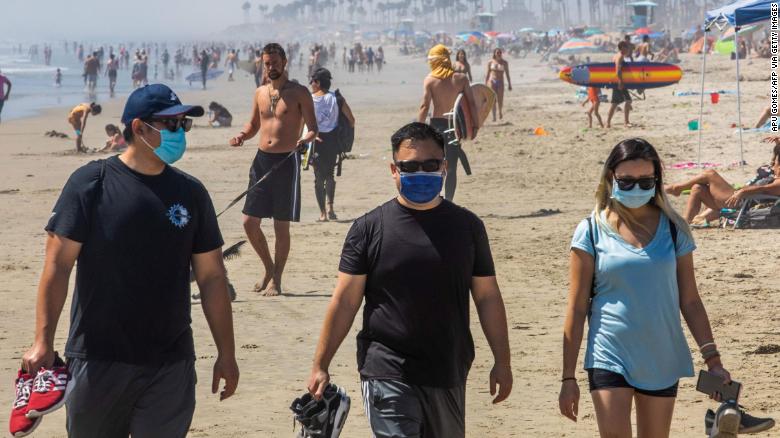
But summer is fast approaching, with fine weather to tempt people to throw off the bonds of social separation and self-isolation, for the relaxation and happy times that not so long ago were normal in everyone's life, casual adventures in partying, in going off to crowded beaches to soak in the sun and lakes, utterly irresistible, and just too much to expect people to forego and children to be happy with the continued constraints on their summer expectations.
"Asking people to renounce social contact is not just asking them to abstain from pleasurable activities; it is asking them to diverge from a point of equilibrium, toward which they normally all gravitate."
"Yet, we still seek physical contact, with friends, family, loved ones, and there's little chance our 'social capacities and needs' will change, even in the face of an invisible threat."
"When we can be in the same physical space, or even more, when we touch and are in direct physical contact with each other, we have this immediate feeling of reciprocity: I touch your hand, you touch mine. This is very precious, and we know that joint presence, joint attention, play a crucial role in our lives. Joint presence and joint attention are not transferable to online platforms -- not now, and if you ask me, not for a long time."
Ophelia Deroy, faculty of philosophy of mind, Ludwig Maximilian University, Munich 
Campgoers pose at Camp Northland-B'nai Brith in Haliburton, Ont., in pre-pandemic times. (Simon Wolle/Camp Northland)
This, in a world order that has fearfully and grudgingly accepted that it is no longer safe to touch other people, so much as to extend a friendly hand in greeting, to maintain a safe six feet distance apart from one another, to restrain oneself from the impulse to go along to a neighbourhood park, to accustom oneself to the unthinkable reality that there are no hairdressers, group sports, gyms, and other normal social institution distractions for leisure time activities open and available to begin with....

As social animals actively seeking out conversations, activities of shared interests with others, society has had to adjust to a vast difference in how we approach one another -- not at all, certainly not in a confident, close or intimate manner; grandparents maintaining a decreed distance from grandchildren, from extended family members, from previously trusted old friends; no more casual get-togethers, no neighbourly interactions, just distance, distance, distance.

Summer camps for children? That was in the past. Baseball games? Play dates? Not likely, not anymore, not until a minor miracle occurs when the disease either dissipates miraculously, or a reliable and safe vaccine is found to bring our lives back to the casual interchanges we have been accustomed to all of our lives. Meeting and hugging, whispering confidentially to one another, planning evenings out, instead of video-conferencing and no touching, either of people or hard surfaces, out in the great unknown.

We've been at this new, awkward and miserable game of separation and isolation for months, and it's psychologically wearying and beyond frustrating. Constant high-alert is a burden, one we've become fed up with. The basic activities we've taken for granted since forever: shopping, exercising, entertaining, that have been in strict abeyance for months, have been sorely missed, creating a sense of betrayal and resentment. At the same time the contemplation of returning to those old pursuits have lost their scare factor. And as society begins to loosen the strictures of denial, people will inevitably let their guards down.


Dr.Theresa Tam, Canada's chief public health officer, warned most recently that Canadians have an obligation to themselves and to others to remain vigilant; it is far too soon to relax restrictions entirely as some may contemplate. Should society in general relax to the extent that people are now feeling comfortable about inviting neighbours and friends over for drinks on the patio, think twice. Or risk the gains realized by remaining within our homes. We must, she stressed, continue to persevere, to maintain our guard, or the potential of an exponential infection rate becomes a possibility.

Carleton University researchers in a survey of 2,000 Canadians saw 79 percent of respondents agree that it is more important "to minimize available illness and death" rather than restart the economy prematurely. A preference for "getting the economy going again" was supported by 21 percent, even it it could result in more illness and death. Expect no carnivals or festivals this summer; no proms, no Calgary stampede, no Canada Day mass celebrations on Parliament Hill. Celebrate virtually.

Shelter-in-place and physical distancing are here to stay. "I think people have established, as unpleasant as it is, a routine in their lives. I think there is a sense of collective responsibility that everybody is still in this, and doing it", commented Josh Greenberg, professor of communication and media studies at Carleton University
"I do hear people saying that they're tired of this narrow routine, the expectation that they abide by these new safety guidelines.'
"[Caution fatigue  results with being desensitized  to a risk; over time] we adjust, psychologically, to reduce the fear and then we desensitize the pandemic information."
"People start to regain an interest in resuming a routine, trying to maintain their mental, emotional and spiritual health. We want to resume our prior habits."
"There are harsh consequences to the community if caution fatigue drives some of your choices. People feel fatigued from this highly taxing experience."
"Do what you can, when you can, to reduce your risk to yourself and others. So, if you're still going to socialize, put on the mask and stand six feet away."
Jacqueline Gollan, associate professor of psychiatry and behavioural sciences, Northwestern University Feinberg School of Medicine
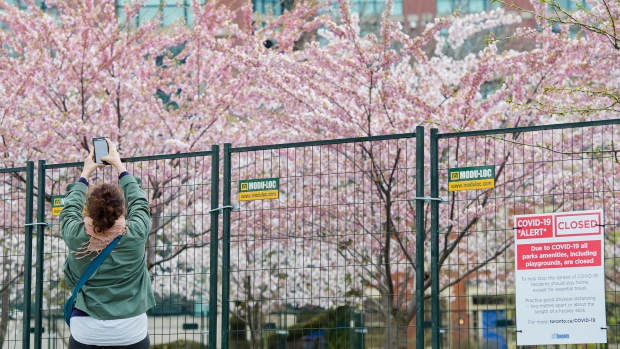
Cherry blossoms
People take photographs of a fenced off cherry blossoms at High Park during the COVID-19 pandemic in Toronto on Friday, May 1, 2020. Health officials and the government have asked that people stay inside to help curb the spread of COVID-19. THE CANADIAN PRESS/Nathan Denette

Labels: , ,

Thursday, March 12, 2020

Agreed: The Formula for Containment is Isolation

"[The situation is such leaving me] deeply concerned by both the alarming spread and severity, and by the alarming levels of inaction."
WHO director-general Tedros Adhanom Ghebreyesu

"You can do it [aggressive social distancing] now or do it in three weeks when the ICUs are starting to fill."
"Countries that have done this successfully have closed schools. We can figure out whether it's overkill later."
Dr.David Fisman, physician epidemiologist, University of Toronto

"We need measures that, while painful for all, will slow social contact."
"And we need to stop feeling sheepish about it and just realize that some places [Italy, Iran] are in crisis and some are very likely in the days before a crisis that will be less bad if we slow down the virus to reduce peak demand on health care."
"We will not intervene as intensely as China, making speed more important."
"[A new study has provided the strongest evidence yet that] presymptomatic transmission is occurring." 
Dr.Marc Lipsitch, infectious disease epidemiologist and microbiologist, Harvard University

"[Researchers in Tianjin, China studied two detailed transmission clusters finding] that people can start infecting others three days before they start seeing symptoms themselves."
"One of the huge roles of these social distancing, self-isolation and quarantine measures is to try to stop those transmissions that could be happening even before people feel sick."
"This is still low risk in Canada right now. But I think it really underlies those preventive measures we can take. [When?] The answer is soon. But I don't know the cost implications of that. It has to be weighed in."
Dr.Caroline Colijn, professor, Canada 150 Research Chair in mathematics for evolution, infection and public health, Simon Fraser University
As COVID-19 cases continue to rise in Canada, experts are trying to slow the spread and prevent the health-care system from becoming overwhelmed. (Christinne Muschi/Reuters)

The question looms large ... if not now, when? With the World Health Organization finally declaring formally that COVID-19 is a global pandemic following weeks of health experts warning the world is in the early stages of one, countries around the world are girding themselves for the potential of a worst-case scenario. "There is so much unknown. People could be asymptomatic and contagious. This is the big difference from SARS", said Pierre-Gerlier Forest, director of the University of Calgary School of Public Policy -- of the situation where people became ill and then contagious, with SARS.

The novel coronavirus has demonstrated that it is able to spread wildly and does so before symptoms appear, and for up to two weeks after someone recovers, still shedding the virus and infecting others. Limiting human contact appears, at this stage, to be the primary foreseeable weapon in controlling the viral outbreak. China did so, brutally, and thoroughly, and it appears to have worked, with the numbers of newly diagnosed cases of COVID-19 steadily declining; most of those newly presenting originating from Chinese travellers outside the country, returning from destinations like Italy and Iran.
Microbiologist and infectious disease specialist Dr. Allison McGeer is pleading with Canadians to be vigilant about the 'boring stuff' — such as handwashing, staying home when they're sick and coughing into their elbows. (Evan Mitsui/CBC)

According to Dr.Forest, ultimately the goal is the reduction of the number of people that one single infected person can infect, to less than one. "If you can bring it under one, the epidemic starts to dwindle. The question is how to do it", and earlier rather than too late. Discovering who is spreading the disease is made infinitely more difficult when you throw in the equation that people can be asymptomatic, yet spread the contagion. "The case for social distancing is extremely strong", emphasized Dr. Forest.

Without public health intervention, pointed out Dr.Fisman who with his team's model for Canada, saw an overall attack rate of 70 percent among the population hit by the virus. That's an immense number of people to be felled by a virus, one that is potentially fatal for the elderly and the health-impaired. The emphasis on containment is public health intervention, finding and isolating at least fifty percent of mild cases through testing to allow a significant drop in the attack rate.

And it is envisaged that aggressive social distancing; sporting events played behind closed doors, people working from home, video conferencing, cancelling of concerts, no mass gatherings, shopping at off-peak hours and closing all schools among the many and varied decisions taken to minimize social contact.The goal is "flattening the curve", retarding the number of new infections and the spread of a virus that has already upended the lives of millions.

International researchers studied the virus incubation period -- held to be the time between exposure and the appearance of symptoms -- and serial interval, the time between someone becoming symptomatic and those they infect themselves becoming symptomatic. Two detailed transmission clusters were the focus of study leading to the finding that "people can start infecting others three days before they start seeing symptoms themselves" according to Dr.Colijn.

Any imposed restrictions on individual freedoms according to the federal pandemic plan in Canada, must be proportional to the magnitude of threat. "This principle of 'least restrictive means' should always be a consideration when enacting social distancing measures", reads the governmental plan.

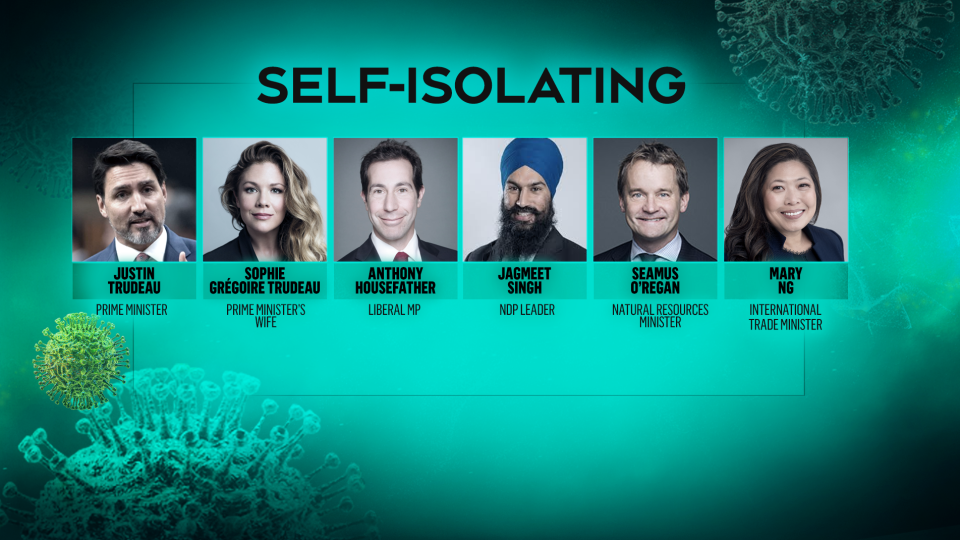
And as a demonstration that no one is immune from this virus, Sophie Gregoire-Trudeau, wife of Canada's prime minister has been diagnosed with COVID-19. She had just returned from a trip to Britain to attend a convention at which she had a speaking engagement. She and her husband, Justin Trudeau, have entered self-isolation. Joining a lengthening list of public officials in self-isolation.
  • Self-isolation
    Liberal MP Anthony Housefather, Natural Resource Minister Seamus O’Regan, and 
    International Trade Minister Mary Ng are also in self-isolation.

Labels: , ,

Tuesday, April 30, 2019

An Initiative Long-Past Due

"This unprecedented step, led by the Department of State, recognizes the reality that Iran is not only a state sponsor of terrorism, but that the IRGC actively participates in, finances, and promotes terrorism as a tool of statecraft."
"[The move is meant to] significantly expand the scope and scale [of pressure on Iran]. If you are doing business with the IRGC, you will be bankrolling terrorism."
U.S. President Donald Trump

"Who are you to label revolutionary institutions as terrorists?"
"You are the leader of world terrorism."
"This mistake will unite Iranians and the Guards will grow more popular in Iran and in the region."
"America has used terrorists as a tool in the region while the Guards have fought against them from Iraq to Syria."
"[The US is the] leader of world terrorism."
Iranian President Hassan Rouhani
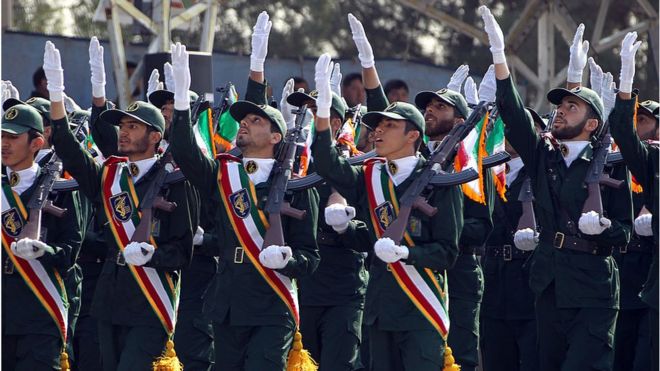
Iranian elite revolutionary guards march during an annual military parade which marks Iran's eight-year war with Iraq, in the capital Tehran on September 22, 2011.
ATTA KENARE/AFP/Getty Images
The Conservative government of Stephen Harper broke off diplomatic relations with the Islamic Republic of Iran in recognition of its role as a terrorist-sponsoring state, and its responsibilities in the deaths of countless people in attacks it inspired, carried out by its Lebanon-based proxy militia, Hezbollah. Canada closed its mission in Tehran, while informing Iran that its missions in Canada were to be shuttered. Iranian assets in Canada other than those linked to diplomacy were frozen.

When Justin Trudeau became prime minister he made it clear he meant to re-establish diplomatic links with Iran.
Prime Minister Justin Trudeau meets with Israel's President Reuven Rivlin in April (Canadian PM Office)

In Canada's Senate, 2017 saw Conservative Party Senator David Tkachuk sponsoring Bill S-219 (the Non-Nuclear Sanctions Against Iran Act) requiring sanctions be implemented, along with a recommendation by the Minister of Public Safety and Emergency Preparedness to recommend that the Islamic Republican Guard Corps be recognized and named a foreign terrorist entity, under the Canadian Criminal Code. The bill was defeated following a year-long debate. Canada has a majority Liberal government.

Once that sanctions bill saw defeat, the Conservatives proposed a House of Commons motion for the government to cease re-engagement talks with Iran, and to list the IRGC as a foreign terrorist entity. This time the majority Liberals voted to support the motion. Still, the motion was not legally binding, with Minister of Public Safety Ralph Goodale confirming that a number of options were being considered before implementation of the measure in formal practise. Sounds very much like evasion.

The United States has announced its decision to list the Islamic Revolutionary Guards Corps as a proscribed terror group. The IRGC, formed under the auspices of the 1979 Iranian Revolution in support of the Islamic Republic, is deeply influential in Iran's domestic and international politics. It has a stranglehold on the nation's economy and is fully invested in support of the Republic since leaders of both the political and military arms have much to gain or to lose. Both groups have grown wealthy as they manipulate the country's resources.

The IRGC's interests and control over the nation's telecommunications, construction, energy and automotive industries are integral to its vital importance to the regime and in the regime apart from its military function. Control of everything associated with Iran's ambitious nuclear program is vested in the IRGC. The al Quds division of the IRGC is the arm deployed abroad, training the Houthi rebels in Yemen as they did the Syrian military during its civil war, along with Hezbollah.

The IRGC al Quds division has a long acquaintance with the terrorism of martyrdom and carnage inflicted on Iran's enemies; primarily the U.S. and Israel. During Lebanon's upheaval when Syria, Israel, the Palestinians, the Lebanese sectarian factions, the Druze, Christians, Muslims, Sunni and Shia were battling, establishment of Hezbollah by Iran, its training and its arms acquisition were carried out enabling it to mount massive deadly strikes against the U.S. marine barracks, and the U.S. and French diplomatic missions in Lebanon.

The U.S. Treasury Department had already listed the IRGC as a banned terror group in reflection of Iranian aggression and its role in destabilizing the Middle East, along with its dedication to sponsoring terror to the extent of having been responsible for tens of thousands of deaths of innocent people. This designation is a first for the United States; the first time it has recognized an entire critical unit of another nation in such a manner.

This move will have an even greater impact on Iran than the already-crippling sanctions imposed in view of Iran's intransigence respecting its technical exploits in refining long- and medium-range ballistic missiles and its ambitions to acquire nuclear devices under the guise of domestic energy empowerment.

The impact will be more far-reaching, involving companies doing business with Iran, as well as banks, and countries with ties to the Republic. The European Union, and Federica Mogherini will certainly have much to think about; their insistence that Iran does no wrong while overlooking its terrorism links, and business and trade must not be impacted, leave them on the wrong side of history.

Now it remains to be seen whether Canada too will continue to vacillate between recognizing Iran for the dangerous threat it poses to stability in its region and throughout the world, given its campaign of assassinations, missile attacks and bombing campaigns from Latin America to Europe and the Arab world, and taking the necessary final step to completely isolate a theistic regime whose agenda includes the oft-stated destruction of the state of Israel.

Labels: , , , , , ,

() Follow @rheytah Tweet