Politic?

This is a blog dedicated to a personal interpretation of political news of the day. I attempt to be as knowledgeable as possible before commenting and committing my thoughts to a day's communication.

Sunday, November 14, 2021

Ecuador Penitentiary System Deadly Gun Riots

"[In the initial fighting, inmates] tried to dynamite a wall to get into Pavilion 2 to carry out a massacre. They also burned mattresses to try to drown [their rivals] in smoke."
"We are fighting against drug trafficking. It is very hard."
Pablo Arosemena, governor, Guayas province, Ecuador 

"The first right that we should guarantee should be the right to life and liberty, which isn't possible if security forces can't act to protect."
"There will be more than 1,000 pardons, but this is part of a process [to eliminate prison overcrowding]."
"For example, installing a freight scanner in the Guayaquil Penitentiary to avoid the entry of arms costs $4 million."
Ecuadorian President Guillermo Lasso
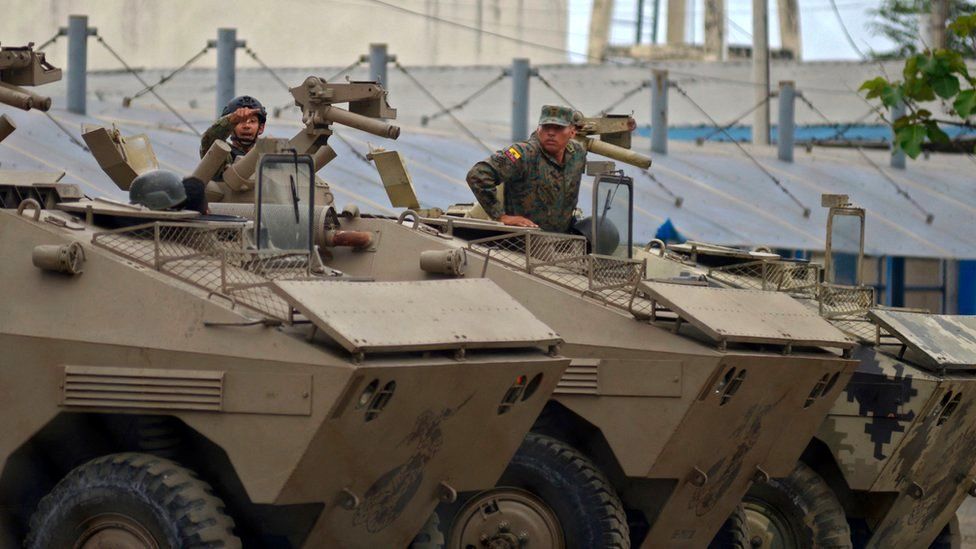
Soldiers in armoured vehicles secure the Guayas 1 prison in Guayaquil, Ecuador
Soldiers in armoured vehicles are positioned near the perimeter of the Guayaquil prison  Getty Images
 
Ecuador is badly in need of international financial assistance to enable it to meet the challenge it faces in attempting to secure the country and protect the nation from the wild violence of drug gangs. The nation's prisons cannot contain all those arrested for criminal activities connected with the movement of illicit drugs. The governor of the state of Guayas where the latest prison atrocities have killed hundreds in mass prison gunfights between inmates is badly in need of help. Aid, Governor Arosemena, announce, is expected in the form of resources and logistics.

Ecuador houses close to 40,000 prison inmates in its entire penitentiary system with an optimum capacity of 30,000, which means that ten thousand more prisoners than the system is built to accommodate present a problem for prison authorities in their capacity to exert control and maintain order and security. Of the total of those incarcerated, half have not yet even been sentenced. So the justice system has some catching-up to do, as well.

The country's president has stated that Ecuadorian authorities plan to deal with prison overcrowding through granting pardons where applicable, through relocating inmates, and transferring some foreign inmates back to their countries of origin. The outstanding problem the country and the penitentiary system faces aside from overcrowding is he introduction of guns and explosives smuggled into the hands of inmates.

A series of violent, deadly gun battles have taken place between rival gangs incarcerated in the largest prison in Ecuador. In the latest of these, at least 68 inmates have died, and dozens more wounded on Saturday. It took an entire day for authorities to regain control of the Litoral Penitentiary located in the coastal city of Guayaquil. The gun battles began before dawn with shooting lasting eight hours. New clashes took place in the afternoon before order was finally restored.

Fighting among prison gangs is linked to international drug cartels. Social media replayed videos showing bodies of inmates, some had been burned, lying on the ground in demonstrations of ferocious brutality. When night fell it was announced that "the situation is controlled throughout the penitentiary". Some 900 police officers had taken control. Two months earlier fights among gang members led to the deaths of 119 inmates at the prison, where over 8,000 inmates are kept.

Early in the day, according to police commander Gen.Tanya Varela, drones flown over the chaos revealed inmates in three pavilions to be armed with guns and explosives. Weapons and ammunition enter the prison into the hands of prisoners through the medium of vehicles delivering supplies and on occasion by drones. President Lasso in October issued a national state of emergency empowering security forces to fight drug trafficking.
 
More than 20 inmates have been killed during the latest prison riots in Ecuador.
 
The Constitutional Court however, refused recently to permit the military access into prisons, refuting the declared state of emergency. Soldiers can only assemble outside the Literal. Of the bloody fighting within Litoral prison when 119 inmates were killed in late September, five of the dead had been beheaded. In simultaneous riots in various prisons last February, 79 inmates were killed. In total for the year, over 300 prisoners died in penitentiary clashes across Ecuador.

"Enough of this. When will they stop the killing? This is a prison not a slaughterhouse, they are human beings", pleaded Francisca Chancay, whose brother has been imprisoned for eight months in Litoral. Those desperate to see an end to the slaughter call for the military to take control of the prisons. 
"Here you sleep with one eye open[ and now, word is spreading inside the prison of attacks on other pavilions in a few days]. They want to break you ... and gain control of the drug-trafficking routes and micro-trafficking [or local drug sales]."
"[At the Litoral Penitentiary], everything is arranged with massacres, extortion. If you don't cooperate you die, they decide who lives, who dies, who gets rich."
Unidentified inmate
Ecuador prison
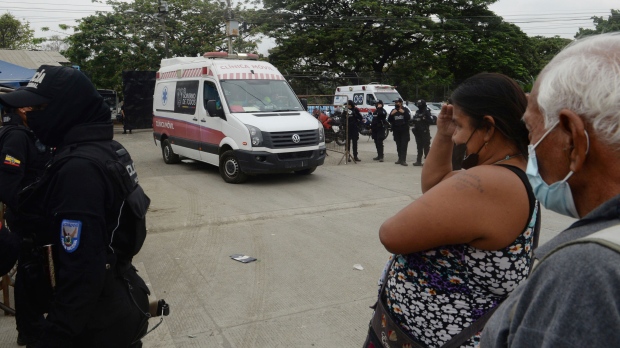
An Ambulance leaves the Litoral penitentiary the morning after riots broke out inside the jail in Guayaquil, Ecuador, Saturday, Nov. 13, 2021. (AP Photo/Jose Sanchez)

Labels: , , , ,

Friday, February 14, 2020

Mexican Cartels' War on Farming Villages

"We find ourselves under siege. This is a public cry for help by a community that's been cornered."
"They've been trying to get assistance by federal and state government, unsuccessfully, so they're trying to escalate the language to try to negotiate and get help."
Falko Ernst, analyst, International Crisis Group 

"I don't know how they can get the government's attention aside by doing these sorts of things -- or by dying, and even that will only get the authorities' attention for a few days."
Chris Kyle, anthropologist, University of Alabama, Birmingham
Miguel Toribio, 11, puts a pistol belonging to his father into his belt, before demonstrating newly learnt skills from military-style weapons training, to a Reuters journalist in Ayahualtempa, Mexico, February 3, 2020.   REUTERS/Alexandre Meneghini

The children wear uniforms with jackets emblazoned with "Community Police". They mask their faces with handkerchiefs. Thirteen-year-old Alex spoke of the training he received, how good it made him feel. He could feel the weight of the gun, fully loaded with ammunition. "There was no fear in his eyes. That's how I knew he was ready", his father Santos Martinez said. "I'm preparing to defend my village", Alex added.

Mexico's enormous problem with heroin production and drug cartels and gang killings is legendary. Not so well known is the plight of remote villages in areas where the drug gangs control everything, posing an existential threat to villagers' safety, controlling their comings and goings, exacting vengeance on those they believe betray them, and the ongoing siege of the villages leading to well-founded fears for the lives of village children.

Fathers of families see little option but to allow their children to be involved in military-type training, learning how to handle themselves in dangerous situations, arming them with deadly weapons to enable them to self-protect should/when the occasion arises. Venturing outside her community, a 56-year-old villager, a grandmother, was kidnapped, tortured and murdered by cartel members, a warning to others to remain in their villages, silent, obedient.

The ten-year-old granddaughter of the murdered woman was given her father's permission to obtain training. "They do this to prepare themselves to defend the family, their siblings and defend the village", corn farmer Sanchez Luna explained of the "community police" his rugged region was required to form in self-defence. Arms training is offered to school-age children, seen as a matter of forced necessity.
Children walk in a single file, holding toy and real guns, as they demonstrate newly learnt skills from military-style weapons training, to a Reuters journalist, in Ayahualtempa, Mexico, February 3, 2020. REUTERS/Alexandre Meneghini

Children as young as six years of age are seen carrying guns, demonstrating their military manoeuvres with ease. "They are killing children. We have to arm children", said 25-year-old Isabel Marquez, mother of two. The Indigenous community elders near the city of Chilapa add that young children would not be allowed to fight cartel gunmen; the situation is being used to attract help from far-off officials in Mexico City.

Last month suspected Los Ardillos Cartel members ambushed and killed ten area musicians after they had exited the territory their self-defence militias guard. Their bodies were  later found charred. The cartel dominates Guerrero state, their specialty the trafficking of heroin. A number of murders in the area preceded the attack on the musicians. One murder was a beheading, frightening the 6,500 residents whose land sits surrounded by poppy-growing farmland.

In Mexico, constant violence led by heroin-trafficking cartels threatens the population. President Manuel Andres Lopez Obrador has focused on the method, not the message: Those who arm children "should be ashamed of themselves", he pronounced, denouncing the use of children to grab the attention of an inattentive government. It worked. The government noticed."Giving children weapons and taking videos is an act of cruelty", he added and doesn't seem ashamed that its citizens must resort to such methods.
A community police agent poses for a photo as he guards a check point in Ayahualtempa, Mexico, January 30, 2020. REUTERS/Alexandre Meneghini

Residents, for seemingly good reasons, are suspicious of regional authorities, much less the few local police in their villages. They accuse them of being in league with the Los Ardillos cartel, whose presence forces their children to stop formal education at age twelve, since the middle schools are located in territory the cartel controls.So, from that age forward, the boys become men, carrying weapons as part of their own local "police patrol".

"We are surrounded by the bad guys, so we have to prepare ourselves to defend our town and our families", said Louis 'Gustavo Morales, 13,  holding a 20-gauge shotgun. The self-defence militia is known as CRAC-PF. Last year they managed to repel a major attack by Los Ardillos, leaving residents in fear of the warning siren going off again.

Children with toy and real guns demonstrate newly learnt skills from military-style weapons training, to a Reuters journalist in Ayahualtempa, Mexico, February 3, 2020. REUTERS/Alexandre Meneghini


Labels: , , , , , , ,

Tuesday, December 19, 2017

The Vanished

"There are an infinite number of people who are too scared to even say anything, whose cases we know nothing about."
"The entire state is a mass grave. It is the biggest mass grave in Mexico and perhaps one of the biggest in the world."
Jorge Winckler, attorney general, State of Veracruz

"The cruelest thing about a disappearance is that it leaves you with this desperate hope that your child might actually still be alive somewhere."
"You're trapped in this horrific limbo where you can't mourn or move on because that feels like betrayal, like you're killing off your own child."
Daniel Wilkinson, managing director, Human Rights Watch

"I'm not simply looking for the remains."
"I know you want to find body parts, but I have information that our kids were probably dissolved in acid or burned."
"I'm looking for buried clothing. And ashes."
Carlos Saldana, Xalapa, Mexico
mexico drug war grave
Investigators search for human remains in a mass grave in La Barca in western Jalisco state, November 21, 2013.  REUTERS/Alejandro Acosta

Though the Mexican government has acknowledged the disappearances of over 30,000 people, the fact is that there is no one who knows the absolute number who have disappeared. The remains of close to 300 bodies were unearthed from rough graves in Veracruz in the last year alone. The remains come in the guise of unidentified fragments leaving searchers and bereaved family members to imagine what happened to their loved ones over the last decade.

The bits of bone and other objects discovered in those graves have overwhelmed the state and Veracruz stated that it lacked the funding to conduct DNA tests on those remains that have been found, let alone others that will inevitably be unearthed, not by government agency necessarily, but by determined poses, groups of women focused on discovering the whereabouts of their dead relatives, for the state also announced it was halting all new searches for those clandestine graves.

They have run out of space to store the bodies.

Cartels across Mexico have acted with complete impunity, killing rivals, disposing of their remains in unmarked graves. In the war against corruption, violence, crime and drug cartels, the military and law enforcement personnel have often adopted the very same methodology, leaving families terrified and fearful of asking for government assistance when it is viewed as being likely complicit in the atrocities.
Mexico Ayotzinapa families disappeared
Relatives hold pictures of some of the 43 trainee teachers who disappeared in September 2014, during a demonstration to demand justice for their disappearance, in Chilpancingo, Guerrero, February 5, 2015.   Jorge Lopez/Reuters

No body, no case. Leaving bereaved families little option but to look to one another for support, linking themselves in collectives and launching meetings. Families have resigned themselves to the reality of government offering little assistance, that they are largely on their own. They must build coalitions, exact pressure, beg officials to cooperate while they cling to any shred of hope that they might, in the end, discover what had occurred to their missing relatives.

Among them are those who become detectives, who comb through areas criminals are known to have been seen, where others are known to have vanished, presumed murdered. they organize free DNA tests, raise funding to pay for their frenetic activities. They look for suspicious plots of land, on the lookout for signs of disturbed earth. In discovering such an area, long metal crosses are hammered two meters into the ground, then withdrawn and sniffed for the odour of decay in search of the dead.

Mr. Saldana, searching for his missing daughter, was informed of a ranch where cartel members were  believed to take their victims, to dissolve their bodies in acid. He felt convinced that on that ranch he would unearth evidence that would lead to the discovery of what had happened to his daughter. He had arranged for a convoy comprised of camouflage trucks with marines, police officers and officials and members of the families of the missing.

Among the officials driving in the convoy to the ranch were forensic scientists, police officers and investigators. On reaching the ranch, healthy horses, cattle and well-tended sheep were found roaming about, otherwise the ranch had been abandoned. They found a cinder-block chamber with a soiled mattress and chains; a grisly torture chamber where a stack of women's undergarments was also found. Looking at areas of disturbed earth, pieces of clothing were found.

Eventually no fewer than 500 items had been discovered, ranging from baby outfits to women's blouses, jeans and shoes. "I wonder if this clothing might be as close as we ever get to our children. That its very existence means we may never reach them." And if the stories of bodies being dissolved in acid are true, there is nothing to be found. Those they seek have well and truly 'vanished'.
"There are so many mass graves in Mexico, the country is starting to resemble a Swiss cheese."
"The number of graves that havn’t been found is infinitely larger than the number that has been discovered."
Jorge Reveles, veteran crime reporter
Mexico Veracruz mass grave killing victims bodies homicide soldier police
A policeman stands guard on a plot of land where skulls were found at unmarked graves on the outskirts of Veracruz, Mexico, March 16, 2017.   REUTERS/Carlos Jasso  

Labels: , , ,

Sunday, January 31, 2016

Mob Justice

"There is a crisis in terms of the growth of violence and crime and a parallel erosion of authority and the rule of law. These lynchings acquire a double meaning. People lynch both the suspect and the symbol of authority."               Raul Rodriguez Vuillen, professor, writer: Mexico Lynchings, 1988-2014

"If they were innocent, and I'm not saying they were, then this is a case of one group paying for the crimes of another."
"What happened the day of the lynchings is a situation that has been unraveling for some time now. One thing led to the other. In security, frustration, confusion and weariness."
Emanuel Petia, 33, Ajalpan, Mexico

"I can't imagine how this is happening in our country They stepped on every inch of my brothers' integrity, on all of t heir humanity."
Pablo Copado, brother of two lynched men
Women place crosses and flowers where a mob beat, killed and burned two pollsters who were conducting a survey, in front of the Municipal Palace in Ajalpan, Puebla, Mexico, Wednesday, October 21, 2015. As police took the two men to City Hall to try to protect them, a crowd, of some 2,000 strong, began to pelt the building with rocks. The police chief, tried to move them to safety on the second floor. But townspeople broke inside and began trashing the place, as the men looked on in shock. (AP Photo/Marco Ugarte)

Mexico has been a scene of drug cartel violence where gangs target one another to protect their turf, and authorities haven't seemed to be able to control the situation which also targets police if they think they can pursue their charged duties, and civilians who may happen to get in the line of fire of the gang wars. People were seeing the bodies of murdered drug dealers at the sides of roads, or hung in public places to deliver a message.

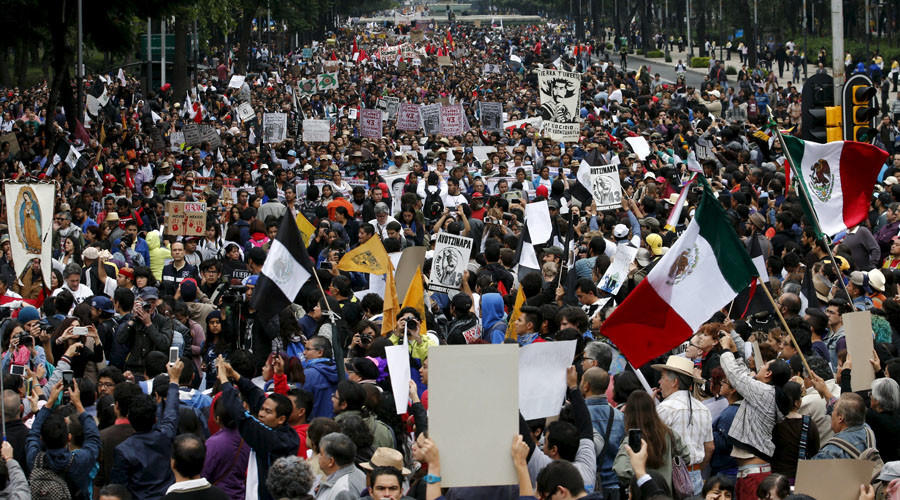
Demonstrators take part in a march to mark the first anniversary of the disappearance of the 43 students from Mexico's Ayotzinapa College Raul Isidro Burgos, in Mexico City, September 26, 2015. © Henry Romero

People also became acutely aware that sometimes municipal officials and the police they were told to trust, were taking a cut of the drug cartels' business. The abduction of 43 college students from Iguala who were setting out to attend a rally against corruption, and their murder and the revelation that the town's mayor and police chief were involved has done nothing to restore faith in the public that their political representatives and police are interested in bring security, law and order and justice to bear.

Little wonder that Mexican citizens are angered and frustrated and have no trust in their elected officials and their national police. But an event that happened in Ajalpan in southeastern Puebla state in October 2015 had few precedents and represented a reprehensible backlash against authorities by mortally and horribly victimizing two innocent young men. Their deaths seemed to be a matter of indifference to the townspeople in their overriding rage against government and police, however.

Mexicans have taken increasingly to mob rule, and to taking matters of crime alleviation into their own hands, a result of what many explain as having arisen from hopelessness and feelings of impotence. Little wonder, since 98 percent of murders are never solved and a mere 12 percent of crimes are even reported since there is such an utter lack of belief that justice will be served. Mostly because the state is absent in many areas.

There was an estimated 78 lynchings in Mexico last year. Last year five police officers were beaten after killing a villager during one of their operations and two of the police died. Residents of the borough of Iztapalapa have erected banners warning that thieves will not be turned in to police. Vengeance will instead be taken on their mothers.

In Chiapas State in September two men having been accused of stealing a car, were set ablaze. Self-defense groups have erupted everywhere in frustration at the state of affairs, to themselves fight organized crime, since government forces have proven incapable of challenging criminal gangs.

Two young brothers visited Ajalpan in their professional capacity as data-gatherers for their marketing company, Marketing Research and Services that was interested in having an informed idea of the number of children in the town who ate tortillas regularly. The brothers Jose 32, and David, the elder of the two were out polling residents in the town and suspicion was raised that they were really out to kidnap children in the town of 60,000.

Social media had been rife with warnings about child abductions, and that should strangers be seen in town, they be viewed with suspicion. The brothers arrived in the morning, and by evening a group of people from town demanded an explanation why they were asking questions about children. This elicited a patient explanation from the brothers who produced identification to allay fears. When the residents became aggressive, police took the brothers into custody for their safety, informing the group they were innocent.

A girl was produced who had been sexually assaulted. Brought into the precinct, "She said she had never seen them", explained Enrique Bravo, the duty police officer. Regardless, the town church bells began ringing, representing a call to parishioners to assemble, and hundreds of people flooded into the square and began exchanging rumours with hundreds more as they kept arriving.

The assembled crowd stormed the government center where the brothers were being held for their safety. The library was set on fire and the brothers were grabbed from the police. The brothers were beaten senseless by the ravening crowd until a man doused the semiconscious men with gasoline and lit a match. Local news media played and replayed a cellphone video of the atrocity.

The mob felt justified that they had solved yet another problem of child kidnapping.

A family member waits to receive the bodies of two brothers who were murdered outside the morgue in Tehuacan, Puebla, Mexico, Wednesday, Oct. 21, 2015. Pollsters Rey David Copado Molina, 39, and Jose Abraham Copado Molina, 32, were beaten, killed and burned while conducting a survey in the small town of Ajalpan, authorities said Tuesday. The brothers were mistaken for miscreants and killed by a mob of townspeople frightened by both the gang violence plaguing much of the nation, and recent tales of alleged child abductions. (AP Photo/Marco Ugarte)

Labels: , , ,

() Follow @rheytah Tweet