Politic?

This is a blog dedicated to a personal interpretation of political news of the day. I attempt to be as knowledgeable as possible before commenting and committing my thoughts to a day's communication.

Thursday, November 04, 2021

A Missing Child, Found

"It certainly looked like Cleo [but] I wanted to be absolutely sure it was her."
"So I asked her a third time and then she looked at me and said, 'My name's Cleo' ... and that was it."
"We turned around and walked her out of that house."
Police Officer, Carnarvon, Western Australia
 
"If you see something, report it. It doesn't matter if it's small or big, or if you're sure or not. We want our little girl home."
"She would never leave that tent alone."
"When the police were asking us to go through everything I remember thinking, 'How did someone come into that tent and take Cleo'?"
"How could someone take a child, and my gut just felt sick."
Mother of 4-year-old abducted child
Cleo Smith waves from a hospital bed after her rescue
Police released a photo of Cleo Smith after her rescue   WA Police
 
These were truly desperate straits. A four-year-old child missing, taken overnight from a tent that held her younger sister and her parents, all sound asleep. It was only the following morning when Cleo's mother awoke that she realized her little girl was no longer in the tent with them. Her sleeping bag was gone, her child was missing. The tent had been unzipped and she had no idea what had happened. And nor did the police who responded, at least at first.
 
Other campers tented nearby at the Blowholes campground an hour's drive from Carnarvon, where the family lived, reported hearing a vehicle revving its engine and speeding away at some point during the night. "The chances of finding her alive were so slim", commented Commissioner Mick Fuller of New South Wales Police. What followed was a huge land and sea search on the assumption the child wandered from her family tent and would be found nearby. That was the hope. 

The little girl had awakened at 1:30 a.m., asking her mother for a drink of water. The next morning, she was nowhere in evidence. The potential of foul play was not long in coming. A reward of $1 million in Aussie funds was posted. There were countless volunteers who set out to discover the little girl's whereabouts. Posters were distributed nationwide, billboards placed in shop windows. "Unfortunately, all of those proved unfruitful" remarked Det.Supt.Rob Wilde.

Over two weeks had passed and initial confidence had waned substantially, to the point where official searchers feared they might find the child, but not alive. The conviction she had been abducted had long since set in; evidence in support of that supposition came in the form of a tent zipper out of the child's reach, other campers reporting a vehicle racing away in the night, and the mystery of her missing sleeping bag.

"We had real concerns for her welfare. And as time passed by, they grew worse", explained Det.Supt.Rob Wilde, who grew to believe that the abduction represented "an opportunistic type event". A regiment of the army was drafted to assist, and as the days passed, police issued a nationwide appeal for information. Cleo's family came under suspicion on the part of the sympathetic public. Abuse soon followed.

Police sifted "every inch" of the campsite, including roadside litter along a 600 kilometre coastal stretch, launching drones in a search for anything that might point to disturbed ground. Det.Supt. Wilde led a team of 140 officers who searched the family home, collected CCTV and dashcam footage, fielding over a thousand tips from the public. Then late Tuesday a "needle in the haystack" clue directed police to track Cleo down in a nighttime raid after a tip.

When the targeted home -- located half a street distance from Cleo's home -- was entered there appeared to be no one there. But behind a locked door in a room, sat little Cleo by herself. The place they had entered was actually just minutes away from police headquarters in Carnarvon. The little girl was asked her name, to verify identification. She failed to respond twice. It was on the third attempt that she identified herself.
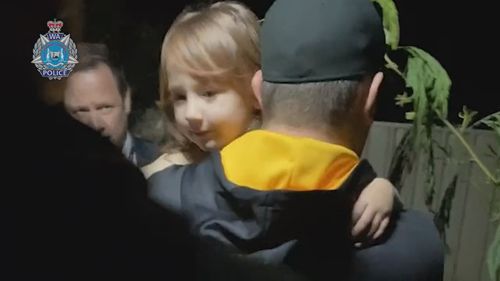
WA Police released 12 seconds of body camera footage showing the moment little Cleo was carried out of the home where she was found.
This is the moment little Cleo was carried out of the home where she was found. (Supplied)
 
And was scooped up into the arms of the officer who asked for her name. The little girl clung to the hood of the officer's coat. All of this was relayed back to the station, and there, officers on tenterhooks and hope, wept watching body camera footage in real time.

A 36-year-old man, an occupant of the suburban house where Cleo had been locked into a room by herself, was arrested to be questioned about the disappearance of the child. He is no longer in prison, having been transferred to hospital with head injuries suffered while in a holding cell. The report was that he had been attacked by other inmates. Predictable in a situation of this kind. It seems police were none too concerned over the possibility ... 

No charges have yet been laid. And no one will be receiving the posted reward. Details, no doubt, will be forthcoming ...

"[In the end], dogged, methodical police work [led to Cleo being found]."
"[The moment Cleo was found was] one of the most remarkable days of policing we'd had in Western Australia."
"I've been in policing for 45 years and I can say this is why police come to work every day."
"Little Cleo is home. She is with her parents."
Chris Dawson, Western Australia police chief
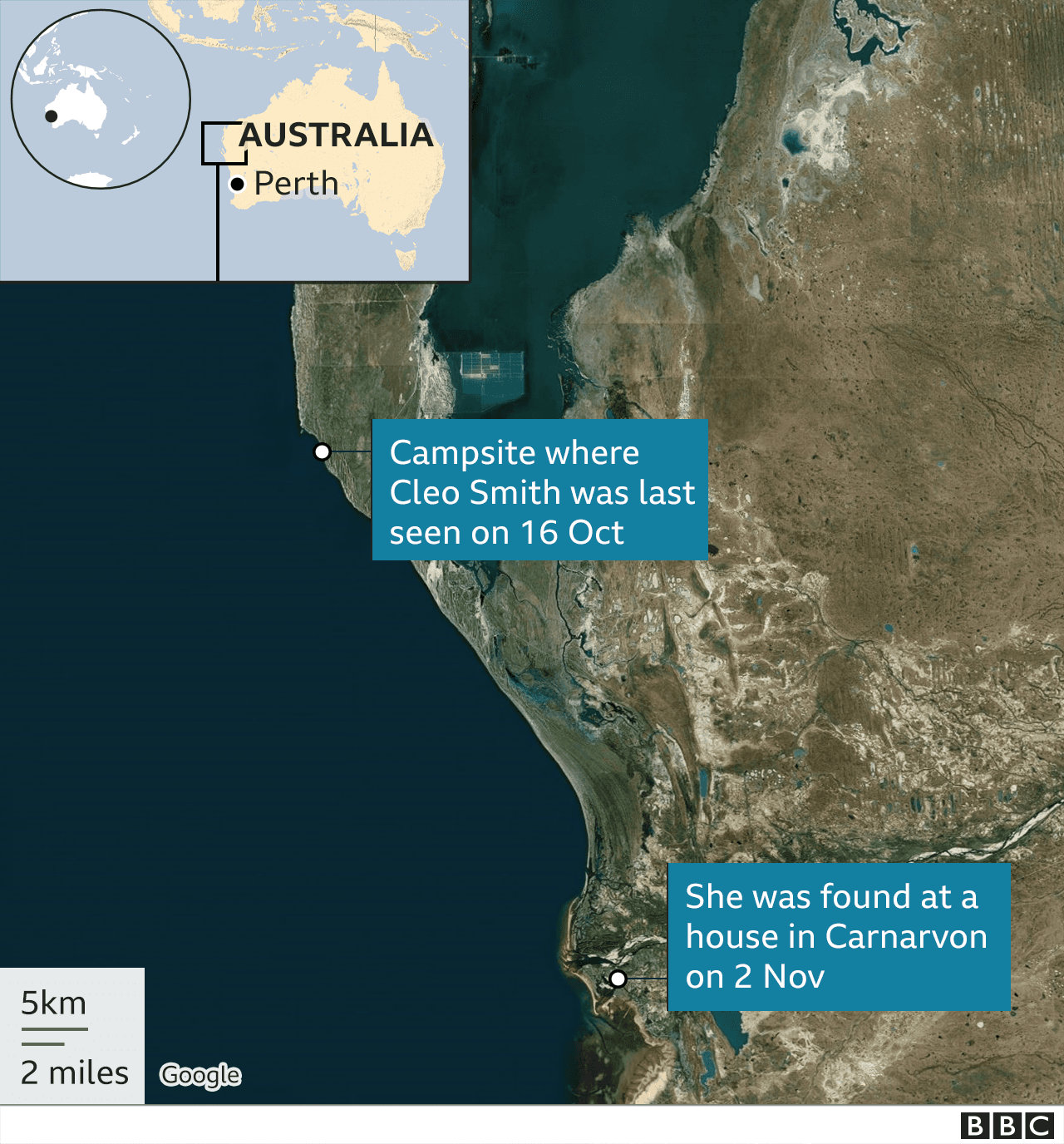
Map showing where Cleo Smith was last seen and where she was found

Labels: , , , ,

Sunday, March 07, 2021

Pakistan's Religious Intolerance, Violence Against Girls

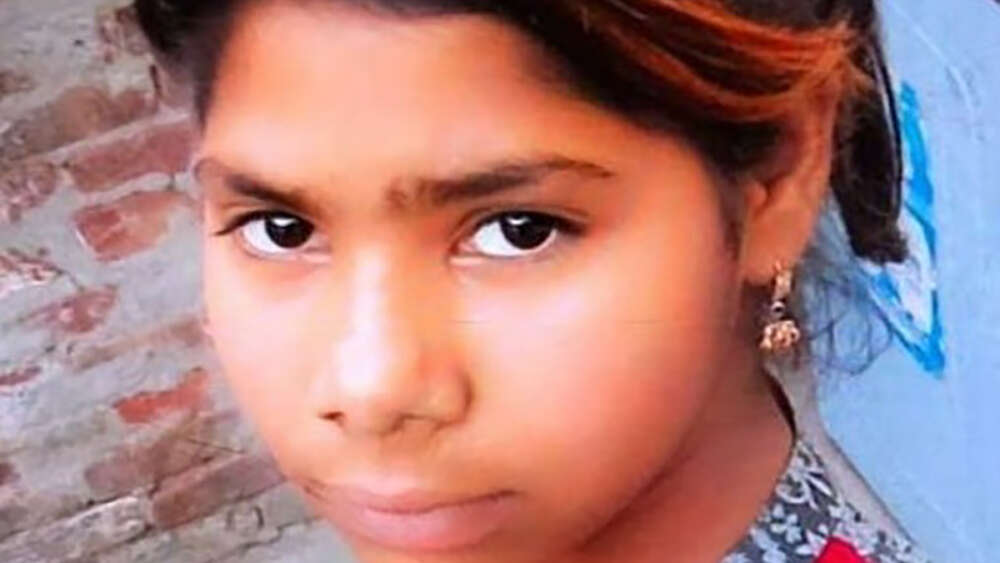
Farah Shaheen
Farah Shaeen   ... Pakistan Christian Post
"The reports coming out of Pakistan of Christian and Hindu girls being abducted, raped, forced into marriages and coerced to convert from their faith are deeply concerning and need to be addressed."
"I call upon the Prime Minister to re-establish the Office of Religious Freedoms and resolve to work with our allies to end these religious persecutions."
Candice Bergen, Conservative party deputy leader

"Canada is deeply concerned by the mistreatment of religious minorities in Pakistan. The right to freedom of religion or beliefs among the human rights issues at the forefront of Canada's foreign policy interests."
"[Canada] is committed to advancing gender equality and the empowerment of women and girls -- a priority at the centre of Canada's foreign policy and international assistance efforts."
Grantly Franklin, Spokesperson, Foreign Affairs Canada

"Such acts [as kidnapping, rape, forced conversion] are committed by extremists who are operating in an environment that breeds extremism, does little to discourage or punish extremism, and indeed, rewards these acts of violence, as perpetrators are even valorized by media and political leaders."
Aaron Rhodes, president, Forum for Religious Freedom-Europe
Police officers escort Arzoo Raja, background center, after her appearance in Sindh High Court, in Karachi, Pakistan, on Nov. 3, 2020. Raja was 13 when she disappeared from her home in central Karachi. The Christian girl’s parents reported her missing and pleaded with police to find her. Two days later, officers reported back that she had been converted to Islam and was married to their 40-year-old Muslim neighbor. (AP Photo/Fareed Khan

Under Canada's previous Conservative-led government a government arm was created called the Office of Religious Freedom. Its role was to recognize the commonality of human rights offences linking religion and violence against women and against minority communities. A year after taking office, the Liberal government shut down the office and created another which it stated was more 'inclusive'. This was the Office of Human Rights, Freedoms and Inclusion.
 
That office last November took part in the Ministerial to Advance Freedom of Religion of Belief, when the Parliamentary Secretary to the Minister of Foreign Affairs raised the concern of "violence targeting religious minorities, particularly Christians" in Pakistan. Experts in the field feel that Pakistan requires a particular focus, that of religious persecution where targeted kidnappings, rapes and forced conversion are seen as symptomatic of deeply-rooted religious intolerance and the acceptance of violence.

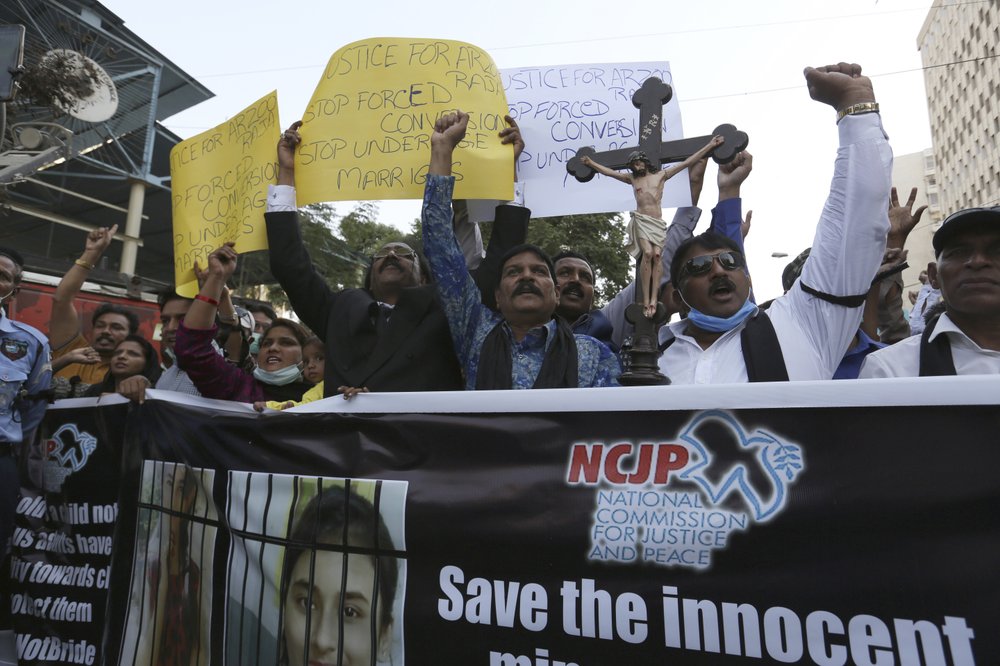
Christians demonstrate against child marriage and forced conversion, in Karachi, Pakistan, on Sunday, Nov. 8, 2020. Nearly 1,000 non-Muslim girls are forced to convert to Islam in Pakistan each year, largely to pave the way for marriages that are under the legal age and non-consensual. (AP Photo/Fareed Khan)

The former Ambassador of the Office of Religious Freedom, Reverend Andrew Bennett adds that Pakistan has a long-held ideology of persecuting its minority groups: "These ideas are amplified by the media, or by religious leaders, which are then taken up by people who do wicked things." Some of his duties in the position had been inclusive of working with the government of Pakistan in urging penal code changes. "When the office was closed we lost that voice", he stated.

The Conservative party's international development and human rights critic, Member of Parliament Garnett Genius, spoke of the complex dynamics of religious persecution frequently overlooked by Western governments where in those countries religion is not as deeply rooted in comparison to countries like Pakistan. Canada has been left without a response against targeted abductions, rapes and forced conversions of young Christian and Hindu girls in Pakistan.

The Christian woman who spent nine years on death row in a Pakistani prison as a result of accusations brought against her of blasphemy following an argument with co-workers, represented a well-known instance of religious intolerance in Pakistan. Eventually the Pakistan High Court ordered her released from prison, occasioning mobs of protesters marching violently, insisting she be put to death for blasphemy against Islam, an accusation meriting the death penalty under Pakistan's penal code.

She was eventually released and at which time she, husband and daughter found refuge in Canada. Her notoriety and the passion of religious intolerance she still evokes makes it necessary for her to live anonymously, her location hidden from public knowledge. Shahbaz Bhatti, a Christian Pakistani, was a member of the Pakistan Cabinet. His support for Bibi's freedom led to his assassination by an Islamic extremist in 2011. His brother, Peter Bhatti is the founder of International Christian Voices, a Canadian human rights organization. It was Shahbaz's murder that led to the creation of the Office of Religious Freedom.

Over a thousand Christian and  Hindu girls annually are kidnapped in Pakistan. Girls between the ages of 11 to 25 raped, forced to convert to Islam and forced into marriages with their abductors. Police rarely investigate much less make arrests for these criminal actions. Lawyer Sumera Shafique working with kidnapped victims' families in Pakistan explains that in Islam apostasy is punishable by death and that death is most often delivered by lynch nobs. 
 
Any hope the girls may harbour of returning to Christianity raises a violent backlash. Non-Muslim legal guardianship over Muslim children is prohibited as well, under Pakistani law, to the extent that once the girls have been forcibly converted to Islam, their parents have no legal rights concerning their welfare, their future, or for any other reason. 
 
Pakistani Christians attend Christmas Day prayers at the Sacred Heart Cathedral Church in Lahore.

Labels: , , , , , ,

Tuesday, June 11, 2019

The Horrors of Hate-Inspired Degeneracy

Asifa Bano was eight years old. Courtesy family of Asifa Bano

"Action alert: Talib Hussain - who was arrested last week - has been tortured in Samba police station while on police remand, skull broken, rushed to hospital in Samba, he is a key witness in the Kathua gang rape-murder case."
"This is unacceptable in a democracy."
Supreme Court lawyer Indira Jaising

"These are false cases filed against me [charges of domestic violence and attempted murder] because I am fighting for justice for the eight-year-old who was brutally raped and murdered."
"There is no truth to all these claims. I will continue to fight.”
Talib Hussain, key witness, Kathua rape case
In India, official statistics indicate that incidents of rape are on the increase. This, in a country where rape is already endemic, violent and murderous. What is unclear is whether this is the result of more frequent reporting of what has always been a dreadful part of India's history, much of it associated with the class system, where higher-class Indians feel it is their right to rape and even murder lower-class Dalits, or whether these horrific events are simply being reported more frequently.

Irrespective of speculation, those who are involved in efforts to advocate for more serious punishment for rapists state unequivocally that most rapes do not get officially reported. There is shame for the family involved in making it public, there is the threat of violence against those reporting, to restrain the impulse to search for justice. A number of truly horrifying cases of rape and murder have been highlighted where children are involved.

Official India is not enamoured of the international publicity and shame that is engendered by reports of these crimes against women and children. In rural areas where bathroom facilities are non-existent and women and girls wait until dark before heading to fields adjacent villagers to relieve themselves, they become victims of rapists, leading India to vow to build public toilets where privacy can be assured in protection of women and girls, not just for hygienic purposes.

Last year an eight-year-old Muslim girl, Asifa Bano was tortured, raped and killed by a group of Hindu men whose crime took place over a four-day period in a Hindu shrine, after abducting the child, sedating her and inflicting torture and rape before murdering the little girl. Three men have been sentenced to life in prison for the crime by an Indian court. Another three stood convicted of destroying evidence, earning them a 5-year sentence and a fine.
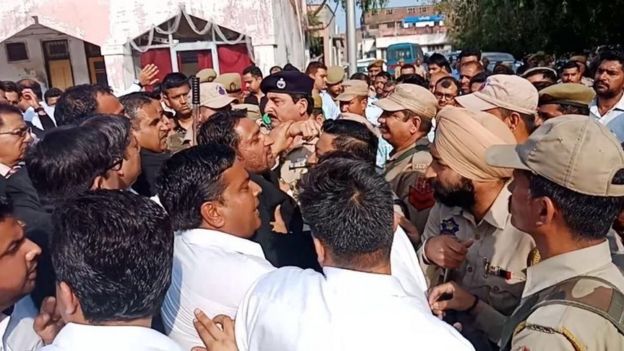
Lawyers protest on behalf of the accused
Lawyers in Jammu tried to stop police from entering the court to file a charge sheet    Photo Sameer Yasir

This dreadful event took place n the state of Jammu and Kashmir. A number of local members of the country's ruling party came out in protest against the charges levelled against the suspects. "Facts came to light despite hindrances", stated former state chief minister, Mehbooba Mufti who supported the investigative and legal team's success in conviction. Hindus revere animal life and eschew eating meat; Muslims butcher animals for human food.

The absurdity is that Hindu nationalists infuriated over Muslim butchering of 'sacred' animals by Hindu reckoning, doesn't hinder them from murdering a child to demonstrate their rage over killing animals. The two cultures have many areas of divergence, the majority Hindus taking umbrage over the Muslims' view of what is permissible in their religion, having no tolerance for a religious culture unlike their own; in effect each is intolerant to the other.

The viciously gruesome abduction, rape and murder was part of a politically motivated plot against nomadic Muslims. The child had been abducted from a village in the district of Kathua in the Hindu-majority area of Jammu. A concerted search for the little girl proved fruitless. Her body was eventually discovered days later in a forest, the very place where she was accustomed to tending to her family's livestock.

A subsequent investigation into the little girl's death revealed that she had been sedated, gang-raped and ultimately strangled with her own scarf, her head bashed with a rock. The child's agony was carried out over a four-day period in a small Hindu shrine. One juvenile and seven men were arrested. A retired government clerk, said to be the planner of the unspeakable atrocity, Sanji Ram, was charged in the plot recognized as part of a larger plan to drive Muslim nomads from the area.
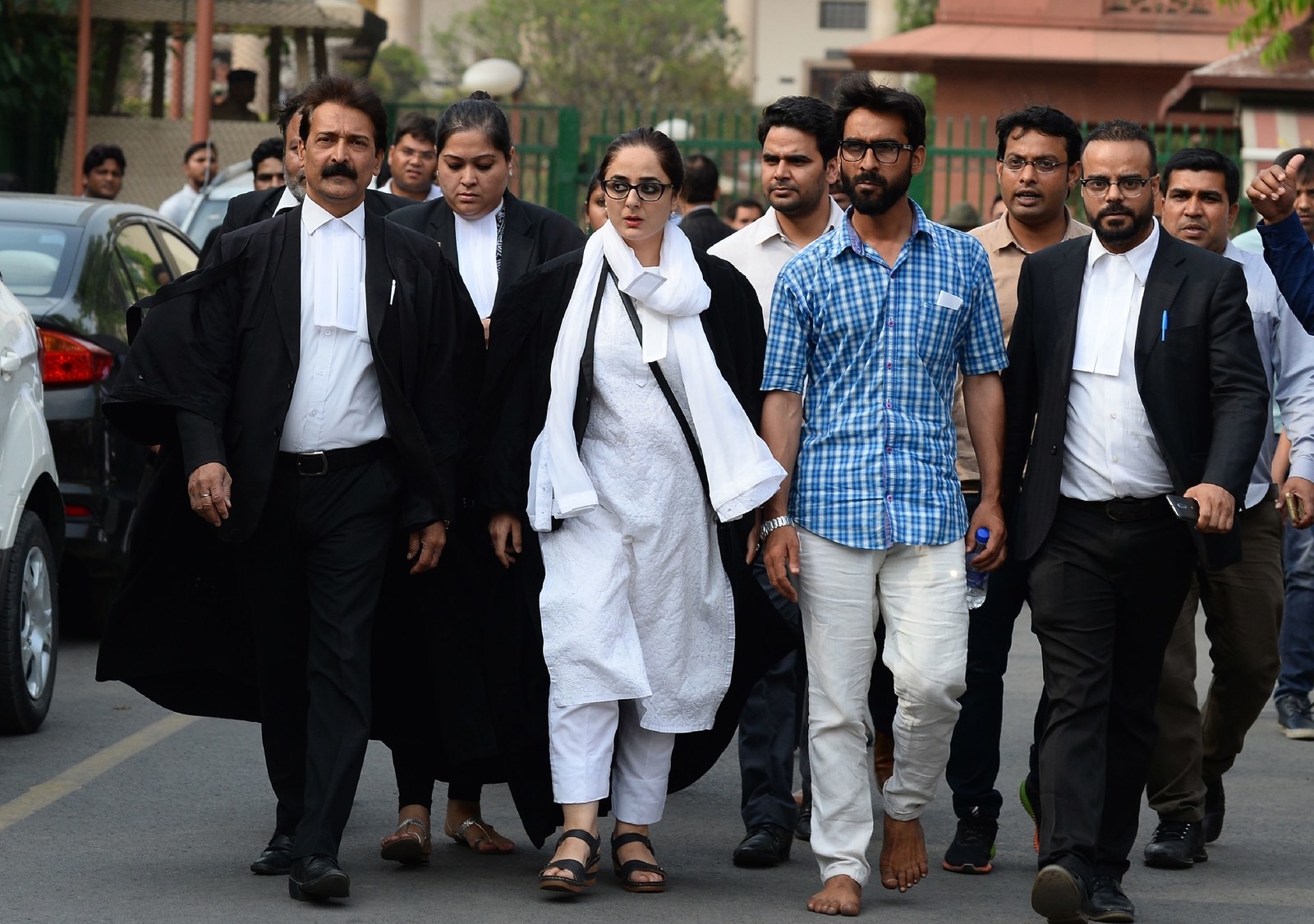
Lawyer Deepika Singh Rajawat (center) at India's Supreme Court in New Delhi in April 2018.
Meanwhile, the team of police officers who investigated the case, as well as a woman lawyer who appeared for the victim’s family, were obstructed in Jammu by lawyers chanting pro-Hindu slogans. Deepika Singh Rajawat — the lawyer who initially represented the victim's case in court — was also threatened, doxxed, and warned not to appear in court.  
Lawyer Deepika Singh Rajawat (center) at India's Supreme Court in New Delhi in April 2018. Sajjad Hussain / AFP / Getty Images

Three men -- Ram, a police officer, and another man -- were convicted of the rape and murder. A fourth man was acquitted, while three other police officers were found to have been involved in helping in the destruction of the crime's evidence. The youth involved is set to be tried singly. "We wanted to see them hanged till death", Sudam Hussain, a family member said, of the family's feeling that they failed to receive "complete justice".

At the time of the discovery of the child's horribly mangled body, outrage was justifiably manifested on the one hand, and then the news was consumed by rallies in support of the suspects, where two local Bharitiya Janata Party (BJP) nationalists took part in the protests. At one point, lawyers attempted to physically block police officers from filing the charges, claiming the targeting of Hindus was involved.

Within the courtroom, absent Asifa's immediate family members, where the verdicts were being read, no media was permitted a presence. A heavy security appearance that included armoured vehicles and police teams was fully manifested outside the courthouse.

Students in Kashmir join a demonstration in April 2018 against the rape and murder of an 8-year-old girl.
  Sopa Images / Getty Images

Labels: , , , , , ,

() Follow @rheytah Tweet