Politic?

This is a blog dedicated to a personal interpretation of political news of the day. I attempt to be as knowledgeable as possible before commenting and committing my thoughts to a day's communication.

Wednesday, February 25, 2026

Canada, Straining to Accommodate A Huge Influx of Migrants, Refugees, Asylum Seekers

"Under the Liberals,the Interim Federal Health Program [IFHP], the program that provides benefits to asylum claimants, has morphed well beyond its initial intent of providing care to a small number of legitimate refugees who are fleeing to Canada from war zones into a massive boondoggle that provides care to bogus asylum claimants."
"The Liberals are proposing to set up a costly bureaucracy that would still force Canadian taxpayers to foot the bill for 70 percent of the premium health-care costs that failed asylum claimants incur." 
Conservative MP Michelle Rempel Garner, Opposition immigration critic  
Conservative member of Parliament Michelle Rempel Garner asks a question during question period in the House of Commons (Sean Kilpatrick/The Canadian Press)
 
A report published this month by the Parliamentary Budget Office broke down rising costs of the IFHP. The program has risen from $226 million in 2019 to $1 billion in 2025. The cost is projected to climb to over $1.5 billion by 2030. The number of beneficiaries, according to the PBO, will continue to grow and to expand to over 680,000 eligible beneficiaries in 2029-30. 
 
Coverage  under the program begins with basic and supplemental health care of which the basic coverage is inclusive of hospital services, services from medical doctors, registered nurses and other licensed health care providers along with ambulance services and lab and diagnostic services (including blood tests and ultrasounds). Psychologists, occupational therapists, physiotherapists and speech language therapists, as well as assistive devices such as prosthetics, mobility aids and hearing aids, home care and long-term care, urgent dental care and limited vision care, medical supplies and equipment, represent the supplemental portion. On top of which is prescription drug coverage. 
 
All of which represent a pretty exhaustive parade of medical services for people who have never paid into the Canadian tax system that supports these social services. Among whom are those whose claims for migrant or refugee status have been refused, most of whom are either to be deported or are expected to leave the country of their own volition. Again, many among them exhaust all avenues of appeal, which can take years to get through the system. While in Canada they are entitled to claim social services.
 
https://www.migrationpolicy.org/sites/default/files/source_images/cp-2025-canada.jpg
Canadians welcome Syrian refugees to Toronto. (Photo: stacey_newman/iStock.com)
 
This, at a time when Canadian hospitals are stretched beyond their limits to provide elementary care to Canadian citizens, where wait times at emergency clinics can stretch to 12 hours before a physician can examine people awaiting care after triage investigation instructs them to take a seat in crowded emergency facilities until they can be accommodated. In a health care system where waiting for surgery that can be life-saving can stretch out into months while health conditions continue to fester and become more aggravated.
 
MP Rempel Garner brought forward a motion to restrict health care benefits to failed asylum claimants. Her motion calls on the federal government to find savings through reviewing the program, to restrict federal benefits received by rejected asylum claimants to emergency life-saving health care only, to provide an annual report to Parliament of the IFHP program and pass policies to expel foreign nations immediately who are convicted of serious crimes while in Canada. 
 
https://www.migrationpolicy.org/sites/default/files/source_charts/cp-2025-fig5-canada-targets.png
 
"We want to still protect those refugees and those people that are claiming the help and need from Canada that legitimately deserves to be protected including the children. We will continue to do that", responded federal Immigration Minister Lena Diab. Leading Rempel Garner to state that the government sits back awaiting failed refugees to respond to deportation orders, many of whose sole source of income in Canada is social welfare.
 
According to data by the Immigration and Refugee Board of Canada, Canada's refugee backlog stands at 299,960 from January. Wait times for processing of refugee and migrant claims can vary, depending on the complexity of each case, taking anywhere from months to years for completion. During that time, points out Rempel Garner, applicants can claim various types of benefits. The open question remains the status of rejected asylum claimants who appeal decisions, extending to a much longer process of determination.
 
Retroactive from 2020 the Liberal government has changed refugee rules through its borders bill to make refugee claims ineligible if they are made one year or more after the day of  entry to Canada. The new rule would render some 19,000 to 50,000 asylum claims filed between June and October 2025 ineligible. 
 
 https://www.migrationpolicy.org/sites/default/files/source_charts/cp-2025-fig2-canada-birth.png

Labels: , , , , , , ,

Tuesday, February 24, 2026

Canada's Failed Asylum/Refugee Vetting System

"Between January 1, 2019 and February 28, 2023 ... the IRB [Immigration Review Board] accepted 24,599 asylum claimants into Canada without questioning them."
"That means that a person from a country on the IRB's Country List can enter Canada, make a claim for asylum, and receive a positive determination in the mail, without being asked a single question."
"Some asylum seekers who present a security risk to Canada may be identified only through in-person questioning at a hearing."
"Careful questioning can reveal inconsistencies in complex or fabricated accounts. The provenance of documents can also be tested at a hearing by asking questions about them. There is no substitute for this process."
The Yousif Report, C.D. Howe Institute
https://akm-img-a-in.tosshub.com/indiatoday/images/story/202602/a-report-claimed-canada-gave-25-000-applicants-asylum-status-without-meeting-them-once-245706335-16x9_0.jpg?VersionId=jSuHLzl.tMJ06KS7K3TBYmSNl3cGInqG&size=690:388
The number of asylum claims processed by Canada rose from 6,000 in the 2010s to over 100,000 in 2024, with an 80% acceptance rate. (Image for Representation: Wikimedia Commons)
 
A surge of illegal border-crossers and asylum claimants in the years following 2017 saw Canada overwhelmed and incapable of handling the numbers adequately, leading the Immigration and Refugee Board of Canada to choose to eliminate most of its protocols of screening for unwanted potential criminals intending to enter the country. Review processes became automated as security checks were abandoned, resulting in close to 25,000 people being given refugee status when no government employee had interviewed them in person.
 
This situation was taking place at the very time when record numbers of foreign nationals attempted to secure Canadian residency through the asylum system. All usual controls to vet out fraudsters, human traffickers and terrorists went by the wayside. James Yousif, a former director of policy at Immigration, Refugees and Citizenship Canada, issued a report for the C.D. Howe Institute outlining the gravity of the situation and Canada's failure to halt the entry of malefactors into Canada. 
https://smartcdn.gprod.postmedia.digital/nationalpost/wp-content/uploads/2026/02/AFP_33AN3VG.jpg?quality=90&strip=all&w=564&h=423&type=webp&sig=GvFlIU5_lm160Lao4vFz6w
 
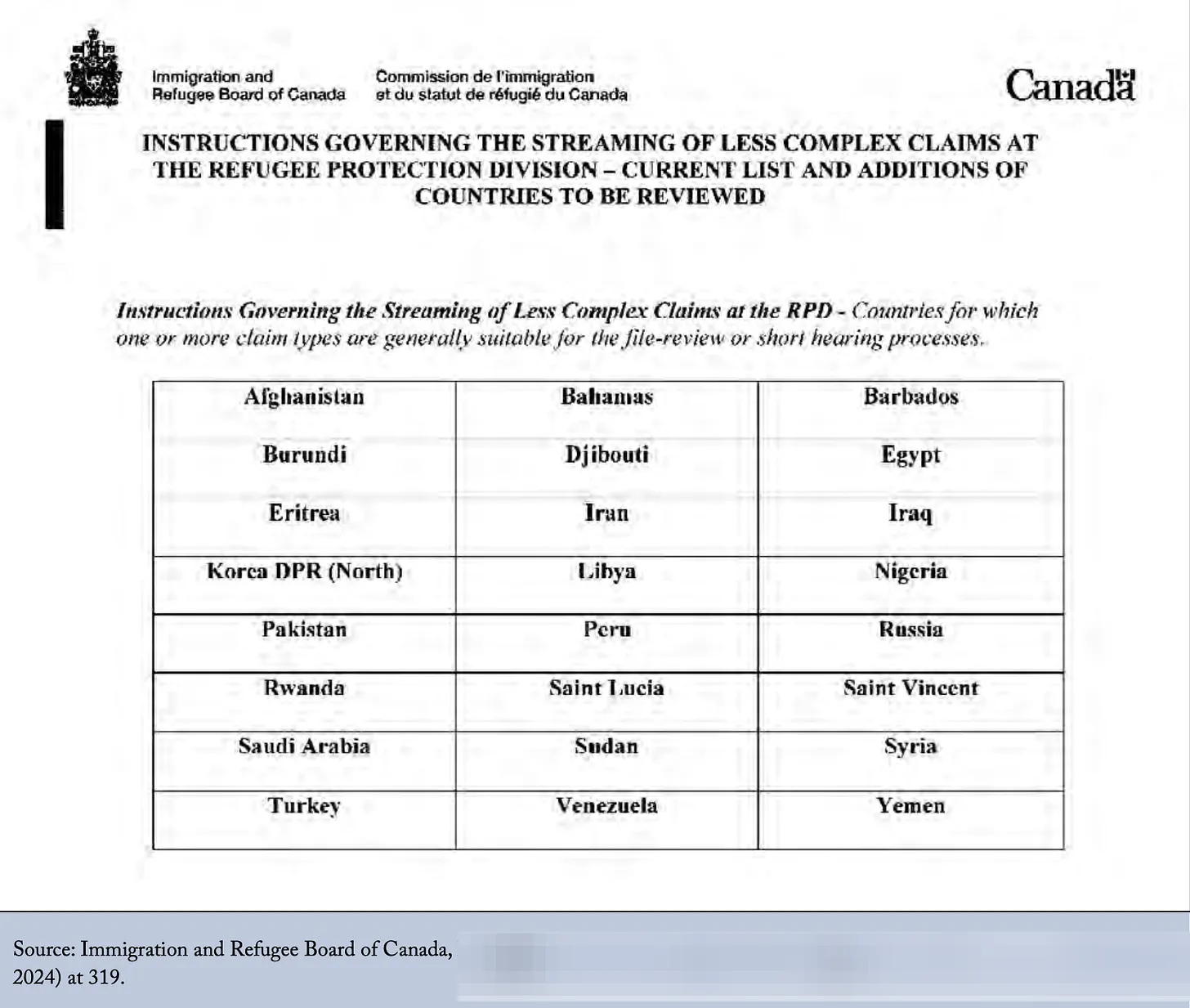
For the first time since the end of the Second World War, the government of Canada has been granting refugee status to individuals whose backgrounds have not been inspected. A new system known as File Review has been put in place in an effort to reduce the asylum claim backlog as expeditiously as possible, leading the Immigration Review Board to draw up a list of countries whose nationals could skip past usual screening protocols. Which meant their refugee claims were no longer scrutinized in person by investigators. Where applicants under File Review could be approved on the written claims in their asylum applications, taken on trust. 
 
The Yousif Report included a 2024 version of the list with 24 countries listed. In fact this appears to be a short list of nations known for criminality, terrorism and state hostility, among them Russia, Afghanistan, Yemen, Venezuela, Eritrea, and North Korea. This, on the theory that failed states are likelier to produce legitimate asylum claimants. However, the reality is that Canada decided to forego its standards on the very countries replete with criminal and terrorist networks most likely to take advantage of a low-barrier asylum system. 
 
In 2024, a Pakistani national almost completed an asylum claim when he was arrested in Quebec en route to carrying out a terrorist attack against Jews in New York city. Iran, also on the list alongside Pakistan, hasn't stopped members of the Iranian Revolutionary Guard Corps on Canada's terrorist list, from entering Canada. The most recent data from the IRB lists 79.8 percent of all Canadian asylum claims being accepted; a dramatic increase of acceptance under the new system.


As few as 6,000 asylum claims were made in the early 2010s, when immigrant officials rejected about 40 percent. Canada now processes over 100,000 asylum claims annually, with 80 percent accepted. No peer countries boast a rate of acceptance as steep as Canada's even those similarly overwhelmed by waves of recent asylum claimants. Sweden rejects 60 percent of such claims, Ireland, 70 percent, and Germany rejects 41 percent, according to the Yousif Report.
 
"Negative decisions rejecting a claim of asylum require much more time and effort", the Yousif Report notes. Ironically, just as official warnings that the country was being overwhelmed by bogus refugee claims arose, acceptance rates of asylum claimants increased dramatically. While top officials in the Liberal government stated Canada was being exploited by foreign nationals abusing its asylum system, the system was accepting them. 
 
Nigeria, placed on the File Review Country List, became a huge source of Nigerians  obtaining tourist visas to the U.S., then illegally crossing into Canada, claiming asylum. Thousands of foreign students in Canada on study visas began claiming asylum when their visas approached expiry. File Review, pointed out the Yousif Report, opened Canada to infiltration by criminal gangs, terrorist networks or fraudulent migrants by setting aside in-person interviews, the single most effective method of closing off the asylum system from endangering national security.
 
 https://substackcdn.com/image/fetch/$s_!QOuS!,w_1456,c_limit,f_webp,q_auto:good,fl_progressive:steep/https%3A%2F%2Fsubstack-post-media.s3.amazonaws.com%2Fpublic%2Fimages%2F8f4ea954-f091-4213-8108-b58418740078_1528x1294.png
  
"The Government of Canada did not develop or approve this policy. The cabinet-driven process of policy development would ordinarily act as a check against overreach and provide valuable oversight and input, but the IRB appears to have excused itself from that process, taking an expansive interpretation of its quasi-independence." 
The Yousif Report 

Labels: , , , ,

Thursday, July 09, 2020

Illegally in Canada

"If you receive a Removal Order you cannot legally remain in Canada and must leave the country. Depending on your situation, your removal order may be effective immediately, or after a negative decision if you had made an appeal."
"There are three types of Removal Orders issued by Immigration, Refugees and Citizenship Canada (IRCC) or the Canada Border Services Agency (CBSA). These are Departure Orders, Exclusion Orders and Deportation Orders. The form number on the Removal Order indicates what type of order you received."
Canada Border Services Agency Website
The auditor general found despite a recent increase in removals, about 50,000 enforceable cases piled up in the CBSA's inventory during the time of her audit. (Jonathan Hayward/The Canadian Press)
"The timely removal of foreign nationals who are found inadmissible protects the integrity and fairness of Canada's immigration system.It is also one of the most effective ways to deter those who might otherwise seek to abuse the system. In the case of criminals, timely removal protects the safety and security of Canadians."
"The Canada Border Services Agency removed a few of the foreign nationals in Canada who were subject to enforceable removal orders. Despite a recent increase in removals, the level of enforceable removal orders remained largely unchanged, even for priority cases. Most orders had been enforceable for several years."
"We determined that at least 70% of all criminal cases were not reviewed annually, and 75% of all failed asylum cases were not reviewed every three years as required."
"Agency officials confirmed that cases in its wanted inventory are generally considered a low risk to public safety and are not an agency priority."
Auditor General report 
Confirmed removed Working inventory Wanted inventory
Failed asylum cases3,60010,70024,100
Criminal cases1,2501,6502,800
Other cases4,6502,9507,800
Total9,500*15,30034,700

Should a foreign tourist overstay their visa or an asylum claimant have their request denied with all legal recourses to appeal exhausted, the federal government then produces an enforceable removal order linked to that individual to ensure they will not remain in the country. This is where the Canada Border Services Agency enters the picture with their responsibility to enforce the mandated removal. Of the foreigners ordered to leave Canada each year, failed asylum seekers represent the largest proportion ordered to leave.

What an audit of the process has revealed to the Auditor General of Canada is that the federal government has no knowledge of the location of over 34,000 foreigners ordered to be removed from the country. Of that total, close to 3,000 are criminal cases. The number of asylum claims in the past three years have increased substantially, leaping from 50,000 in 2017 to 64,000 in 2019. Leaving the CBSA  with the considered impression that removal numbers to be executed will continue to rise.

CBSA doesn’t know the whereabouts of 34,700 foreign nationals to be deported

In 2018-2019, the Canada Border Services Agency was able to remove 6,700 cases representing a small part of an enormous backlog. It is clear the department has a struggle to hope to come anywhere close to reducing its backlog. The agency has, in fact, lost track of 34,700 individuals for whom an order to be removed was issued and who now, having eluded removal, a warrant has been issued in their name. Close to three thousand of the total are considered top priorities for removal, reflecting the fact they represent criminal cases whose presence may pose a safety or security risk.

By law the CBSA and police forces must investigate -- in a search for new information on the whereabouts of these individuals being sought for removal from Canada -- once yearly or every three years in a search for new information which might bring locations to the attention of authorities. According to the audit results, even that detail reflecting Canadian law, fails to be committed to.

Significant issues with the government's data quality, case management protocols and information sharing was also revealed between CBSA and Immigration, Refugees and Citizenship Canada, leading to "avoidable delays" in thousands of the cases.


Approximately 1,500 cases, as a result, which included 150 instances involving serious criminals had been set aside, not worked on for up to two years. The government indicated its acceptance of the auditor's recommendations for change to the system as it is currently practised. Removals strategy is slated for improvement; the way the border agency tracks and triages cases to ensure priority cases are speedily addressed will now come into play -- if assurances from the Public Safety Minister can be taken at face value.


Labels: , , , , ,

Monday, July 08, 2019

Illegal Migrants Bypassing Official Border Entry, Canada

"...Once legal avenues have been exhausted, individuals are expected to respect our laws and leave Canada, or as per our commitments, be removed."
"We are reinvesting in the agency [Canada Border Services Agency] to ensure that processing continues to happen in a manner that is fair, fast and final."
Marie-Emmanuelle Cadieux, spokesperson, Border Security Minister Bill Blair
Aug. 11, 2017: A group of asylum seekers wait to be processed after being escorted from their tent encampment to the Canada Border Services facility in Lacolle, Que.
Christinne Muschi/Reuters

Asylum seekers who enter Canada crossing the border between it and the United States deliberately bypassing official border crossings, and who are unsuccessful in their refugee applications -- which take up to two years to process, and additional lengthy periods of time before all avenues of appeal are exhausted -- are being gradually and slowly removed by the Canada Border Services Agency. Slowly and gradually because of an immense backlog of cases that the agency is hard put to deal with.

A target was set last fall for ten thousand removals for the fiscal year of 2018-19, an increase over the previous years when the average removal rate went from 7,900 to 8,600. Since 2017, 45,000 illegal entries from the U.S. into Canada have taken place. Creating a total backlog of 75,000. The flood of border crossers has diminished since their height two years earlier and the CBSA is prioritizing the removal of those whose claims have been denied.

Those considered to represent threats to national security or who are involved in organized crime, crimes against humanity or other kinds of criminal activity are given removal priority. Even so, a small minority of the tens of thousands of illegal asylum seekers entering Canada in the last two years have been deported with merely 723 illegals with failed refugee claims deported between April 1, 2017 and June 21, 2019.
The number of asylum-seekers crossing into Canada at unofficial points of entry is on the decline: the RCMP intercepted 888 people during the month of January 2019, and 808 in February 2019, compared to 1,517 and 1,565, respectively, the previous year. (Charles Krupa/The Associated Press)

Some 6,609 people have been detained in holding centres in 2017-18, an increase from the year before. There are centers in Toronto, Laval and Vancouver; in other regions of the country people who have been detained as posing security risks may be held in provincial jails. In the holding centres separate accommodation is provided for men, women and families who have access to outdoor recreational areas, are provided daily meals, access to games, televisions and telephones, medical services and visitation areas.

In theory, parents decide for the most part whether or not their children remain with them in detention. "This is really a false choice", points out Hanna Gros, immigration and refugee lawyer. "When you're new to a country, you don't necessarily know anybody here, you don't have family friends, contacts or community support. You have people here who are left with really horrifying choices to make in these situations." Needless to say, these are the same people who chose to enter Canada illegally....

For deportation to another country to take place, both countries involved must agree to an individual leaving one state to arrive at another. "Deportation is a two-way agreement between states, and not so much contingent on the individual. There has to be an admission or an entrance of some sort into another state", points out Stephanie Silverman, with migrant advocacy group Thinking Forward Network. If the detainee's identity cannot be verified by the state nor the person leaving, proof must be achieved from within a detention centre, which is extremely difficult.

Certain states will not issue travel documents for nationals who are convicted of crimes in another country, lengthening the detention process, complicating the process for immigrants with a criminal record.

Asylum seekers line up to enter Olympic Stadium, Friday, August 4, 2017 near Montreal.
THE CANADIAN PRESS/Paul Chiasson

Labels: , , , ,

Tuesday, April 17, 2018

Canada's Asylum Seeker Woes

"Even the numbers we're getting from the federal government show us that the situation is different, there's going to be more asylum seekers, so we need a new plan."
"This is not about money, this is about saying that Quebec can do its part, but our resources are completely saturated and we can't do more."
Quebec Immigration Minister David Heurtel
More than 25,000 asylum seekers crossed into Quebec from the U.S. in 2017, according to the Quebec government. Their projections show that number could grow in 2018. (Charles Krupa/Associated Press)

"The current provisions on medical inadmissibility are over 40 years old and are clearly not in line with Canadian values or our government's vision of inclusion."
"These newcomers can contribute and are not a burden to Canada. These newcomers have the ability to help grow our economy and enrich our social fabric."
Canadian federal Immigration Minister Ahmed Hussen

"We at committee could not get good cost data."
"Right now [Hussen] is going to have to look at this, the minister of health will have to look at this, the provinces and territories are going to have to look at this and hopefully in a year or two they are going to recognize that this is not a significant cost."
Liberal MP Rob Oliphant, chair, Common citizenship and immigration committee

"My concern is that the federal government is downloading costs to the provinces without a real plan to deal with that and that seems like something they should have done and considered before they made this announcement."
Michelle Rempel, Conservative immigration critic
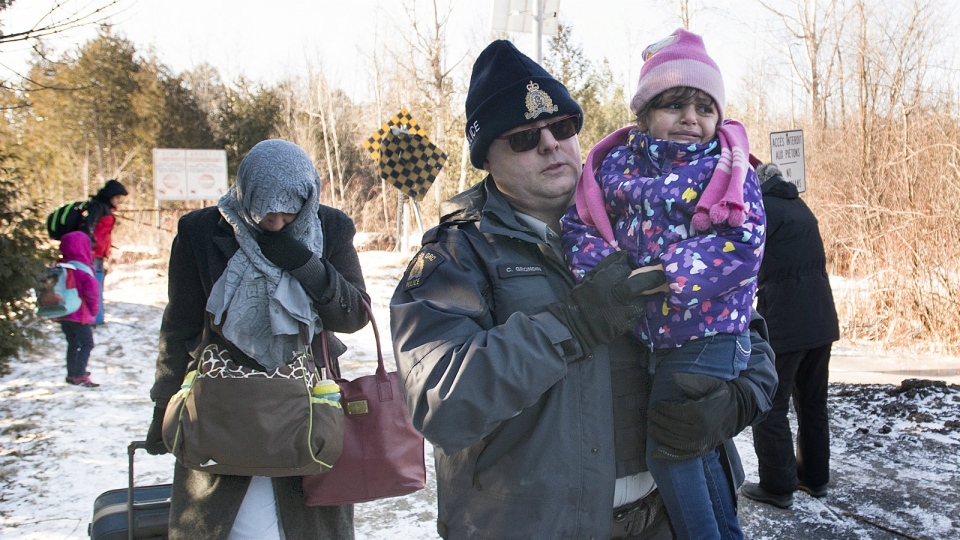
An RCMP officer escorts a woman and a child claiming to be from Yemen as they cross the U.S.-Canada border in Hemmingford, Que. on Sunday, March 5, 2017. (Graham Hughes / THE CANADIAN PRESS)
The government of Quebec feels the federal government must invest in a plan to help deal with the influx of migrants pouring across the border from the United States to Canada, a number that has tripled from 2017 and is being forecast to increase to even greater numbers with better weather. Quebec's immigration minister speaks of the potential of seeing up to 400 crossings daily in the summer months, in comparison to the 250 seen last year.

Quebec's resources are being strained; in addition to front-line services, health care and education requirements are stretching its budget. Through both legal and illegal means last year 25,000 asylum seekers entered Quebec, representing 50 percent of all asylum cases in Canada. The province's 1,840 places for asylum seekers in Montreal is 70 percent occupied, leaving scant place for additional illegal crossers in the temporary shelters in the city, much less for those who enter the province by legal means.

Anecdotal stories of Canada's generous welcome, fuelled by Prime Minister Trudeau's stirring Twitter rejoinder in virtual signalling, responding to President Trump's threat to rid the U.S. of its millions of illegal residents has resulted in people arriving in the U.S. then immediately heading for a popular irregular crossing between the New York-Quebec border. Of the 50,000 people who entered Canada last year as migrants, 20,000 crossed irregularly. They enter Quebec but plan to go on further to other areas of the country.

A reflection of what has been seen occurring in Europe, where Greece and Italy have become the entry points with the intention of migrants to spurt on further to Germany or Sweden where they are assured of a welcome and sturdy social services supports. All of what is happening in Canada reflects the 'progressive' values of the Liberal government of Justin Trudeau. Which is now busy overturning decades of restricted entry to Canada for those with intellectual or physical disabilities.

According to Immigration Minister Ahmed Hussen, himself a former immigrant to Canada from Somalia, Canada will no longer reject permanent resident applications from anyone with serious health conditions or disabilities. Previously, these rejections were built upon the acknowledgement that the country's universal health care system was under strain as it was, and needed no additional extraordinary burdens.

Of 177,000 economic immigrants that Canada admits yearly, roughly 1,000 have been affected by the policy of medical inadmissibility. The total number of immigrants that Canada has accepted in the last several years has risen to 300,000.

An asylum seeker is questioned by an RCMP officer as he crosses the border into Canada from the United States on Aug. 21, 2017 near Champlain, N.Y.    The Canadian Press

Labels: , , , ,

() Follow @rheytah Tweet