Politic?

This is a blog dedicated to a personal interpretation of political news of the day. I attempt to be as knowledgeable as possible before commenting and committing my thoughts to a day's communication.

Wednesday, April 26, 2017

Holding Out Hope for a Syria Accounting

"This is not some abstract human rights issue. This lies at the core of this conflict and of any possible solution or reconciliation. Hundreds of thousands of victims and their families need justice, remedy and assurance that the future will be free from such violations."
Laila Alodaat, lawyer, Women's International League for Peace and Freedom

"Countries don't need this evidence -- they already know what's happening."
"There is no justice. And because there is no justice, there is no hope."
Abu Ali al-Hamwi, Syrian detained and tortured by the Syrian regime

"The problem as I see it is not so much what mechanism one can use to bring accountability, but how you actually get your hands on the people you want to prosecute."
Kevin Jon Heller, law professor, SOAS, University of London
Report title page
Syrian Accountability Project
Evidence abounds, of the human rights violations perpetrated by President Bashar al-Assad's Alawite-led regime in Syria. The level of sustained cruelty this regime has engaged in has few parallels in today's world, of a government committing to persecute, torture and slaughter its population representing a majority sectarian religion ruled by a minority sect fearful of losing its grip on power, using all the tools in its advanced military arsenal against rebel groups unequally armed to defend themselves, marks this conflict as a modern-day aberration.

Yet tribal and religious conflicts between national groups competing for influence and power are not that unusual; what sets this one apart is the level of barbaric viciousness displayed by a government against its people. This is a situation that the United Nations recognizes as threatening a segment of humanity at any given time, and which it took steps to guard against by committing itself to intervention through an obligatory protocol called 'Responsibility to Protect' (R2P). A theoretical invention which was incapable of venturing beyond theory.

Mostly because of the need for the UN Security Council comprised of permanent members, Britain, France, United States, China and Russia to full agreement in the imposition of sanctions and action to be taken to interrupt the slaughter. Russia, sometimes alongside China, casts the dissenting vote. Although figures range between 400,000 to 600,000 deaths so far in the Syrian Civil war displacing half of its 23-million population the carnage continues unabated with the regime using treaty-forbidden methods of mass murder.

In the six years the war has raged, no path to peace has yet presented itself. Syrian human rights groups claim over 200,000 people are missing, while tens of thousands remain in government custody where prisons are geared to torture and kill opponents of the regime. Others who are eventually released speak of torture, fear, hunger, deprivation, health declines, filth, disease and overcrowded conditions where humanity is totally absent.
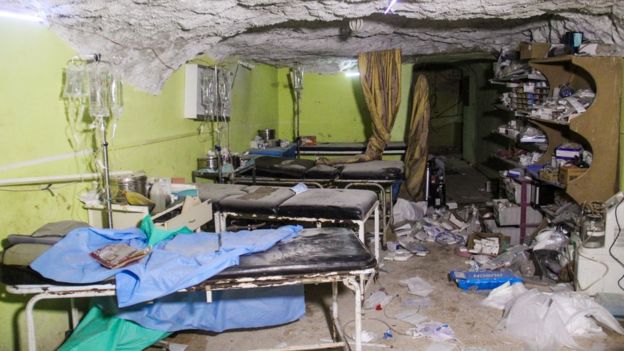
Destruction at a hospital room in Khan Sheikhoun. April 4, 2017
Getty Images : Witnesses said clinics treating the wounded were subject to air strikes
As for evidence: an estimated three tons of Syrian government documents sketching out a gruesome catalogue of of war crimes committed by the state are being held in Europe, provided by a Syrian police photographer who had photographic evidence of 6,000 dead Syrians, tortured and slaughtered by the state; documentation which he had fled Syria with, with a view to sharing them with the world, hoping to see justice done.

Instant communication through the use of smartphones and the Internet have provided more than sufficient evidence from direct, on-site accounts by survivors of the perpetrators of state barbarism. Yet only one war crimes case against Syrian officials filed in Spain exists and no prospective cases have been sent on to the International Criminal Court, since Syria was never a signatory. And while the United Nations Security Council has the capacity to refer a case to the court, Russia's veto power ensures it will not.
A Syrian victim receives treatment after an alleged chemical attack at a field hospital in Idlib province, 4 April 2017
Russia clashes with other world powers over chemical gas deaths in Syria : BBC


The Syrian government and Bashar al-Assad are adamant that the conflict has resulted from an international conspiracy to destroy his country; all opposition represents a coalition with foreign-backed terrorism, and nor had his regime committed atrocities. In March of 2011 a dozen boys wrote on the wall of their village school "It's your turn, Doctor"; that Assad would represent the next Arab leader to fall in the Arab Spring. The boys were speedily arrested, imprisoned, tortured and signed 'confessions'.

Arrests, torture, killings began in earnest thereafter, as did aerial bombardments and chemical attacks.

A United Nations Commission of Enquiry, along with human rights groups, described the regime's assault against its civilian populations as representing an industrial scale massacre. In one prison facility alone, thousands of prisoners have been executed, according to Amnesty International studying Saydnaya prison close to Damascus. People disappear and are never again seen. People have no hope left.

Still, activists, lawyers and others within Syria document atrocities taking place there, in the hope that one day justice will be seen. Among them are experienced war-crimes prosecutors building cases against the president and his government officials. The non-profit group Commission for International Justice and Accountability has been acquiring captured government documents, with over 750,000 government documents holding hundreds of thousands of names of regime enablers.
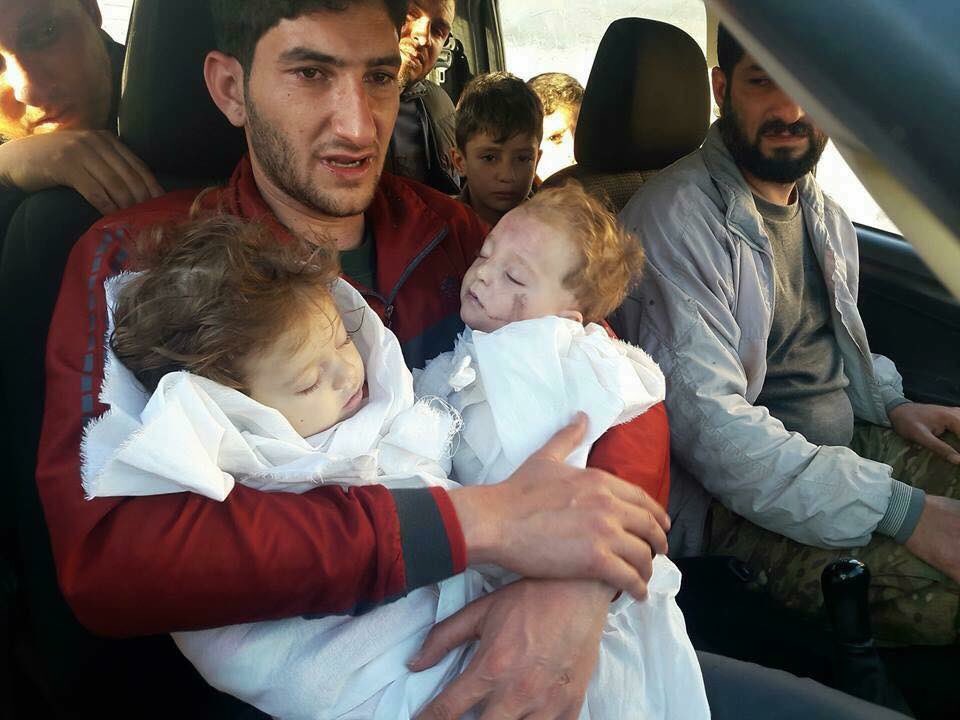
The look of this father carrying his two children after the chemical attack in Syria encompasses all of the injustice of this world ... Kareem Shaheen/Twitter


Labels: , , , ,

Thursday, April 06, 2017

Surpassing Criminal Barbarity

"Their pupils were as small as pinpricks, their skin was cold. They were unresponsive like zombies."
"Chemical attacks leave no marks. It's a silent killer that works its way through the body slowly."
Mamoun Najem, physician, al-Rahma hospital, Idlib
"The smell reached us here in the centre; it smelled like rotten food."
"We've received victims of chlorine before -- this was completely different."
"Victims had vomit from the nose and mouth, a dark yellow colour, sometimes turning to brown. They had paralysis of their respiratory functions -- children were dying faster than adults because of this."
Unnamed hospital nurse 

"[The Syrian airforce struck Khan Sheikhoun] between 11:30 a.m. and 12:30 p.m. local time [Tuesday; the target had been a large terrorist ammunition depot] on the town's eastern outskirts."
"On the territory of the depot, there were workshops which produced chemical warfare munitions. Terrorists had been transporting chemical munitions from this largest arsenal to the territory of Iraq."
Russian explanation

"[It seemed] pretty fanciful [Russian explanation of chemical attack in Khan Sheikhoun]. "Axiomatically, if you blow up Sarin, you destroy it."
"It's very clear it's a Sarin attack. The view that it's an al-Qaeda or rebel stockpile of Sarin that's been blown up in an explosion, I think is completely unsustainable and completely untrue."
Hamish de Bretton-Gordon, former commanding office, British Armed Forces Joint Chemical Biological Radiological Nuclear (CBRN) Regiment.
http://networkeditorialssl.newscdn.com.au/multitools/slider/content/1491361508856/1491428767986.jpeg
"The likelihood of exposure to a chemical attack is amplified by an apparent lack o =f external injuries reported in cases showing a rapid onset of similar symptoms, including acute respiratory distress as the main cause of death."
World Health Organization
According to Hasan Haj Ali, Free Idlib Army rebel group commander, Russia's claim of defense of the Syrian regime represented an outright "lie" for the simple reason that rebel fighters lacked the capacity to produce nerve agents. The strange disparity in the stated timing also failed to jell with reality; the chemical weapons attack, witnessed as falling canisters from aircraft, took place at 6:30 a.m., not the later time frame that Russia quoted.

According to Matthew Rycroft, Britain's UN representative, the United Kingdom had no intelligence whatever that non-state actors in Syria were in possession of the kind of chemical weaponry consistent with the agonizing symptoms seen in the victims of the attack. And, France's Francois Delattre pointed out that "no fire" erupted in the wake of the airstrike, even though a strike on an ammunition depot "would have caused a fire".

Although Moscow claimed that the Islamic State group had forwarded chemical weaponry to Iraq, they have no presence in Khan Sheikhoun. U.S. intelligence is satisfied that it has exhausted all avenues to determine who was responsible for the latest chemical attack on the city in Idlib province, and without a shadow of a doubt they remain convinced that the Syrian military, despite its denials, carried out the attack at the instruction of Bashar al-Assad.

The New York Times now reports that the Trump administration has carried out a substantive missile attack in Syria, responding to the Sarin attack that killed over 80 people in Khan Sheikhoun two days earlier. It has been reported that dozens of Tomahawk missiles were aimed at an airbase in Syria, according to American military officials. The question now is how and if Moscow is prepared to respond.

Biological tests that were undertaken confirmed that it was, as suspected, Sarin gas that the regime used to produce an agonizing death, taking the lives of entire families, and an estimated thirty children. It us obvious that had the Obama administration followed through on its threat after the Ghouta suburb of Damascus was hit by a chemical attack in 2013 when over a thousand people died, the entire trajectory of the six-year war would have been different.

At that time, President Assad was anxious to avert military action threatened through 'red lines' being crossed, so he was amenable to the plan that Vladimir Putin put to President Obama who was no doubt just glad to have the matter taken off his hands, regretting what he had committed himself to, relieved to have President Putin solve the pressing problem of making good on the clout he passed over to Russia. In the process severely diminishing the reputation of the United States.

Even more significantly, becoming an accessory to simply standing by and allowing the Syrian airforce to drop an estimated 200 barrel bombs weekly on civilian populations in rebel-held areas of Syria. A good proportion of the deaths that have occurred since that deflated warning of American intervention could have been averted had the U.S. and its allies set up a no-fly zone over rebel-held areas, well before Russian intervention.


Labels: , , , , , , ,

Wednesday, April 05, 2017

Desolation and Darkness 

"Bodies of children, women and men that don't show a drop of blood and everyone is suffocated -- even birds fell from the sky, dead."
Syrian opposition member

"When the attack happened the sound was not so loud and it seemed ordinary to us because we've been through six years of war."
"But after a few minutes we began to get messages on our mobiles that something dangerous and unexpected had happened."
"They [people in the streets] couldn't talk, they couldn't move, they couldn't breathe. Most of them were women and children."
Samer al-Yusuf, resident of Khan Sheikhoun, Syria

Survivors of the Assad regime's suspected chemical attack in Khan Shaykhun town of Idlib district, receive treatment at an hospital in Idlib, Syria on April 05, 2017.

The military of Bashar al-Assad's Shiite Alawait Baathist regime at war with his majority Sunni Syrian population had obviously been authorized once again to use chemical weapons on defenceless civilians on the pretext that the attack was meant for the Syrian opposition fighters. The town of 50,000 Sunni Syrians is located in an area dominated and held by the Syrian opposition fighters, but the town itself is peopled with civilians.

These are Assad's favourite tactics, to bomb civilian enclaves as group punishment for being Sunnis and as such in support of the Syrian Sunni factions prepared to fight the regime that refused to give the country's majority status Sunni population equality with the minority Shiite Alawites supporting the regime. Chlorine gas was used to great effect on previous occasions by the Syrian military.

Committing massacres of dissident Sunnis represents a tactic in high favour with previous administrations, as during the reign of Bashar's father when Hafez Assad authorized his brother Rifaat Assad as leader of an elite military corps taking the initiative in the 1982 massacre in the central city of Hama. Although thousands were killed back then, Bashar has effectively proven he could outdistance his father's legacy number of kills.

The barrel bombs that rained down on Syrian towns and villages where the opposition held sway was effective enough in increasing the body count. And the steadfast militia support of Hezbollah in supporting the regime's military campaign against Syrian dissidents has gone a long way to defeating the rebel cause since the Islamic Republic of Iran is intent on prevailing with its aspiration for a Shiite crescent comprised of Iran, Iraq, Yemen, Lebanon and Syria.

The Syrian opposition fairly well controls Idlib province and the strike on Tuesday was Assad's calling card putting them on notice that, with Russia's intervention the tide has turned completely, and any gains the opposition had made before Russia's air support will never be regained. In Khan Sheikhoun, most people were still in bed, when the canisters containing deadly sarin gas were released, and it was the feral cats roaming the streets who first died.

Once the chemical gas began spreading, people in Khan Sheikhoun began their descent into pain, helplessly gasping for breath. There was no practised protocol for the town residents in preparation for such an attack. The rescuers who rushed to the area were themselves victimized by the chemical. Mosque loudspeakers blasted warnings for people to give the area wide berth, but people were anxious about their friends and families and rushed to the area to help.

And just as it is a favoured tactic of Islamic State terrorists to set off an initial explosion, then another once people rush to the scene to attempt a rescue mission, so the second explosion causes additional barbaric bloodshed, on this occasion the Syrian military did likewise. The hospital desperately treating children who were immobilized and stricken by the gas along with comatose adults, came under bombardment, which killed even more people and rendered the hospital inoperative.

From past aerial assaults it is fairly well known that both the Russian and the Syrian air force seemed to be attracted to hospitals, bombing them, putting them out of commission so they could no longer tend to the wounds of people who were previous victims of bombardments. Hospitals and schools seemed to be favourite targets.

The wounded, desperately trying to breathe, overcome by the chemicals they were exposed to, were stripped of their chemical-infused clothing by rescuers who hosed their bodies with cold water in an effort to disperse the chemicals. People lay in the streets, not even able to scream in their pain, because they were physically immobilized.

In the homes closest to where the chemical-containing canisters fell, whole families were discovered, dead. A Syrian opposition journalist had rushed to a Khan Sheikhoun hospital to record the treatment given to the wounded when warplanes were heard overhead, and the clinic was struck, his camera capturing portions of the building's roof in collapse, and then darkness.

This photo provided Tuesday, April 4, 2017 by the Syrian anti-government activist group Edlib Media Center, which has been authenticated based on its contents and other AP reporting, shows  Syrian doctors treating a child following a suspected chemical attack, at a makeshift hospital, in the town of Khan Sheikhoun, northern Idlib province, Syria. The suspected chemical attack killed dozens of people on Tuesday, Syrian opposition activists said, describing the attack as among the worst in the country's six-year civil war. (Edlib Media Center, via AP)
This photo provided Tuesday, April 4, 2017 by the Syrian anti-government activist group Edlib Media Center, which has been authenticated based on its contents and other AP reporting, shows Syrian doctors treating a child following a suspected chemical attack on Khan Sheikhoun, Idlib province, Syria

Labels: , , ,

Tuesday, December 06, 2016

Clowning Around Aleppo

"We can't keep up. We're having to choose who we find and who we don't."
Ibrahim Abu Laith, White Helmets civil defence group volunteer, Aleppo

"Where we used to bury one man, we lay down entire families now."
"We dig and we dig. It never ends."
Abo Jaafar, east Aleppo coroner

"For the sake of humanity, we call on, we plead with the parties and those with influence to do everything in their power to protect civilians and enable access to the besieged part of eastern Aleppo before it becomes one giant graveyard."
Stephen O'Brien, head, UN humanitarian body

"He would act out skits for the children to break the walls between them."
"All of us in this field [child care] are exhausted, and we have to find strength to provide psychological support and continue with our work."
Samar Hijazi, Space for Hope, east Aleppo
Nic6355459
(ZEIN AL-RIFAI/AFP/Getty Images)

"My brother Anas Al Basha who was the reason why besieged children smiled ... killed today in Aleppo due to the Russian-Assad shelling."
"[Anas] lived to make children laugh and happy in the darkest most dangerous place. Anas who refused to leave Aleppo and decided to stay there to continue his work as a volunteer, to help the civilians and give gifts for the children in the streets, to bring hope for them."
Mahmoud al-Basha, Facebook
aleppo-crown.jpg
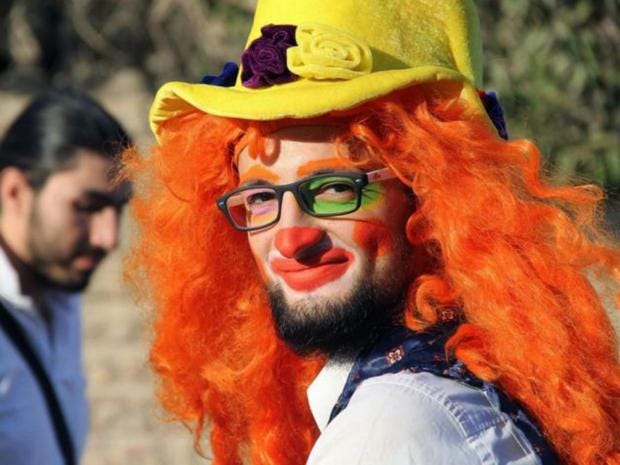
Anas al-Basha was killed in an air strike on the besieged city. He was 24 and newly married AP

When Anas al-Basha's family left Aleppo to preserve their lives and their sanity, he decided to remain behind. He had a mission as a member of a local civil society group, and as a social worker. To give hope to children for another life beyond what they have known for five years, when the assaults against their community by their president would come to a halt and some kind of normalcy might ensue. The kind of normalcy that might ensue would never return to them their dead parents. These are children whose mother, or father, or both were killed by the regime.

A more dire situation for a child cannot be imagined and the loathing and fear of death must haunt their sleeping hours and their waking days. Anas al-Basha sought to give them hope, with his clown humour to make them laugh, to think about better times and to remember how much they were loved. He died in a missile strike in eastern Aleppo, yet another body count notched up to the Syrian regime and their Russian ally for whom bombing schools and hospitals simply represent normalcy.

Oh, and yes of course, bombing funeral processions and cemeteries, those too. Making it now too dangerous to bury the dead in broad daylight. It is now a night-time activity to swiftly conduct the funeral rites, when warplanes don't tend to circle above, nor ground troops venture into eastern Aleppo's rebel held districts. Eastern Aleppo continues to be pounded and the rebels set off their rockets even as their enclaves steadily shrink.

Lebanese Hezbollah, Iraqi and Iranian Shiite militias are all aligned in the deadly game of retribution against Syrian Sunnis, alongside the Alawite regime and the sectarian-oblivious Russians. New districts keep falling to the military offensive, causing massive displacement which the UN estimates at over 31,000 as having fled, mostly to Kurdish areas, preferring to shield themselves from further violations of human rights should they flee to the government side of the city.

Russia has now lost two of its warplanes, but not as a result of the rebel defence, since they are not equipped to match the armaments of the regime and its co-fighting supporters, but to technical-mechanical deficiencies on the Russian aircraft carrier stationed in the Mediterranean. In eastern Aleppo the graveyards are full and shallow graves have been spreading in public parks.

Among them the grave of a 24-year-old social worker who dressed as a clown to entertain children, to take their minds away from their dreadful losses, their fear and pain, their miserable existence, orphaned by the president of their nation.

Mideast Syria Clown Obituary
Al-Basha was a center director at Space for Hope, one of the many important but unheralded local initiatives that has operated against the odds to provide the services of civil society in Syria's war-torn opposition areas. (Ahmad al-Khatib/AP)


Labels: , , , ,

Sunday, November 20, 2016

Cleansing East Aleppo of "Terrorists"

"We were sleeping when a barrel bomb fell near our home."
"We went down and discovered it was chlorine gas. The victims weren't activists or anything ... but they were suffocating so much, they turned blue."
"It was a man, four kids, and his wife. The oldest boy was ten years old. Why did this happen? May God curse you, Bashar (al-Assad)."
Aleppo resident

"It is imperative all parties agree to the plan and allow us to secure immediate, safe and unimpeded access to provide relief to those most in need in east Aleppo, but equally in all other parts of Syria where there are people in need."
Joint statement, Syria Humanitarian Coordinator Ali Al-Za'tari, Regional Humanitarian Coordinator for the Syria Crisis Kevin Kennedy

"[Saturday's bombardment of hospitals marked] a dark day for east Aleppo."
"The attacks have destroyed entire hospitals, electric generators, emergency rooms and wards, forcing them to stop all medical activities."
"It is not only MSF that condemns indiscriminate attacks on civilians or civilian infrastructure, including hospitals, but also humanitarian law. The message is simple and I don't know how to say it any louder: Stop bombing hospitals."
Doctors Without Borders emergency coordinator Teresa Sancristoval 
A wounded child is rescued by a White Helmets volunteer after airstrikes on eastern Aleppo Friday.
A wounded child is rescued by a White Helmets volunteer after airstrikes on eastern Aleppo Friday.  CNN
Full bombing of east Aleppo has been resumed by the regime of Bashar al-Assad, while his ally, Vladimir Putin is no doubt ecstatic to have ordered the pride of the Russian fleet including its sole aircraft carrier into the Mediterranean off the Syrian coast to show the international community that Russia means business and boasting that it is targeting Islamic State and al-Qaeda's Nusra militias, while denying that it has had any hand in bombing Aleppo now.

So it has had nothing to do with a suspected chemical attack that has destroyed the lives of civilians, nor with the barrage of barrel bombs that hit the neighbourhood of al-Sakhour, according to the Syrian Observatory for Human Rights and the Aleppo Media Center.  Local medics confirmed that victims in the al-Sakhour district had suffocated to death as the bomb that hit them was laced with chlorine gas. Moscow may have distanced itself from the actual bombing in Aleppo at this point, but it is entirely complicit with the mass murderer who orchestrates it.

Rescuers were busy in an area where several hospitals were bombed on Friday, leaving the chief of a pediatrics clinic frantic to find somewhere to move his patients. "Now it [his pediatric hospital] is being bombed ... I am sorry ... I have to go to transfer the children", he stated through a text message. Dr. Hatem noted that his facility had been targeted multiple times on Friday and on the Wednesday before. Not strategically, of course, simply coincidentally.

The 275,000 Sunni Syrians still living in the rebel-held enclave fear to leave their homes, hoping that their personal shelters will suffice to protect them from the air assaults courtesy of their president who speaks of six or seven thousand rebels holding his, Assad's 'people', hostage to their agenda. That it is for this reason that he cannot, will not accede to a United Nations recommendation that east Aleppo be granted "self rule".

Impossible, huffed Assad, since that would be tantamount to violating "national sovereignty". Violating the human rights of Syrian Sunni civilians is obviously a matter of far lesser moment. Instead, this sanctimonious butcher chooses to bomb civilians as well as the hospitals where their wounds could be treated. Syria Civil Defence, the volunteer rescue service known as the White Helmets, confirmed that 180 air strikes hit east Aleppo on Saturday alone.


Dr. Mazen Kewara, director of the Syrian American Medical Society, warned that "For the first time, eastern Aleppo is out of hospitals operating at full capacity". Major trauma hospital were taken out of service, leading to the forced evacuation of babies, according to Doctors Without Borders. Though according to east Aleppo activists, five other hospitals in eastern neighbourhoods yet retain some level of practical functionality. Perhaps, under the circumstances, not for long.

Rubble and abandoned furniture in the streets of eastern Aleppo
Eastern Aleppo has been under heavy bombardment since Tuesday  Reuters

Labels: , , , , ,

() Follow @rheytah Tweet