

The Climate-Changing Himalayas
"Nepal is very vulnerable to this because half our country is covered with mountains. That's going to affect the people living lower down below the valley along the river.""It's a big threat. The moment glaciers recede ... the lakes are going to rise and then one day, it's going to breach and break. And that's exactly what is happening.""It happened in Thame [his father Tenzing Norgay Sherpa's home town], half of the village was wiped off [the map].""I think we have to be very careful now as to how we look at mountains and how we approach climbing mountains nowadays."Jamling Tenzing Norgay Sherpa, 61
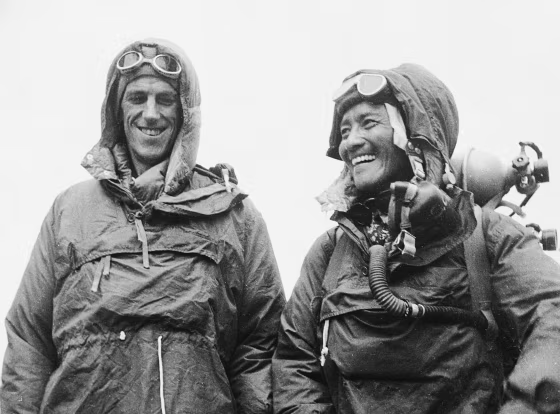 |
| Edmund Hillary, left, with Tenzing Norgay in Kathmandu, Nepal, in 1953. AP |
Tenzing Norgay Sherpa's son is convinced the world needs to sit up and take notice. The Himalays are being transformed by climate change. Mountaineering which his father Tenzing Norgay Sherpa pioneered on the majestic mountain considered to be the tallest and certainly one of the world's most difficult to climb is now more dangerous in its laborious ascent and descent. He is also in a sense, celebrating a long-overdue view back at his father's historic climb alongside mountaineer Sir Edmund Hillary of New Zealand. The story of their summit on Mount Everest has always been told from the perspective of Sir Hillary, never Tenzing Norgay.
 |
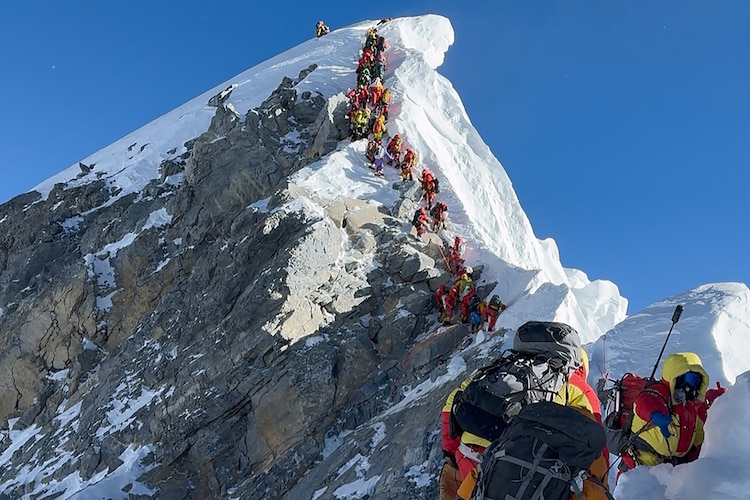
| For climbers and mountaineering Sherpa community, the changes are also making their occupation more dangerous, with unpredictable weather and frequent avalanches. RTE100 |
That never-before succeeded spectacular feat of sheer human stamina and determination in the face of the seemingly impossible, 70 years ago was a rare event in human expeditionary adventure. Yet, the Himalayas of those long decades past is not the Himalayas of the present era. Nepal, whose mountainous terrain and approach to Mount Everest and its sister mountains represent the most-commonly favoured routes to ascending those famous peaks, is not the Nepal of yesteryear.
Tenzing Norgay Sherpa's home village of Thame, at an altitude of 3,800 meres (12,460 feet in height) is no more. Two years earlier, a devastating flood caused by a glacial lake outburst swept it away. Another more recent event in August saw a glacial collapse trigger a massive flash flood along the Rishuli and Bhote Koshi river systems in Nepal and Tibet. Close to 800 people lost their lives. The areas in question have become ecologically fragile.
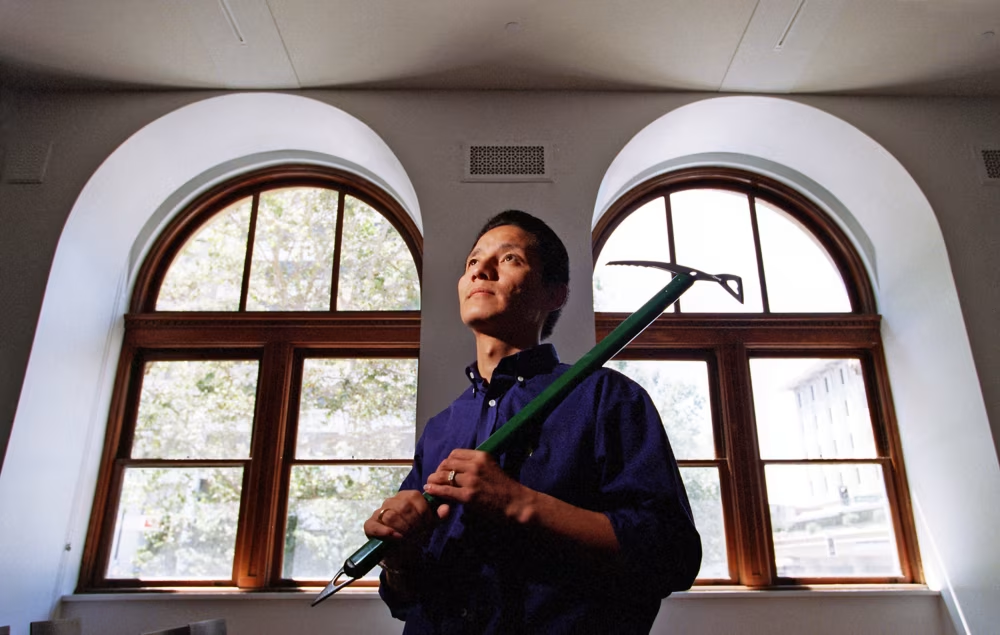 |
| Jamling Tenzing Norgay in 2001. Carlos Avila Gonzalez / The San Francisco Chronicle via Getty Images |
In 1996 Tenzing Noray Sherpa's son Jamling Tenzing Norgay Sherpa set out to follow his father's footsteps. "I looked up to him as my greatest role model, you know, he was my hero, and I wanted to become just like him." Some geological events and incidents of historical moment however, cannot be emulated entirely in their original form. Guides now find water at Camp 2, situated some 6,400 metres (21,000 feet) high up the slope of Mount Everest. "There was never water at all. It's always solid ice up there", emphasized Sherpa.
Unpredictable weather has always been a problem climbing such unapproachable peaks where raging winds and devastating snowstorms can mean the difference between life and death. But the unpredictable weather now includes a definitely notable warming trend resulting in more frequent avalanches, both auguring far more dangerous and difficult conditions being faced by climbers and the mountaineering community of Nepal's famous Sherpas. Add to that the dangers inherent in the newly-crowded conditions found on the mountain with the popularity of these prestige-assuring climbs
 |
"I think it was long overdue, a film, a biopic about my father, his life.""But at the same time, he really didn't care about it. It wasn't the fame he looked for, why he climbed the mountain.""He climbed because it was his passion and he had a dream to climb this mountain."Jamling Tenzing Norgay Sherpa
While the mountains, said Sherpa, were a passionate longing for his father, and many Nepali climbers are now finally being recognized for their own heroic stature in climbing the Himalayas and Mount Everest in response to eco- and mountaineering-popularity, the mountaineering industry is driven for the most part by financial necessity. "The Sherpas climb today to keep bread and butter on the table, you know, to feed their children, to give their children a good education, so their children wouldn't have to do the same thing", he explained.
"It's not only affecting us in the Himalayas, it's affecting European countries, it's affecting places in the U.S. with all these wildfires.""If we don't star taking care of our planet, there's going to e a price to pay.""While he [Tenzing Norgay] was still alive, before the '80s, nobody talked about climate change because we didn't see the changes.""We notice this now."Jamling Tenzing Norgay Sherpa
Labels: Climate Change, Jamling Tenzing Norgay Sherpa, Mount Everest, Nepal, Sir Edmund Hillary, Tenzing Norgay Sherpa
posted by Pieface | 9:21 PM


0 Comments:
Post a Comment
<< Home