Politic?

This is a blog dedicated to a personal interpretation of political news of the day. I attempt to be as knowledgeable as possible before commenting and committing my thoughts to a day's communication.

Sunday, January 23, 2022

Punishing Dissenters ... There is No Escape From the CPC

"To escape further persecution, he [Dong Guangping], managed to make it to Thailand in 2015, where he was granted official refugee status by the UNHCR."
"As he awaited resettlement to Canada in a Bangkok immigration detention centre, Chinese police walked in, handcuffed him in front of Thai officers and led him out."
"Dong later resurfaced in detention in China ... where he was sentenced to three years in prison."
"Foreign governments must ensure all diplomatic discussions on these issues take place in an open, transparent and public space and, where possible, expose activities carried out on its soil by overseas agencies that violate its judicial sovereignty."
"Without transparency, violators are encouraged to continue and expand their activities. Silence will increase the transgressions, not reduce them."
Safeguard Defenders human rights, Madrid
 
"The main purpose of Xi isn’t just to get these people back to China — it’s to prevent Chinese high-level government officers from escaping from China."
"He wants to show even if you escape to the U.S., I can still get you back to China."
Gao Guangjun, New York-based attorney
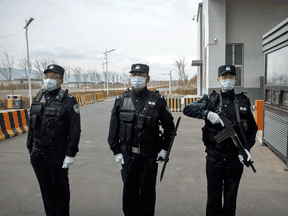
Police stand outside a detention center in Dabancheng in western China's Xinjiang Uyghur Autonomous Region. A human rights group estimates that the number of forced repatriations by China has increased rapidly during the COVID-19 pandemic.
Police stand outside a detention centre housing Uyghurs in Xinjiang Province  AP
 
According to a report from Safeguard Defenders. an estimated 1,421 forced repatriations took place in 2020 and another 1,114 in 2021. The human rights group estimated an increase in forced repatriations despite widespread travel restrictions where China sought out and forcibly returned "fugitives" it represents as criminals, back to China, where they are prosecuted and sent to prison.
 
These are called out as state-sanctioned kidnapping, labelling Chinese who disagree with the ruling Chinese Communist Party as a dictatorship holding the entire population hostage to its Marxist ideology and thus becoming enemies of the state who can be accused of undermining the authority of the government and face prison sentences.

According to Chinese government sources responding to criticism, these people are taken back to China to face trial for economic crimes or for crimes related to their official duties. The targets, however, stand out as "lawyers, dissidents, bloggers, journalists, Tibetans, Uyghurs and Hong-Kongers". Methods used in their capture range from refusal to renew passports,  to covert operations viewed as "state-sanctioned kidnappings", according to the Safeguard Defenders report.

The report mentions the issuing of Interpol red notices, the intimidation of family members in China by state actors, and state agents taking to threatening their targets in person. Among some of the targets have been those tricked into travelling to a third country from which they could be extradited.

The case was cited of a Chinese human rights defender, Dong Guangping, who had previously served three years in prison in China on charges of inciting subversion of state power in the early 2000s. In 2014 he was again sentenced to another detention of eight months, before he escaped, only to be  hounded down and brought back to China.

According to data cited in the report, Uyghurs are being targeted increasingly in a similar vein. Over 300 cases have been tracked by the Uyghur Human Rights Project, which warns the real number is likely to be much higher in actual fact. For its part, China has always denied kidnappings or that the state violates foreign and international laws.
 
Yet since 2015, Beijing's Operation Sky Net has made targets of thousands of 'criminals' sought by China to be brought from abroad where they are illegally captured to be taken back to China. The program appears to have been expanded to include Uyghurs seeking refuge abroad, escaping their persecution in Xinjiang and their mass detention for forced labour.
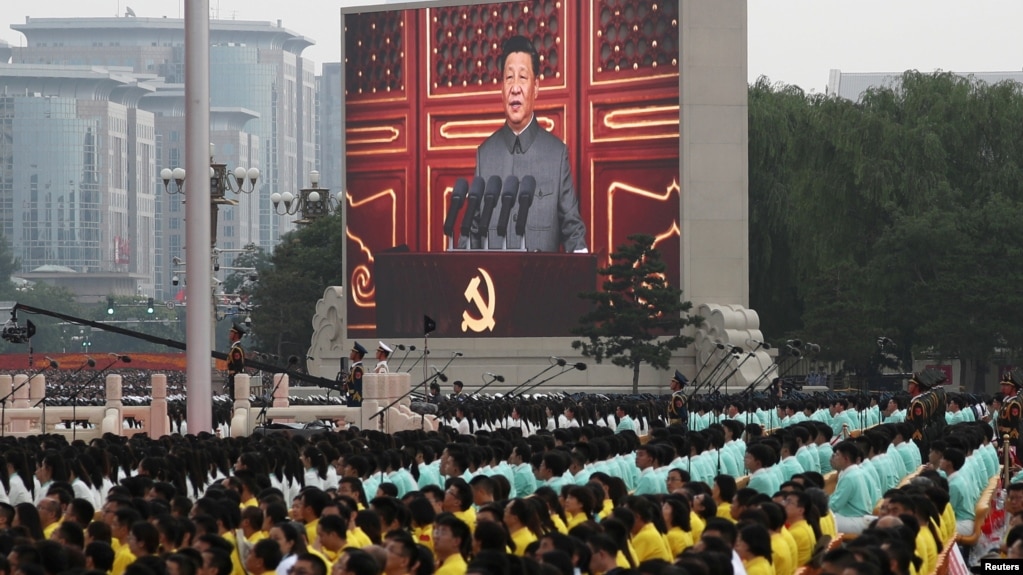
Chinese President Xi Jinping is seen on a giant screen as he delivers a speech at the event marking the 100th founding anniversary of the Communist Party of China, on Tiananmen Square in Beijing, China, July 1, 2021.

Labels: , , , , ,

Friday, July 02, 2021

In Defence of China

"Canadians are saying to Chinese friends that we don't want them to make the same mistakes. We do so not because we have a superior moral position, not because we have the answers to the problems they are trying to solve and not because we want to embarrass China. We do it because of the pain we feel over what happened in our own country and for what we can learn from each other in not making such mistakes again."
"[Canadians wouldn't tolerate mass arrests, forcing people to attend schools, sterilizing women or relocating villages], except that we did all of those things, and we did them throughout our short history as a country, most appallingly to Indigenous peoples, but also to recent immigrants and minority groups who were deemed undesirable, untrustworthy or just un-Canadian."
"On a different question about the degree of democracy, respondents in China expressed greater satisfaction with the status quo in their country than did respondents in Canada or the United States."
"The management of relations with other countries, especially great powers, is exceedingly complex and does not lend itself to one-off pronouncements that are based on the desire to perform without the responsibility to manage."
"The fact that China does not share our view of individual freedoms or, indeed, our interpretation of freedoms based on the Charter is not a basis on which to lecture the Chinese on how they should govern themselves."
Senator Yuen Pau Woo, Senate of Canada, Ottawa, Ontario
Independent B.C. Sen. Yuen Pau Woo has criticized Canada for condemning China's treatment of its Uyghur minority. (Justin Tang/Canadian Press)
 
Beijing is not shy about telling other countries not to interfere in China's internal relations in seeking out harmony between its peoples. Tibetans, Chinese Christians, the Falon Gong movement, Turkic minorities, the Uyghur Muslims in Xinjiang province all face oppressive situations of illegitimacy in the treatment meted out to them by the Chinese Communist Party which wants all of its citizens to be uniformly loyal, speaking the same language, thinking the same thoughts, venerating the CCP and President Xi, never venturing into opposition territory.

All of China's actions against its minority groups are fairly well known to the international community, most of whom feel that whatever China does is China's business, but for many Western democracies which decry China's oppressive autocracy. Rumours of body organs taken from prisoners for transplant in transplant tourism in China have not gained it much admiration abroad. Similarly charges that a million Uyghurs have been imprisoned, used as slave labour, brainwashed to deny their culture, traditions, religion and language have brought universal censure to China.

Beijing has an immense propaganda machine, has invested vast sums in establishing its Confucius centres in foreign academic institutions in the interests of serving as a link to greater friendship between countries through familiarity with Chinese history, culture and traditions to support an aura of relaxed trust between the West and China. It has also infiltrated other countries through its United Front Work Department which calls upon its former citizens living abroad to remind them that they have an obligation to their mother country to come to its defence. 

Chinese expatriates the world over have entered governments and business and academia at every level, gaining trust and respect for their intelligence and skills and experience, while some among them at the same time nudge their adopted countries toward closer ties with China. China's influence and control has grown through its generous funding of developing nations' infrastructure in its Belt and Road initiative, through loans and technical assistance, in the process indebting countries to a benefactor and placing them in financial difficulties to repay the loans.
People wearing masks are seen during a rally in Hong Kong in 2019 showing support for Uyghurs and their fight for human rights. (Lee Jin-man/The Associated Press)
 
The Parliament of Canada, like many of its collegial-nation countries has seen fit to charge Beijing with cultural genocide aimed at its Uyghur and Tibetan population, which enrages President Xi Jinping. And Canadian-Chinese Senator Woo has cleverly and persuasively taken up a gentle verbal cudgel of admonishing Canada for its arrogance in charging Beijing with cultural genocide when Canada itself has perpetrated a very similar program dating from the 19th century targeting its Indigenous First Nations population.

The issue of the residential school system where it became law for Indian, Metis and Inuit children to attend these residential schools operated on behalf of the government of Canada by religious communities, and where First Nations children were scooped into the residential schools away from their families and tribes to be indoctrinated into the superior culture of European settlers laid waste to the culture of First Nations. Their children forbidden to speak their native languages, given new names, unable to see their parents, fed inappropriate food, harshly punished and given inadequate medical care.

Other appointed senators in the Red Chamber of 'sober second thought' in Parliament took umbrage at Senator Woo's first speech after being appointed to the Senate by the current Prime Minister in 2016, as a China apologist when he argued against a motion for the government of Canada to urge China to reduce tension in the South China Sea, his first message being to "deliver a message not on behalf of Canadians, but on behalf of Beijing". Senator Woo has also said that Canada "should give up on the idea that it is part of Canada's mission to change China".

As for Senator Woo's contention that Chinese are more satisfied with their government than are Canadians with theirs and Americans with their own, he might be reminded that Beijing closely tracks each and every Chinese citizen, knows the most intimate things about them; tunes in to their behaviour and their expressed opinions. Chinese simply do not express criticism of their government for legitimate fear of punishment in retribution. Canadians and Americans have the guaranteed freedom to do so if they wish.
In this 2018 file photo, a guard tower and barbed wire fence surround a detention facility in the Kunshan Industrial Park in Artux in western China's Xinjiang region. (Ng Han Guan/AP Photo)
 
It is really difficult to be too harsh over Senator Woo's position. An intelligent man, well spoken and making comparisons between the two countries on a superficial level, bypassing the aggressive stance China has taken toward its neighbours' claims to disputed border territories, from India to the Philippines, Japan to Korea and Vietnam, the world's trading colossus has revealed its agenda as a bully. One that does not hesitate to use the most underhanded methods of spying on other countries to snatch trade, military and government secrets for its own use.

Its transgressions are legion, from cyber espionage to infiltration of other nations while warning the international community that China itself will brook no interference in its internal affairs, much less its external affairs, threatening other nations that spurn offers to link their communication systems to China's, a country that seeks to dominate every sphere of human endeavour, from amassing rare earth minerals to investing in other countries' national enterprises, the better to rise to the top.

Labels: , , , ,

() Follow @rheytah Tweet