Politic?

This is a blog dedicated to a personal interpretation of political news of the day. I attempt to be as knowledgeable as possible before commenting and committing my thoughts to a day's communication.

Tuesday, May 27, 2025

Predictive But Unheeded Canadian Labour Woes

"Not only has Canada experienced an unprecedented surge in immigration, but the composition of recent newcomers has been markedly different than in the past."
"[Since 2015 -- when the Liberal government of Justin Trudeau took office], the average nominal wage gap between temporary and Canadian-born workers has more than doubled."
"[By mid-2024, non-permanent residents were representing] almost two-thirds of population growth [in a] sharp divergence [from the norm]."
"[Dropping wages among] non-permanent workers [could be a sign that] the productive capacity of the Canadian economy grew less than it would have if recent newcomers had the same socioeconomic characteristics as in the past."
The Shift in Canadian Immigration Composition and its Effect on Wages .. Bank of Canada report
https://d29ao6x945u76k.cloudfront.net/blogposts/8/ab9a07cca8c0e336423d247e0cbc1080.jpg
Canada has been experiencing ongoing labor shortages, particularly in unskilled labor roles. In response, Immigration, Refugees and Citizenship Canada (IRCC) has developed several immigration visa pathways to help unskilled migrants obtain work visas and fill these vital positions. This comprehensive guide explores how unskilled workers can immigrate to Canada, the visa pathways available, and the advantages of building a career in Canada.  CanaMigrate
 
As younger, lower-skilled immigrants enter Canada to shore up its lagging workforce, the share in the labour force of native-born Canadian workers has dropped almost by ten percent since 2006, according to a report issued by the Bank of Canada documenting the country's economy becoming increasingly reliant on migrant workers on low-wages. The bank's Economic Analysis Department published a discussion paper on May 9.
 
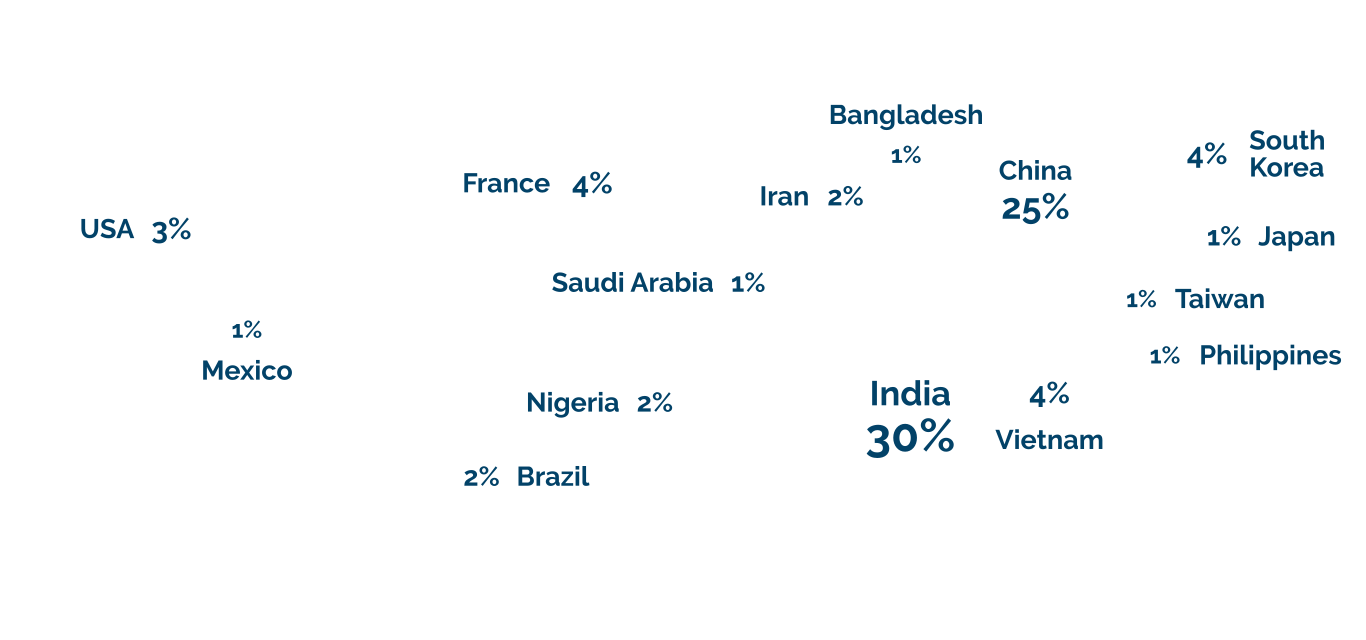
The analysis discovered that the average Canadian immigrant has become younger, lower-skilled and likelier to emanate from poor regions of the world: India, sub-Saharan Africa or the Middle East, comprising a situation driven largely by a temporary migration surge. Among Canada's surging ranks of temporary migrant workers wages have been "reduced significantly relative to Canadian-born workers" the paper states. 
 
https://d29ao6x945u76k.cloudfront.net/feeds/1/e0227672c6b7bbf266ea7b27a5e30bd1.jpg
Things to Consider When Choosing a Tech Bootcamp as a New Immigrant in Canada  CanaMigrate
 
According to the authors' calculations, the average migrant worker in Canada is paid over one-fifth less than a Canadian-born worker in comparable working positions. Prior to 2014, the wage gap was 9.5 percent, rising to 22.6 percent by 2023. The paper, titled The Shift in Canadian Immigration Composition and its Effect on Wages, is regarded as one of the most definitive official documents yet produced with respect to the massive surge of migrant workers brought to Canada immediately following the COVID-19 pandemic.

Canada began to accept over a million newcomers annually, beginning in 2022, for the most part in "non-permanent" categories of immigrants in a spectrum from international students, among those admitted under the international mobility program, to temporary foreign workers. This massive intake of workers was not matched anywhere else in the world of advanced economies.
 
Population growth in Canada between 2019 and 2023 amounted to over six percent, triple the rate in the United States, and double that in Switzerland, the two developed economy countries analyzed for the paper with a demographic shift coming a distant close to Canada's. The situation is hardly reflective of the norm for Canada traditionally where immigration flows are "generally stable and predictable over history."
 
Canadian population growth until 2015 was almost entirely unaffected by "non-permanent residents". Immigration came through permanent channels; the "NPR" cohort vanishingly small to the extent that new temporary immigrants entering the country were generally negated by those leaving.  As well, temporary migrants were sourced from different regions. The region between 2006 and 2014 where the highest level of non-permanent immigration to Canada arrived from was Northern and Western Europe. Now, since 2024 India has replaced that traditional source.
 
https://d29ao6x945u76k.cloudfront.net/feeds/1/4c832ddc4bec7999838c17efa874aa1b.jpg

The Bootcamp Advantage for New Immigrants
A career in tech in Canada generally offers competitive salaries, opportunities for growth, and often, supportive work environments. CanaMigrate

"An increasing number of NPRs have been migrating from lower-income regions" the report states. Canadian "net births" have been sharply reduced, even while an massive influx of migrant workers increased. Until the early 1990s, net births remained the primary driver of population growth. They became "negligible" by 2024, the paper notes. Canadian babies born in 2024 were equivalent to the number of Canadians who died. As well, the paper documents a marked decrease in the labour force of Canadian-born workers.
 
Alarmingly the post-pandemic surge in migrant workers matched a massive increase in youth unemployment, particularly among retail and food services -- sectors that relied traditionally on part-time entry-level workers, now relying on temporary work visas. Service jobs of a temporary nature were, in the past, employment opportunities for high-school and university students as a means to pay their tuition fees. Less attractive to Canadian-born students looking for summer employment was agricultural work, where migrant workers took up the slack.
 
https://d29ao6x945u76k.cloudfront.net/feeds/1/892a57c592004400847290c7faf33b8e.jpg
While many assume that only skilled workers are eligible for a Canadian work visa, there are numerous pathways available for unskilled workers. CanaMigrate
 
King's Trust Canada found in a November report that between 2015 and 2023 the rate of temporary foreign workers in Canadian restaurants had increased by a whopping 634 percent. The Bank of Canada report authors surmise that the  trend they analyzed could have an effect on the country's overall productivity -- how much the average Canadian worker is capable of producing. 

In recent years they note, Canadian productivity has gone into sharp decline with each passing year yielding a progressively lower rate of per-capita GDP than the year before. This trend is likely exacerbated, according to analysts, by Canada's surge in cheap, low-skilled temporary labour. Former Bank of Canada governor David Dodge in 2023 warned that a "large and rising inflow of workers with lower skills" was impacting in depressing wages and propping up "uncompetitive" businesses.
 
https://d29ao6x945u76k.cloudfront.net/feeds/1/0e893f4de52692f6cdbf3103ee34d8c6.jpg
Provinces in Canada with High Demand for Unskilled Workers ... CanaMigrate

Labels: , , , , ,

Friday, November 22, 2019

International Students of Today, Canadian Residents of Tomorrow

"The volume of non-compliance should not really be a surprise to anyone. Most international students at the community college level are edu-immigration clients. If they can avoid school and gain immigration status through work opportunities, that's what all of them would do."
"Having a study permit offers direct access to employers for this purpose." 
"Students had no idea what 'actively pursue' meant or what the consequences were until these program delivery instructions occurred six years after the compliance regime was put in place."
Earl Blaney, immigration consultant, London, Ontario

"Sometimes people have valid reasons to be non-compliant with the conditions in their study permits."
"Maybe they have to go home for a family emergency."
"The integrity of the international student program is very important. It's a top priority for us and our members to ensure all students access to quality education in Canada."
"Nobody benefits from students not showing up in class."
Denise Amyot, CEO, president, Colleges and Institutes Canada

"She [international student Kaur Gursimran] changed schools and programs, moving from business programs into a general arts and science program in spite of her permit specifying that she is to study business or commerce."
"Additionally, she took off two semesters in three years, and failed more courses than she has passed."
" Kaur's absences alone are sufficient to demonstrate that she did not comply with the ... requirement that she actively pursue her studies."
Justice Ann Marie McDonald, federal court decision leading to expulsion 

"I would love to know more about those non-compliant cases. Where do they come from? Which institutions? Is it colleges? Is it universities? Is it private [institutions]? Is it public? This would shed some lights and would steer policies one way or another."
"We have a huge body of international students. They contribute a lot to our teaching and learning in the classroom. There are a few non-compliant cases. When we introduce any new policy, we need to make sure we don't complicate life for everybody in the process."
Amira El Masri, international education policies, York University
Anase El Kamel was issued a student visa for the Universite de Moncton in New Brunswick but the young man from Morocco attended not one class at the university, nor did he ever live in New Brunswick. When he arrived in Canada he went directly to Montreal in 2017, took a job with a parking management company, and made the claim that he was too ill to attend school. Eventually he was tracked by immigration officials who ordered  him to leave Canada since he failed to "actively" study, reflecting his visa's requirement.

"The [education] program he was to complete in Canada was not of great concern to him. He simply wanted to quickly complete a program so that he could then apply for permanent residence in Canada", a Federal Court decision found, whereupon he was extradited for failure to live within the expectations of the visa issued to him for the specific purpose of pursuing his further education in Canada, a gateway to eventual residence and citizenship.

According to a report from Immigration, Refugee and Citizenship Canada, about ten percent of international students who enrolled in post-secondary institutions do not "potentially:" comply with study permit conditions. There is no formal monitoring and investigation of international students to determine whether they conform to rules. An honour system of reporting by the hundreds of academic institutions in the detection of "non-genuine students" is what the Immigration Department relies upon.


The program is reliant on school administrators reporting on the status of international student enrolment following an explosion of such enrolment after 2014 when policy changes eased the way for international students at publicly funded institutions to work and apply for permanent residency.
At present 572,000 international students study across Canada, representing a 73 percent increase in the past five years. And of the 655 accredited schools, 90 percent (587 schools) duly submitted enrolment data.

In 2018, school administrators identified nine percent (28,049 of 316,631 study permit holders as "potentially non-compliant", while failing to report the status of another 15 percent (51,041 international students). Additionally, since 2018, officials scrutinized school acceptance letters used to apply for study permits, referring over 10,000 such letters for verification, and finding 1,240 to be fraudulent.


Provinces accredit schools in their jurisdiction to accept international students; the schools in turn must meet standards and monitor student enrolment. The list of recognized schools in Ontario alone has grown from 298 in 2014 to 420 currently. The breaching of employment restrictions by international students, an issue raised by immigration officials in a 2015 report, found many enrolled in Canadian schools linked to the easy access to jobs, where many of the students end up in low-skilled, low-paid work.

Any of the students caught breaking rules face consequences such as losing their permits and being deported. In the first two months of 2019, 1,048 study permits were cancelled. Jobandeep Singh Sandhu, 22, attending Canadore College took employment as a long-haul truck driver. Stopped by Ontario Provincial Police on a routine inspection in 2017, his driver log book revealed he had worked greater hours than his student permit allowed, resulting in his deportation.

In the United States, as an example, eligibility for a postgraduate work permit is tied to employment in the field of study of an international student, who may work off-campus only during school breaks, explained Colorado-based Rahul Coudaha, an international education consultant.
"[Canada already has a] rigorous [study permit application process to screen ineligible students out at the front end]."
"The goal of these mechanisms is to ensure the integrity of the system, but it is also important for Canada to attract and retain these international students."
"There are always those who try to game the system, but you don't want the 90 percent of genuine students being affected."
Rahul Choudaha, international education consultant, researcher, Colorado

"Some educational institutions in Canada offer low-quality education programs with minimal entry requirements and adjust their programs to allow international students to maximize the duration of their postgraduate work permit."
"The current program design ... increases the motivation to create low-quality education programs facilitating long-term work opportunities."
Price of Admission, investigative report
Students fill an auditorium at Centennial College’s Progress Campus in Scarborough for an international welcome day event on Sept. 7. Students were provided with information on issues such as housing, staying safe, immigration and health. International students make up half of Centennial’s 28,000-student population.

Labels: , ,

() Follow @rheytah Tweet