This is a blog dedicated to a personal interpretation of political news of the day. I attempt to be as knowledgeable as possible before commenting and committing my thoughts to a day's communication.
Canada's Liberal Government in Contempt of Parliament
"There's a lot of politics going on by both the Liberals and the Conservatives but in parallel to that, there is zero doubt in my mind that there are very good reasons to protect at least some of the information here."
"It's very hard to know where the line is between government efforts to actually legitimately protect classified information, which is very real, and government attempts to protect itself against embarrassment."
"NSICOP [the National Security and Intelligence Committee of Parliamentarians] has done and said things that were independent, that were autonomous, and that did not make the intelligence community happy, that did not make the government happy."
"Any time you set up new institutions, there's always a process of two steps forward one step back, two steps sideways; This is multiple steps back."
Thomas Juneau, associate professor, security issues, espionage, University of Ottawa
"My understanding is that parliamentary privilege is absolute. So how to convince a judge otherwise, what would be the rationale for that is really something that is quite puzzling to me."
"I think it's dangerous if we start to play that game and try to limit access like that, using courts to limit access to documents."
Daniel Beland, director, McGill Institute for the Study of Canada
"The research community goes where the best science and opportunity is taking place."
"I think it would be short-sighted to heavily restrict research partnerships. After all, science is a global enterprise and one never knows where and when a breakthrough or major discovery can emerge."
Paul Dufour, adjunct professor, Institutute for Science, Society and Policy, University of Ottawa
"This is our future."
"Good relations with China means our future scientists and theirs will be in constant communication, visiting back and forth and trading information."
"The freer they are to do so, the better for all of us."
James Robert Brown, professor emeritus, Institute for the History and Philosophy of Science and Technology, University of Toronto
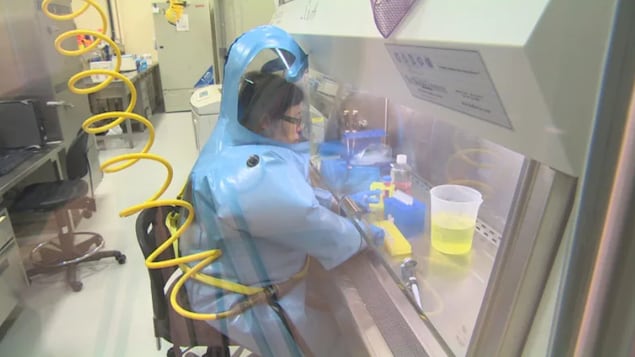
Xiangguo Qiu, her biologist husband and her students have not returned
to work at the National Microbiology Lab in Winnipeg, after being
escorted out in July 2019. The RCMP is still investigating a possible
'policy breach' reported by the Public Health Agency of Canada. (CBC)
The Parliamentary Committee of the House of Commons Canada-China relations committee had censured Iaian Stewart, President of the Public Health Agency, for having ignored their calls for documents to be presented for their scrutiny to answer the mystery of the firing of two Chinese bioscientists from the high-security Winnipeg-based National Microbiology Laboratory. Two scientists with professional links to research and scientists linked to the People's Liberation Army laboratories.
Questions surrounding the two scientists' escort from the high-security bioresearch laboratory along with Chinese bioscience students studying in Canada and recruited by Xiangguo Qiu and her husband Keding Cheng to work alongside them at the Winnipeg laboratory have gone stonily unanswered. Both the President of the Public Health Agency, which oversees the Winnipeg laboratory, and the Liberal government have refused to release the requested documents. The Liberal government has now filed with the Federal Court to give legal impetus to its refusal to release the documents.
Michael Juneau-Katsuya, formerly head of the Canadian Security Intelligence Service Asia-Pacific section reminds that CSIS consistently gave warning of China's vast intelligence gathering network and that it poses a grave threat to Canadian intellectual property. He had commissioned a report in mid-1990 while still with the service, estimating that Canada had experienced a loss in excess of $10 billion annually as a result of economic espionage carried on by China. He criticizes the government for its lax approach in protection of Canada's science breakthroughs.
Mr.Juneau-Katsuya points to the cost associated with a 2014 cyber attack on the National Research Council, despite which Canada's cooperation with China went on unabated. "CSIS has identified a lot of threats and knows a lot about the threats, but the government does not warn its employees. The only defence is prevention. When they steal your stuff, it's too late", he said. An internal document produced in 2016 revealed that rebuilding the ransacked system would take years at an estimated cost of breach repair in the hundreds of millions. Still, the agency continued to collaborate with China.
One of
the scientists escorted from the National Microbiology Lab last year
amidst an RCMP investigation was responsible for a shipment of Ebola and
Henipah virus to the Wuhan Institute of Virology four months earlier -
although the Public Health Agency of Canada still maintains the two are
not connected. CBC
It was at the National Research Council where an Ebola vaccine was developed in 2018 alongside the Chinese Academy of Military, Medical Sciences and CanSino Biologics. China's Ministry of Science and Technology issued a joint call with the National Research Council in 2019 for proposals for collaborative industrial research and development projects. A number of additional ventures were conducted by the National Research Council, along with annual meetings with the China National Biotec Group.
A research-council employee from China who had been employed in the People's Republic's Ministry of Foreign Trade and Economic Cooperation had conducted much of the work involved in setting up partnerships and guiding Canadian technology companies to enter the Chinese market. Council researchers had developed a cell line as a scaffolding for virus research which they provided to CanSino for use in the Chinese company's COVID-19 vaccine. That was followed by an agreement for the NRC to help in testing the vaccine and to manufacture it at an NRC facility.
By August of last year, when the CanSino vaccine candidate was prepared for shipping as per agreement to Canada, Beijing stepped in to refuse to allow the vaccine to be exported to Canada. Viewed by those knowledgeable as yet more retribution, aside from the arrest on charges of 'espionage' of two innocent Canadians, Michael Spavor and Michael Kovrig, for the arrest in Vancouver on a warrant from the U.S. of Huawei CFO Meng Wanzhou.
The Riddle Within a Mystery Encapsulated in a Puzzle
"If her contract permitted it, that would be a scandal. If the contract didn't permit and they ignored the contract, that would be a scandal."
"If the contract didn't even turn its attention to this, that would be a scandal, too."
Mark Warner, trade lawyer, former legal director, Ontario Research and Innovation Ministry
"We cannot comment on this matter."
"The National Microbiology Laboratory has policies and processes that allow for scientific collaboration and these are reviewed periodically as part of the Science Excellence initiative to adapt them as needed."
Mark Johnson, spokesman, Public Health Agency of Canada
Xiangguo
Qiu's ouster from the National Microbiology Laboratory remains cloaked
in mystery and has been the subject of ongoing debate in Parliament.Photo by MCpl Vincent Carbonneau, Rideau Hall/File
The plot sickens as it thickens. That the Government of Canada is shielding documents from the Parliament of Canada that would shed light on the strange and rather awkward dismissal of two Chinese scientists long employed by Canada's topmost secret biology laboratory, biologists of distinction who had links both with the Wuhan Virology Institute and scientists working directly for the CCP's People's Liberation Army laboratories, defies logic.
The dismissal of scientists Xiangguo Qiu and her husband Keding Cheng in January following their having been escorted out of Winnipeg's National Microbiology Laboratory a year and a half earlier along with Chinese biology students that Dr. Qiu had brought into the NML, is an event of great interest to parliamentarians and to the Canadian public. Particularly at this time of a global pandemic when a viral pathogen erupted in Wuhan, China and there are suspicions whether it was a natural event or whether the Wuhan Institute of Virology had been involved.
The head of the Winnipeg laboratory was called before Parliament and given instructions to produce documents to clarify the reason behind the scientists' escort from the laboratory and their consequential firing. Public Health Agency of Canada chief Iain Stewart adamantly, despite being reprimanded, continues to refuse to provide unredacted documents to Members of Parliament sitting on the Canada-China relations committee.
It has now been made clear that it is the Liberal government of Justin Trudeau which has instructed Mr. Stewart to refuse to surrender the documents in question. The Liberal government has filed an application to the Federal Court asking it to prohibit disclosure of the requested documents, challenging the principle of the House of Commons' supreme position to demand documents be produced regardless of privacy or national security laws.
Yet the government that has imperilled national security through its continued positions on allowing Beijing access to Canadian academic circles, corporate interests, government infiltration, scientific and technical inventions and production has filed an application requesting an order confirming the documents should remain undisclosed; the disputed material being "information which if disclosed would be injurious to international relations or national defence or national security".
Dr.
Xiangguo Qiu, a prominent virologist at the forefront of an ongoing RCMP
investigation, is seen in an undated screengrab at the Winnipeg-based
National Microbiology Laboratory. She was fired from her post in
January, but officials won't say why. Photo: CBC
It would, in the sense that such disclosures have the potential to demonstrate the extent of this government's lax attention to securing its own intelligence, linked to that of its G7 and Five Eyes partnerships. News that Xiangguo Qiu, currently under investigation by the RCMP, is listed as an inventor on two patents filed by official agencies in China is another unsavoury revelation. As a long-time Canadian civil servant her obligation is to Canada, not China.
It is, in fact, illegal for any employee of the Microbiology Laboratory to patent anything discovered at the Lab; it is the property of the Lab and of Canada.While her escort out of the Microbiology Lab continues to shrouded in mystery, the subject of Parliamentary debate, these new revelations serve to deepen the conundrum.
One patent listing her as a co-inventor with others was filed with the Chinese National Intellectual Property Administration by China's National Institutes for Food and Drug Control, describing an 'inhibitor for Ebola virus'. Ms.Qiu had been celebrated in Canada for her work in helping to develop a treatment for Ebola. In the other patent registered by the Inspection and Quarantine Technology Centre of Fujian province a "detection method" for Marburg a hemorrhagic fever, is involved.
Just coincidentally, Dr.Qui had been involved in an unauthorized shipment of NML materials involving those same biological inventions out of the Winnipeg laboratory to the Wuhan Virology Institute. Dr.Qiu, it seems apparent, was either in violation of the inventions law or had received permission from the minister to proceed as she had, which seems unlikely, given its illegality and the strange potential decision to provide such highly classified and protected material and research to a hostile country.
It had been revealed by a journalistic investigation that Professors Qiu and Cheng had failed to pass security screening by the Canadian Security Intelligence Service, somewhat after the fact. They had been known to work alongside Chinese scientists as well as a PLA military researcher who had also been employed by the Winnipeg Laboratory. None of this inspires confidence in the Public Health Agency of Canada, nor the Government of Canada in this hugely unsavoury event.
The National Microbiology Laboratory in Winnipeg
where scientists Xiangguo Qiu and Keding Cheng worked until they were
escorted out in July 2019, and finally fired in January 2021.Photo by Michel Comte/AFP via Getty Images/File
"They have told the staff nothing, other than a ridiculous order last summer that we're not allowed to discuss it or speculate about what may be going on."
"Many of us think it is such a huge story that they are trying to keep buried for some pretty serious reasons."
"We just don't know what those are."
Anonymous Public Health Agency employee
"In response to a request from the [Wuhan] institute for viral samples of Ebola and Henipah viruses, the Public Health Agency of Canada sent samples for the purpose of scientific research in 2019." "The National Microbiology Laboratory [NML] shares samples with other public health laboratories-- as they do with the NML -- to contribute to the advancement of science." "The [internal] administrative review remains underway. We cannot provide further details." Eric Morrissette, spokesperson, National Microbiology Laboratory, Winnipeg
Xiangguo Qiu, her biologist husband and her students have not returned
to work at the National Microbiology Lab in Winnipeg, after being
escorted out in July. RCMP are still investigating what was described by
Public Health Agency of Canada as a possible 'policy breach.' (CBC)
A widely respected and renowned microbiologist, Xiangguo Qiu, regarded as a star performer at the Winnipeg Microbiology Laboratory, Ms.Qiu obtained her medical degree from Hebei University in China, as well as a Masters in Immunology from Tianjin University, before immigrating to Canada n 1996, eventually being offered employment at the federal microbiology laboratory. Some of her colleagues at the laboratory consider her a stellar researcher.
She became famous working with Gary Kobinger, at present a professor at Laval University, when they worked together to develop 'monoclonal antibodies' for the treatment of Ebola, a disease that was devastating populations in Africa. Their work contributed greatly in forming part of the drug Z-Mapp, held to be an effective treatment for the Ebola virus in West Africa. Their research was recognized as groundbreaking, winning them the Governor General's Award for Innovation.
Suddenly, last July, an explosive event occurred. The reason behind it has never been made public, and the Laboratory that employed her continues to advise that the investigation that led to Xianggue Qiu's removal from the laboratory is ongoing, with the RCMP probing the situation. "The matter is still under investigation. No charges have been laid at this time", stated St.Paul Manaigre, a Manitoba spokesperson for the federal policing agency.
Not only was Ms.Qiu, the NML's star performer escorted without explanation out of the laboratory, her husband, biologist Keding Cheng, also employed there, along with several Chinese students studying under Dr.Qiu also were escorted from the premises. A year has passed, and there has been no additional information released in this highly secretive situation at Canada's only BSL-4 (biosafety level 4) disease laboratory.
What is known is that a shipment of Ebola and henipavirus samples had been sent to China at the request of the Wuhan Institute of Virology, a high-security research facility for the handling of pathogens. Dr.Qiu was heavily involved with the Wuhan laboratory, taking frequent trips to China in the past few years. A situation that has raised speculation among onlookers who seem to sense a connection with the two laboratories, the esteemed scientist and the emergence of COVID-19.
Aside from the virus shipment to Wuhan in 2019, on another occasion another laboratory employee had been stopped, carrying vials of unidentified material on a flight to China. Neither the Ebola nor henipavirus samples have any connection to COVID-19. Dr.Qiu had been known to make eight trips to China, two of them to Wuhan, revealed by agency records. Most visits were for presentations on the high-profile Ebola issue, which saw the Public Health Agency "at the forefront of the field".
Wuhan Institute of
Virology, Wuhan, China.HECTOR RETAMAL/AFP via Getty Images
Records indicate that Dr.Qiu had travelled to Wuhan, invited to train scientists and technicians at the BSL-4 laboratory "for 7-14 days per trip, twice a year for two years". Quite the commitment, but not surprising for a China-born citizen who later emigrated to further her career in Canada, yet remaining loyal both to her country of birth and to the biological sciences, as a medical professional. Dr.Qiu's last visit to Wuhan was to speak at an international virology conference.
With the devastating advent of the global pandemic in the emergence of SARS-CoV-2, The U.S. government has raised its concerns that the virus that causes COVID-19 had accidentally 'escaped' the Wuhan lab. In 2018, U.S. diplomats, after visiting the Wuhan lab had cabled Washington of their concerns over the safety procedures at the lab. No evidence, however, exists that the lab in Wuhan tampered with the virus, nor that Dr.Qiu might have any untoward relations with the lab.
Complicating matters even further, American intelligence and science institutions have reported their findings that the virus's cause was a naturally occurring virus likely originating in bats, that leaped the species barrier to humans through an intermediary animal like a pangolins, commonly sold in wild animal markets for human consumption.
And while American authorities have examined possible ties between scientists from China and their country of birth, former colleagues of Dr.Qiu have attested to her loyalty to science and to the laboratory, pointing out the place of international collaboration as an integral part of scientific communication and cooperation worldwide.
Qiu accepts an award from Gov. Gen. Julie Payette, left, at a
ceremony at Rideau Hall in 2018, for being part of the team at the
National Microbiology Lab that created the Ebola drug ZMapp. (CBC)