Politic?

This is a blog dedicated to a personal interpretation of political news of the day. I attempt to be as knowledgeable as possible before commenting and committing my thoughts to a day's communication.

Monday, November 23, 2020

Death At A Time of Despair

"Decades of studies have confirmed two facts about end-of-life care in Canada. It consumes a vast amount of resources; many people will consume more 'health care' in the last years before death than in the entireity of their lives before that. And most Canadians do not want to spend large parts of that last year in hospital."
"Palliative care, hospice care and home care are what is needed and what is desired. Yet these remain chronically underfunded and delayed while the option for a quick and cheap death is full speed ahead."
Fa.Raymond De Souza, Columnist, National Post
 
"[Under Bill C-7, a mental illness will] not be considered an illness, disease or disability [for the purpose of the assisted-dying law]."
"A provision that applies only to persons with mental illness, without appropriate justification, in discriminatory in nature because it is arbitrary."
"A provision that applies to all persons with mental illness, without appropriate justification, is unconstitutional because it is overbroad."
"Explicitly stating that mental illness is not an illness, disease or disability is inaccurate, stigmatizing, arbitrary and discriminatory."
Canadian Psychiatric Association brief

 
Up to the present in the four years that medically assisted death has been available in Canada, a small number of Canadians with severe irremediable mental health disorders have asked for and received assisted deaths, legally. With Bill C-7, some changes have been made whereby the government now proposes to expressly exclude people suffering from mental illness at the very time it is expanding the law with amendments to make it easier for people with physical failings to apply for assisted death. 

Many doctors are completely averse to the very idea of helping people to end their lives, rather than offering compassionate end-of-life care tailored to the individual. In the first four years of the program, the core measure of suitability for assisted death was an immediately foreseeable death occurring while the individual was suffering from an incurable disease or illness. Now that provision is to be removed. The number of witnesses has been reduced, a requirement that the individual requesting assisted death repeat that request immediately prior to lethal injection has also been erased.

It is easier to die in Canada if you are chronically and irremediably in pain, than if you are a mass murderer being punished for horrific crimes. Canada is fastidious about the death penalty; it simply does not exist in Canada as a civilized democracy; the state does not kill to avenge killing. But it will and does aid people who are suffering from a medical/health calamity to end their lives. This Liberal government led by Prime Minister Trudeau has truly enriched the Canadian experience.

Under this government of progressive democratic liberalism ground-breaking legislation has been passed to enrich the lives of the nation; such as the legalization of drugs, assisted death, and massive, colossal government debt. The three D's that define the government of Justin Trudeau. Included in that group should be gender dysphoria, where it is illegal for parents, doctors, advisers to attempt to change a child's mind when he/she expresses a wish to be regarded as a member of the gender they were not born to.

Shutterstock
Ironically when MAID (medical assistance in dying) was introduced in 2016, the government was quick to assure Canadians that legislation was geared to "safeguard" against abuse; no one would be under pressure to request a lethal injection to end their lives, that the existence of alternatives would be advised to a requester, and offered instead of assisted death where appropriate. That reassurance has degenerated to the point that it now will be possible for lethal injection to be administered the very day it has been requested.

In a country whose medical system is under such strain that it takes months to see a medical specialist upon referral, and months to have available some types of diagnostic imaging, months to a year to have surgeries scheduled, but dying can be readily accomplished. This at a time when surveys regularly show that most people would choose palliative care for  end-of-life situations, not peremptory death. But palliative care is poorly funded and opportunities are rare.

And now the issue of excluding psychiatric patients whose suffering is intense and incurable is deemed a disservice to society, and an offence against human dignity. But the near-death provision under the legislation has been scrapped, widening the opportunity pool for assisted death, while excluding those people with mental illness. Psychiatrists are incensed at the exclusion of those whose weal they are engaged in, considering the amendment a "flagrant violation of Section 15 of the charter"; discriminatory to a class of Canadians.

Canada's Minister of Justice, David Lametti, informed the House of Commons "that the trajectory of mental illness is more difficult to predict than that of most physical illnesses, that spontaneous improvement is possible and that a desire to die and an impaired perception of one's circumstances are symptoms, themselves, of some mental illnesses." At opposite ends of the spectrum, there is push-back from health-impaired Canadians and their physicians that the disabled would welcome death. 

"All the doctor seemed to see, though, was a disabled woman alone, sick, tired and probably tired of living" commented a woman who when she was in her twenties with pneumonia, wheelchair-bound, her attending doctor suggested she might consider euthanasia, rather than wait for recovery. She rejected his suggestion, recovered, and is now an advocate for the disabled who fear euthanasia being forced upon them.They call the program MAD.

Pexels Photo

Labels: , ,

Friday, November 13, 2020

Legalizing Suicide, Enabling Death

"If I could give my patients anything, I would give them life."
"But life isn't necessarily the option they're being presented with."
"Many of them are choosing between very hard choices, and my wish for them to be better certainly doesn't make that so."
Julie Campbell, Ontario nurse, assisted dying services

"Bill C-7 declares an entire class of people, those with physical disabilities, as potentially appropriate for suicide -- that their lives are potentially not worth living."
"Indeed were it not for their disability, we would not be willing to end them. I cannot imagine a more degrading and discriminatory message for our society to communicate to our fellow citizens living with disabilities."
Dr.Ewan Goligher, assistant professor, University of Toronto
People rally against Bill C-14, the medically assisted dying bill, during a protest organized by the Euthanasia Prevention Coalition on Parliament Hill on Wednesday, June 1, 2016 in Ottawa.
"Until we're committed to making sure that everybody has an equal opportunity to live a good life, then medically assisted death on the basis of that disability is not the solution."
Krista Carr, executive vice-president, Inclusion Canada

"[...The requirement for natural death to be [reasonably foreseeable [is an arbitrary one, in which] suffering takes a back seat [to the question of how far away a patient might be from death]."
"This is a flagrant contradiction of the fundamental principles concerning the autonomy of competent people, and it is this unequal recognition of the right to autonomy and dignity that is discriminatory in this case."
Quebec Superior Court 2019 decision on federal MAID law
The House of Commons justice committee heard today from opponents of the federal government's plan to change the rules for medical assistance in dying. (Shutterstock)
 
Canada's Parliament is studying Bill C-7, an update of the Liberal government's medical assistance in dying (MAID) regime which became law in 2016. The original legislation has a provision that the natural death of a patient must be 'reasonably foreseeable' for that person to qualify for medical assistance in dying. Because of a Quebec Superior Court decision brought down in 2019 that the original law restricts assisted death to terminally ill patients unconstitutionally, it is being revisited.

The result is Bill C-7, to update the MAID regime. It does not sit well however, with disability advocates who have been raising their concerns over the new assisted dying law. Their concern is that it lacks safeguards to protect the most vulnerable of Canadians. One witness in the House of Commons at a justice committee hearing described the 'norm-shattering legislation' to allow patients with non-terminal illnesses to be euthanized.

Advocates for the disabled feel the new law could lead disabled individuals particularly to seek out euthanasia even where the patient might recover to full health. They call on Ottawa to adjust the proposed bill. Committee chair at the Council of Canadians with Disabilities, Dr.Heidi Janz, spoke of her "alarm at the breakneck speed at which this committee is operating", calling on Parliament members for an extension of public consultations on the legislation.
 
Roger Foley, who suffers from an incurable neurological disease, is urging MPs not to expand medical assistance in dying to allow people with disabilities to end their lives. He spoke to the Commons justice committee today via Zoom from his hospital bed in London, Ont. (CBC News)
 
Another committee member who lives with cerebral palsy, spoke of her personal experience when she underwent a long fight with a serious bout of pneumonia. Taylor Hyatt described her doctor at one point making the suggestion that she might consider the possibility of medically assisted death. As it happened, in time she recovered from the illness. She was 20 years of age at the time. She is aghast that medical professionals discounted the chance she would return to health and worries this experience of hers could be repeated frequently should Bill C-7 pass.

"All the doctor seemed to see, though, was a disabled woman, alone, sick, tired and probably tired of living", she said. Policy makers had sought to strike a balance between protecting patients and allowing them their right to decide when faced with a chronic illness whether they would choose to select MAID. The current law has on two occasions been challenged on constitutional grounds in Canada.

While many health-care professionals and advocacy groups lend their support to the assisted dying regime brought in by the Liberal government, feeling it proffers humane relief for patients grappling with chronic and often painful illnesses, many others do not, pointing out the humane alternative of better and more personal care for those in desperate medical straits.

Overwhelmingly, those who seek out euthanasia to end their lives are those who have tried alternatives but who determine ultimately they have no other choices, according to Julie Campbell, a nurse in Ontario who specializes in guiding patients seeking assisted dying services. Recently an Angus Reid Poll commissioned by Cardus, found 77 percent of Canadians consider access to MAID to represent a basic human right.

On the other hand, 48 percent of the respondents were "cautious supporters" with concerns revolving about potential abuses of the system, in particular targeting aging and vulnerable people. Changes under the new bill would reduce the number of witnesses required from two to one, and drop a requirement that a patient must be capable of consent a second time directly prior to taking their lives. The requirement that a person must wait ten days after being approved for the procedure would also be dropped.
 
Michael Bach at Canadian Press Conference
People who request medical assistance in dying can be motivated by a range of factors unrelated to their medical condition or prognosis. These factors make some people vulnerable to request an assisted death when what they want and deserve is better treatment – to have their needs for care, respect, and palliative and other supports better met.  Inclusion Canada

Labels: , , ,

Friday, May 29, 2020

Beijing Protecting Hong Kong From Terrorism

"Hong Kong has flourished as a bastion of freedom."
"[The security law would ] curtail the Hong Kong people's liberties, and in doing so, dramatically erode Hong Kong's autonomy and the system that made it so prosperous."
Joint statement, United Kingdom, United States, Australia, Canada

"This is the death knell for Hong Kong, make no mistake of it, this is the end of 'one country, two systems' ...the Hong Kong that we loved, a free Hong Kong'.
Dennis Kwok, pro-democracy lawmaker
    Credit...Lam Yik Fei for The New York Times

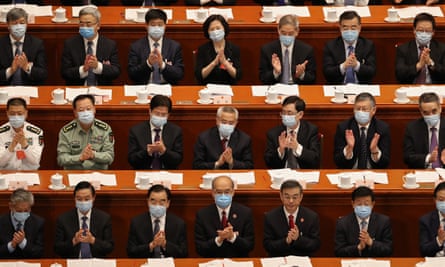
The National People's Congress, voting in the Great Hall of the People, just west of Beijing's Tiananmen Square, loudly approved and applauded the vote that took place on Thursday, a tally that indicated 2,878 votes supported moving forward with legislation, with one vote opposed and six abstentions. While the world has been distracted and busy attempting to ward off the worst advances of the SARS-CoV-2 virus, Beijing has immersed itself in finalizing the death knell of autonomous Hong Kong, cancelling the formula that recognized its unique status since 1997.

The imposition of a new security law on Hong Kong will now criminalize any such activities like protesting and criticizing Beijing. Either of which is analogous in Beijing's opinion to secession and the detested 'splittism'. As the Communist Party elite explain it to any who might not understand, the purpose of the legislation is to cope with secession, subversion, terrorism and foreign interference in Hong Kong. The plan had sufficed to instill fear into Hong-Kong's pro-democracy factions, triggering large protests.

And those protests brought out the riot police in huge numbers even while its own lawmakers engaged in debating an entirely other piece of legislation with a like purpose, to criminalize disrespect of China's national anthem. Police made 360 arrests while thousands of Hong Kongers marched in protest in the streets over the anthem bill and the national security legislation. It is abundantly clear that Beijing is imposing its authority, eroding the autonomy of Hong Kong in the process.

Attendees of the Second Plenary Session of the National People’s Congress clap their hands during a speech on May 25
China’s National People’s Congress  Photograph: Andrea Verdelli/Getty Images

An assurance was issued by China's Premier Li Keqiang, that the "one country, two systems" formula is meant to remain a national policy, but the new law would provide for Hong Kong's long-term stability and prosperity. Enactment of the law is anticipated prior to September, as details are being drawn up in the coming weeks. But no threat exists to the city's autonomy, Chinese authorities claim, backed by the Hong Kong, Beijing-approved government.

According to Hong Kong's leader Carrie Lam, the legislative work would be completed as soon as possible as she works with Beijing: "The law will not affect the rights and freedoms enjoyed by Hong Kong residents". Somehow, the pro-democracy element finds her statement as reassuring as that emanating out of Beijing.

"We urge China to step back from the brink", stated British Foreign Secretary Dominic Raab.
Britain plans to change the status of British national overseas passport holders, should China not suspend the new law, enabling such BNO passport holders to come to the United Kingdom for periods in excess of six months, an effective pathway to eventual citizenship.

Anti-government demonstrators in Hong Kong scuffle with riot police Wednesday during a protest as the second reading of a controversial national anthem law takes place. (Tyrone Siu/Reuters)

Labels: , , , ,

() Follow @rheytah Tweet