Politic?

This is a blog dedicated to a personal interpretation of political news of the day. I attempt to be as knowledgeable as possible before commenting and committing my thoughts to a day's communication.

Thursday, August 20, 2026

Tactical Surrender: World Professional Association for Transgender Health

"WPATH [World Professional Association for Transgender Health] now agrees that pediatric transgender medicine is marked by 'medical and scientific uncertainty."
"Yet for years, WPATH presented its guidelines as an  unquestionable medical standard of care."
"The social and scientific costs of questioning their recommendations were steep and could be career-ending."
"For 10+ years doctors have been told WPATH's is the only way." 
Society for Evidence-Based Gender Medicine (SEGM) 
 
"SEGM's characterization of WPATH's legal position is a clear misrepresentation of an established legal distinction by the courts."
"[Our dedication to our mission and the served patient population] remains unwavering."
"[We are a nonprofit] dedicated to promoting science-based medical care, education, research and public policy in transgender health." 
"[Our Standards of Care] articulate a professional consensus about the psychiatric, psychological, medical and surgical management of transgender people."
"That transgender health care is an area of intense medical debate does not entitle Plaintiffs to prevent individuals and organizations like WPATH from free speech aimed at contributing to that debate."
"Many governments and organizations, including New Zealand, Canada, and some U.S. States and the American Academy of Pediatrics, agree that the evidence supports SOC-8 [Standards of Care-8 updated by WPATH]." 
World Professional Association for Transgender Health
 
"Parents have been told that the WPATH approach is not optional, but medically necessary and lifesaving."
"[WPATH] has aggressively promoted that approach, including by suppressing and stigmatizing alternatives. I think it's disingenuous at best for WPATH to now frame its recommendations as merely one opinion in a legitimate debate."
Leor Sapir senior fellow, Manhattan Institute for Policy Research 

https://wpath.org/wp-content/uploads/2025/12/WPATH-2028-Meeting-Logo.jpg 
 
Within the throes of a legal battle with the Trump administration, the U.S. transgender health organization appears to have made a shift of significance in its guidelines; the very guidelines that platform gender-care policies in North America. According to a new legal filing, the World Professional Association for Transgender Health now claims that its guidance to doctors represents one area in a matter of "intense medical debate"
 
The organization has brought forward a dismissal of lawsuit motion that the U.S. Federal Trade Commission brought against WPATH, by now claiming that its Standards of Care that have been so influential up to the present are not in fact presented as "assertions of fact, but rather opinions" ,that have been based on cited scientific studies.
 
WPATH claims its opinions are "non-actionable", protected by the First Amendment; that it is doctors who have based their decision-making on WPATH's guidelines who are in point of fact the bearers of "independent responsibility for their own advice", according to the legal filing by WPATH. In response, the organization's critics regard these arguments as a "remarkable humbling in attitude". 
 
They are, in essence, shrugging off their own responsibility in presenting their guidelines as the final word in response to gender dysphoria. Their having framed those guidelines as a matter of dire necessity to respect the confused gender choices made by underage children meriting instant responses of pediatric decision making in hormone-arresting maturation of pre-puberty adolescents and even 'corrective' surgeries now rests on the consciences of the doctors responding to the authority of their original guidelines. 
"[WPATH] went to great lengths to convince insurance companies, doctors and parents that its standard of care was the 'settled science'."
"And now it's claiming that the standard of care is worth no more than a student essay in a high school newspaper."
Andrew Ferguson, chair, U.S. Federal Trade Commission  
The initial development of WPATH's guidelines in its Standards of Care date from 1979. A recent 2022 update was signed off by over 100 co-authors. Guidelines for gender-affirming care in Canada have been driven in alignment with WPATH recommendations. In its position statement in support of an affirming approach to care, the Canadian Paediatric Society refers to the recommendations within SOC-8. Those are recommendations described as internationally accepted standards of care. A chapter dedicated to adolescents states the "medical necessity of treatment and care is clearly recognized for the many people who experience dissonance between their sex assigned at birth and their gender identity"
https://smartcdn.gprod.postmedia.digital/nationalpost/wp-content/uploads/2026/08/transgender-children.jpg?quality=90&strip=all&w=564&h=423&type=webp&sig=oFqJx2Wo1gXqfpnPa8YlLg

WPATH describes itself as a non-profit "dedicated to promoting science-based medical care, education, research and public policy in transgender health." Photo by Adobe Stock

In the original document WPATH offers “suggested minimum ages” for a number of irreversible surgical procedures for minors, such as: 
 14+ years old for cross-sex hormones 
 15+ years old for double mastectomies 
 16+ years old for breast implants, facial feminisation surgery 
 17+ years old for metoidioplasty, orchiectomy, vaginoplasty, hysterectomy, fronto-orbital     remodelling  
18+ years old for phalloplasty.  
The decision to remove all age requirements (apart from the phalloplasty) was taken despite there being no new evidence to support that recommendation. 
Genspect 
 
Britain's National Health Service took the initiative to question its own earlier position that the effects of puberty blockers are wholly reversible. Doctors, SOC-8 adherents are now advised, may decide to depart from WPATH's guidance in reflection of a patient's "unique anatomic, social or psychological situation", led by a research study  or other reasons. "These departures should be recognized as such, explained to the patient and documented for quality patient care and legal protection."
 
The Federal Trade Commission's lawsuit (along with Alaska, Iowa, Nebraska and Texas) claims that WPATH made "false, misleading or unsubstantiated" statements regarding the necessity, effectiveness and safety of puberty blockers, hormones, and sex-change surgeries. WPATH asserts, in seeking to squash the complaint that the "core deceptive statements" have no  presence in SOC-8 and thus were paraphrased from other quotes based on citations by the group quoted in published research.
 
According to WPATH, the deceptive statements are "non-actionable opinions about subjects and scientific uncertainty", reads the WPATH motion, in that the plaintiffs "fail to allege a single deceptive statement by WPATH, much less a statement to consumers". "SOC-8 does not tell doctors what to say, much less how to mislead". "Plaintiffs", they go on, "seek to brand one side of scientific debate as 'deceptive' without even considering the science"
 
The evidence is of such low certainty, it is impossible to determine whether the use of puberty blockers and cross-sex hormones in children and teens help or harm, according to Canadian researchers who last year published two major reviews. For its part, WPATH claims the Federal Trade Commission and other plaintiffs are "attempting to insert themselves in the middle of this medical debate and silence those with whom they disagree".  
"All clinical guideline recommendations are evidence informed, but opinion based."
"The guidelines for hypertension, for diabetes, for Crohn's disease. Pick a disease, pick a clinical scenario, pick a preventative health issue."
"An 'opinion' in this context does not imply ill-considered loose thoughts or brain droppings, but specifically refers to a genuinely subjective judgement that cannot be proven true or false and thus cannot be sanctioned merely because he government disagrees with it."
"[However, a legitimate debate is to be had over whether WPATH's opinions are supported by the evidence]."
Dr. Laura Targownik, professor of medicine, University of Toronto 
https://wpath.org/wp-content/uploads/2026/02/WPATH-2026-Web-Banner-2400x600-v2.jpg 


Labels: , , , , , ,

Saturday, February 25, 2023

In Truth, There Are Consequences

"Michelle's stated desire to become transgender was never challenged and it was treated to the exclusion of her other serious mental health issues, closing the door to alternative treatment options."
"[The defendants] permitted Michelle to self-diagnose as transgender and prescribe her own treatment without providing a differential diagnosis or proposing alternative treatments."
"Michelle came to believe that her biological sex of female did not match her true gender identity of male."
"She further came to believe that this mismatch between her biological sex and gender identity was causing her feelings of depression, self-harming behaviour and unease in her body, a mental-health condition commonly known as gender dysphoria."
"However, as a result of what she read on the internet, she became convinced that she was a transgender man, and that once she embraced this new identity, her depression would subside." 
"Michelle has struggled to come to terms with the permanent changes from her hormone treatments and hysterectomy surgery have caused; a low voice, male-pattern balding, facial hair, an enlarged clitoris, a flat chest, and the inability to ever become pregnant."
"All of this has caused her to suffer from a worsening of her depression."
Statement of claim; legal suit,Ontario Provincial Court
Michelle Zacchigna on testosterone and after detransitioning

Orillia, Ontario resident 34-year-old Michelle Zacchigna has launched a malpractise suit against no fewer than eight health professions. Included among them are doctors, psychologists, a psychotherapist, and a counsellor. The defendants operate out of a number of clinics and institutions in southern Ontario. Four of the defendants filed notices of intent to defend against the suit in Ontario Superior Court; statements of defence have yet to be filed.
 
"I've been under the impression that all medical malpractice suits are challenging. Doctors win the majority of cases in Canada", observed the women in conversation with news media. "It's very much a David and Goliath undertaking." 

Ms. Zacchigus narrates her early years of social difficulties forming relationships with fellow students in elementary school. She was often the subject of bullying at school. Which led her by age eleven to begin behaviours known as self-harming; cutting her arm with a knife as example, behaviours that carried forward into adulthood. At age 20 she attempted suicide and was referred for psychotherapy by her family doctor. She was treated for social anxiety and clinical depression.

None of which helped her out of her unhappy and depressed state. She dropped out of university as a result of her mental health decline. While she was in therapy she came across an online community focused on gender noncomformity. What she gleaned from the site was an insight into her dysphoria; the first indication she felt of having been born in the wrong body. Before this she had not identified as male.
"Michelle received these formal diagnoses for the first time nine years after she was formally referred to the [therapist] following her suicide attempt in 2008, and eight years after she first 'came out' as transgender in 2009."
"[The psychologist] did not analyze or consider whether Michelle met the diagnosis for gender dysphoria in her assessment reports."
Statement of claim for lawsuit
At this point she began attending a support group in Toronto for people thinking of gender transition. There a counsellor informed her of opportunities she could access to proceed through a medical transition and she was invited to apply for medical intervention in 2010. A recommendation letter written by the counsellor outlined a medical history failing to match fully her past medical history, according to the claim. Nor were alternatives recommended or encouragement to seek confirmation of her own diagnosis of gender dysphoria.

All this in a background where professional medical governing bodies, institutions such as school boards and dysphoria-counselling clinics have cautioned teachers, doctors, academic administrators, as well as friends, family members and even parents not to question people  -- including underage children -- convinced they are occupying incorrect genders and plan to transition to complete their journey through life in psychological comfort.

Her regular therapist recommended her for transition treatment, indicating that she was an 'ideal candidate for hormone therapy'. The supervising psychologist of the therapist supported the recommendations and at a Toronto health centre Ms. Zacchigna was prescribed testosterone hormone therapy following three appointments. The MD working out of the health centre then became her family physician.
"On or about November 20, 2020, Michelle began to question whether she had ever been transgender, or if she had ever met the criteria for gender dysphoria."
"Since that time, she has commenced a process of detransition toward living life as a woman again."
"The Defendants failed to investigate or failed to adequately investigate and/or confirm that Michelle's stated desire to transition to the male sex was rooted in a diagnosis of gender dysphoria resulting from other factors in Michelle's mental health including her history of clinical depression, anxiety, developmental disabilities, and social difficulties."
Statement of claim, lawsuit
According to the lawsuit claim neither her mental health nor counselling records were consulted; no screening "for any other mental health diagnoses or development disabilities" were considered. She underwent testosterone therapy for three or four years. Then, in 2012 her breasts were removed by a surgeon in Florida on the recommendation of her doctor; a procedure she paid for. She became 'disenchanted' with testosterone four years later. "She no longer cared about the ongoing masculinization of her body".
 
A psychologist diagnosed her in 2017 with several conditions, including attention defiicency, hyperactivity disorder, borderline personality, clinical depression, autism spectrum disorder, and traits of post-traumatic stress disorder, according to the statement of claim. Her family doctor referred Ms. Zacchigna in 2017 to another doctor for possible hysterectomy surgery. A year later she underwent a partial hysterectomy. 
 
She now seeks $350,000 in general damages to compensate for pain, suffering and loss of enjoyment of life, as well as an undetermined amount for past and future loss of income, past and future medical treatment, along with other expenses and costs. It might seem to the casual onlooker that she could experience some difficulty persuading a judge and jury of the implication that she experienced 'loss of enjoyment' through a life fraught with psychic insecurity and unhappiness, much less loss of income.

Under current medical practise, patient insistence that they know best what they feel and how they feel and why they feel should be honoured. Doctors are pretty well forbidden from questioning the wisdom of choice of patients, suspected mental instability aside. In fact, mental instability might be viewed as par for the course for anyone seeking gender transition. Health professions committed to the concept of 'the patient knows best' have become enablers out of conviction.

“I will live the rest of my life without breasts, with a deepened voice and male-pattern balding, and without the ability to get pregnant. Removing my completely healthy uterus is my greatest regret,”


Labels: , , , , ,

Friday, January 06, 2023

Parents Out, Teachers In: Solving The Issue of Gender Dysphoria

"The way that I see it, the schools are triangulating the family -- they're becoming a wedge between the child and parent."
"It's not a benign act. It's a psychological intervention -- and it's not a minor psychological intervention -- that teachers and counsellors are entering into without any psychological training at all."
Mother of student and former academic with doctorate in psychology
 
"School is an incredibly important part of this. School is a fundamental part of youth experience, growing up and becoming adults. They spend six, seven, eight hours a day at school. It's fundamental to their well-being."
"The parents ultimately realize the child is the person they've always loved. With the parents' support, the child starts to go to school again, they come out of their room, they start talking with their parents and siblings."
"They're having plans for their future they did not have before."
Dr.Margaret Lawson, endocrinologist, head, Children's Hospital of Eastern Ontario gender identity clinic
Canadian schools accept name and pronoun preferences, provide gender-neutral washrooms and teach from a young age about gender identity. In some cases, they can even refer students directly to gender-treatment clinics.
Canadian schools accept name and pronoun preferences, provide gender-neutral washrooms and teach from a young age about gender identity. In some cases, they can even refer students directly to gender-treatment clinics. Photo by Getty Images

"My real concern here is that people are using schools and the education system for decisions that should be made in the medical system."
James Cantor, former scientist with Centre for Addiction and Mental Health, Toronto
Dr. Cantor is not comfortable with the intervention of schools and teachers' involvement in guiding children toward solutions to their gender confusion. To his professional sense, the role of the schools in ushering children toward transitioning makes it likelier for a young person to move on to medical transition, inclusive of cross-sex hormones and gender-reassignment surgery. In his new role in private practise as a psychologist he has become a prominent critic of the affirmative approach taken by school boards.

For her part, Dr. Lawson -- as head of a major children's hospital's gender identity clinic, co-founder of the TransYouthCan! research project -- points to what she sees as potential perils should schools not affirm new identities for their students. Her studies suggest that close to 40 percent of gender-dysphoria patients at Canadian clinics avoid school on occasion to avoid harassment. Supporting these children "is not pointing a child in a direction they wouldn't otherwise take. No one chooses to be transgender", she states.

According to some professionals in the field, there is good reason for schools to be involved in what is referred to as social transitioning; that otherwise these institutions of learning would represent exposure to harm to the well-being of their students. This, despite parents' legitimate and responsible concerns that their agency as parents and guides to their children's well-being is being usurped by those in the teaching profession who have taken it upon themselves to pattern their students in ways parents do not approve of, and without parental consent.

In the United States where a similar situation prevails, some Republican-led state governments have passed laws that bar transgender students from school washrooms or sports teams and discussion of gender identity is prohibited in classrooms. Moves that have been widely condemned as transphobic and politically motivated. 'Progressive' advocates tend to label questioning of the "affirmation" approach taken up by schools and the health-care system as anti-trans or representative of hate-speech.

Dr. Lawson points out that the number of young people reporting gender dysphoria has been "exponentially growing"; the majority of whom are adolescent girls. Whereas traditionally it has been very young, prepubescent boys or alternately middle-aged men most likely to identify themselves as trans. Professionals in the field tend to feel the transgender boom is now occurring lately based on growing social awareness and acceptance following years of intolerance and violence.

There are other explanations more popular with skeptics; that online influencers, social contagion and education in schools represent the prompting elements to convince confused or troubled teenagers in their decisions to choose gender-identity as the source of their troubled social status. Another of Dr. Lawson's studies disproves "conclusively" that "rapid-onset gender dysphoria" is a problem.

It seems, however, that the phenomenon is such that it has convinced jurisdictions such as the U.K.,
Sweden and Poland to back away from the affirmative approach over concerns that other mental health issues could be overlooked in the rush to address and advance gender identity. Britain's Cass Review recently released a report on gender-identity services for young people, claiming the decision to begin social transition should be carefully decided by "the young person, along with their family/carers".
 
 
On the other hand, Canadian schools are instructed that parental involvement is not required in affirming a child's wish to transition socially. A background document put out by Public Health Agency of Canada instructs teachers and other school staff not to disclose a student's changing gender-identity to anyone -- "including parents/caregivers" -- who is not aware of the situation. The document reads: Disclosing a new gender identity "may signify the end point of a very long internal struggle to be secretive with their identity because of fear or shame".

Evidence indicates that social transitioning results in making it more likely for a young person to move on to medical transition which can include cross-sex hormones and gender reassignment surgery, which makes the involvement of schools as initiators in transitioning problematical. "It's a really new area that nobody really understands and I think the schools and everybody else is just saying 'Let's make this child happy, no matter what'", remarked the mother of a Toronto District School Board student whose child at birth was male and has come out now as a girl at the end of Grade 11.

Her school, including a summer-school teacher, without consulting the parents, immediately adopted the new name and pronouns. She also has a number of friends and acquaintances with children identifying as trans, said the mother, wishing the school required parents to at least sign off on gender-related name changes, offering opportunity for discussions to families. 
 
In north-central Ontario, a father explained he simply accepted the situation when his transitioning daughter's school adopted her new male name. However, when she was assigned to a hotel room with three boys during an out-of-town trip, even his child was uncomfortable. She has since reverted to her birth-gender identity.

In Ottawa, a mother took a local school to the Ontario Human Rights Tribunal when her daughter's Grade 1 teacher suggested to the class that no difference existed between boys and girls during a lesson on gender fluidity. This left her child confused and upset, and the mother reacted as any mother would under normal circumstances. As it happened, the tribunal ruled in favour of the school. 

Schoolkids gender transition
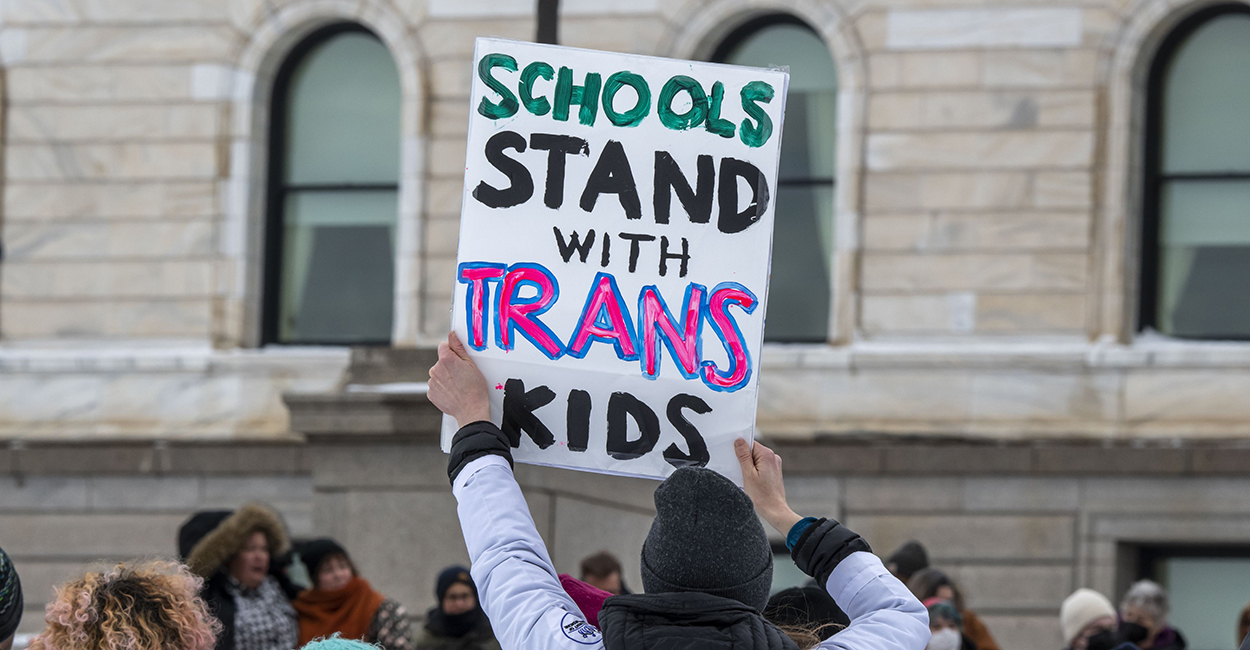
Schools are promoting transgender ideology in the classroom and “socially transitioning” confused children with official “gender support plans” while keeping parents in the dark. Pictured: People rally at the state capitol in St. Paul, Minnesota, to support transgendering for children, March 6, 2022. (Photo: Michael Siluk, UCG/Universal Images Group/Getty Images)


Labels: , , ,

Sunday, December 05, 2021

Transitioning? Not So Fast!

photo of transgender
"For years and years, people have been homophobic, transphobic."
"We're now trying to correct that, but by doing that we're putting others at risk. And those others we're putting at risk are children."
Mary, Toronto,  (last name withheld)

"No one makes these decisions lightly. They are made very slowly, very cautiously, after long discussions with these youth and their parents."
"It would be incredibly worrisome [to create additional delays in treatment]. It would harm so many kids. I would hate to think what would happen to them."
Dr.Margaret Lawson, medical director, gender-diversity clinic, Children's Hospital of Eastern Ontario

"In trans health care, patients diagnose themselves and prescribe their own treatment."
"Medical professionals are encouraged to accept a person's belief without question under the assumption that it will never change."
Michalle Zacchigna (first to be treated under the new transition model, and living with regrets)
Maciek Jasik
 
"Alarms are being sounded all over the world [against the trend to proceed in undue haste to effect transgender changes in young people]. And Canada seems completely deaf to it", stated Aaron Kimberley a transgender man living in British Columbia. He is also a registered nurse and is experiencing qualms over the current approach in Canada among medical professionals and parents to proceed with alacrity and insufficient caution to usher children into the process of gender transition; gender dysphoria is declared, minors are treated with hormones, and surgery follows soon afterward.

A government move is underway in the House of Commons, supported by all political parties, to make it illegal to subject children or adults to any form of conversion therapy. A practise that has been said to be discredited, with its goal of focusing on changing someone's sexual orientation or gender identity. The bill has passed in the House and is prepared to move to the Senate for assent before it becomes law. The bill is a reflection of the current zeitgeist, the sacred belief that children expressing discomfort in their birth gender assignment must be encouraged to transition to a more 'comfortable-fitting' gender.

Mary's daughter insisted she had to alter her sexual identity, suddenly announcing at age 16 that she was a transgender boy. The young girl had long suffered depression and uncertainty along with a deep sense of anxiety. A doctor wrote a prescription for testosterone following a few 15-minute appointments and within months the teen had a double mastectomy, to become a trans male. Her mother recalls that as her daughter was  being wheeled into the operating room for the mastectomy she expressed self-doubts about her decision.

She is now 21 and in the process of "detransitioning", a reversion to her original female identity. Her mother, Mary, has become a partner in a movement asking that the health care system now geared to affirmation of a young person's transgender feelings with drugs and surgery slow down, and seriously consider assessments of other psychological issues before declaring the young to be fully capable of making such a life-altering decision.

Outside of Canada which has embraced full transitioning for young people with scarcely enough medical and psychological examinations of their expressed feelings and emotions over the issue -- which has seen a tidal wave of children demanding they be assisted in their determination to leave the gender they were assigned at birth based on their physical characteristics, when they claim their minds and emotions are lodged in the other gender -- a reversal of social attitude is taking place.

Countries as diverse as Finland and Australia have taken steps to back up from the affirmative approach. At the same time, some leading figures in the transgender medical world have themselves begun to urge caution. A provincial bill in Ontario's legislature is set to speed up access to medical transition and to reduce the need for medical practitioners to make referrals for treatment. At both the provincial and federal level, the way is being paved for children to confuse their identities and face an uncertain future.

While there may well be a good number of legitimate instances of a psychological need to transition, the entire process has taken on a popular social-activist stance, with young children wanting to be part of the new trend. Parents and detransitioners indicate their support for improving access to medical transitions for those who really require it to be done, and feel transphobic bigotry has no place in society. While not opposing gender neutral bathrooms or public funding for transition treatment, they argue the pendulum has swung uncontrollably, and not to society's or the most vulnerables' advantage.

In some instances, gender treatment  occurs outside hospitals. The questioning newly arisen of the status quo has arrived in parallel with a boom in demand driven by patient demographics; both looking suspiciously like red flags that something is badly amiss. People presenting with gender dysphoria were predominately young boys or middle-aged men, traditionally. Now, gender-identity clinics are coming face-to-face with mostly teenagers born girls. 

Pediatric patients numbers at ten hospital clinics across Canada leaped from close to none in 2004 to over 1,000 by 2016. Some 80 percent represented natal girls, most under age 16, when first arriving at the clinics. In the U.S., a major college health study found the percentage of students identifying as transgender or gender non-conforming rose from .05 percent between 2008 and 2014 to three to four percent more recently. 
 
An American study of parents skeptical about gender treatment in 2018 hypothesized that there was a new "rapid-onset gender dysphoria" phenomenon among young girls sometimes convinced by online influencers and through social contagion. According to gender-medical professionals the explosion is a reflection of a growing acceptance of transgenderism following years of stigma and isolation, and the true number of youth in need may in fact be much higher.

The complaint from critics is that health care practitioners are too ready to place children on "puberty-blockers"; drugs to "pause" the development of puberty, and then cross-sex hormones, followed frequently by reassignment surgery. The emphasis, they feel, should lie in an exploration of the complex mental health issues of young people presenting as trans. "We feel the health-care system has been completely taken over by a political agenda at the expense of the actual evidence", said a representative of the group Gender Dysphoria Alliance.

Dr.Marci Bowers, a trans woman, a widely respected gender-reassignment surgeon herself, preparing to become president of the World Professional Association for Transgender Health (WPATH), is among top figures in the field who have expressed concerns. Concerns which led to change in recent months in some countries. Where Finland last year encouraged psychotherapy before transition treatment, and the Australia-New Zealand psychiatry regulator claimed it to be essential. In Sweden, clinics stopped prescribing puberty blocking drugs and cross-sex hormones to patients under 18 this year.

Dr.Bowers, the gender reassignment surgeon, suggested that children are sometimes placed on puberty blockers too soon, with complications arising in reassignment surgery which can deprive them potentially of sexual satisfaction for their lifetimes. Transgender women Erica Anderson and Laura Edwards-Leeper, senior officers with WPATH as psychologists, spoke of sloppy and dangerous assessment of young people presenting as transgender, the results of overly hasty prescribing of medical interventions.

W5 The Transition

Labels: , , , ,

Saturday, March 20, 2021

Unprecedented Agony of Parental Dilemma

"As concerning as C.D.'s conduct was, however, it does not necessarily follow that such conduct equates to the kind of psychological or emotional abuse that would constitute 'family violence' under the [Family Law act]."
"This order should not restrict C.D.'s right to express his opinion in his private communications with family, close friends and close advisers, provided none of these individuals is part of or connected with the media or any public forum, and provided C.D. obtain assurances from those with whom he shares information or views that they will not share that information with others."
Supreme Court of British Columbia Judgement
Robert Hoogland is facing a jail sentence for the “crime” of trying to protect his daughter from being transitioned by the state.

Initials only are used as identifiers in this case where a father in British Columbia who objects to his child's decision that she suffers from gender dysphoria and plans her future as one that obliterates the female she was born to become the male she feels she is, has no authority over her. The father has been referred to by initials C.D., the child, A.B., and the mother, E.F. Their identities must remain anonymous in deference to the age of the child, now 14, and the need for privacy.
 
In the language of the present when pronouns and gender identification are given formal nomenclature descriptives, A.B. was 'assigned' female at birth. In other words born female with all the unmistakable physical characteristics of a female child. Yet the child has insisted on her right to decide her future in the most dramatic of ways; to receive gender transition treatments. Her mother is fully supportive of her child's decision and the forthcoming medical treatments to enable full transition.
 
The story is that at age 11, the child was certain she was male, not female. A year later the child began to transition socially, according to a court decision dated 2020, "enrolling in school under a chosen male name and using male pronouns with 'his' teachers and peers". The child's mother made appointments with a number of psychologists when the child reached 13 at a time when "persistent discomfort with his body led him to want to take steps to appear more masculine". Going beyond talking the talk to walking the walk.
 
In 2018, A.B. met with an endocrinologist whereupon a plan to proceed with hormonal treatment took shape. The father strenuously objected, appearing before the Provincial Court of British Columbia in an effort to prevent treatment to proceed, absent his consent. He succeeded in preventing the child from seeking treatment, but further applications were made before the Supreme Court of British Columbia to declare the child capable of making her/his own health decisions.
 
The ruling was brought down that the child was able to consent to medical treatment, and a defacto publication ban was issued that the names of all involved must remain anonymous.The girl-turned-boy appeared before Justice Francesca Marzari for a court order to prevent the father from speaking publicly about the medical case, while the father countered that speaking about the case was "important to society and to his rights as a parent".

In the interests of which, spurning the court's decision that he refrain from speaking publicly and revealing identities and medical details, the father did just that. Leaving the objecting father who obviously feels that his child is making a decision that will ruin her/his life, court-ordered to remain silent and accept the child's decision making, has been ordered to prison for repeated public revelations relating to the case. Again.

He has been charged with contempt of court. Again. Arrested for breaching court orders. Again. "The subsequent breach of court order allegations are being treated as aggravating circumstances", according to the B.C. Prosecution Service. The complexity of ethical and legal issues binding parents when children make such gender dysphoria choices is beyond comprehension. Yet such life-changing decisions are supported and upheld by the medical community and by assenting law in a 'woke' society.
"I had a perfectly healthy child a year ago, and that perfectly healthy child has been altered and destroyed for absolutely no good reason."   
"She can never go back to being a girl in the healthy body that she should have had. She's going to forever have a lower voice. She'll forever have to shave because of facial hair. She won't be able to have children…"   
"I had decided at that point: 'I am not going to respect the ruling.' A girl is a girl, that girl is my daughter."   
"I mean, the reason I do it, or did it, is because I am taking the best interests of my child at heart."
Outspoken BC father in transgender child case faces jail time for violating gag order

Labels: , , ,

Friday, September 06, 2019

Social Engineering

"For a transgender person, having the world refuse to accept the gender identity that you say you are is the most profound harm because it's a denial of your human identity."
"[The] dad's expression rights end at the point where they harm [the child]."
"His dad doesn't think that transgender is a thing, that it's essentially not human."
Barbara Findlay, lawyer for transgender child

"It's really hard to explain to anybody who's not transgender how terrible it feels to have a body that doesn't match your gender. Sometimes I feel like I want to rip my skin off."
"[Since hormone treatments were started] When I look in the mirror I see myself. ... It is so amazing to feel normal."
"I don't really want to see my father right now because he only wants to harass me about being trans."
Child's affidavit excerpts

"Just because you say [the father] is acting in a particularly evil manner would not seem to justify restrictions that go beyond what's necessary."
Justice Harvey Groberman, panel member, B.C. Appeal Court hearing

"We're in this complicated situation where it can't be done -- in the face of [the father's] past conduct -- in a more narrow way [without restrictions]."
"[The child] is distressed because of the mismatch between his body and who he really is. And a part of that is how the world receives him, and his dad is a big part of that world."
Jessica Lithwick, lawyer for child's mother
The case started last year as a clash between child autonomy and parental rights.
The case started last year as a clash between child autonomy and parental rights

Basically, a family dispute between father and mother and a young daughter who declares herself to have been wrongly identified at birth despite all the visual clues available identifying her as a girl when she really has the mind and soul of a boy, with the mother supporting the daughter, now her son, and the father objecting that the whim of a brain-washed child will not be validated by him. He recognizes the fact that he has a daughter, not a son.

This is the kind of dispute that might once have been settled within the family group, and is now a public interpretation and settlement issue, bringing in consenting physicians and the justice system in defence of a child's insistence that she knows her gender and it is not the one that nature assigned her to. It would be fascinating if a really rigorous study were conducted to determine the number of young girls who fantasize being a boy and who briefly or permanently fashion themselves into tomboys to accomplish that fantasy in part.

Many if not most of these girls outgrow the impulse to act like a boy. Either by losing interest, by acting out the fantasy as a boyish girl competing with boys in recognized male spheres while still maintaining their female alter-personas, or by recognizing that nature frequently cross-fertilizes her creations so that while one gender is the dominant one, an individual can still demonstrate ownership of identifiers of another gender and still fall within a 'normal' persona range.

But just as the global community has finally advanced to the point where homosexuality and lesbians should be accepted for what they are and respected for their individuality, other branches of non-binary identifiers have emerged to declare their equal rights and in the process accuse mainstream society of forcibly closeting gender-identity differences. Guilt-ridden society has succumbed to placating and pleading forgiveness for the truly horrible wrongs done in defence of 'normalcy'.

And while society has adapted to the new normal in equality and human rights, the scales appear to have tipped a tad too far on LGBTQ-2 rights to encompass children's restless explorations of themselves, deciphering all affectations, whether misguided and temporary, dysphoric or legitimate as one and the same. And that parents and society must henceforth accede to all children's 'choices' of gender identity.

In the case cited above a girl who identified as male from age 11, now fourteen years of age, was referred by a psychologist to B.C. Children's Hospital for treatment of gender dysphoria where the gender clinic at the hospital declared the child's best interests would be served to proceed with hormone therapy in transition from a female body to a male. The mother consented, along with the child, the father failed to.

When the father attempted to block the treatment it was ruled by a B.C. Supreme Court justice that the child was "exclusively entitled" to consent to treatment and moreover the child must be referred to by male pronouns. Any effort on the part of the father to refer to his child with female pronouns, or to persuade his child to abandon treatment "shall be considered to be family violence". The sadly wayward father continued to refer to his 'daughter' and used female pronouns, dismayingly.

A month later another B.C. Supreme Court justice issued a protection order restraining the father from discussing the case publicly, leading the father to file another appeal on the basis that all scientific opinion on such treatments had not been considered; an individual the age of his child being incapable of appreciating the possible consequences of a "still experimental treatment", and an order preventing him from discussing his child's conundrum infringed on his freedom of expression.

At the three-day appeal court hearing, another panel member questioned whether the father's actions truly met the definition of family violence to which the lawyer for the child responded that the father's insistence that his child remain someone he is no longer, represented a clear effort at coercion and intimidation.

A case regarding a parent's ability to intervene in their child's treatment for gender dysphoria is before the B.C. Court of Appeal. (Maggie MacPherson/CBC)
"It is clear that interference of the state and its agents — which include the courts, the schools, and hospitals — is eroding parental authority. Parents are now at the mercy of every agenda-driven school counselor, sympathetic psychologist, and activist judge."
"It is time that Canada took that pledge seriously and protected a parent’s fundamental right to direct the upbringing and education of their children."
"To that end, we need to create a parental bill of rights. If elected, I will work alongside my colleagues to strengthen parental rights legislation. In a free society, the most cherished and sacred relationship is that between parents and their children."

Angelina Ireland, political candidate, People’s Party of Canada, Delta, British Columbia

Labels: ,

() Follow @rheytah Tweet