Politic?

This is a blog dedicated to a personal interpretation of political news of the day. I attempt to be as knowledgeable as possible before commenting and committing my thoughts to a day's communication.

Monday, February 21, 2022

Collateral Damage

"I would say this is probably so far the most direct and most immediate type threat to people's safety."
"When workers are sitting in vehicles and they are being attacked by these assailants swinging large axes, smashing the windows, hitting the vehicle when [workers'] bodies and heads are just feet away, having torches thrown at their vehicles and [in] the boxes  of their vehicles that could compromise their lives -- this has gone way too far."
RCMP Chief Superintendent Warren Brown

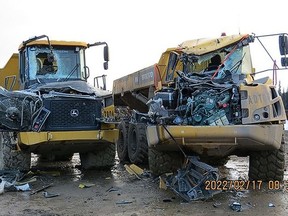
Damage caused to the Coastal GasLink construction site near Houston, B.C., on Feb. 17.-/AFP/Getty Images

"[We respect people's right to conduct peaceful protests], but intimidation of workers, impacts to the environment, and destruction of property and equipment goes far beyond protest and disagreement and is something we as British Columbians and Canadians can never condone."
LNG Canada

"Will the Trudeau government now seize the bank accounts of the foreign funded eco-terrorists responsible for this violence [referencing the Emergencies At permitting authorities to target donations made to illegal convoy activities]."
British Columbia Premier Jason Kenney

"If the Trudeau government is set on using the Emergencies Act to end blockades, then they should also use it to follow the money, seize the associated vehicles and provide all the resources necessary to ensure those illegally acting here [on the Coastal GasLink pipeline in northern British Columbia] are arrested for damaging and blocking this critical export infrastructure."
Saskatchewan Premier Scott Moe

The damage to the construction site was allegedly caused by 20 masked and camouflaged attackers.-/AFP/Getty Images

During his career overseeing the north district of the province of British Columbia RCMP Chief Superintendent Brown has long been accustomed to encountering the work of protesters, particularly those invested in protecting the environment as they see it, from exploitation by energy producers, but this latest episode of damaged industrial equipment, booby traps, incendiary devices and blockaded roadways represent an upscaled violence he had never before seen.

The violence took place on Thursday evening at a remote drilling site close to the Morice River. Security footage is being reviewed by investigators who are interviewing some nine Coastal GasLink employees present on the site when twenty or so masked marauders entered after midnight, brandishing axes, attacking security guards and threatening workers wih flare guns in a coordinated attack.
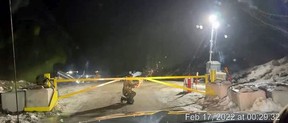
 
A surveillance camera captures an attacker lighting off a flare during the attack on the Coastal GasLink camp near Houston, B.C, on Feb. 17. This image, taken as the attack started, was provided by the company. The attackers disabled the cameras a short time later.
A surveillance camera captures an attacker lighting off a flare during the attack on the Coastal GasLink camp near Houston, B.C, on Feb. 17. This image, taken as the attack started, was provided by the company. The attackers disabled the cameras a short time later. Photo by Coastal GasLink /PNG
 
Heavy equipment and trailers suffered millions of dollars in damage. The attackers commandeered equipment at the site and used it to damage other machinery and to demolish site buildings. Equipment's hydraulic and fuel lines were cut by the attackers, as well, causing significant leaks. The Coastal GasLink pipeline, coming in at $6.7 billion, is owned by TC Energy Corp based in Calgary for the purpose of connecting British Columbia's shale gas resources to LNG Canada's export project in Kitimat, B.C.

The project, close to 60 percent complete for the 670-kilometre pipeline, has been stricken with demonstrations and blockades from environmentalists along with some First Nations groups, since the beginning of construction in 2019. The project has government approval, along with the support of all twenty elected First Nation councils spanning the pipeline's route through northern B.C. First Nations will see employment as a result, and will share in the pipeline's profits to an agreed-upon percentage.

It is some hereditary chiefs, not the democratically elected councils of the Wet'suwet'en people who are opposed to the project, a distinct minority. No arrests have yet been made relating to Thursday's attack; the challenge has not yet been met in identifying the assailants, disguised and masked when they arrived on foot at the site. 

The public and community must understand that the police response to the incident will not equate to a crackdown of law enforcement on lawful protest, said Chief Superintendent Brown. This was a violent, criminal act that will be treated with all the severity that the law commands. Canada's Western provincial premiers have called on the federal government for a more aggressive stance in responding to the attack, amidst heightened tensions across Canada in view of the blockade of truckers around Parliament Hill in Ottawa.

There are distinct differences in how Prime Minister Justin Trudeau addresses these two very different situations. The Truckers' Convoy is viewed by the prime minister as a direct assault on his orders, which it is, as well as a defiance of a mandate that was totally unnecessary and which led to people losing their livelihoods, as well as threatening the deliveries of critical food and medical supplies across the country. Added to which the Convoy protesters made it abundantly clear that they abhor this prime minister and he, ostensibly governing all the people of Canada, returned their contempt in spades.

He has called for the first time in history on the Emergencies Act to solve a problem that policing agencies and local municipalities should have well in hand, but which will commandeer banks to freeze the bank accounts of all those identified as taking part in the protests, deemed unlawful under the special provisions he has brought to bear. A protest that has certainly got out of hand, and has done so because of the prime minister's inept and contemptible treatment of people's legitimate concerns.
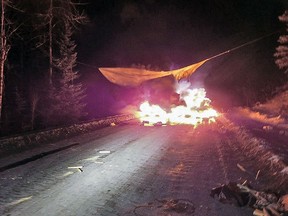
 
Police rushing to assist Coastal GasLink workers who had been attacked by a group of about 20 people said their way was blocked by booby traps, including several fires.
Police rushing to assist Coastal GasLink workers who had been attacked by a group of about 20 people said their way was blocked by booby traps, including several fires. PNG
 
The violent incident in northern British Columbia, on the other hand, has elicited no comment from him, and nor has it featured large in most mainstream media, by contrast to the coverage given to the Truckers' Convoy and the clean-up aftermath of police making hundreds of arrests and towing away big rigs. Matters of environmentalists indulging in wildly vicious criminal behaviour is of relatively little interest to this government.
"Their arrival seemed to be very well coordinated. The violence, the rhetoric, the threats -- their purpose seemed to be very coordinated."
"This was definitely coordinated and it was targeted and it was done at that time for a specific reason."
"This is not about enforcing a court injunction. This is not about measuring the volatility of protesters."
"This is about a specific criminal act that happened on February 17."
"This is about 20 or so people who have taken it far too far and we're going to find out who they are."
RCMP Chief Superintendent Warren Brown
Millions of dollars in damaged equipment and property was left behind by vandals who attacked a Coastal GasLink site near Houston on Thursday.

Labels: , , ,

Sunday, February 16, 2020

'Reconciliation' Repurposed

"There's a lot of people that aren't from these communities, that aren't Aboriginal, that are saying hereditary leadership has full authority, and they're not doing it based on any facts. It would be like me saying that the elected leadership of British Columbia and Canada has no authority, and it's the Queen who has all authority."
"That would be a very destabilizing remark to make. It's a very irresponsible remark to make."
"A lot of what I see out there right now, from these people talking about it, is basically opinion. It's not fact. In fact, in the Indian Act band councils are legally authorized to sign agreements and contracts on behalf of the communities."
"It inflames the situation, and I think that's what the point is for all these people who are talking like this -- Natives and non-Natives alike. They just want to heighten the situation that's facing us today. And these communities don't need their issues escalated."
"I'm not sure they are aware of it, but they have the potential to tear these communities apart -- right down to family and friends."
Ellis Ross, Liberal MLA, Skeena, B.C.

"What currently is going on does not reflect the true governance of the Wet'suwet'en -- on both sides."
"When you look at what's happening with the youth, it's spreading like wildfire, but there's no control."
"We are afraid something bad might happen."
Andrew George, Wet'suwet'en Nation member, wing chief, Gidimt'en

"K'omoks First Nation was never contacted or advised of this event [blockade on Highway 19 using the K'omoks authority] and we are disappointed that our name was unknowingly used."
"This event was organized by non-Indigenous Comox Valley residents who aren't connected to our territory in the same way as K'omoks, and in no way represent K'omoks or our values."
"If you're in a Nation's territory, you really should be engaging with the First Nation."
K'omoks First Nation Chief Nicole Rempel
An enforcement officer reads an Injunction to members of the Tyendinaga Mohawk Territory in Tyendinaga Mohawk Territory, near Belleville as they block the CN/VIA train tracks. Lars Hagberg / THE CANADIAN PRESS

People with an agenda from outside Canada, (Extinction Rebellion}, dedicated environmentalists who have long intervened in Canada's plans to manage and exploit the vast petroleum resources the geography is endowed with, have found a made-to-measure protest movement they can integrate with and continue their challenge to Canada's environmental and resource sovereignty. They stand alongside urban Canadians, who feel that the environment is being abused in corporate interests, and university students who take pride in supporting and standing alongside what they feel is a legitimate First Nations grievance.

Leading to expanding protests and stand-offs and blockades, reminiscent of many other, earlier such episodes of purely local natures, none of which had the potential as these current ones do, of shutting down Canada's transportation system across the country, both commuter rail, and commercial, affecting Canadian National and Canadian Pacific Railways from one end of the country to the other. Vital goods are not being delivered to ports and Canada's trade is being impacted seriously.

Which is precisely what the protests are designed to accomplish. All the while federal, provincial and municipal police, fearful of stepping beyond the bounds of political correctness and finding no firm directives for action from related authorities, despite court injunctions that have charged the protesters to cease and desist, have taken no overall action to disperse the protests, release the blockades and allow the rail systems to resume their vital capacity to move people and goods across the country.
People from Aamjiwnaang First Nation and supporters gather for a meeting with officials as their blockade of the CN St. Clair spur line continued in Sarnia, Ont.  (Dave Chidley/Canadian Press)

Despite that the extraction and pipe-building corporations holding consultations and meetings with First Nations communities whose geographic areas will be impacted by moving oil and gas by pipe across their heritage territories and reaching sharing agreements, five hereditary chiefs have dug in their heels and assumed the responsibility to deny what democratic action has wrought, bringing public opinion to their side, which has resulted in these blockades, protests and even a temporary shut-down of the legislature in Victoria, B.C.

Protesters in support of Wet’suwet’en hereditary chiefs camp out in front of legislature before the throne speech in Victoria, B.C., on Tuesday, February 11, 2020. Chad Hipolito / The Canadian Press

There are literally hundreds of First Nations bands, with an average population of 300 people; British Columbia alone has 200 bands. Each considers themselves sovereign and there are often competing programs and aspirations. Because the chiefs of each enjoys the power they have, they are unwilling to join forces since that would surrender their autonomy and authority. Claims over land and fishing and hunting rights are often competitive, resulting in poor cross-band relations.

While claiming nationhood for each band, proclaiming themselves outside the law and authority of the government of Canada, it's a strange arrangement under the Indian Act that each of the bands is funded by tax dollars; not a reasonable version of independent nationhood by any measure. First Nations people living on band property pay no taxes, and don't contribute to Canada in any meaningful way where unemployment is rife and opportunities to thrive are few.

Those few bands who have succeeded in making themselves independent of funding from the Canadian treasury, and with good sound management have invested in businesses that employ their members, resulting in a high quality of life are simply too few, though they stand proudly as an example to what others can also aspire to -- if they are not located in completely isolated and remote geographic areas.
OPP Sgt. Diana Hampson of the liaison team, middle, speaks with members of the Mohawk Territory in Tyendinaga Mohawk Territory, near Belleville, Ont., on Tuesday, Feb. 11, 2020. The members have blocked the CN/VIA train tracks for six days in support of Wet’suwet’en’s blockade of natural gas pipeline in northern B.C. Lars Hagberg / THE CANADIAN PRESS

But Canada's 632 First Nations leaders have been subsidized for too long, their negotiating skills augmented by a non-native communal sense of colonialist guilt within Canada, with the knowledge that Aboriginal Canadians have been discriminated against, been led by government agency to an existence with few rewards and despite promises very little hope appears on the near horizon. Nothing excuses the Wet'suwet'en hereditary chiefs and their supporters in their defiance of court orders, defying 20 band council agreements in northern B.C.

The 670-kilometre gas pipeline to a $40-billion LNG plant on the coast would mean that First Nations peoples through whose territory the pipeline will stretch, will have benefits from the resources through reliable resource-sharing payments, through employment opportunities, through spin-off industries, all being denied them by the hereditary chiefs' claim of sovereignty over a 22,000-square-kilometer stretch of land where they refuse the Coastal GasLink pipeline.
"Right now, this is probably got one of the biggest job creations in the province here, and we want to be part of it. The hereditary chiefs' office, they don't speak for the whole clan."
Philip Tait, Wet'suwet'en member

"A majority of our people do want to see this project go through."
"The reason why it's not out there is because people are afraid to speak  up, but that's starting to change."
Bonnie George, Wet'suwet'en member

Labels: , , , , , ,

() Follow @rheytah Tweet