Politic?

This is a blog dedicated to a personal interpretation of political news of the day. I attempt to be as knowledgeable as possible before commenting and committing my thoughts to a day's communication.

Sunday, July 30, 2017

Suicide as a Metaphor for the Failed Arab Spring

"I wanted to burn myself because I was burning inside [with anger and desperation expressing his hopelessness]."
"I wanted to die this way."
Adel Dridi, 31, street fruit seller, Tebourba, Tunisia

"This kind of suicide stands more as a dissenting attitude toward the post-revolution society, which deeply changed."
Dr. Mehdi Ben Khelil, forensic pathologist

"Imed used to pour gas on himself as a way to blackmail the police so they would give him back his merchandise."
"He had already done that as a last resort two or three times before and he told me it worked."
Ahmed Ghanmi, brother of Imed, deceased

"With the dictatorship, the state was ubiquitous; we were under a police rule and deviation was less possible."
"There were already suicides with self-immolation or hanging, but it was in the privacy of the home, not in the public sphere like today, and the youth is very exposed to this new phenomenon."
Fatma Charfi, Ministry of Health committee, Tunisia
  Five years ago, two Tunisians set themselves on fire in protest against the...
Clemens Höges/ DER SPIEGEL -- Hosni Kaliya in Kasserine

These types of protests by people who feel themselves victimized by institutionalized abuse have a way of becoming entrenched, popularized and repeated by people who feel their grievances cannot be addressed any other way than by the kind of shock treatment that creates a wave of public awareness and fear, through the ultimate sacrifice of self-harm leading to death. When it seems to those who have been exposed to the personal, psychological violence of an uncaring bureaucracy imperilling their livelihood and survival, violent rejection of life becomes a tool, rejecting that society.

One isolated incident stands out as the symptom of an ailing society and the symbol of desperate rejection of police harassment, the self-immolation seven years ago of the street fruit vendor Mohamed Bouazizi, whose final act of asserting himself defiantly, even if only to claim death by his own agency, saw a spiralling of reaction and events leading to the downfall of the government in Tunis hated for its corruption. Tunisia, in its reinvention of itself as an Islamist-style democracy is pointed to as the first and the sole success of the Arab Spring.

  In the days after Kaliya's self-immolation, tens of thousands of Tunisians...
In the days after Kaliya's self-immolation, tens of thousands of Tunisians took to the streets in early 2011, eventually forcing the country's autocratic president, Zine el-Abidine Ben Ali, to flee the country. This image is from Tunis on Jan. 14, 2011. Reuters

The fever of people power challenging the authority of their governments under a system detached from presiding over the fulfillment of people's needs and aspirations in free societies, spread to Egypt, Libya, Syria, Iraq and the Gulf States. The revolutionary zeal of those rejecting the status quo nurtured a fervent hope that their nations would undergo a change reflective of some form of democracy. Libya responded with utter, violent chaos, the Gulf States methodically used their military power to squelch any thought of change, Egypt reverted to military rule, while Syria and Iraq imploded.

Mr. Dridi, pre-revolution, made a very good earning in his country. Now, constantly harassed by police just as Mr. Bouazizi before him had been, he is desperate to react in some meaningful way that might help him, but could only find a solution in attempted suicide which he survived. Unemployed teacher Imed Ghanmi, 43, did the same as police confiscated his merchandise when he tried to support himself selling the smuggled goods on the street. He finally succeeded in killing himself when immolation as threat no longer succeeded.
  Protests have once again become commonplace in Tunisia. This image is from...
Protests have once again become commonplace in Tunisia. This image is from Kasserine, Hosni Kaliya's hometown. Demonstrators clashed with police during a march protesting the lack of jobs and opportunity. Reuters

But it is not only the middle-aged who resort to these desperate measures to destroy their futures. Young teens in high school have taken to immolation as well in a feverish denial of the lives they no longer wish to live. Like Ramzi Messaoudi, whose repeated disagreements with his English teacher for expelling him from school led him to set himself afire, dying three days later from the burns he sustained. "He just could not take it anymore. When he arrived at the hospital, he was still conscious and he was smiling and kept on repeating the word 'injustice'," said his 19-year old childhood friend, Wissem Hadidi.

Because there are few opportunities for the young, and because job insecurity is so high, with a tough unemployment rate, there is desperation among young people in Tunisia. Thousands have chosen to migrate abroad. Tunisia has the distinction, irrespective of how it alone among the Arab countries touched by the Arab Spring, is considered the only 'successful' Arab Spring revolution, despite which there are more Tunisians who made common cause with Islamic State, joining the jihadist terrorist group than any other country in the region save for Libya.

  The Jebel Chaambi mountains near the city of Kasserine are now home to...
The Jebel Chaambi mountains near the city of Kasserine are now home to Islamist training camps and considered a hotbed of jihad. AP/dpa
A record 104 burn patients who had chosen self-immolation over life were admitted to the country's main burn hospital in Ben Arous in 2016, representing a tripling of self-immolation following Tunisia's revolution. Driven largely by hardships and a hatred of the authorities. Dr. Mehdi Ben Khelil forensic pathologist, conducted a study to show the increase of the numbers of people who chose to self-immolate rather than resign themselves to a situation whereby no opportunities are available to them to achieve their aspirations.


Labels: , , ,

Thursday, December 17, 2015

Documenting the Arab Spring Fallout

The 2011 uprising kick-started the Arab Spring
Tunisia's uprising in January 2011 drove support for protests in surrounding countries Getty Images

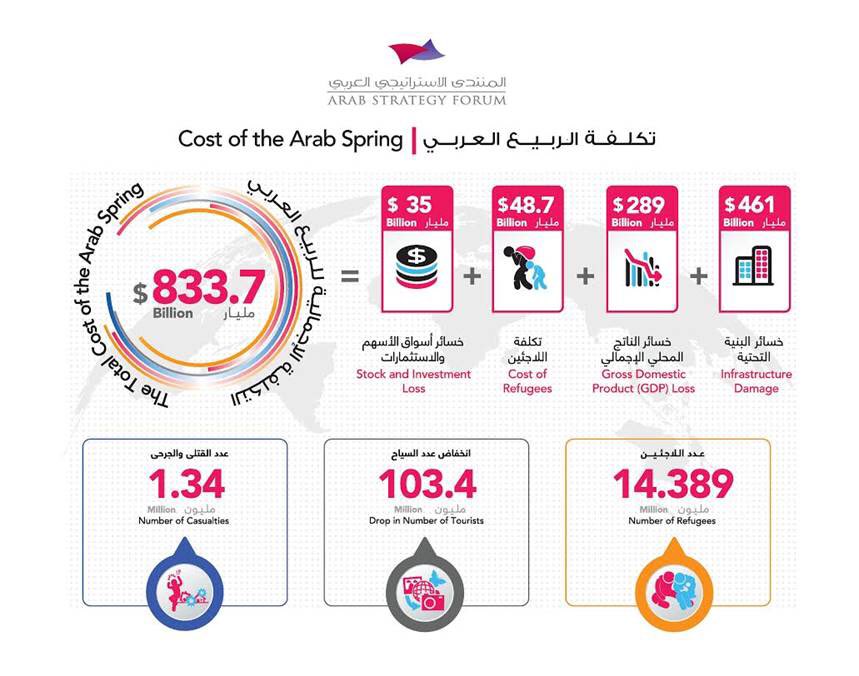
The "Arab Spring Cost Report" was released in Dubai by the Arab Strategy Forum. The study documenting the economic fallout of the 'Arab Spring' gives a figure of $883.7 billion lost as a result of the uncertainty and turmoil five years ago that took place in Tunisia, Egypt, Libya, Bahrain and Syria, those world-class social upheavals that the international community took signalling a modernization of the Arab world and a re-structuring of their political systems.

What infamously resulted was the breakdown of law and order that had been held together by ruthless dictators, and the dismal fate of an estimated 1.34 million people killed or injured, not to mention the millions more who were left homeless in the upheavals throughout the Maghreb and the Middle East. The financial loss relates to foregone international investments as well as the massive losses in securities markets, GDP failures and infrastructure reconstruction invoices.
Embedded image permalink
Although Syria is included in this name-place gathering of social-political failure, they must stand as a special case. Tunisia has rebounded and its political factions have reunited in the greater interests of preserving their heritage, culture and a balanced political awareness. Libya is now finally, after violent paroxysms of tribal and sectarian conflicts, finding some measure of accommodation to preserve itself, as well.

Egypt has rebounded from an Islamist theocracy failing to govern the country for the good of the country, back to the military rule that has sustained it for decades upon decades. Egypt had little option, it seems, but to return to the tried-and-true, having removed its benevolent tyrant in favour of a military autocracy; little option given the violence that is inflicted upon it by the convergence of Islamist factions coordinating themselves to overwhelm Egypt into a Sharia state.

Syria is its own very special case, where the cruel violence of Baathist Alawite Hafez al-Assad has been overwhelmingly superseded by his son-and-heir Bashar who learned the lessons of brutality well from his father. Syria's nascent Arab Spring never really got off the ground, it was simply unable to assert itself when the regime took steps to grind it into the ground through arrests of young and old, torture and extrajudicial slaughters.

The entire Middle East might have been looking wistfully to the United States for some signal usually forthcoming that the world's single power authority would intervene on the part of liberty and democracy. When the green movement in Iran staged their demonstrations against the ruling mullahs they were mown down, arrested and waited in vain for America to assert its stern commitment to peace and good governance.

But it had been to the ayatollahs that President Obama had extended the hand of friendship, not rebellious Iranians. And nor did Barack Obama recall that Hosni Mubarak had a special relationship with the United States; that relationship earned him a disinterested, flippant back of the hand dismissal, while the Muslim Brotherhood gained respected entry to the White House and Mohammed Morsi was lauded as an answer to Egypt's need.

The U.S. was firm that Syria's problems began and ended with Bashar al Assad and no question; before the tempest could be quelled he had to go. He is no longer going. Secretary of State John Kerry, speaking on behalf of the Obama administration, feels now he should remain. In the interests of stability, and an end to the civil conflict, he should now stay as a stabilizing force; a fixation emanating from Moscow and now endorsed by Washington.

Effectively, the United States has thrown its regional interests -- leading from behind -- backing the Islamic Republic of Iran, Hezbollah, and the Baathist regime in Syria, a trifecta of Shiite terrorism equally brutal and dedicated to assigning death duties to Sunni opponents as the Islamic State of Iraq and the Levant is to liquidating as many Shiites as they possibly can.

The Syrian Sunni population, a majority of Syrians, has been viciously crushed, the rebel leadership that had looked appealingly to the United States for basic support and a fraction of the arms that had been given to Iraq were left to their own devices, not quite a match for the military offence of the Shiite regime. It has taken almost five years, but 182,079 Syrians have been slaughtered courtesy of their president and his colleagues from Lebanon, Iran and Russia.

The number of Syrian civilians on the other hand, killed by the Islamic State butchers dwindles in comparison.

Labels: , , , , , , ,

Sunday, May 17, 2015

Strategic Defense in the Middle East

"If ISIS, for example, threatens to base itself in the Syrian Golan, it might be that a Hezbollah presence is actually preferable."
Lt.-Col. Ron Tira, fighter pilot, strategist, Israel Air Force

"The emergence of an uncertain and unstable strategic environment is conducive to strategic surprises."
"Israeli intelligence is challenged by a plethora of new actors and leaders whose modus operandi is far from clear."
Efraim Inbar, director, Begin-Sadat Center for Strategic Studies, Bar-Ilan University

Inside the Delta Force Mission to Kill Top ISIS Leader
Inside the Delta Force Mission to Kill top ISIS leader -- ABC news
Israel has never been free from the potential of attack against its existence. Initially it was one joint Arab military attack after another, all determined to dislodge the Jewish state from its geographic perch in the Middle East, in an area approximating its origins in the ancient past. And then it became an issue of non-state militias of terrorists pledging themselves to the destruction of the State, and the annihilation of its Jewish population whose presence represented an insult to Islam.

Israel proved itself time and again equal to the occasion. Surprising both the assemblage of Arab military coalitions confident of easy conquest, and the international community, watching with interest as one drama after another unfolded, with Israel Defence Forces proving equal to the task of defending the country and dispersing its manifold enemies. Defending itself against near neighbours proved somewhat more taxing. Including the offensives of suicide bombers in near proximity.

When a solution presented itself through a security barrier, the world screamed foul, accusing Israel of criminal behaviour in defending its citizens against the constant surprises of martyrdom-fuelled mass murders. But it did prove a fairly useful solution, and the suicide attacks came to a halt, leaving the country's European critics grumbling about the unfairness to Palestinian aspirations. New challenges now present themselves above and beyond the rockets that Hamas is lobbing from Gaza.

The Arab Spring, that Israel and the rest of the world sat back and watched with the suspense of curiosity has left anarchy in its wake, aided and abetted by Western interference in the prerogatives of Middle Eastern despots to tyrannize their tribal, ethnic, sectarian populations into the submission of reasonable behaviour. But with Moammar Ghadafi's stern hand of retribution absent, after taking out the dictator of Baghdad, nothing has gone according to Western schedule.

Libya and Iraq struggle to surmount the malignant influence of Islamist lunacy for whom slaughter has become an aphrodisiac. Syrian civil war with its president continuing to teach his insubordinate Sunni population a lesson they could never recover from, since no one has yet revisited life who has been consigned to death, has created waves of desperate migrants flooding into Europe, along with other Muslims suffering the ill-fated experience of Islamist carnage.

And for Israel, there is the ongoing problem of its neighbours. If it isn't Hamas, then it's Hezbollah; if the Gulf States have relented in their collective fear of Iran, and now view Israel as perhaps the solution to their concerns, Israel's existence has become critical to the furtherance of their own, in no small part. Israel's collaboration with Egypt, and vice versa, Saudi Arabia's conversion to reasonableness about a Jewish presence, all signal a sea change in the Middle East.

Whether any of that might last beyond a solution over Iran's hegemonic Shiite conquest is moot. But for the presence, Israel, along with the Sunni Middle East, is suffering quite the headache. Near Israel's northern border with Lebanon the village of Muhaybib, a farming village of some 90 houses hemmed in by fields, Israeli intelligence has now determined the village to have been transformed to a fortress.

The village now has five rocket-launching sites, nine arms depots, three anti-tank positions, a command post and what appears to be signs of the existence of three tunnels. Hezbollah appears to have moved military equipment into Shiite villages near Israel's perimeter; strategizing civilians as a human shield, for to attack a missile base would be to sacrifice innocent villagers. What is good enough for Hamas, is certainly good enough for Hezbollah; they all sing from the same chorus.

And then there is the danger of igniting, perhaps inadvertently, an overall war in the Middle East, bringing hideous devastation to the region, already beset with human rights violations of the most unfathomable varieties. The focal point of the concern is Iran, always the growing power that Iran has manipulated itself into. Those Arab regimes not consumed like Libya, Syria and Iraq with ISIS, have Iran to contend with.

Sunni Arab states are no longer fixated on the Palestinian problem vis-a-vis Israel's existence. Peace is a requisite not with the Palestinians in an accord with Israel, but in the removal of the threat that Iran represents. "Iran has divine permission to destroy Israel", stated  Mojtaba Zolnour, a figure of note in the Revolutionary Guards. The situation in the Middle East is so fluid, so complex, so confusing that intelligence is elusive.

So elusive that the Middle East itself finds it difficult to parse the intentions and outcomes of what it sees playing out before its incredulous eyes as Islamism runs berserk over everything that is discernible as 'normal', 'usual', 'expected' or 'acceptable'. But it is traditional, it does reflect Islam's origins and its original purpose in proselytizing to expand the Prophet Mohammad's brave new Bedouin religion worldwide.

Labels: , , , , , , ,

Thursday, March 19, 2015

Tunisia's Arab Spring Leaking

"I want the people of Tunisia to understand firstly and lastly that we are in a war with terror, and these savage minority groups will not frighten us."
"The fight against them will continue until they are exterminated."
President Beji Caid Essebsi, Tunis

"After they entered the museum, I saw their faces: They were about ten metres away from me, shooting at anything that moved."
Josep Lluis Cusido, tourist, mayor of Spanish town of Vallmoll
Tunisian security forces stand guard as journalists gather at the visitors entrance of the National Bardo Museum in Tunis on March 19, 2015, in the aftermath of an attack on foreign tourists (AFP Photo/Fethi Belaid)
Foreign tourists exiting a bus at the National Bardo Museum, on an onshore trip off their cruise liner were met by militants wearing military-style uniforms and with assault rifles gunning them down. After shooting eighteen of the tourists and two local Tunisians dead, the attackers charged the interior of the museum to take hostages. Eventually two of the terrorists were killed in a firefight with security forces but not before 50 innocent people were injured.

A hunt was immediately begun for the two or three accomplices who had managed to escape after the attack. The tourists who lost their lives in a country hugely dependent on its income from tourism, were from Poland, Italy, Spain, Germany and Colombia. The cruise ship, with an estimated three thousand tourists aboard, left Tunisian waters and is unlikely to return any time soon.

Islamic State Twitter accounts were rife with congratulatory messages. And urgings that Tunisians take steps to "follow their brothers" in organizing additional such attacks. The Islamic State of Iraq and al-Sham, in fact, is taking full credit for the deadly attack at the country's largest museum. Tunisia has appeared as the sole country in the North Africa/Middle East continuum to have emerged from its Arab Spring as an intact democracy.

After unseating its dictatorial ruler, Zine El Abidine Ben Ali, a country that had always looked to the West to emulate its democratic, civil style in a cosmopolitan atmosphere of tolerance, struggled to find its new place in the world of reformed democratic action. As the harbinger of the Arab Spring phenomenon that trickled through to the Middle East with disastrous outcomes, it is the only country that persevered with the outcome of freeing itself from the shackles of authoritarian rule.

The original protesters who empathized with the self-immolating despair of a fruit vendor harassed over a trade permit were affluent and sophisticated, hoping for their country to fully pattern the Western tradition of liberty and democracy and the tradition of human rights practised in Europe. The country's Islamist parties at all levels of the spectrum from moderate to fanatical made their own visions for the country's future known.

Parliament divided between secularists and Islamists, and each made an effort to get along. But radical Islamism gained the momentum to the extent that secular politicians were harassed and sometimes assassinated, calling for an end to the tolerance from radical religious parties whose aspirations represented a threat to the well-being of the country.

The slums of Tunis saw the rise of the radical Ansar al-Sharia group who saw much in common with al-Qaeda and now Islamic State, with their Libyan counterparts. Banned several years ago when the country cracked down on extremists when two leftist political leaders were killed, the government remains in a struggle to stamp it out altogether, difficult with its contiguous border with Libya now home to Islamic State militants.

Tunisian Islamists, however, have swollen the fighting force of Islamic State to an extent few other countries in the region have. Of eleven million inhabitants, Tunisia has gained the distinction of having contributed a larger number of jihadist fighters to Syria and Iraq, dedicated to the caliphate of Islamic State, than any other country in the region.

Labels: , , , , ,

() Follow @rheytah Tweet