Politic?

This is a blog dedicated to a personal interpretation of political news of the day. I attempt to be as knowledgeable as possible before commenting and committing my thoughts to a day's communication.

Sunday, November 03, 2024

Failed Canada-India Diplomatic Relations

"To remain somewhat viable and respectable in the eyes of the United States and Canada and Britain -- the Western world -- he claims to be non-violent."
"And if he didn't [the media] wouldn't give him a nano-second of coverage."
"I think he has bamboozled all of you for a long time."
Ujjal Dosanjh, Sikh, former B.C. premier/federal cabinet minister

"We are just trying to tell India and the world that it's a ticking time bomb which could detonate due to India's constant policy of violently crushing even the peaceful initiative of a referendum."
"The [Prime Minister Narendra] Modi regime's constant policy of crushing the Sikh peoples' initiative of ballots with bullets may, against our wishes, push this purely political conflict into a cycle of violence...SFJ's videos are not inflammatory but rather informatory."
"People under occupation from Punjab to Palestine will react and violence begets violence. If India is going to keep occupying Punjab, there will be a reaction."
"SFK believes in ballots, SFJ believes in votes. The liberation of Punjab is on the cards. India, the choice is yours: ballot or bullet."
Gurpatwant Singh Pannun, exponent, Sikh independence movement: Khalistan
https://npr.brightspotcdn.com/dims3/default/strip/false/crop/4900x3268+0+0/resize/1200/quality/85/format/webp/?url=http%3A%2F%2Fnpr-brightspot.s3.amazonaws.com%2Fa0%2F93%2F74c7429a4c0cae23612a6b398470%2Fnpr-jeenah-0002.JPG
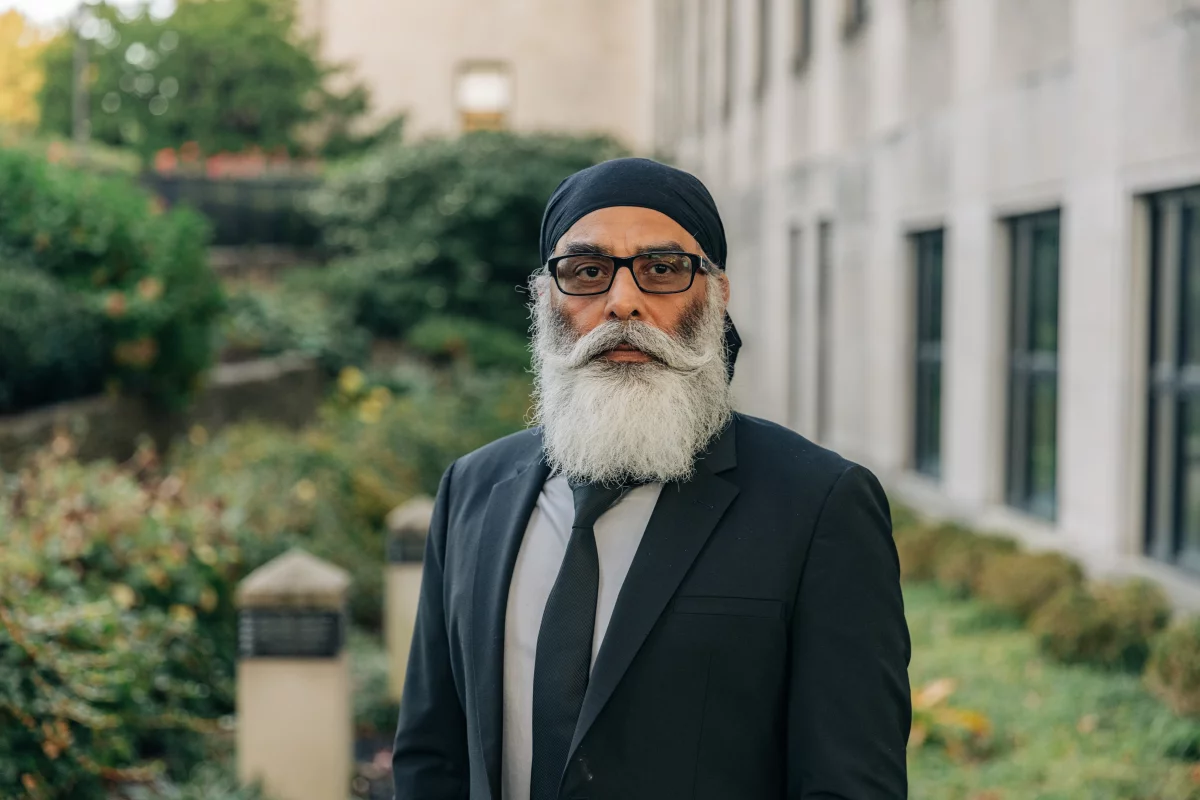
Sikh activist Gurpatwant Singh Pannun stands for a photograph in New York City on Oct. 25. Jeenah Moon for NPR
 
Pannun is a Canadian-American lawyer who has raised an issue of a global referendum to verify the Sikh independence-from-India movement, in a call to split India for the purpose of dividing the Punjab as a gift to Sikhs who view it as their homeland, one they call Khalistan. He is at great pains to deliver the message to Western democracies that his is the voice of reason, and his movement is one of moderation, wanting nothing other than recognition of the right of Sikhs to become a sovereign nation free of India.

He heads the group Sikhs for Justice. And in his online presence speaking for Sikhs for Justice, Pannun's rhetoric is volatile, his social-media posts appear to promote violence. Based in New York, Pannun speaks of the need to "balkanize" India in his mission to carve Punjab away from India's 'occupation', and includes support for other independence movements as well. Including common cause with Chinese President Xi Jinping, recommending he forcefully seize a disputed corner of Indian territory.
"President [Xi] Jinping -- now is the time to order the Chinese army to take Arunachal Padesh back."
"By 2047, the current boundaries and borders of India will be redrawn, and the current borders and boundaries will be wiped out from the world map."
"2024, one India. 2047, none India."
Gurpatwant Singh Pannum
https://cdn.wionews.com/sites/default/files/styles/story_page/public/2024/05/06/429546-khalistan.png?imwidth=400
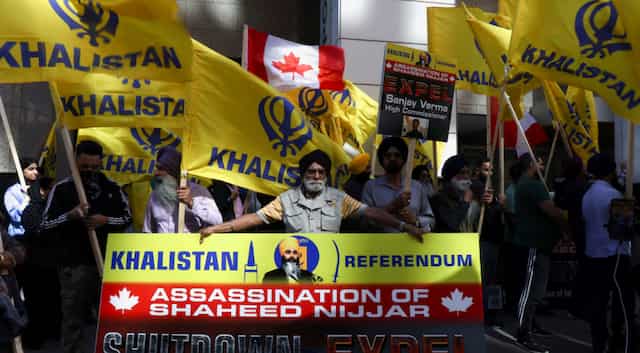
Protesters hold yellow flags with the word Khalistan, as well as a banner with the picture of Sikh separatist leader Hardeep Singh. Photograph:(Reuters)
 
"Violence begets violence" he warns; India has a choice between his referendum and possible armed rebellion: "ballots or bullets", comparing Palestinians to Sikhs in Punjab. In November, Sikhs, he said, should boycott Air India; those who fly on November 19 could endanger themselves. The shadow of 1985's bombing of an Air India flight by Sikh terrorists in Canada. Present at a Calgary rally for Sikhs, he led a chant: "Liberate Punjab, Kill India", a mild display of 'moderation'.

The non-binding referendum run by Sikhs for Justice asks whether Sikhs in Canada, Europe and anywhere the Sikh diaspora exists, asks whether there is support for making Punjab an independent country. Within India itself the issue appears to be of no moment. It is among the large expatriate Sikh community outside India -- particularly in Canada where the largest expatriate community lives -- that the issue of Sikh separation from Hindu India resonates and where Sikh fanatics overwhelm the Sikh-Canadian population uninvolved in the movement.

New Delhi, for which the prospect of such a separation is a non-starter, views Pannum as a terrorist. Interpol has been asked by India to issue a "red notice" for the arrest of the man. After deeming the request political or religious, not criminal, Interpol refused. Canada's large and influential Sikh population -- some 800,000 in number -- does not support political Sikhism/Khalistanis, but they are threatened and silent, harassed and fearful. Canada's Liberal government, however, appears to cater to the Khalistanis; some high-ranking Cabinet members who are Sikh are sympathetic to the Khalistan cause.
 
https://www.ctvnews.ca/content/dam/ctvnews/en/images/2024/4/30/justin-trudeau--khalsa-day-1-6867249-1714483527642.jpg
Prime Minister Justin Trudeau waits to speak to a crowd during Khalsa day celebrations at City Hall in Toronto, Sunday, April 28, 2024. THE CANADIAN PRESS/Cole Burston
 
Narendra Modi's government is fiercely opposed, needless to say, and disappointed and frustrated with the Trudeau government's response to its request for extradition of a number of Sikh-Canadians who have been found guilty of violent criminal activities in India. Justin Trudeau's public accusation of the government of India's involvement in the assassination of a committed Khalistani, denied by India, has caused a diplomatic rift in relations between the two countries, each expelling the others' diplomats.

Pannum, from his social media pulpit speaks of "genocidal violence" against Sikhs. In particular memory of the 40 years that have passed since a massacre of Sikhs by Hindus enraged after Indira Ghandi was assassinated by her Sikh bodyguards. Sikhs for Justice, he announced in a video, was in support of independence movements in the Indian states of Assam, Nagaland, Manipur and Kashmir. Another, earlier video had him connecting the Palestinian-Israeli conflict to the situation in Punjab: "People under occupation from Punjab to Palestine will react and violence begets violence".
 
https://akm-img-a-in.tosshub.com/businesstoday/images/story/202405/663a54f4a9872-canadas-justin-trudeau-and-pm-narendra-modi-062044391-16x9.jpg?size=948:533
   
"We have repeatedly raised our strong concerns regarding the violent imagery being used by extremist elements in Canada against our political leadership. Display of posters of Indian diplomats have also been put out across Canada threatening violence against them."
"Celebration and glorification of violence should not be a part of any civilized society. Democratic countries which respect the rule of law should not allow intimidation by radical elements in the name of freedom of expression."
"[We are concerned over the] security of our diplomatic representatives in Canada. [Ottawa should stop giving space to] criminal and secessionist elements."
Randhir Jaiswal, spokesperson, India’s foreign ministry

Labels: , , , , ,

Wednesday, September 13, 2023

The Master of Cynical Sanctimony

"As always, we will emphasize how important the rule of law is."
"[It is important] to protect Canadians from any and all types of interference."
"Yes, China and Russia are responsible for interference [in Canadian politics], but other countries engage in it as well. [The newly-installed commission into foreign interference in Canadian politics] will go where the facts bring them."
Canadian Prime Minister Justin Trudeau
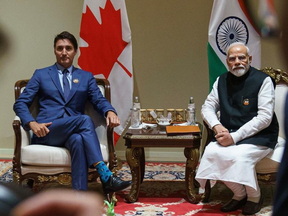
Justin Trudeau with Indian Prime Minister Narendra Modi.
The official portrait released by the Office of the Prime Minister of Canada following Trudeau’s meeting with Indian Prime Minister Narendra Modi at the G20 summit in New Delhi. Photo by Instagram
 
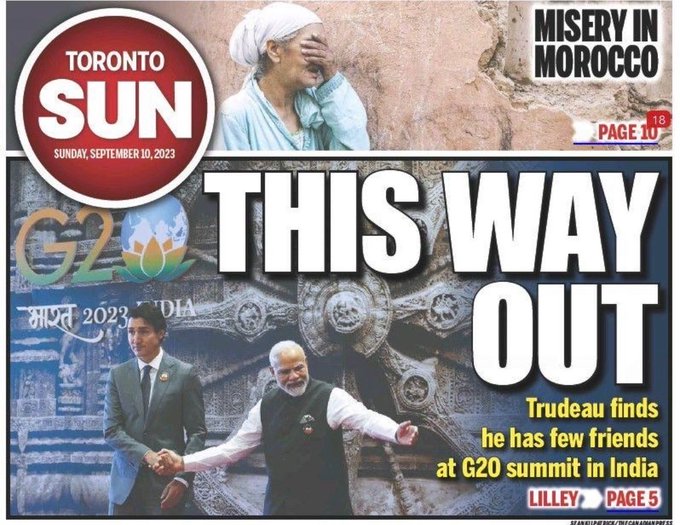
Preparing to set off to the G-20 summit in India, Prime Minister Trudeau sought a meeting with India's Prime Minister Narendra Modi on the margins of the summit. Prime Minister Modi met with other world leaders, for fairly lengthy one-on-one discussions, but he saw fit to grant a ten-minute interview with Canada's prime minister. As a sign of the confidence in which the Canadian government is  held by India's government, where other international G-20 guests were conveyed from the airport in limousines befitting their status, a rather elderly, undistinguished vehicle awaited Mr. Trudeau's arrival.

Canada, seeking to disentangle itself as much as possible from trade with China, anticipates an alternate trade agreement with India, now the world's most populous country. Mr. Trudeau had been advised by his national security adviser that India has become a top source of foreign interference in Canada, notably around Canada's Sikh community in support of separatist ambitions in the Indian state of Punjab where Sikh extremists extol the aspiration of Sikh 'Khalistan'.

Canada has had ample experience with separatist sympathies emanating from Quebec separatists going to great lengths, including violence, to attain a separate French nation cutting itself free from Canada. Quebec is the sole province within Canada granted near-autonomy while remaining financially reliant on supposedly equalizing transfer payments extracted from the Western-Canadian province of Alberta which Quebec is otherwise hostile toward.

The G-20 summit agenda was intended to focus on climate change, food security, global energy needs, gender equality and Ukraine's Russian invasion. An issue of importance to New Delhi is that Sikh extremists living in Canada have been interfering in Indian domestic affairs, most particularly relating to the Khalistani separatist movement. So while the government of Canada has had its experience with Quebec separatism, the Indian government is struggling with secessionist Sikh aspirations.

And Canada's experience with terrorism was originally that of Quebec violent separatist terrorists in early 1980 while, in 1985, Canadian Sikh terrorists were responsible for an explosion aboard an Air India flight carrying mostly Canadian citizens travelling to India as an act of murderous sabotage meant to impress upon India the lengths that Sikh extremists were willing to go to force the Indian government to agree to a geographic division of its territory. The bomb they placed on the passenger jet killed all 329 people aboard.
 
Now, all these years later, Canadian Sikh extremists are still fulminating for a Khalistan 'homeland' in India's Punjab province. Justin Trudeau defends their right to 'freedom of expression' as a Canadian virtue. Yet when discontented Canadians fed up with the government-imposed COVID mandates on masking and vaccinations travelled in a huge truck convoy to Ottawa to protest their perception that their rights were being trampled on, Trudeau refused to meet with them, labelled them contemptible misfits and racists. Their freedom of speech criticizing government was not respected.

In India during Trudeau's second official trip to India, following his disgraceful, clownish performance on the first trip meant to be a trade mission, but one which embarrassed both India and Canada in Trudeau's foppish theatrics, and his impossibly ignorant faux pas by accepting in his retinue the presence of a Sikh Canadian who had been found guilty of attempted murder of a visiting Indian politician, insulting India in the process.

The Indian press was not impressed with the presence of Trudeau on his second trip. The Hindustan Times wrote of "Trudeau's India Agony". The English-language NewsX cable channel denounced Trudeau for the ignorant hypocrite that he is: "Like any good Punjabi I have family in Canada, and I promise you that the nonsense that you're talking is emanating from sheer hubris. What do we do with this man?" rhetorically asked anchor Rishabh Gulati.

India's Ministry of External Affairs issued a statement following the short meeting between Trudeau and Indian Prime Minister Narendra Modi, indicating that most of the encounter had Mr. Modi reprimanding Trudeau for allowing Canada to become a safe haven for secessionist extremists: "They are ... inciting violence against Indian diplomats, damaging diplomatic premises, and threatening the Indian community in Canada and their places of worship", read the statement.

The issue of Khalistan, the Sikh secessionist movement seeking to separate 'Khalistan' from the Punjab remains the single most aggravating issue responsible for tense relations between the two governments. Canada has become a hotbed of Khalistan extremism following the Air India bombing, planned and perpetrated by Khalistani terrorists based in British Columbia.

After Prime Minister Modi's demands that Trudeau crack down on radical Khalistani activities, reporters in New Delhi were informed by Trudeau that while Canada was "always there" to prevent violence, it was his intention to defend "freedom of expression, freedom of conscience, and peaceful protest", as though Canadians fed up with the miserable governance they have been subjected to by Trudeau's Liberal government, who complain about his inept government and the impoverishment of the country under his rule, are given respectful hearings.

Image

Labels: , , ,

() Follow @rheytah Tweet