

Forging Trade Ties -- Forgoing Human Rights
"We highly appreciate the proactive stance of the new Canadian government in promoting the improvement and development of bilateral relations.""Cooperation between the two countries in trade, energy, and cultural exchanges has yielded fruitful results, and has brought tangible benefits to the people of both nations.""Looking ahead, China and Canada should translate the important consensus reached by our leaders into concrete actions and work together to steer our relations back to healthy, stable, and sustainable path."Yang Wanming, president, Chinese People's Association for Friendship with Foreign countries"[While the world is going through] a period of profound global upheaval, an era shaped by shifting geopolitics and economic volatility, within this uncertainty, there is also opportunity.""This is one of our most consequential trading relations.""[Canada is committed to working with China] as we look to address trade challenges and advance cooperation to shape a forward-looking economic relationship.""[We] can help China simultaneously meet its growing energy needs and climate goals." Canadian ambassador to China Jennifer May
Prime Minister Mark Carney shakes hands with Chinese President Xi Jinping at the start of a meeting in Gyeongju, South Korea, on Oct. 31. (Adrian Wyld/The Canadian Press)

As
the Canadian Liberal government wrestles with the trade and political
relations problems the second iteration of a Donald Trump presidency in
Washington has brought to the fore, the search for new international
trade partners has seen Canada finding it suddenly expedient to warm
relations with the People's Republic of China, after an interval of
frosty relations. The reasons for which have been many and compelling.
Not the least of which, but the most recent as it were, Beijing's
interference in Canadian politics during elections.
There
have been other recent issues; the arrest and detention and
imprisonment of two Canadians in China known as the 'two Michaels' (Michael Kovrig and Michael Spavor) in
2018, held for several years in extremely rough conditions as purported
spies. This was an illustration of Beijing's 'hostage-diplomacy' in
retaliation to the arrest of Huawai's chief financial officer Meng
Wanzhou on a U.S. warrant, for extradition to the U.S. to stand trial on
criminal charges. Other Canadians faced charges related to drugs,
leading to death sentences.
Chinese
cyber threats in Canada, the regime's threats against Chinese
Canadians, its infiltration of academia, along with wholesale thefts of
sensitive government and private industry initiatives, the most
notorious of which was Nortel where former Chinese national employees
lifted sensitive internal documents taken to China enabling groups like
Huawai to profit from a successful global enterprise whose operations
were repeated in China leading to the collapse of the Canadian firm.
 |
| Xiangguo Qiu wears a biocontainment suit while working in the containment lab at the National Microbiology Lab (NML) in Winnipeg. Qiu, her biologist husband Keding Cheng, and her students were escorted out of the NML in July 2019. Qiu and Cheng were fired in January 2021. The RCMP is still investigating a possible 'policy breach' reported by the Public Health Agency of Canada. (CBC) |
Another
operation of industrial espionage took place at the Winnipeg-based
National Microbiology Laboratory linked to the Canadian Science Centre
for Human and Animal Health, when two Chinese nationals employed at the
facility, Dr. Xiangguo Oju and Keding Cheng, her husband, illegally sent
vials of infectious materials back to China in 2019; they and their
Chinese students were escorted out of the lab, on suspicion of stealth
of scientific data which ended up at the Wuhan Institute of Virology.
Relations
between Canada and China under Liberal-led governments in Canada have
always flourished. Former Prime Minister Jean Chretien led countless
trade missions to China, and on his retirement from government working
for a prestigious Canadian law firm, became their point man for China
through his many high-level government contacts. Under former Prime
Minister Justin Trudeau relations were on-again, off-again, with his
government yearning to restore trade relations despite setbacks.
The
current leader of the Liberal Party of Canada and now current prime
minister, Mark Carney, whose business background with Brookfield Asset
Management Ltd. has warm, profitable relations with China has now once
again reinstated relations with China. Mr. Carney has accepted an
invitation by Beijing to visit China at "a mutually convenient time",
for the purpose of strengthening bilateral ties; read that trade issues
of immense importance to Canada, although for China these are fungible
trade issues.
 |
| Prime Minister Mark Carney has committed to tackling ‘irritants’ with Chinese President XI Jinping as the two countries had their first formal leader-to-leader contact since 2017. Carney was also invited by Xi for a state visit. Still from video/CBC |
The
Canadian embassy in Beijing arranged a reception to mark the 55th
anniversary of the founding of diplomatic ties between Canada and China,
co-hosted by the Chinese People's Association for Friendship with
Foreign Countries, a state-linked organization. At a meeting last month
in the Republic of Korea, the two leaders, Prime Minister Carney and
President Xi Jinping congenially agreed to reopen warming talks toward
improved relations.
That
meeting during the Asia-Pacific Economic Economic Leaders' Meeting in
Gyeongju marked the first meeting between Canadian and Chinese leaders
since 2017. The leaders "agreed that their meeting marked a turning point in the bilateral relationship",
with both leaders directing their officials to work toward resolving
outstanding trade issues, primarily seafood, canola and electric
vehicles. They spoke as well of clean and conventional energy, climate
change, manufacturing and international finance.
Even
with strained relations, China is Canada's second-largest trading
partner after the United States. China is the second-largest source of
imports, second-largest export market. A thaw in relations between the
two countries will certainly benefit Canada. In the same token, China's
human rights record with respect to the Uyghurs...Canada went so far as
to pass a motion in the House of Commons condemning the People's
Republic of China for 'genocide' against its Uyghur population.
China
takes advantage of both Canadian products and expertise, including
education, financial services and sustainable infrastructure for clean
conventional energy. Beijing is also interested in increasing energy
resources such as oil and gas, from Canada. For China, it is Canadian
raw materials and its abundance of natural mineral resources that draws
its interest. For Canada it is finished products that come from China
that form the bulk of its imports.
"Fifty-five years [since former Prime Minister Pierre Elliot Trudeau opened Canada up to China] is a milestone that invites us to reflect on our history, what we have achieved together, and how we navigated deeply complex and changing times.""I want to be very clear that we are here to build this relationship and to build it strong."Jennifer May, Canadian ambassador to China
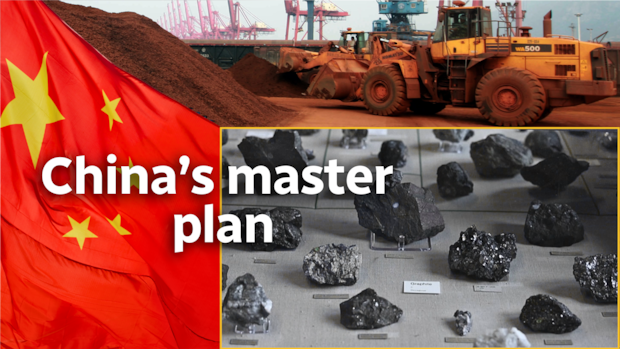 |
| China controls the world's largest reserves of rare earth elements, and now it's tightening its grip. China's export restrictions are giving it powerful leverage over the United States and U.S. President Donald Trump is determined to catch up. Images provided by Getty Images, The Canadian Press and Reuters. |
Labels: Canada-China Relations, Cybercrime, Documents Theft, Election Interference, Espionage, Human Rights, Import/Export, Scientific/Industry/Government Data, Trade
posted by Pieface | 8:51 PM


0 Comments:
Post a Comment
<< Home