

Canadian Security Intelligence Service Report
"Worryingly, nearly one in ten terrorism investigations at CSIS [Canadian Security Intelligence Service] now includes at least one subject of investigation under the age of 18.""Fortunately, only a small number of youth or adults with extreme views resort to violence. But when they do the consequences are devastating.""[CSIS has helped to disrupt 24] violent extremist actions [that led to arrests of terrorism peace bond charges in just over three years].""[Our agency is focusing more resources on] particularly alarming [cases involving plots by Iranian intelligence to repress -- and sometimes kill -- critics and dissidents of the regime in Canada].""In more than one case, this involved detecting, investigating and disrupting potentially lethal threats against individuals in Canada."CSIS Director Daniel Rogers
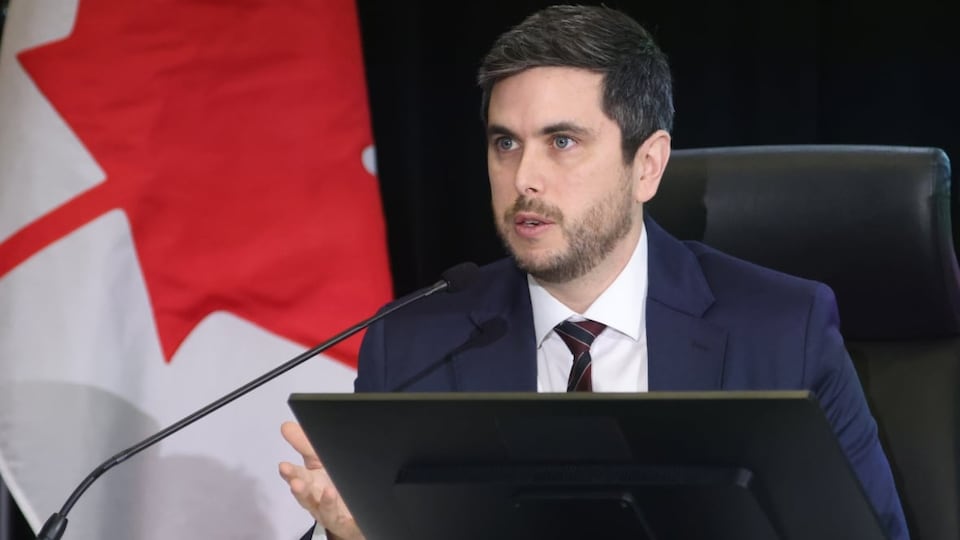 |
Dan Rogers appears at the Public Inquiry into Foreign Interference in Federal Electoral Processes and Democratic Institutions hearings, in Ottawa. (Patrick Doyle/The Canadian Press) |
Young people in Canada, warns the director of Canadian Security Intelligence Service, are increasingly radicalized online, resulting in rising violent extremism, markedly among those under 18 years of age. Motivated to extremism by a variety of ideologies among which are antisemitism, xenophobia, misogyny 'extreme interpretations' of religion or accelerationism [an inclination to accelerate the collapse of society], spreading with the momentum of social media's vast influence.
Teens and even children appear more susceptible to believing what they see and hear online; the allure and excitement of the socially forbidden; violent extremism seems like an adventure to their immature minds, drawing them into a never-ending cycle of the ever-increasing volume of viciously anti-social tropes. Speaking before an audience of government and police officials, academics and reporters in his first annual speech, Mr. Rogers attested to his increasing concern of the spread of extremism within the Canadian public.
A minor in Montreal was arrested, alleged to be planning an attack for Daesh (Islamic State); another, a 15-year-old in Edmonton suspected by police of planning to commit attacks on behalf of an online transnational violent group. 60 people have been injured, 29 killed in Canada in the past 11 years as a result of some attacks that were carried out before they could be apprehended. Many more were disrupted with the intelligence assistance CSIS provided.
"Chinese spies have tried to recruit Canadians with access to government plans, intentions, information and military expertise, through social media and online job platforms.""Both of those countries [China and Russia], and others, have a significant intelligence interest in our Arctic and those who influence or develop its economic or strategic potential.""It's no surprise, then, that CSIS has observed both cyber and non-cyber intelligence collection efforts targeting both governments and the private sector in the region.""CSIS will be challenged to adopt technology and use data in new and more significant ways to keep Canadians safe and to secure an advantage for Canada."CSIS Director Daniel Rogers
CSIS assisted in the arrest of two 15-year-olds in Ottawa, plotting to commit a mass casualty attack against the Jewish community. Information leading to the arrest of a man planning a Daesh-inspired attack on the New York Jewish community saw CSIS contributing important information. China's reputation for spying on Canada to appropriate state, military and intellectual property continues unabated. Chinese agents entering Canada, he pointed out, increasingly target the private sector. While both China and Russia engage aggressively for more intelligence and influence in the Canadian Arctic.
 |
| Canadian soldiers prepare for a surveillance mission in Pond Inlet, Nunavut, as part of the annual Operation Nanook on Sept. 6. The exercise sees the small team inserted onto a remote mountain top with no additional support, honing their survival skills for multiple days. (David Common/CBC) |
"Non-Arctic states, including the People’s Republic of China, seek to gain a strategic and economic foothold in the region. Russia, an Arctic state with a significant military presence in the region, remains unpredictable and aggressive.""National governments are still targeted for sensitive intelligence, military and economic secrets but so too are corporations and other levels of government whose data, technological innovations, influence and access to resources can shift the balance of advantage.""We benefit greatly from intelligence and security sharing by the United States, and we contribute back, So I think it’s still strong.""Today, while the goals are similar, the targets are more varied. Some of the world’s most advanced and emergent technology is now held by private sector and academic institutions."CSIS Director Daniel Rogers
 |
| The Chinese vessel Xue Long, seen here in East Antarctica, is believed to be dual purpose, meaning it’s primary role is research but what it surveils can also be used for Chinese military purposes. (Andrew Peacock/Reuters) |
Labels: Annual Report, Canadian Youth, China, CSIS Director, Increasing Extremism, Influence, Intelligence Gathering, Iranian Threats, Russia, Violence
posted by Pieface | 8:23 PM


0 Comments:
Post a Comment
<< Home