"Engagement is not approval."
"There are very few countries in this world that have the standards of Canada, the rights of Canada, the conviction of Canada, the constant reinforcement of those rights, so that all Canadians can live their lives as they choose."
"If you would have asked us a year ago how we would have pegged the chances [of Canada making a Candu sale in Turkey], that would have been very low. Now there are good chances."
"Our first and foremost job is protecting, not just protecting LGBTQI rights and two-spirited rights in Canada, but promoting those rights and ensuring that all Canadians can live their full selves in Canada."
"So first and foremost that's our responsibility."
Canadian Prime Minister Mark Carney
 |
| Turkish President Recep Tayyip Erdogan, left, welcomes Prime Minister Mark Carney during an official ceremony in Ankara, Turkey's capital, on Thursday. (Adem Altan/AFP/Getty Images) |
Canada's Prime Minister Mark Carney is nothing short of a preening hypocrite, to declare that Canada, under the administrative mishandling of its values, culture, priorities and dedication to multiculturalism remains a haven for all of its citizens under the Liberal-progressives that embrace Critical Race Theory in tandem with DEI. The Canada that existed before 2015 was indeed a country to be proud of, one where equality and mutual respect reflected the social order and government position. That Canada has been eviscerated.
The current Canada has embarked on friendly trade missions to Qatar and Turkey, both of which nations are in the willing thrall of the Muslim Brotherhood whose mission is one of stealth conquest of the West. Qatar's vast oil wealth has been generating the kind of goodwill that only money can buy, through 'investments' in academia in North America, in conjunction with the infiltration of members of the Islamic Republican Guard Corps as residents of Canada, where it is able to influence future generations of Canadians of the justice in supporting Palestinian victims of Israeli oppressive 'occupation'.
Both Qatar and Turkey openly shelter and pamper leaders of the Hamas terrorist group whose mission is the destruction of the Jewish state, an outcome that would fit comfortably into the plans of both Islamist nations. And these are the 'allies' toward which Mark Carney, on Canada's behalf, turn to. Turkey, where Recep Tayyip Erdogan has ruled for 18 years as an Ottoman-empire caliph, where political dissenters are imprisoned and independent journalists arrested. In no Muslim country are LGBTQI communities permitted; Carney's daughter would be imprisoned and possibly gang-raped in a squalid lifetime cell.
 |
| Prime Minister Mark Carney, left, and Turkish President Recep Erdogan shake hands during a news conference at the presidential palace in Ankara, Turkey, on Thursday, when both countries signed a new trade and defence partnership. (Murat Cetinmuhurdar/Presidential Press Office/Reuters) |
And there stands Prime Minister Carney, bursting with pride that he is succeeding in selling a Candu nuclear reactor to Turkey for, of course, industrial-civilian use. Not so long ago that would register as enabling nuclear proliferation. All the more perplexing when a country like Canada that positions itself as an exemplar of peace, security and good governance is exporting a potential doomsday weapon in a region of the world that is perpetually unsettled and in conflict, one where the Islamic Republic of Iran threatens to use a nuclear bomb if it considers itself under attack.
Chief executive of AtinsRealis, Ian Edwards, stated his company is prepared to conduct a feasibility study on "a potential new build of Candu reactors" at Sinop, a port city in Turkey. "We welcome this opportunity to deepen energy cooperation between Canada and Turkey while bringing Canadian nuclear technology and expertise to a growing international market". Turkey, where an ever-increasing dictatorship from a once-emerging democracy, whom Freedom House scores as 32/100 on its civil-liberties index: "not free". The Turkish President and his party "have become increasingly authoritarian in recent years, consolidating significant power through constitutional changes and by imprisoning opponents and critics."
Turkey has taken to shutting down a pro-opposition media outlet recently, raided LGBTQ groups, and convicted a standup comic of insulting President Erdogan. To the West, Turkey sitting at the crossroads of Europe and Asia, has always been viewed as a vital link between the two. Its long-lasting efforts to be accepted for membership in the European Union has always been deferred on the basis of its democratic deficit -- and that was long before the advent of Mr. Erdogan's 'Justice and Development Party'.
But according to Mr. Carney, a 'strategic partnership' between Canada and Turkey represents a bonus for both; it would, to Mr. Erdogan; such recognition providing legitimacy where it is not due. As for Canada, under this Liberal government, it should blush with shame over such blatant sanctimony spouted by its prime minister. "Part of the way we discharge that [our independence and sovereignty] is to be a truly sovereign nation. Part of the way we become a truly sovereign nation and reinforce our sovereignty is to have a broad range of partnerships around the world", claims Mark Carney, broadly smiling.
"Turkey is a formal partner of Canada in NATO and one of the most important geostrategic countries, not just in this region, but in this world."
"So we need to engage, and we do engage."
"[If Canada doesn't engage, it can't] be in the room [to raise Canadian perspectives on international challenges [citing geopolitical matters in regions near Turkey including Iran, Ukraine, Syria, the Middle East and the prospect of] continued stabilization [in relations between Armenia and Azerbaijan]."
Mark Carney
"I commend Mr. Carney for how much energy he's putting into diversifying Canada's trade, but he's not getting the balance right."
"[The Prime Minister] is decidedly on the side of pursuing commercial goals with downplaying other questions of human rights and democracy and the rule of law."
"[The Carney visit to Turkey comes at a difficult time for human-rights campaigners in Turkey who are] by necessity very brave and some of them are in jail and have been incarcerated in the last few weeks and I think it's incumbent on any Canadian prime minister to do more."
Roland Paris, professor of international affairs, University of Ottawa
In Istanbul on Friday, the prime minister held meetings with Turkish companies that included Sabanci Holding, an industrial and financial conglomerate; with Calik holding, a company that operates in the energy, mining, construction, textile and financial sectors; Baykar, manufacturer of military drones -- and arms manufacturer Aselsan. That will most certainly advantage their Canadian counterparts in those very same industries.
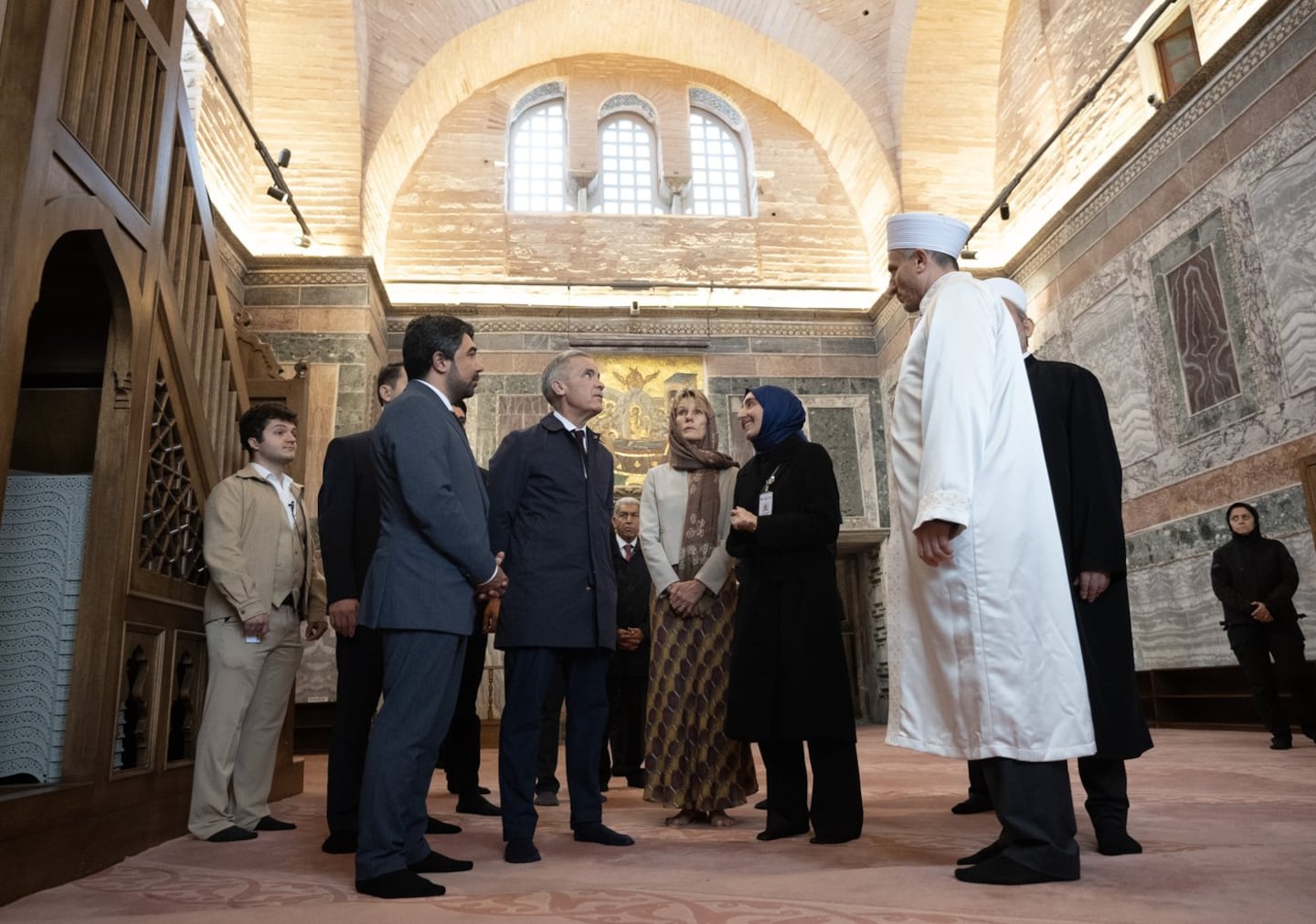 |
| PM Mark Carney and wife Diana Fox suitably garbed, visiting the Kariye mosque in Istanbul, Turkey on 24 October, 2026. LA PRESSE CANADIENNE/Adrian Wyld |
Labels: Canadian Prime Minister Mark Carney, Islamist Rule, Turkey's President Recep Tayyip Erdogan, Turkish Autocracy