Politic?

This is a blog dedicated to a personal interpretation of political news of the day. I attempt to be as knowledgeable as possible before commenting and committing my thoughts to a day's communication.

Sunday, February 09, 2020

Zimbabwe, Where Hunger Stalks

"Inflation is a rampant problem and people said, 'We'd prefer the food."
"[This month the World Food Program plans a switch to a] fully in-kind food program [for the first time, to distribute monthly rations of grain, oil and nutritional supplements for children under five]."
"The weather forecasts are basically saying we're looking at a very dry growing season." 
Gerald Bourke, spokesman, southern Africa operations, World Food Program

"Life is hard, all things are expensive, there are no price controls and inflation just keeps getting worse."
"The money here is valueless now."
Benjamini Dunha, 57, plumber, Harare

"I cannot stress enough the urgency of the situation in Zimbabwe."
"[Sixty percent of the country's 14 million people are] food-insecure, living in a household that is unable to obtain enough food to meet basic needs."
Hilal Elver, United Nations human rights expert on food security

"We used to buy favourite foods, such as ice cream, cheese, bacon, sausages and ham, and prepare good breakfasts for our families."
"These things are a vision of the past now."
Moreblessing Nyambara, 35, Harare schoolteacher

"This is not just a food crisis. It is a wider, more complicated situation."
"People have to make choices: Do I seek H.I.V. treatment or food?"
Ursula Mueller, deputy emergency relief coordinator, United Nations
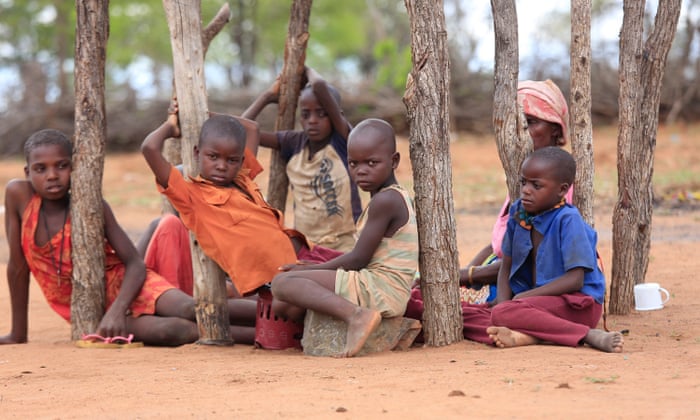
Children in Mafomoti village, in Zimbabwe’s Mwenezi district, wait while their mothers prepare their only meal of the day. Photograph: Aaron Ufumeli/EPA

This is former President-turned-tyrant Robert Mugabe's legacy for Zimbabwe. He began as an African independence hero, wresting his country from British colonial rule, transforming Rhodesia into the independent Republic of Zimbabwe. Freedom fighter to President, he then became a dictator, ruling like an African potentate. White farmers who had remained in Zimbabwe after independence, who considered themselves citizens, and whose farming expertise helped Zimbabwe become an African cornucopia of produce sufficient to feed its population and trade the surplus, became targets of land confiscation.

The 'freedom fighters' whose exploits as Mugabe entitled stalwarts were given title to confiscated farms. Black Zimbabweans who had worked on the white-owned farms found themselves out of work, and Mugabe's friends who then owned the farms were disinterested in farming, knew nothing about it and cared less, and the land went fallow. From that point on, food became scarce and was imported, inflation rose, the Zimbabwean currency became useless, unemployment soared.

The more recent droughts that have impaired crops and created even greater scarcity of food arrived at a time when Zimbabwe's new president, Emmerson Mnangagwa, who had been an ally of Mugabe, was ostensibly attempting to turn the economy around, and bring stability back to the country, but he doesn't appear to be much less of a despot than his predecessor, and just as haplessly corrupt in his inept administration.

Food aid is desperately needed. The crisis is being attributed to southern Africa's climate crisis, with drought conditions ensuring fewer crops to harvest. With insufficient nutrition people's health declines and crime increases along with other "negative coping mechanisms", according to Ursula Mueller of the United Nations. Basic maladministration, corruption and gross incompetence come to the fore in Zimbabwe, just as it all does in all too many areas of the African Continent.

People line up, anxious and early for the opportunity to buy subsidized maize meal offered by the government-operated Grain Marketing Board depot. Affordable prices for many, enabling them to have food for their families. So hundreds of people patiently wait in line for hours until a guard exits the depot to announce that the supply is rotten, removing it for sale for the day. Frustratingly enraging; is the food going elsewhere, and the story being circulated untrue? They will never know.

Benjamin Dunha earns 700 Zimbabwe dollars monthly as a plumber, the equivalent of $38 at official exchange rates. His salary less than a year earlier was worth closer to $700.00. He has eight children to feed. He has been able to provide them with vegetables and sadza, a thick porridge of boiled maize meal. Now that porridge will be absent until he is able to find another source.

Hunger haunts Africa. In Zimbabwe, the annual inflation rate is the world's highest, at 300 percent, according to the International Monetary Fund. Buying any food beyond maize meal is considered a luxury. The World Food Program plans to double the number of aid recipients in Zimbabwe to four million, this year.
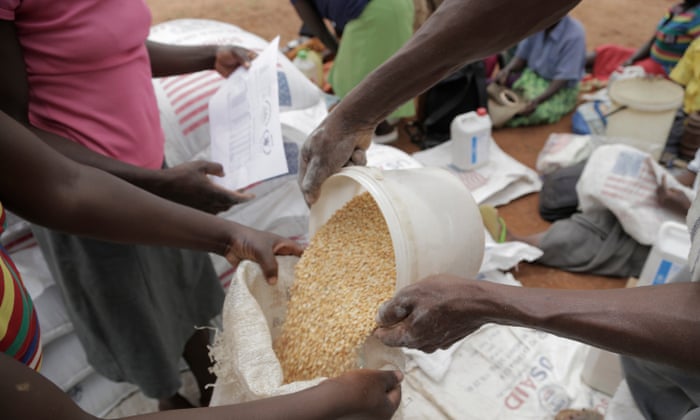

A woman pours food aid into a sack at a distribution point for Mafomoti primary school in Zimbabwe’s Mwenezi district. Photograph: Aaron Ufumeli/EPA

Labels: , , , , , ,

Thursday, November 16, 2017

Shy No More

"He came to me [in the presidential typing pool] and started asking about my family. He just started talking to me, asking me about my life. Were you married before, things like that … I didn’t know it was leading somewhere. I was quite a shy person, very shy."
"I felt a bit uncomfortable when he proposed to me since he was still married to Sally (Mugabe's wife, suffering from terminal cancer]."
"I was very young when I started living with President Mugabe. But he was patient with me and took time to groom me into the woman that I am now."
Grace Mugabe, Zimbabwe 'first lady'
South African rights campaigners say it would be a disgrace to grant diplomatic immunity to Grace Mugabe.
South African rights campaigners say it would be a disgrace to grant diplomatic immunity to Grace Mugabe. Photograph: Tsvangirayi Mukwazhi/AP

Grace Mugabe might have started out shy, but it didn't take too long for her to become assertive and materially entitled. While Zimbabweans suffered a plunging value in currency, rising unemployment, scarcity of food and rampant inflation, she amused herself, travelling to Paris to shop, earning herself the uncomplimentary title of "Gucci Grace". Famously, another beautiful and wilful first lady, Imelda Marcos of the Philippines, was known in a much earlier generation for her profligate spending on shoes, and Grace Mugabe doubtless has come a close second, with her own estimated 3,000 pairs.

During one infamous shopping trip to Paris she is reputed to have spent 75,000 pounds, consolidating her reputation as an avaricious woman plundering her nation's scarce financial resources while her countrymen and women suffered privation in a country once considered the breadbasket of Africa. Her husband's scheme of forcefully reclaiming large tracts of land from white Zimbabwean farmers and doling them out to his political government henchmen, members of his family and his supporters destroyed agriculture in Zimbabwe.

Trips to Paris to spend her nation's financial resources are now out. As is her conniving to become the ruling successor to her 92-year-old husband. At age 52, Grace Mugabe will have to start all over again, somewhere else, with the aid of the funds she has squirrelled away since her parade has been rained upon, her schemes overturned, her husband under house arrest. South Africa has offered her haven, but it is rumoured that she has since departed to preserve her life, to Namibia.
 Grace Mugabe, wife of Robert, was known as Zimbabwe's 'First Shopper'
Grace Mugabe, wife of Robert, was known as Zimbabwe's 'First Shopper'  Reuters

She does have an enemy who is guaranteed to look for revenge. The Vice-President, a long-time supporter and colleague of her husband's whom she persuaded Robert Mugabe to re-think his fitness to replace him, offering herself as a more suitable and appropriate candidate to become president, as a fait accompli by executive order. Mugabe had, indeed, a week ago informed his ZANU-PF party of his intentions and urged them to support Grace Mugabe as vice-president to replace Emmerson Mnangagwa, whom he had dismissed from his post and his successor last week.

"No one will remove the president except God", Grace Mugabe said at a cabinet meeting days ago. She had also said on a previous occasion that when Mugabe died he would be propped up and would remain president of Zimbabwe even dead. But at age 52 she felt herself to have been sufficiently schooled by him and mature enough in her political wisdom to take his place. The place that Mnangagwa was assumed to have been groomed for. A man whose sobriquet is "the Crocodile". Evidently, the man earned that name and the reputation accompanying it.

He is said to be more ruthless than Mugabe, and more cruel. During Mugabe's 37 years of dictatorship, Mnangagwa served as his spy chief, his chief of defence, and situation enforcer in the early years. Doubtless during the land-seizure campaign beginning in 2000 when white Zimbabwean farmers, skilled in ensuring that the land they farmed was productive, and employing black Zimbabweans who are now though knowledgeable, unemployed, his heavy hand was involved.

But a feud had developed between Grace Mugabe and Emmerson Mnangagwa, and during a ZANU-PF rally she urged her husband to agree that "the snake must be hit on the head". When he was fired, Mnangagwa seeing the writing on the wall as his chief lieutenants were also removed, fled the country, leaving Grace Mugabe to celebrate her victory, and since her husband is old, ill and feeble, her near-ascension to power.

It is assumed that the military chiefs became alarmed at the purge of Mnangagwa's faction, that it would spread to affect their high command. With Mnangagwa orchestrating things from exile in South Africa, a coup was concocted, skilfully and thoroughly, and to great effect, with no blood spilled, the people assured that their president and his family would be safe, that only the corrupt would be arrested.

A military convoy began the proceedings at midnight on Tuesday, launching a surprise assault on the barracks of the presidential guard while other units moved securing vital installations in government districts, to surround parliament, government offices and the studios of state television. Cabinet allies of the president's wife were swiftly hunted down and apprehended, spoken of by General Constantino Chiwenga, as criminals, threats to Zimbabwe.

Finally, liberated from the dictatorship of Robert Mugabe and his ambitious wife, Zimbabweans can breathe a sigh of relief. At least for a brief moment or two. But another, sinister threat of a totalitarian-thug-in-waiting preparing to ascend to the height of power in the country is close on the horizon.
 The couple were married in 1996
The couple was married in 1996  Getty Images

Labels: , , ,

Saturday, September 19, 2015

The Black/White Checkerboard

"The problem now is that we have the land, but they have the experience. We need to help each other."
"He kept saying, 'You stole our land'. And I told him, 'No, I'm indigenous. This land belongs to us."
Tracy Mutinhiri, black Zimbabwean landowner

"We can't have another war to liberate a country we have already liberated."
"If white settlers just took the land from us without paying for it, we can, in a similar way, just take it from them without paying for it."
Robert Mugabe, President, Zimbabwe

"There's no one who disagrees with social justice, but instead we watched as land reform was used as a tool of political patronage"
Peter Steyl, head, Zimbabwe commercial farmers' union 

As one black landowner puts it: ‘We have the land, but they have the experience. We need to help each other.’

Zimbabwe, when it was still Rhodesia and under white colonial rule, was an African breadbasket. It was white farmers who 'owned' the farms in the country, employing black farm workers and producing a cornucopia of food sufficient to feed the populace, with enough excess to sell abroad, constituting a huge income for the nation. Rhodesia was one of the last colonized countries of Africa to become independent, and it did so after a war against white rule.

In the 1960s and 70s, indigenous black Rhodesians fought against their oppressed and colonized condition, and Robert Mugabe was one of the heroes of the Rhodesian civil war that ended when black rule began. There were great hopes for Rhodesia, and there seemed to be a conciliatory effort on the part of both the colonizing Rhodesians and the indigenous Africans whose country it truly was at independence in 1980 when the country was renamed Zimbabwe.

Up until 1997, the country's economy was strong. Between 2000 and 2009, agricultural revenue fell by $12-billion, resulting from the agricultural revolution in devolving white farming into black farming. Which was when white farmers received notice that their productive farms were being appropriated by the government and handed over to the people who had earned their right to own the farms as black Africans. There was no compensation and there was abundant violence.

Some white farmers who resisted the forced takeovers lost their lives, just as they were losing their livelihoods, working farms that had been in their families for generations. As white farmers were kicked off the land they considered their own, the black farm workers employed by them became unemployed as well. In some instances farms were handed over to cronies of Robert Mugabe. It can be safely stated that none of the blacks taking over white farms had any farming experience.

In many instances the land, once vibrant with rich growing crops went fallow and was returned to nature. In others, the farm owners proved incapable of properly and profitably farming the land. But it was a revolution and as such a triumph. Even while the Zimbabwean economy fell into ruin, inflation soared, and so did unemployment. Not much has changed since then.

"The whites had their turn. It's time for our people to have a chance", said Savior Kasukuwere, minister of local government. So the former white farmers were landless and unemployed. Now, as farms are struggling to produce under black ownership, the country is heavily reliant on international aid to feed a quarter of its population, according to the World Food Program.

The Mugabe administration thinks it has a solution; force the farm owners to produce more crops more efficiently by pressuring them with threats to exact a quarterly 'rent' to the state. If they don't succeed they in their turn will be evicted. So black farmers who are facing difficulties have turned for advice and aid to the white farmers who had once operated the farms, offering to employ them as managers and advisers.

The dictatorial Robert Mugabe is none too pleased with this turn of events. But the economy is in dire straits, and black farmers see the need to have assistance from the very individuals whose misfortune led directly to their fortune. "Every week they're asked, 'Wouldn't you like to come back to the farms?", noted John Robertson, an economist in Harare.

And therein lies a dilemma. Some believe that taking that proffered employment would serve to legitimize a land-reform system they feel is unjust and politically driven. But with few other job prospects in the offing and the reality of widespread unemployment, many are indeed hiring themselves out as consultants and farm managers.

And, in fact, the new reality may just be of tremendous use to both solitudes, and in the end, help pull Zimbabwe out of its current misery status. Now ... if only Robert Mugabe would fade into history....

Robert Mugabe has warned that forging ties with white farmers is a step backward (AFP/Getty) Robert Mugabe has warned that forging ties with white farmers is a step backward (AFP/Getty)

Labels: , , ,

() Follow @rheytah Tweet