This is a blog dedicated to a personal interpretation of political news of the day. I attempt to be as knowledgeable as possible before commenting and committing my thoughts to a day's communication.
"China’s DF-26, an anti-ship missile tested and 'demonstrated'
by the People’s Liberation Army reportedly able to travel 2,000 miles
to destroy carriers, does present a credible threat to be taken
seriously. Yet much of the hype seems to leave out certain critical comments made by senior U.S. Navy leaders and various adaptations the modern Navy has made to respond to or 'counter' China’s often-discussed A2/AD (anti-access/area denial) strategy."
"With a range of up to 2,500 miles and 4,000-pound payload, with
satellite targeting the DF-26 in theory could strike U.S. Navy warships
across the western Pacific Ocean. 'Even when launched from deeper inland
areas of China, the DF-26 has a range far-reaching enough to cover the
South China Sea', an unnamed military expert told Global Times in a report several years ago."
"However,
upon closer examination and careful reading of public comments from
senior Navy officials, there certainly seems to be room for debate on
this question. While certainly nobody questions the seriousness of a
threat of this kind, and clearly the Chinese weapons are taken
seriously, yet some of the threat language might accurately be assessed
as 'hype' given the steady stream of ongoing advances in layered Carrier
and Carrier Strike Group defenses."
Kris Osborn, Military Affairs Editor, 19FortyFive, President, Warrior Maven – Center for Military Modernization
DF-26
According to boasts by Chinese scientists, the new hypersonic weapons China possesses could destroy the newest aircraft carrier in the American Navy. A research team on a war game software platform that China's military uses, indicated Chinese forces sinking the USS Gerald R. Ford carrier fleet with a volley of 24 hypersonic anti-ship missiles. A report in the South China Morning Post claimed the results of the hypersonic strikes, made public for the first time in a May paper published by the Chinese-language Journal of Test and Management Technology.
Computer-generated battle scenarios are often used by military planners to game out strategies. However, they cannot be overly relied upon in real-life conflict where terrain, weather and other unforeseen factors are capable of disrupting weaponry, warn experts in the field. The strategic scenario used a platform of an attack on American vessels that had steamed toward an island claimed in the disputed South China Sea by China.
Some of the missiles in the three-wave attack, according to researchers, were fired from as far distant as the Gobi Desert. The entire play relies on a diplomatic confrontation over the waterway and its rich resources that has escalated for years in a landscape of overlapping territorial claims between regional nations and an increasingly aggressive Beijing.
With China determined to extend its reach by claiming and militarizing islands, reefs and rocks, the United States Navy has accelerated its own 'freedom of navigation' patrols in universally recognized international waters that Beijing claims as its own. China has been developing its missile arsenal rapidly, including hypersonic technology, as a reflection of its focus on building its naval capabilities.
The Chinese military had three days earlier tested a new hypersonic intermediate-range ballistic missile named the DF-27, according to a leak of a top-secret report, by the U.S. Joint Chiefs of Staff intelligence directorate, several months back. The DF-27, according to the document, possessed a high probability of capacity to evade U.S. ballistic missile defence, designed to boost Beijing's ability to strike large parts of the Pacific. That would include the U.S. territory of Guam, and its strategic military base.
China last year deployed versions of the new missile capable of attacking land targets and ships. Also revealed was that the DF-27 has increased potential as a "carrier killer" vastly out-performing its predecessors. Researchers from the North University of China in the latest war game, concluded that almost every U.S. surface vessel was shattered by the hypersonic attack and sank eventually.
USS Gerald R. Ford Aircraft Carrier (Photo by Matt Cardy/Getty Images)
"[Beijing would not hesitate to make an example of Britain] to execute one as a warning to a hundred."
"China is likely to escalate its attempts to expel the warships at any time. In the future, stopping such intrusive behaviour that violates China's territorial waters is a struggle China is destined to intensify."
"If the U.K. wants to play the role of coercing China in the South China Sea, then it is behaving badly. If it makes any substantial moves, it is looking for trouble."
"We seriously warn this group: they are obliged to remain restrained and obey the rules."
"Please follow the current international shipping lanes and stay at least 12 nautical miles away from the Chinese islands and reefs."
Global Times editorial
China has been building artificial islands in the South China Sea Getty Images
"We must hold our nerve. China is now, after having ten years able to operate at will in the South China Sea, feeling the might of the international community questioning its false right over what's clearly international waters."
"This is the beginning of the ratcheting up [of] tensions with China as they see this as their backyard and are using this harsh language to intimidate."
Tobias Ellwood, chairman, British Defence Select Committee
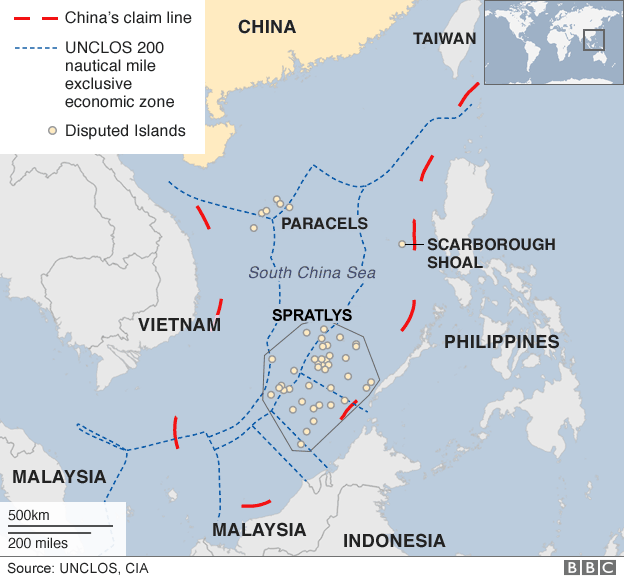
The Chinese 'islands and reefs', of course, refer to the illegally-built-up areas of 'land' in a maritime region in dispute. China infamously claims the South China Sea as its very own bailiwick. Its neighbours feel otherwise. China has been claiming sovereignty over land (Himalayan) disputed between itself and India, over airspace where it warns other nations they may not fly in areas China identifies as its sole purview, and at sea where Vietnam and the Philippines and Japan also claim rights to disputed areas.
The US has sailed through the South China Sea AFP
Areas that are designated legally as international, where any nation has the freedom to navigate the oceans and sail where by global agreement the oceans are open to all, and which are now being claimed by China and coincidentally (in the Middle East) by Iran, two countries that seem to get on very well together. Britain has been put on notice that sending the HMS Queen Elizabeth carrier strike group into the South China Sea is horribly offensive to Beijing.
London has been instructed to "remain restrained and obey the rules". These are Beijing's rules. Beijing has no use for international rule-of-law. Theirs however, have no international standing as legitimately-recognized barriers. But the threat by Beijing has been issued; Britain is duly warned. And any other nation's vessels which venture into what they believe to be international waters must take Beijing's warning into account, because quite simply, Beijing insists they must do so.
According to the Daily Telegraph, Britain's aircraft carrier entered the contested waters almost a week ago with its return route not yet confirmed, though it had no intention of sailing through the Taiwan Strait on its maiden mission. The U.K. Defence Secretary Ben Wallace set the stage for a confrontation when he stated the intention of the deployment was to sail on any route defined as legitimate under international law.
China's claim of sovereignty over the South China Sea offends a 2016 international court ruling that the sea did not belong to China. The world looked on as China illegally built military bases and airport runways on islands they constructed in the disputed waters. And with those actions Beijing has grown increasingly belligerent and combative, irascible over its declarations being contested as legally unrecognized. And U.K. Defence Secretary Wallace preferred not to reveal whether the fleet intended to breach China's declared '12-mile zone'.
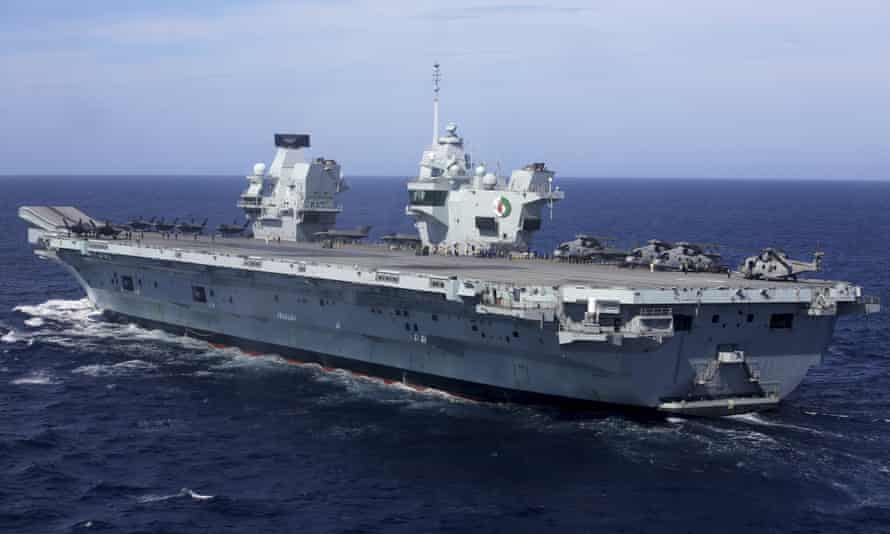
The strike group is led by HMS Queen Elizabeth. Photograph: Ana Brigida/AP
"China is threatening our citizens and undermining our rights and freedoms with its covert operations in Canada. Everything should be under consideration to defend Canada and Canadians -- including a boycott of the 2022 Beijing Winter Olympics."
"Canada is a winter sports powerhouse. No Winter Olympics could be a success without Canada's participation."
Michael Chong, Conservative Member of Parliament, Opposition foreign affairs critic
"The decision on whether or not to participate in the Olympic and Paralympic games lies with the Canadian Olympic and Paralympic Committee, as they operate independently of the government."
Department of Canadian Heritage
"There's no question that there's aspects of what the Chinese are doing that fits into the definition of genocide in the genocide convention [in Beijing's persecution of ethnic Muslim Uyghurs in Xinjiang Province so I've asked the UN Human Rights Council to investigate]."
Canadian Ambassador to the United Nations, Bob Rae
"I would like to ask this ambassador, if his logic is plausible in finding out who best fits the label of genocide, it seems that it is not the Uyghurs who are persecuted, but rather the people of Canada, am I right?"
"How did [Ambassador Rae] reach his conclusion without any evidence?"
Chinese Foreign Minister Zhao Lijian
China is not, on the record, very given to respecting human rights. Its occupation of Tibet and subsequent persecution of Tibetans, its incarceration of up to a million Uyghurs in massive 're-education' compounds to free them from the bonds of Islam and re-acquaint them with the merciful and opportunist merits of the Communist system represents a harmonious alternative to the dread 'splitism' challenging the Chinese Communist Party's authority.
China's aggression toward its neighbours claiming ownership of disputed air, sea and land territories in the South China Sea, its installation of military bases on islands claimed by its neighbours and occupied by China, its border challenges to India in the Himalaya, all attest to Beijing's new assertiveness through intimidation, threat and military intervention. Beijing's Belt and Road enterprise from Africa to the Middle East uses carrots instead of sticks, all geared unerringly toward power, influence and conquest.
When push comes to shove, Beijing has no equals. It has been shoving Australia around for pursuing an enquiry into the actions that China took at the turn of 2020 when the SARS-CoV-2 virus that causes COVID became a global threat of colossal proportions. China has launched a propaganda campaign of misinformation alleging that the virus emanated originally from Europe, then entered China, not that it escaped from a non-secure biological laboratory in Wuhan, China, to surface there as a dread disease that would go on to become a global pandemic.
China has abducted innocent Canadians characterizing them as a threat to the People's Republic of China, imprisoned them and intimates they could be released with the release from custody of Huawei's CFO taken into custody in Vancouver at the extradition request of U.S. authorities, where she resides in comfort in her two luxury Vancouver mansions, while Michael Spavor and Michael Kovrig have spent two agonizing years exposed to subtle Chinese torture charged as "spying on national secrets".
Canada, a member of the "Five Eyes" intelligence coalition of Australia, New Zealand, the United Kingdom and the United States, is the only one among them which has failed to announce that Huawei Technologies will not take part in Canada's 5G upgrades, as the others have done. The coalition issued a joint statement on Hong Kong to the effect: "China’s action is a clear breach of its international obligations under
the legally binding, UN-registered Sino-British Joint Declaration. It
breaches both China’s commitment that Hong Kong will enjoy a ‘high
degree of autonomy’, and the right to freedom of speech."
A
Chinese foreign ministry spokesman warned the Five Eyes countries to stay out of
China's affairs saying: "They should be careful or their eyes will be
plucked out."
"The
Chinese never make trouble and are never afraid of anything," Zhao
Lijian told journalists in Beijing on Thursday, saying it did not
"matter if they had five or 10 eyes". BBC
Canada, along with other Western nations has been plagued with state-sponsored cyber threats that have become the "new normal", emanating from hackers in China, Russia, Iran and North Korea. China has for decades engaged in commercial and military espionage. One of the telecommunications successes in Canada, Nortel, with its huge networks and advanced technologies was a giant in its field, one that employed Chinese technicians who took what they learned at Nortel to build Huawei while destroying Nortel.
It is past time for this Liberal government of Justin Trudeau to do a number of things: inform Beijing without equivocation that it will no longer tolerate that two Canadians are being held ransom. Three other Canadians have been given death sentences, on convictions of drug peddling, sentences that just happened to coincide with the Huawei affair.
Huawei should be informed without further delay that they will not be involved in Canada's 5G upgrade. The federal government and the Canadian Sports Federation should agree that Canada is set to boycott the Beijing Winter Olympics.
Chinese
police patrol outside the Olympic Stadium in Beijing on July 21, 2008.
Canada seems perfectly prepared to send its athletes to a sporting
competition in a country where two of its citizens are held in state
custody.Photo by MARK RALSTON/AFP/Getty Images
And no longer should Canada tolerate China's outreach within Canada, not only its intolerable spying, but its intimidation of Chinese-Canadian citizens. The world is very much aware of Chinese bullying in its belief that its destiny is to become the world's sole powerhouse, that its time has come and it will no longer take the advice of Deng Xiaoping in the 1980s that China should bide its time; observe carefully, secure its position, cope with affairs calmly and bide its time.