Politic?

This is a blog dedicated to a personal interpretation of political news of the day. I attempt to be as knowledgeable as possible before commenting and committing my thoughts to a day's communication.

Thursday, October 02, 2025

The Fate of Taiwan's Independent Status as a Fully Functioning State

"Taiwan is a front-line state in the Peoples Republic of China's outward push to expand its physical and political influence in the Indo-Pacific, just as Ukraine stands in the way of similar ambitions in Putin's Moscow."
"The fate of the island nation's 23.5 million people will have direct repercussions for the future of democracy the global economy, the future of technology and the ambitions of authoritarian regimes to create a world that is more hospitable to their anti-democratic outlook."
J. Michael Cole, academic, Taipei, former intelligence officer 
https://www.tribuneindia.com/sortd-service/imaginary/v22-01/jpg/large/high?url=dGhldHJpYnVuZS1zb3J0ZC1wcm8tcHJvZC1zb3J0ZC9tZWRpYTEwOWFmMjgwLTllZDgtMTFmMC04NjMyLTFiZGZhNzM3NzM5Zi5qcGc=
Most Taiwanese consider themselves Taiwanese only, while some among them acknowledge their Chinese heritage. Unlike China, Taiwan has fully embraced democracy, and as Mr. Cole points out, Taiwan is "increasingly incompatible with, and resistant to, Beijing's attempts to annex it." He explains this and much more in his book The Taiwan Tinderbox: The Island Nation at the Center of the New Cold War, arguing that Beijing's annexation determination does not reflect a historic wrong through uniting a divided nation, but far more reflects China's authoritarian territorial expansionism. 
 
On the weekend, the Australian Broadcasting Corporation noted a U.S. intelligence report that there has been a rapid buildup of the commercial ferry fleet by China in preparation for an invasion of Taiwan; roll-on/roll-off ferries are being produced by a Chinese shipyard modified to carry tanks for an amphibious operation. Some 70 of these vessels will have been built to order by 2026's year-end. 
 
Beijing's President Xi Jinping had been governor of Fujian province situated directly across the strait from Taiwan, and irrespective of the fact that 92 percent of Taiwanese have no wish to join China, Xi has ordered the People's Liberation Army to build its military capacity to prepare to invade and take Taiwan by force by 2027 while he is still alive to enjoy his territorial acquisition exploit and perhaps before he turns his ambitions toward accessing disputed territories with his South China Sea neighbours.
 
https://thehill.com/wp-content/uploads/sites/2/2024/09/AP24066235067015-e1725573229968.jpg?w=640&h=360&crop=1
 (AP Photo/Aaron Favila)  A Chinese coast guard boat moves near the Philippine resupply vessel Unaizah after it was hit by their water canon blast causing injuries to multiple crew members as they tried to enter the Second Thomas Shoal in the disputed South China Sea Tuesday, March 5, 2024. 
"The Gordian knot tightens, with little, if any potential for a truly peaceful resolution."
"The calm and pragmatism that has characterized the Taiwanese people's threat perception has undoubtedly contributed to Taiwan's resilience. It has prevented panic and stock market crashes whenever China holds major military exercises to coerce Taiwan."
"However, This pragmatism relies on a reading of Chinese intentions and  capabilities that may no longer reflect reality."
J. Michael Cole, Taipei  
In 2023, a war game by the Washington-based Center for Strategic and International Studies envisaged loss of Taiwan's entire fleet, and half of its air force, while, with the U.S. holding firm to its pledge to aid Taiwan, would lose two aircraft carriers, 20 warships and hundreds of aircraft if a titanic military clash did eventuate. The envisioned scenario would also see the PlA with heavy losses, needless to say. 
 
https://live-production.wcms.abc-cdn.net.au/22a9e86badb7d73cbc485c25f44d1ce6?impolicy=wcms_crop_resize&cropH=613&cropW=920&xPos=2&yPos=0&width=862&height=575
China's ocean-going ferries are capable of transporting armoured vehicles and soldiers. (Supplied: CCTV)
 
Taiwan has invested in their own cruise missile stock; they've built beach defences, protected critical infrastructure, reduced trade dependence on China, and created their own satellite network. The growing conviction by Beijing that the U.S is in decline and distracted by domestic infighting, has emboldened Xi. The conviction that Taiwan is "an indispensable element" in the Indo-Pacific state of stability is a true incentive for the West to be highly concerned over Xi's intentions. 
 
And then aside from the dread prospect of hundreds of thousands of lives that might be lost in a conflict of this dimension, there is also the element of world control of rare earth elements and production of critically required communication and technological items. Taiwan produces 60 percent of the world's semi-conductors to a value of $10 trillion -- ten percent of global GDP. 
 
https://live-production.wcms.abc-cdn.net.au/ab8d9ba03f1e61746c9799c25f3485e3?impolicy=wcms_crop_resize&cropH=444&cropW=789&xPos=7&yPos=28&width=862&height=485
A cargo ship is seen next to a new class of specialised landing dock in southern China. (Supplied: US Naval War College/Maxar Technologies)
 

Labels: , , , , , ,

Wednesday, July 19, 2023

Beijing's Global Strategy for Preeminence in Science, Technology and Academia

"China not only seeks influence at an institutional level but will also target individual academics who focus on China, seeking to ensure that they act in the CCP's best interests either through professional inducements or, if that doesn't work, by intimidation."
"China appears prepared to use levers, such as research funding and travel opportunities, to cultivate relationships with academics, and to encourage them to change their research direction or course content in line with CCP objectives."
"Pressure is exerted on institutions, academics and students to prevent engagement with topics that harm the positive narrative presented by the Chinese Communist Party."
"Once established in academic institutions, these students are in a position to identify and exfiltrate valuable information, data and intellectual property back to China."
"In its quest for economic advantage, China often acts in plain sight -- directing, funding and collaborating on academic research for its own ends."
British Parliament Intelligence and Security Committee
 
"China has been aggressive in its interference activities ... It has been particularly effective at using its money and influence to penetrate or buy academia in order to ensure its international narrative is advanced and criticism suppressed."
"This is particularly acute when it involves the so-called ‘Five Poisons’ [Taiwanese independence, Tibetan independence, Xinjiang separatists, the Chinese democracy movement and the Falun Gong]."
Julian Lewis, Committee Chair

"You say something they don't like, they deny you a visa."
"The student bodies are infiltrated. We know there are meetings through the middle of the night and the following morning some Chinese students can get rung up by somebody at the cultural and education section of the embassy to ask them: Why did you say that? Why did you do that?"
Professor Steve Tsang, School for Oriental and African Studies
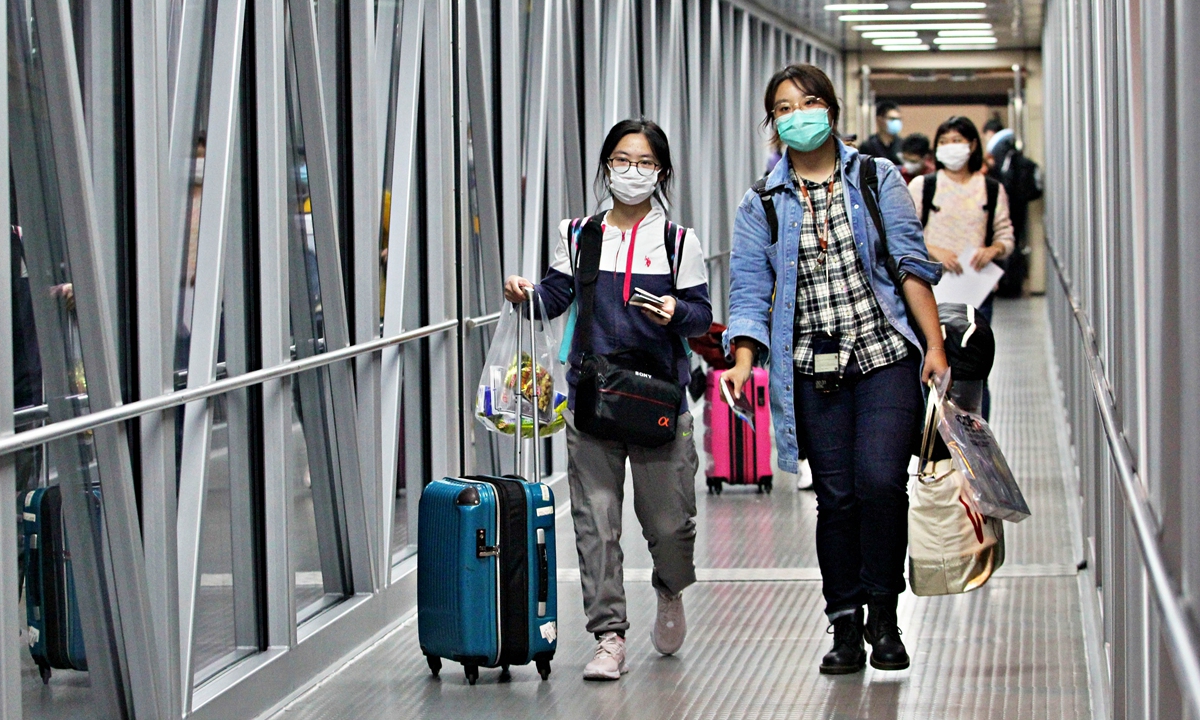
Chinese students board a charter flight from Southwest China's Chongqing to Manchester, UK in September 2020. Photo: cnsphoto
Two students walk through Chongqing Jiangbei International Airport to catch a chartered flight to Manchester in the UK. The plane will take 74 Chinese students to the UK. Photo: VCG
 
Evidence has been revealed of Chinese officials approaching academic lecturers in Britain, to promise them "professional inducements" in the form of research funding and travel opportunities, as part of the manner in which British universities had been "bought" by the Chinese Communist Party. The British Parliament's intelligence and security committee through their extensive investigation produced a 200-page report revealing details of Beijing's concentrated program to inveigle itself into British academia.

Beijing seeks out a prominent place in the global field of science and invention, seeking influence worldwide as a driver of both through a scheme of interdependence which links into its 21st century role as the world's production source of consumer products of every description and dimension. In the UK the report points out that its universities were "turning a blind eye to the risk" in becoming reliant on China for financial support. The University of Surrey accepted a $13-million donation from Huawei to find its 5G6G Innovation Centre.

Chinese state authorities are also evidently intimidating British academics and students by a Beijing directive to infiltrate and purloin research to benefit the People's Liberation Army. One witness interview of Professor Steve Tsang revealed that within six months of accepting his new status within the School for Oriental and African Studies, a political councillor from the Chinese embassy offered him anything he would like, for his 'cooperation'. "It is as blatant as that", he reported.

Access to visas is also being used as leverage, affirmed by Professor Tsang. "If you are an academic and specializing in China, and your entire academic life is focused on China, the threat of not being permitted to travel to the country of your academic focus becomes a very powerful threat." Years previously it was revealed that scientists at leading universities, including Cambridge, Edinburgh and Manchester, worked on projects with researchers at China's nuclear weapons research institution.

Dozens of scientific papers were published by British academics working alongside scientists from a Chinese institution on an American sanctions list, reflecting its research into developing Beijing's nuclear arsenal. Investigative journalism at The Telegraph uncovered that situation. There are over 90 Chinese Students and Scholars Associations (CSSAs) working out of the U.K. -- partially financed by the Chinese embassy -- monitoring the activities of Chinese students. A situation the committee recognized as resulting in a "culture of fear and suspicion among Chinese students in the U.K."

The largest overseas contingent of students on study visas in U.K. universities -- over 120,000 -- are Chinese students. A number greater than in the rest of Europe combined. Five times as many students are sent by China to the United Kingdom, as compared to the country that comes in second for its students studying abroad; India. In Canada, a similar situation prevails, with 60,000 student visas issued at last count, down substantially from the year before which stood at 90,000, as Chinese relations with Canada sour.

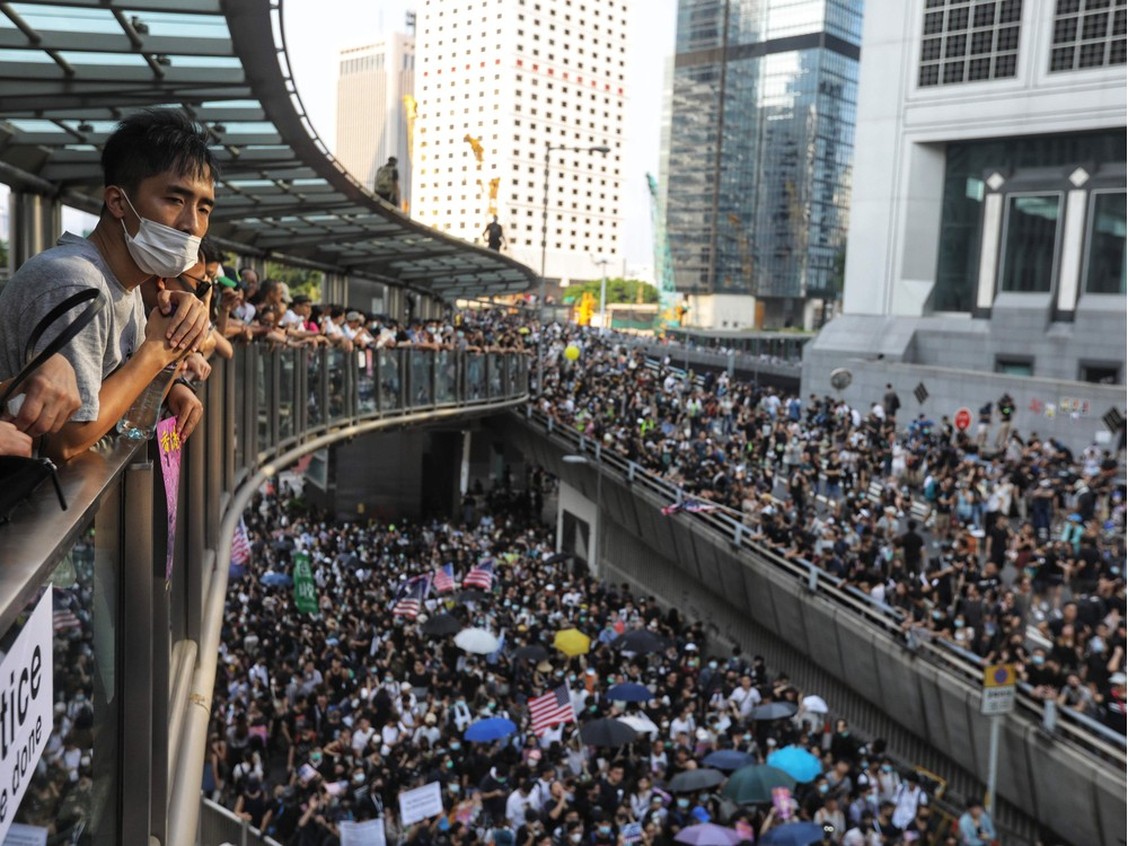
The Glasgow CSSA incited flash mobs to confront Hong Kong demonstrations. "There is Chinese embassy involvement in these demonstrations ... They surrounded us in a circle, waving Chinese flags, singing the national anthem and being hostile", one Hong Kong student narrated. The Joint Intelligence Committee chairman spoke of intimidation examples the Chinese authorities use: "sometimes with the vice-chancellor getting a phone call, sometimes at student body level, to try to discourage universities from allowing speakers on issues like Tibet or Xinjiang".

Beijing exploits research programs at British universities for the benefit of the Chinese military. The People's Liberation Army, according to the Australian Strategic Policy Institute, sent approximately 500 military scientists to U.K. academic institutions in the decade up to 2017. "Once established in academic institutions, these students are in a position to identify and exfiltrate valuable information, data and intellectual property back to China", the committee pointed out.
 

People walk across a street near a large screen promoting the Chinese People's Liberation Army in Beijing  Andy Wong/The Associated Press

"Beijing is using a 'workaround strategy' for postgraduate researchers to study cutting-edge technology at Canadian and U.S. universities after Washington began denying visas for some Chinese students on the grounds that they might steal intellectual property with military uses, according to a Canadian Security Intelligence Service report."
"The Dec. 21, 2021, report, labelled secret ...  said the strategy sends some scholarship students to Canada from the People’s Republic of China (PRC) with the aim of gaining access to critical high tech."
"The Chinese government’s game plan includes training these Chinese citizens on how to avoid drawing too much attention when studying abroad."
"The CSIS report lays out how China is using students to obtain technology that could be of benefit to the Chinese military, such as quantum computing, big data and artificial intelligence. The report was shared across key government departments and with the CIA, FBI and Britain’s domestic intelligence service, M15, as well as Australian and New Zealand authorities."
The Globe and Mail, Toronto
https://smartcdn.gprod.postmedia.digital/nationalpost/wp-content/uploads/2023/07/afp_1k4349.jpg?quality=90&strip=all&w=1128&h=846&type=webp&sig=AOloLcSQo9p60ozoYOTmXw

Labels: , , , , , , , , ,

() Follow @rheytah Tweet