Politic?

This is a blog dedicated to a personal interpretation of political news of the day. I attempt to be as knowledgeable as possible before commenting and committing my thoughts to a day's communication.

Monday, May 08, 2023

Serbia, a Nation in Mourning

"I will continue to work and I will never back down before the street and the mob..."
"Whether it will be a reshuffle of the government or an election, we shall see." 
Serbia's President, Aleksandar Vucic   
 
"We are here because we can't wait any longer. We've waited too long, we've been silent too long, we've turned our heads too long."  
"We want safe schools, streets, villages and cities for all children." 
Marina Vidojevic, schoolteacher   
 
"Part of the shock is because no-one believed it could happen here."  
 "My son told me he doesn't feel safe in school or on the street anymore, and that he cannot fall asleep."
"We need to give them time and space to process it and heal - and the teachers too." 
Ana Djordjevic, graphic designer   
 
"You can feel the strange atmosphere - people are sitting with no music or laughter. If it wasn't for foreign customers, we would have very little business."
"I keep it [legally licensed Beretta pistol that his grandfather carried when he fought with the Partisans in World War Two] as a memento of my grandfather."
 "Perhaps it could be deactivated, so I could just have it as a souvenir. But many people in Serbia have illegal guns." 
Voja Cekic, bar and restaurant waiter, Belgrade's Old Town
 
"We have to learn anew how to speak to each other and how to create a healthy future ... to nurture the beauty of living, of art, science and humanity."  
"The worst among us have been in power for an entire decade, and they imposed the norms of aggression, intolerance, crime and lies."
Biljana Stojkovic, leader of leftist Zajedno (Together) party
A Serbian flag is seen waving in a crowd of protesters marching in a street.
People attend a protest in Belgrade, Serbia, on Monday. Tens of thousands of Serbians demanded better security, a ban on violent TV content and the resignation of key ministers days after two mass shootings killed 17 people. (Zorana Jevtic/Reuters)

Serbia is a nation in disbelief. this, after a gunman killed eight people, wounding another 14 in two Serbian villages. This, at a time when the population is still reeling over a mass shooting that took place a day earlier when a 13-year-old boy took his father's guns and opened fire at the school he attended in the heart of Belgrade, shooting at his peers and killing seven girls, one boy and a school guard.

A woman holding a photo of a young girl and a man embracing a stuffed animal are surrounded by a priest and others during a funeral.
Parents of 13-year-old Ema Kobiljski, centre, mourn during a funeral procession in Belgrade on Saturday. Kobiljski was killed in Wednesday's school shooting. (Armin Durgut/The Associated Press)
 
Serbia had a shameful role when conflict occurred against other former Yugoslavia ethnic groups. Despite that Bosnian Serb commander Ratko Mladic is serving a life sentence for genocide in Bosnia, he has the reputation of a nationalist hero. There is a mural honouring him as such, located a few blocks from the school where the shooting occurred. A red heart was painted over the mural; efforts to remove it thwarted by masked thugs. 
 
Nationalist, right-wing sentiments have been rising in the country. As in Germany after World War II, post-conflict war criminals are seen to retain public roles post-sentencing. 
 
Serbian President Aleksandar Vucic spoke of the shootings as an attack on the entire nation. The 20-year-old shooter wore a T-shirt with a pro-Nazi slogan. The two mass shootings, one following hard on the other, has sent the nation into shock, even a nation for which deadly conflict was so recent. The conflicts of the 1990s left Serbia flooded with weapons. 
 
Politicians and other public figures have attempted to explain the tragedies. But the public is not assuaged; it is grief-stricken and beset with anxiety over what violent tragedy may be next to occur, around the corner. The nation is left deeply divided, in an atmosphere where convicted war criminals are often glorified and violence committed against minority groups tends to go unpunished.

"This is a moment when a nation decides whether it will go along a healing path", commented Serbian actor Srdjan Timarov. With the country going through a period of mourning, television is full of people dressed in mourning black. Music has been banned from airwaves, not heard in cafes and restaurants. In Belgrade, the capital, residents lined up to donate blood, after a broadcasted appeal.

The 20-year-old attacker killed five people near Mladenovac. about 50 kilometres south of Belgrade, wounded six in one village, and then went on to kill three more people before wounding another eight. Following the shootings in Dubona, the attacker hijacked a taxi, forcing the drive to take him over 100 kilometres south to Vinjiste, where he was eventually arrested.

Police found a large cache of illegal weapons and ammunition, including hand grenades, an automatic rifle and handguns. in a search of a relative's home and at a cottage in yet another village. A photograph was released by authorities showing a young man in a police car wearing a T-shirt with the message "Generation 88". Double eights are used as shorthand for 'Heil Hitler" -- 'H' being the eighth letter of the alphabet.

protest against violence in Belgrade, Serbia
People march during a protest against violence in Belgrade, Serbia, Monday, May 8, 2023. The shootings last Wednesday in Belgrade and a day later in a rural area south of the capital left the nation stunned. The shootings also triggered calls to encourage tolerance and rid society of widespread hate speech and a gun culture stemming from the 1990s wars. (AP Photo/Darko Vojinovic)

Labels: , , , , , , ,

Monday, April 27, 2020

Pandemic Siege - Food Insecurity

"We are going to see more nationalistic food systems and attempts at food self-sufficiency."
"But I think that's mostly political, sending signals to people that the state is actively seeking to protect them and is doing all it can to ensure food security."
"For any countries, food self-sufficiency is elusive."
Rami Zurayk, Professor, American University of Beirut

"Would some of you [newly-unemployed in Quebec] be tempted to come work with our farmers, in our fields?"
"We were worried, in the past month, that we wouldn't be able to get the fruits and vegetables we import from the south."
Quebec Premier Francois Legault, press conference

"It is a hammer blow for millions more who can only eat if they earn a wage."
"It only takes one more shock -- like COVID-19 -- to push them [insecure consumers] over the edge."
Arif Husain, senior economist, World Food Program
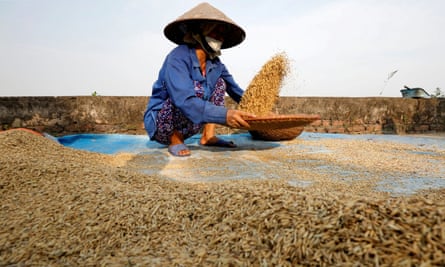
Farmer in rice field outside Hanoi, Vietnam
Vietnam, the third biggest rice exporter, has suspended contracts in the wake of the crisis. Photograph: Nguyen Huy Kham/Reuters
Like United Nations agencies and the European Union, organizations around the world agreed in a report published recently that social and political unrest world 'round is on the rise once again with the coronavirus crisis fuelling discontent in the face of food shortages, job losses and lockdowns. Normal civic life everywhere on the planet has been disrupted and peoples' fears in the face of this new reality bearing scant resemblance to what they're accustomed to, brings back haunting fears of straitened access to food sources.

In March, when the spectre of a rampant viral disease was yet in its early stages, Phil Hogan, trade chief for the European Union, had pronounced with confidence: "There is no global supply shortage at this time and such measures [as disparate nations considering curbing shipments abroad to ensure domestic supplies] are completely unjustified." By mid-April, EU trade ministers were debating how to advance the EU's "strategic autonomy", leading European Commission President Ursula von der Leyen to speak of reducing dependency by "shortening and diversifying supply chains".

The world is struggling to come to grips with a once-in-a-century pandemic, while the public in disbelief views empty supermarket shelves and panic buying in wealthier countries keeps those shelves emptied even while middle class homes suddenly develop a taste for home-baked bread to allay fears of bread shortages. Ukraine, not among the wealthy nations has, as a major breadbasket, limited grain exports. The world's third-larges rice shipper, Vietnam, now bars exports of rice.

Restrictions on overseas sales of grains or rice have been introduced in about ten countries since mid-March, according to the International Food Policy Research Institute (IFPRI) tracker. Governments are beginning to sit up and take notice. "Food is a pretty emotional topic when there is not enough of it", senior research fellow at the Washington-based IFPRI, Joseph Glauber remarked drily.

Is a COVID-19 labour shortage a long-term threat to the food supply? ©GettyImages-cyano66
Labour supply fuels food shortage fears. Food Navigator
"Being rich is no longer a guarantee that you will be able to get the supply you want on difficult markets", observed Tim Benton, research director in emerging risks at think tank Chatham House in London. This, despite that food experts have no problem agreeing that more than enough grain is stored worldwide, along with adequate stockpiles of key food staples. It is, on the other hand, distribution networks that are causing a perceived shortfall.

Distribution bottlenecks triggered by lockdowns. But enough of a public scare has communicted to governments to influence some nations to boost their agricultural sector. The 2020 book by Tim Lang, professor of food policy at London's City University, Feeding Britain, raised the alarm that the United Kingdom's flawed system of importing vast amounts of crops has fuelled a public alarm. An increase of local food production by 2030 is visualized by Singapore which set up a task force to ensure just that.

Jakob Weyde / Shutterstock.com
Countries have been urged to keep trade flowing by a group of food industry figures, to prevent a growth in global hunger. The United Nations is urging states to work together in avoidance of "beggar-thy-neighbour policies". The former communist nations of Romania and Kazakhstan are among those that have increased grain exports in recent years, but now talk about keeping their food at home, recalling memories of food scarcity during communist rule.

When Russia, ordinarily a big grain exporter, panicked in response to harvest failures in 2010, exports became severely limited. Across Africa and Asia political and economic instability saw people struggling to cope between 2008 and 2010, leading originally to the Arab uprisings in the Middle East, which eventually led to the refugee crisis and the spread of malnutrition. Now, once again, in the face of the global pandemic Russia has halted its exports of grain.
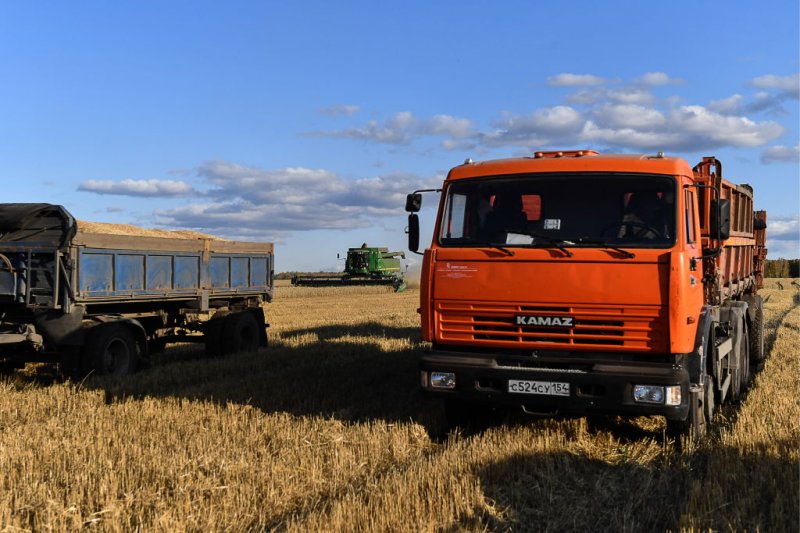
Harvesting wheat grains in a field of the Posevninskaya poultry farm in Cherepanovo District in September 2019.
Russia halts wheat exports, deepening fears of global food shortages, April 2019.
Harvesting wheat grains in a field of the Posevninskaya poultry farm in Cherepanovo District in September 2019.
Kirill Kukhmar–TASS/Getty Images

Labels: , , , , , ,

Monday, December 18, 2017

Raising The Iranian Flag

"There are different interpretations of Islam, but our understanding of the real nature of Iran and of Islam is the Iranian school. From now on, we must present to the world the school of Iran."
"without Iran, Islam would be lost. If we want to present the truth of Islam to the world, we should raise the Iranian flag,"
Esfandiar Rahim-Mashaei, former chief of staff to Mahmoud Ahmadinejad
Iranians gathered to celebrate at the tomb of King Cyrus the Great in Shiraz’s Pasargadae  Middle East Eye
"There are many here like me, who don't care for the Islamic Republic and its rules. But today is about something bigger than that, one of us has been killed."
"At the same time, this American president is breaking our hearts with his rhetoric and threats. We have to choose sides. I choose for my country."

Morteza Hosseinzadeh, 33, theater studies graduate, reformist, Tehran University

"Trump is proving that our hard-liners were right all these years, to say that America cannot be trusted."
"[Iran's leaders though irresponsible in foreign policy have] become the logical party. Of course, I love them more."
Arvand Dashtaray, liberal theater director, Tehran
When people, however much they dislike their governments, feel their nation is being criticized, ostracized, abandoned by governments of other nations whom they normally prefer over their own, the human reaction is to gather together as a family in the self-defense of solidarity. Iranians were warned time and again by their Ayatollahs that the West was not to be trusted, it aspired to destroy Iran. Iranians saw no reason that the West should suspect their nation of plotting violence with its preoccupation with ballistic missiles and nuclear arms.

Many among them may dislike their repressive government leaders and the militarization of their country, preferring to be instead like the liberal democracies they admired. They've forgotten the harsh crackdown at the time of the re-election of Ahmadinejad for his second turn at the presidency when their 'green revolution' was violently put down, their leaders arrested, their reform protest stifled. Feed a population a steady diet of propaganda and eventually it will permeate and stick.
Seeking to capitalize on a wave of nationalist fervor, the Iranian government is bringing out missiles and other weapons, like these antiaircraft guns, where families can pose for photos.  Arash Khamooshi for The New York Times

Appeals to national pride, to religious faith, to celebrate the glorious heritage and history of ancient Persia augmented with the constant iterations of the danger posed by the hostility of the outside world -- from their Arab Sunni neighbours to the Western 'imperialists' all harbouring ill-will and a desire to destroy the Islamic Republic of Iran or at the very least deny it its equal due to all other nations' aspirations to enter the 21st Century and thrive, have had their impact.

The sanctions imposed upon Iran before the 'success' of the Security Council plus Germany and the EU negotiating on its nuclear program caused financial setbacks to the national economy, felt by its population through a shortage of goods and medical supplies and food had their impact. With the signing of the agreement and the lifting of sanctions came economic relief -- in lock step with the Republic's increased support for its jihadist Shiite militias like Hezbollah in Lebanon.

Iran has succeeded in achieving its inspirational Shiite crescent, from Yemen to Iraq, Lebanon and Syria. It has aided the Syrian regime in slaughtering its rebellious Syrian Sunnis thanks to the al-Quds division of the Republican Revolutionary Guard Corps. Among its many military personnel stationed in Syria was a 26-year-old man, Mohsen Hojaji, who lost his life as he dutifully fought in the war zones of Syria and Iraq. He was abducted by Islamic State in August, videotaped being beheaded and became an instant war hero to inspire Iranian nationalism.
Women mourning at the funeral for Mohsen Hojaji, Iran’s national hero of the Syrian war, in Imam Hossein Square in Tehran. Credit Arash Khamooshi for The New York Times

An enormous billboard showing the young man in the Revolutionary Guards Corps uniform appeals to Iranians to be as loyal to the Republic as he was. His violent death, unlike that of many other Iranian soldiers, has been an inspiration to Iranians to forge a new bond with their country and with their government. Both of which are now seen as being under pressure by the United States with President Trump vowing to tear up the nuclear agreement. Fears of Saudi Arabia with its newly accessed American weapons and the appearing belligerence of Saudi Crown Prince Mohammed bin Salman has fueled a sense of isolation and danger.

Iranians are proud of their military part in routing the Islamic State group in Syria and Iraq and the growing influence of Iran in the region from the perspective of citizens of the Republic. When the state orchestrated a commemoration ceremony to honour the martyrdom of the beheaded young Iranian soldier it was not only the traditional supporters of the Ayatollahs who came out to pay their respects, but Iranians who consider themselves reformers, now seeing their country in need of their support. This is the new nationalism.

One where new, technologically advanced weaponry has been put on public display in city centres with the invitation for families and children to come and admire, and pose for photographs with them. An annual pilgrimage to have great groups of Iranians march into neighbouring Iraq, symbolic of national and religious strength, has been promoted by state-run television. Ayatollah Ali Khamenei has extended his favour toward admiration of the song "Iran, if They Break Your Heart", to emphasize his oneness with the people.

Iran Unites in a Nationalist Fervor
Arash Khamooshi for The New York Times   A billboard in a central Tehran square showing Mohsen Hojaji, an obscure 26-year-old who was killed fighting in Syria and is now being promoted as a national hero.

Labels: ,

Monday, December 11, 2017

The EU Outlier

"There is a growing feeling in Brussels that solidarity cannot be a one-way street, and that it becomes difficult to justify the ten billion-euro per year net transfers for a country that is increasingly at odds with the bloc's values."
"It is high time the EU reacted, or it risks losing its soul."
Bruno Dethomas, senior policy adviser, GPLUS consultancy, Brussels

"[It's up to Poles to show] the sick Europe of today the path back to health, to fundamental values, to true freedom and to the strengthening of our civilization based on Christianity."
Jaroslaw Kaczynsky, leader, Law & Justice party, Warsaw

"Hostility towards the EU is part of Law & Justice's DNA, and if it was up to the party, Poland would leave the bloc."
"But Kaczynski knows he can't do that because Poles are benefiting from EU membership. Hence, the party slowly builds a negative attitude towards EU -- while declaring that Poland has no intention of leaving."
Marcin Matczak, law professor, Warsaw University
A couple hold flares as as thousands gather for the nationalist march of Poland´s Independence Day.
Photographer: SOPA Images/LightRocket

Leaders of the European Union in Brussels are resentful of the fact that the EU member receiving the greatest aid from the EU of its 28-member group appears to be slighting and bypassing the intention that all members must accede to the demands imposed upon them to accept the dictates of the European Parliament and European Commission in all matters directed toward the membership, inclusive of accepting their allocated share of the flood of refugees reaching Europe from Africa and the Middle East. Poland has been defying the EU's mandate to order its members' obligations.

Poland receives $270-billion in aid through to 2022 which it absorbs into general revenues to be used for everything and anything it sees fit in infrastructure improvement. The country benefits hugely by its inclusion in the European Union. Polish workers have the right to match their inclination to migrate wherever they wish to other EU member-states for employment; they represent the largest migratory worker group in Great Britain. And, like Britain, they have become a headache to the EU.

Poland's defiance -- under the leadership of Jaroslaw Kaczynski of the increasingly authoritarian Law & Justice party -- against knuckling under the directives of the European Parliament are increasingly worrying. To the EU. The EU is flirting with the imperative of exacting a penalty on any such member countries who flout EU disrespect for the EU's democratic rule of law. Germany, France and the Nordic states in particular would like to see some penalties imposed upon Poland for its refusal, among other things, to absorb refugees.

But of course, Poland is not alone in eastern European EU members refusing to take in Muslim migrants.

Poles are fundamentally nationalist in character, mostly agreeing with their new government's encouragement to remain so, and seeing validation in the statements of intent issuing from the U.S. Trump administration. Neither Poland's government nor its people feel compelled to absorb Muslim refugees. That the EU lacks unanimity to pressure Poland for its stance to strip it of its voting rights at EU summits, leaves the EU leadership fuming  and Poland beyond punishment. For the present.

French President Emmanuel Macron warns that Poland could yet face consequences for defying the EU. The Dutch coalition government signed an agreement in October that specifies "subsidies should be reduced for member states that do not fulfill their obligations". The European Union prides itself on coercing all its members to fall into line from the most insignificant of market rules to the most urgent initiatives relating to the refugee-and-migrant invasion emergency of recent years.

That the Polish government additionally is in the process of finalizing legislation that would alter its Supreme Court and Judicial Council along lines more reflective of the current government's views, risks the basics of democratic convention, according to Poland's commissioner for human rights. "I will vote in line with my party. But this measure is a glaring contradiction to the constitution", commented a parliamentarian of the legality of court changes.

Kaczynski, who in the first place was a critic of Poland's 2004 entry into the European Union, lost when 78 percent of Poles were in support of EU membership. Entry on the conditions negotiated by Poland, he warned at the time, represented a "threat to fundamental values including independence and democracy." Certainly he was right on the issue of 'independence'.

protest1.jpg
Protesters hold a banner which reads, "Stop the Islamization of Europe" during their protest against refugees in Krakow (Image: Reuters)

Labels: , , , , ,

() Follow @rheytah Tweet