Politic?

This is a blog dedicated to a personal interpretation of political news of the day. I attempt to be as knowledgeable as possible before commenting and committing my thoughts to a day's communication.

Sunday, May 03, 2026

Deadly Fibre-Optic Drones

"As both radio‑controlled and fiber‑optic FPV drones evolve, militaries worldwide—including Israel’s—are racing to develop new detection tools, visual‑tracking systems, and close‑range interceptors to counter a weapon whose effectiveness stems not from sophistication, but from its simplicity and rapid innovation cycle. "
"The surge of FPV drone attacks launched from southern Lebanon in recent days has renewed scrutiny of why these small, inexpensive aircraft—whether controlled by radio or by fiber‑optic cable—remain so difficult to counter, even for militaries equipped with sophisticated electronic‑warfare systems." 
"Israeli officials have confirmed that recent incidents involved both traditional first‑person‑view quadcopters and newer fiber‑optic–guided variants flown manually by Hezbollah operators, a tactic that has expanded steadily since late 2023." 
"Reports in Israeli media have described fiber‑optic lines stretching several kilometers, enabling operators to remain deep inside Lebanese territory while maintaining a stable, jam‑proof link."  
"For defenders, this eliminates the possibility of disrupting the drone electronically and forces reliance on visual, acoustic, or kinetic interception."  
"Proximity further complicates the picture. Hezbollah frequently launches drones—both radio‑controlled and fiber‑optic—from positions only a few hundred meters from the border, often concealed behind ridgelines, trees, or building."
"At such short distances, defensive systems have only seconds to detect, classify, and respond.   
Even when partial interference is applied to radio‑controlled drones, their momentum and onboard stabilization can carry them forward long enough to strike their target."
World Israel News
Why Israel struggles to stop Hezbollah’s new drone threat
FPV drone. (Shutterstock)
 
"In a sleekly produced Hezbollah video from Sunday, the quadcopter drone, weighing no more than a few kilograms, hits its target as the Israeli soldiers appear to be completely unaware of its approach. According to the Israel Defense Forces, the attack killed 19-year-old Sgt. Idan Fooks and injured several others. Hezbollah then launched more drones at a rescue helicopter that arrived at the scene to evacuate the wounded troops."
"Fiber-optic drones are effective in their simplicity: Instead of a wireless signal that controls the drone remotely, the fiber-optic cable hardwires the drone directly to its operator." 
CNN  
In the latest round of fighting between Israel and Hezbollah in southern Lebanon, the terrorist group has unleashed a new weapon at northern Israel. These are small drones controlled with fibre-optic cables, cables the width of dental floss, and so transparent they are almost invisible, and they are capable of avoiding detection by electronic means. 
 
Famously, these are drones widely used in Ukraine in its invasion by Russia. They are small, difficult to track and they are lethal. A dozen Israeli soldiers in northern Israel were injured by drones last week, two of them seriously. Attempts to intercept the drones by the Israeli military have been fruitless. These drones launched by Hezbollah killed an Israeli soldier, and separately, a defence contractor operating in southern Lebanon.
 
https://media.cnn.com/api/v1/images/stellar/prod/gettyimages-2267671575-20260501143836105.jpg?c=original&q=w_860,c_fill/f_webp
First responders gather near a crater left by an Iranian missile on March 24, 2026 in Tel Aviv, Israel.
Erik Marmor/Getty Images
 
As a result of Israeli air defences' interception success against larger, more powerful rockets, missiles and conventional drones, Hezbollah turned to using fibre optic drones and they constitute an alarming new threat. Locally produced, the drones are simple and easy to make, requiring off-the-shelf drones, a small amount of explosives, and transparent wire, all readily accessible on the consumer market. "Beyond physical barriers like nets, there is little that can be done. It’s a low-tech system adapted for asymmetric warfare", remarked an Israeli military source.
 
Air defences can resort to electronic jamming of most drones that can cause it to crash, or to return to its point of origin. Fiber-optic drones on the other hand, are not radio controlled, or piloted by GPS signals; instead they have a thin cable connected directly to an operator. Wind or other drones can cause the cables to tangle, but it is impossible to electronically jam them. "If you know what you're doing, it's absolutely deadly", said a drone expert, explaining that the drones fly low and creep up on a target.
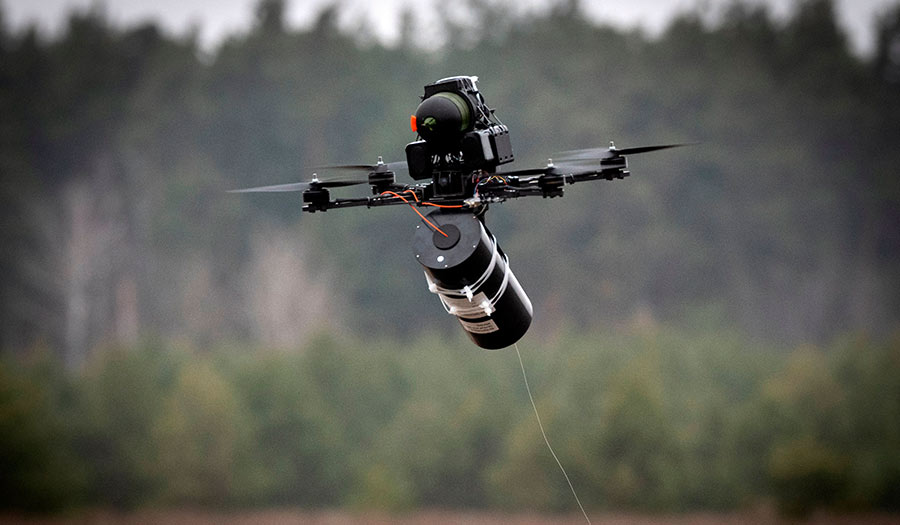
 
A Ukrainian-made FPV fiber-optic drone flies at a military marketplace at an undisclosed location in the Kyiv region, Ukraine (Jan. 29, 2025). AP/Efrem Lukatsky
 
Moscow and Kyiv counter one another in a race to develop new drone technology. While Russia hits almost Ukraine nightly with Shahed long-range attack drones that originated in Iran, some can be taken down by electronic jamming. To solve that dilemma fibre-optic drones were developed, minus the range of a drone that uses a radio link or artificial intelligence to navigate. Israel must search for a method to either net or cut the cables, some of which cables extend up to 50 kilometres.
 
One attack killed an Israeli soldier and wounded six others a week ago. Hezbollah issued a video taken by the drone until it exploded in the midst of troops gathering near a vehicle,while another drone, fired at the same location as a military helicopter landed to evacuate the wounded, narrowly missed. There is no warning sound before the drone hits, and it seems to 'hunt' its target once someone becomes aware of its swift approach and trajectory and attempts evasive action. 
  
https://media.cnn.com/api/v1/images/stellar/prod/gettyimages-2272887551.jpg?c=original&q=w_1202,c_fill/f_avif
Relatives and friends grieve during the funeral of Israeli soldier Sgt. Idan Fooks, who was killed in combat in southern Lebanon, in Petah Tikva on April 27, 2026.  Ilia Yefimovich/AFP/Getty Images
 

Labels: , , , ,

Saturday, December 14, 2024

Weaponizing Hezbollah in the Iran-Proxy Conflict

"The indiscriminate nature of Hezbollah's rockets does not distinguish between Jews and Muslims."
"In targeting innocent civilians, Hezbollah is an enemy for all people." 
Hamid Naim, mayor, Tarshiha, Arab Israeli/Lebanon border town

"Israel will never accept another attack like that of October 7."
"A comprehensive political solution is essential, one that not only addresses immediate security needs but also lays the groundwork for enduring peace."
"There is no six-day war anymore." 
"We're already in a regional war. We cannot say Iran is not interested in a regional war."
"Our goal is to create a stable environment where such threats become a thing of the past, ensuring safety and prosperity for all."
Lieut.-Col. Sarit Zehavi, founder, ALMA Research and Education Centre, Ma'alot-Tarshiha, Israel
https://ichef.bbci.co.uk/news/1024/cpsprodpb/56aa/live/99c6f210-b0eb-11ef-9dc1-eb698fc68a99.png.webp
Israeli soldiers on patrol in northern Israel, near the border with Lebanon  Getty Images
 
The ceasefire that was agreed upon by Israel and Lebanon's Hezbollah, following over a year of cross-border bombings seemed to be over, just as it began, with Hezbollah operatives appearing mere hours after the signing in areas that were to have been off limits to them. And soon enough rockets followed, with Hezbollah claiming that Israel had abandoned the ceasefire. Diplomatic overtures on the part of interlocutors and the principals continue even as weapons smuggling operations continue to thrive while Jewish and Arab homes are hit in civilian farming areas.

Communities that were vibrant and productive along the border lie in ruins. With news of the ceasefire in its infant stages, displaced Israelis who were forced to leave their homes in their tens of thousands for temporary haven far from the border hesitated with both yearning to return and the foreboding that no ceasefire would keep them safe from Hezbollah's deadly assaults. Their instincts proved correct, despite the government's intention to neutralize the area in the interests of their safe return. Communities within the Lebanese border have fared no better.
 
https://ichef.bbci.co.uk/news/1024/cpsprodpb/7ac7/live/3a1650a0-b16c-11ef-b7ba-299d961d4316.jpg.webp
Smoke rose from the Lebanese border town of Khiam following an Israeli strike   AFP
 
Stealth movement of weapons from Iran to Lebanese Hezbollah flouts any hopeful notion of a stable ceasefire. The agreement mandating Hezbollah retreat north of the Litani River for the creation of a buffer zone to stabilize the area, was broken immediately the ceasefire was agreed. Israelis remain doubtful of the commitment to action of the United Nations Interim Force in Lebanon (UNIFIL), given their abysmal failure to do just that in the past.

Lebanon itself has been in a state of destabilization for decades, its economy in ruins, its disparate ethnic, sectarian, tribal factions in a constant state of crisis management, with Hezbollah operating as a state-within-a-state, its militias more focused and better armed than the Lebanese official military which under UNIFIL the terrorist group was meant to hand over its arms to the military and to fuse its units with the military under the military command. None of this ever occurred, and Hezbollah developed a 'political' arm now part of the governing council of the country.

While Hezbollah always declared itself to be independent of the Lebanese military which itself was incapable of disarming the Iranian proxy, were it at this point to meld with the military for political and survival purposes that would create another problematical dimension to the situation. Israel's conflict is not with Lebanon, but with Hezbollah where its focus is on defeating Hezbollah, not attacking and destabilizing Lebanon. 

Northern Israel has been under Hezbollah fire of missiles since October 8 2023. Hezbollah increasingly wavered from targeting Israeli military, to target civilian infrastructure, leading the human toll of the conflict to be exacerbated. Anti-tank missiles with their low altitude and accuracy have wrought havoc on farming villages in Israel. "We're dealing with attacks aimed squarely at civilians", noted, Lieut.-Col. Zehavi.

Towns like Israel's northern Kiryat Shmona have been hard hit; some 90 percent of its population evacuated leading to deep social upheaval of communities, disrupting families, affecting support networks. As for Hezbollah's strategy, it is one of militarization of civilian areas, specifically within Shia Muslim communities. There, houses are commandeered as weapon depots, military structures and tunnel entry points. Mirroring the strategy infamously employed by Hamas in Gaza.

In Tarshiha, northern Israel, the border town is continually struck by Hezbollah drones. Over 1,300 incidents of missiles striking targets in northern Israel have been reported, mostly affecting private residences, not military targets. What is envisioned is the future possibility of a political, diplomatic solution for peace with a view toward long-term recovery for both sides of the border. For this to be achieved, the first step would be to put a stop to Iran's weapons-smuggling to Hezbollah before security can be contemplated.

https://foreignpolicy.com/wp-content/uploads/2024/11/GettyImages-2185988591.jpg?resize=1000,667&quality=90
An Israeli Air Force AH-64 Apache attack helicopter flies over migrating cranes in northern Israel near the border with Lebanon on Nov. 25. Jalaa Marey / AFP

Labels: , , , , ,

Friday, April 26, 2024

Final Show-Down Between Israel and Hezbollah?

"Hezbollah’s continued threats to target all of Israel with missiles show how egregiously the Iranian-backed terrorist group exploits Lebanon as a base for its illegal rocket arsenal."
"Hezbollah has stockpiled masses of rockets, armed drones, anti-tank missiles, and precision-guided munitions in recent years."
"Hezbollah has fired more than 2,000 rockets at Israel since it chose to back Hamas’s brutal attack in October."
"Hezbollah’s continued threats show that it is not deterred and is willing to risk catastrophic escalation in the region."
"The terrorist group must be deterred, and Israel should be supported in operations against Hezbollah."
Seth Franzman, ME Analyst, Journalist, Fellow, Foundation for Defense of Democracies 
https://i0.wp.com/jcpa.org/wp-content/uploads/2023/05/hizbullah_training.jpg?fit=1280%2C720&ssl=1&resize=900%2C506.25
Screenshot of Hezbullah military exercise in southern Lebanon  (RT Arabic)

Cross border fire between Israeli forces and the Iranian proxy terror group Hezbollah in Lebanon in almost daily exchanges dating from Israel's campaign against Hamas in October, have reached a pitch and plans are underway that this escalation of conflict will inevitably led to full-scale war between the two forces. Preparations on Israel's side include additional military exercises for ground, naval and aerial forces in the country's north, according to the Israel Defense Forces.
 
The IDF stated that area leaders with the IDF have been briefed "on the processes to accelerate readiness for continued fighting", while storage facilities are installed for the purpose of a quick and broad mobilization of IDF troops to the front lines.  About 40 targets linked to Hezbollah in southern Lebanon were struck by Israel this week, representing an escalation of hostilities following Hezbollah's deepest attack within Israel, the day before.

Active and frequent clashes have led to the evacuation of tens of thousands of civilians on both sides of the Lebanese border. Hezbollah is considered to be the most dangerous militia in the Middle East, in possession of 150,000 missiles and rockets, among them those with a long enough range to reach virtually anywhere in Israel. About 17,000 rockets, missiles and artillery shells have targeted Israel since October 7; that fateful day of the terrorist invasion of southern Israel with its savage outcome in the massive death count, mutilation, rape and hostage-taking of Israeli civilians.
 
https://csis-website-prod.s3.amazonaws.com/s3fs-public/styles/1200x522/s3/2024-03/GettyImages-1256829885_cropped.jpg?VersionId=pkBN5PjufHa5SVZXL_noqxj8LYl2f_p7&itok=zGrv0l3q
Photo: Anwar Amro/AFP/Getty Images
 
Israel estimates a baseline scenario, should a fully fledged war erupt, of up to 5,000 missiles daily entering Israel from Lebanon, over and above several hundred fired by other Iranian proxies in Yemen, Iraq and Syria. The very volume of which could potentially test Israel's air defence systems to a breaking point, resulting in increased numbers of casualties. It is anticipated that Hezbollah would attempt to hit infrastructure facilities such as power plants and water pipes; sea ports airports and communication sites.

A situation that during wartime, would fully justify Israel striking deep enough into Lebanon to  hit major cities and their critical civil infrastructure; Beirut included. Israel developed a National Emergency Authority to coordinate its various agencies in government in preparation for a surprise attack; the blueprint known as "the compass", a classified document laying out Hezbollah's capabilities and the maximum harm that could result from an all-out war with Hezbollah.
 
https://www.newarab.com/sites/default/files/styles/large_16_9/public/2136563028.jpeg?h=a5f2f23a&itok=-ruZ2tEn
Israel and Hezbollah have been exchanging fire since 7 October [Getty]

Labels: , ,

() Follow @rheytah Tweet