Politic?

This is a blog dedicated to a personal interpretation of political news of the day. I attempt to be as knowledgeable as possible before commenting and committing my thoughts to a day's communication.

Monday, April 15, 2024

United Nations Relief and Works Agency for Palestine Refugees in the Near East/Hamas

"We are not convinced that Canada used the information that we provided in a way that would put UNRWA in a different light than before. It's as if nothing happened."
"Even if we got the message that Canada believes UNRWA needs to be reformed, our conviction is that UNRWA needs to be reformed immediately and completely."
"As an organization, it's become a bottleneck that's part of the problem, not the solution."
Iddo Moed, Israeli Ambassador to Canada

"For years I've had meetings in western capitals."
"I've been to Ottawa and met with Canadian officials in Israel many times, and I tell them, 'You get to feel very good about  yourself, even very smug for giving money to supposedly the poor Palestinians, but what you're really funding is the continuation and perpetuation of the century-long Palestinian war against the Jewish state."
Einat Wilf, Israeli politician former Knesset member 
https://i.cbc.ca/1.7107923.1710207978!/fileImage/httpImage/image.jpg_gen/derivatives/original_1180/israel-palestinians.jpg
United Nations and Red Crescent workers prepare aid for distribution to Palestinians at the UNRWA warehouse in Deir Al-Balah, Gaza Strip on Monday, Oct. 23, 2023. (Hassan Eslaiah/The Associated Press)
 
Among the evidence that Israel made available to its allies, including Canada, were (a) biographies of employees of the United Nations who participated in the massacre in southern Israel of that infamous October 7 day of barbaric slaughter. (b) Also provided were satellite photographs of schools in Gaza that had been built over buried terrorist bunkers. (c) Proof that Hamas rocket launchers were installed within mere metres of marked United Nations compounds.

Canada was given access to a wide range of Israeli intelligence, before the Liberal government of Justin Trudeau decided it would continue to fund the United Nations Relief and Works Agency for Palestine Refugees in the Near East, after initially declaring a 'pause' in funding of the agency, in the immediate aftermath of the October 7 assault.  A wide assortment of other donor nations mostly suspended funding until the conclusion of a UN investigation either cleared or confirmed implication of UNRWA.

Canada is not alone in deciding to resume funding rather than wait for the results of the investigation into UNRWA's involvement in the Hamas savagery in southern Israel that resulted in mass rape, the slaughter of over 1,200 infants, children, women, the elderly and the hostage-taking of an estimated 240 Israelis. Japan, Australia, Finland and Sweden also decided to resume their funding. 

https://smartcdn.gprod.postmedia.digital/nationalpost/wp-content/uploads/2024/04/UNRWA-Hamas-1.jpg?quality=90&strip=all&w=1128&h=846&type=webp&sig=qkiyC7vJTlgILOpcnicaNQ
A Palestinian boy holds a Hamas flag as he protests against a UN Relief and Works Agency (UNRWA) funding gap, outside the UNRWA Gaza headquarters in Gaza City. Photo by Khalil Hamra

Canada's government, before its decision to resume funding, was given verifiable intelligence that Hamas views UNRWA as part of its civil rule in that it provides the material civic support and infrastructure to Palestinians in Gaza, leaving Hamas free to focus on its military terrorist programs. That briefing clarified that "Hamas is deeply and systemically embedded in UNRWA. Hamas members serve in all sectors of UNRWA activities, including key positions."

The United Nations has supported Palestinians as refugees for the past 76 years. Essentially the funding supporting the Palestinians serves to facilitate ongoing attacks against Israel, as they have since the Jewish state's re-establishment in 1948. According to the Israeli UNRWA dossier up to 2,135 UNRWA employees are members of Palestinian terror groups with over three-quarters of those employees Hamas operatives. Of that number, 327 serve in Hamas's 'military wing', the Al-Qassam Brigades.

Also included in the dossier were over a dozen biographies of UNRWA employees who had taken part in the October 7 attack; an UNRWA social worker seen on surveillance video removing the body of a man from Kibbutz Beeri; an UNRWA school principal who moonlights in the Al-Qassam Brigades among them. The school principal closed his school just prior to the attacks, notifying fellow Hamas operatives to muster close to the Gaza border. Eighteen UNRWA school principals are identified as Hamas combat operatives.
 
It is well known and documented that Hamas makes use of its civilian population as human shields, places rocket launchers, command posts and other strategic targets among and within schools, mosques and hospitals. At least 32 UNRWA facilities located within 20 metres of Hamas installations in Gaza were revealed by Israeli intelligence. Under the UNRWA-operated Maghazi Prep School B in central Gaza a tunnel was discovered, as well as a bunker underneath the UNRWA-run Zaitoun Prep School, both of whose principals are Hamas operatives.

Throughout the Gaza Strip, maps show arms warehouses, tunnel access points and logistical centres adjacent to UN-run schools, residences and facilities. A satellite image depicted construction of an underground bunker in 2010; an updated image taken in 2023 showed an UNRWA school built over the bunker. Hamas rocket launchers near Rafah were placed metres from a mosque and schools as well as throughout UN refugee camps nearby. 

"We have built the tunnels because we have no other way of protecting ourselves from being targeted and killed", explained Mousa Abu Marzouk, deputy chair of the Hamas Political Bureau in an interview with Russia Today, emphasizing that the Gaza tunnels were designed not to benefit Palestinian civilians from return Israeli fire when rockets are launched into Israel, but to protect Hamas 'fighters' and their infrastructure from the Israeli counterattacks, where Hamas is happy to sacrifice their citizens as 'martyrs'.

https://i.cbc.ca/1.7107920.1707337069!/fileImage/httpImage/image.jpg_gen/derivatives/16x9_780/lebanon-israel-palestinians.jpg
Activists and their children hold a giant Palestinian flag during a protest demanding that countries resume funding of the United Nations Relief and Works Agency for Palestinians Refugees (UNRWA) near the European Union headquarters in Beirut, Lebanon on Wednesday, Feb. 7, 2024. (Bilal Hussein/Associated Press)

"While we gathered intelligence on Hamas, more and more links to UNRWA came up."
"The problem is that Hamas infiltrated into the ranks of UNRWA in a systematic manner, in a way that Hamas perceived UNRWA as a strategic asset."
"If UNRWA will not recognize that there is a problem, it will be impossible to fix it. Because the infiltration is so wide, we believe it is beyond repair, and we don't want to see the continuation of the activity of UNRWA in the Gaza Strip."
"Not all of the humanitarian aid reached the civilians, Hamas was trying to use this aid for its own purposes [intercepting and seizing humanitarian aid entering Gaza from international donors]."
Senior Israeli diplomatic source

Labels: , , , , , , ,

Saturday, January 21, 2023

"An Immigration Plan to Grow the Economy"

"Last year Canada welcomed over 405,000 newcomers - the most we’ve ever welcomed in a single year. The Government is continuing that ambition by setting targets in the new levels plan of 465,000 permanent residents in 2023, 485,000 in 2024 and 500,000 in 2025. The plan also brings an increased focus on attracting newcomers to different regions of the country, including small towns and rural communities."
Immigration, Refugees and Citizenship Canada, Government of Canada
 
"It's hard to see  how the increased demand for both  health and housing that would accompany large increases in immigration [assuming  no other policy changes] would not further strain both systems."
"We need immigration for other economic reasons."
Arvind Magesan, economist, University of Calgary
 
"Government talks about immigrants as if they're going to the immigrant store and picking up a few."
"Even people born within a privilege situation in Canada are finding it hard to move beyond renting and working. Immigrants are coming and they're even less privileged."
"That doesn't seem to be a concern that's registering with the government. It's a very predatory situation."
Stephen Punwasi, co-founder, data journalism website Better Dwelling
Canada is aiming to welcome 500,000 newcomers in 2025, and one of the goals is to help fill jobs with skilled workers. (Patrick Morrell/CBC)
"According to the federal government’s own website, a skilled tradesperson applying to come to Canada today would have their application processed within 47 months – one month shy of four years. The express program for provincial nominees stands at 15 months."
"There is a strong need for skilled trades but someone facing a four-year wait just to be processed is likely to look elsewhere. Demand for immigrants is high in developed countries and Canada will need to improve its system to compete."
"We also need to do more to ensure the people we do welcome can flourish once here. The immigration department’s own website states that 'Overall immigrant and refugee earnings match the Canadian average about 12 years after arrival'."
"How can Canada attract the best and brightest with processing times like this?
"A 12-year timeframe for immigrants to catch up to Canadian-born citizens is too long. Part of the reason is there are too many barriers still in place stopping people from being able to find meaningful and lucrative work once they arrive."
"There are also problems we haven’t touched on like the lack of housing and transportation infrastructure to handle so many new people each year and, sadly, the Trudeau government too often stands in the way."
Toronto Sun editorial
Pew Research found through a global survey in 2019 that Canada  stood out among its peer countries with the belief that immigration "makes our country stronger". Canada was ranked the world's most migrant-friendly nation through a Gallup survey of 2020. A 2022 poll by the Environics Institute found 58 percent of Canadians backed the belief that Canada "needs more immigrants".
 
While many countries are increasingly suspicious of migration, Canadians tend to welcome immigrants into their neighbourhoods, generally unconcerned whether immigrants are prepared to integrate into Canadian society, and they view immigration critical to the future of the country. Recently the Angus Reid Institute asked Canadians if they felt immigrants were taking their jobs and 71 percent responded "no". 

Among Canada's political parties there is no anti-immigration sentiment. Recent months, however, have seen an opposite trend among Canadians with respect to the government's new accelerated immigration numbers that have risen over 40 percent in the past few years. A record-breaking 431,645 permanent residents entered Canada last year. On a per-capita basis, Canada now brings in four times more immigrants than another historically high-immigration country, our neighbour to the south.

Canadians are now concerned with the nation's universal health care system, with housing and with social welfare infrastructure. Health care in Canada, already overstretched in capacity before the pandemic struck, has since been barely limping along, failing dismally to look after the health needs of the population, with surgeries cancelled and delayed and hospital emergency wards closing down, unable to cope with the influx of emergency cases.
 
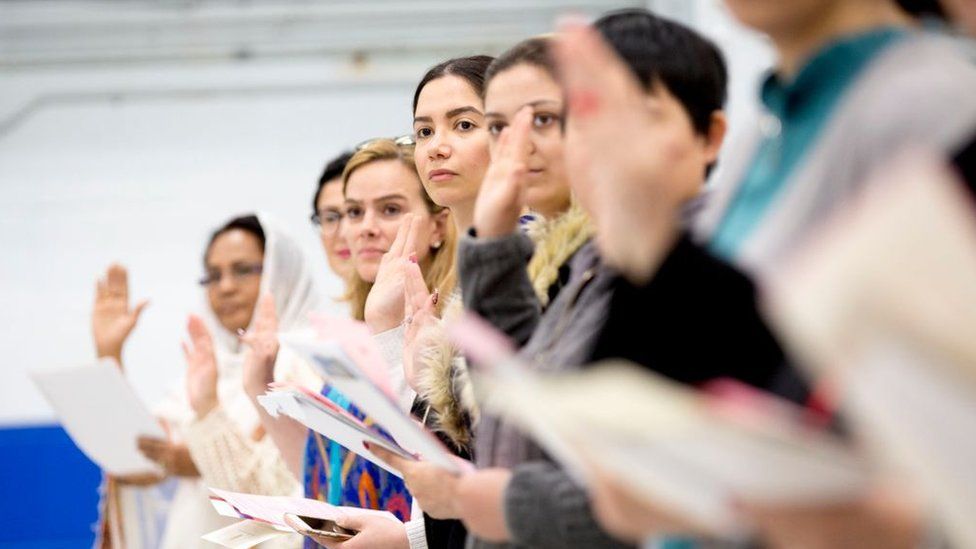
New Canadian citizens
Getty Images
 
A November poll commissioned by the Association of Canadian Studies saw half of respondents expressing the belief that Canada was welcoming "too many" immigrants. 75 percent of all respondents expressed "concern" relating to what the immigrant surge could result in for the country's immediate future. Most of the skepticism stems from a fear that two of the country's most defining crises -- housing affordability and health-care shortages -- will be negatively impacted by greater immigration numbers.

Canada has the distinction of having the most acute housing shortage of any country in the G7; home prices since 2000 have become too steep for normal people to buy up available stock. Canada came last in the OECD's ranking of housing prices in comparison to average incomes last year. Wait times for health care --never very reassuring -- are so acute now that Canadians are treated to news of patients dying in hospital emergency rooms.
 
A poll by the Institute for Canadian Citizenship last year found that among recent university-educated immigrants now in Canada, up to a quarter were re-thinking their future, making plans to leave the country, disappointed in their experiences to date. "Many new Canadians are having a crisis of confidence in Canada -- and that should be ringing alarm bells all over Ottawa", remarked ICC CEO Daniel Bernhard.

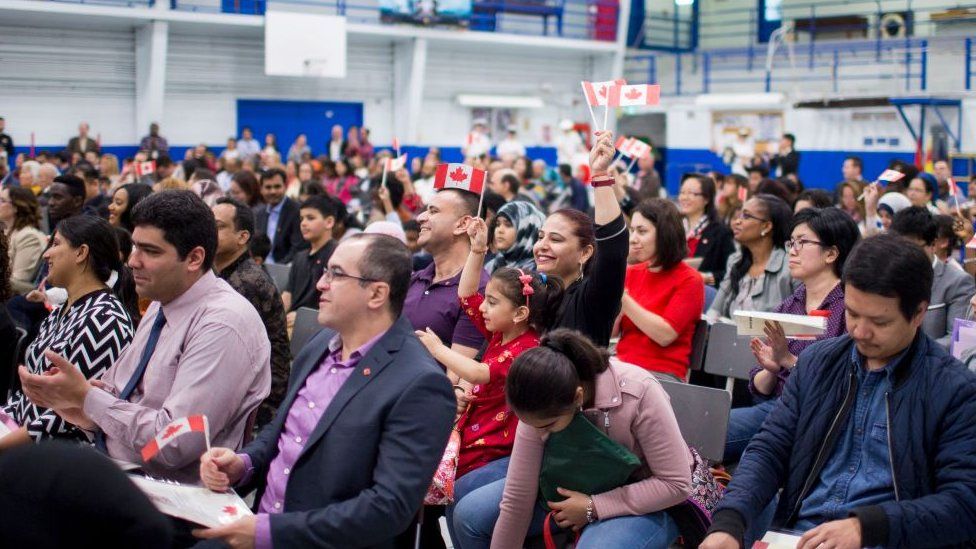
New citizens
About one in four Canadians came to the country as an immigrant     Getty Images

Labels: , , , , ,

Monday, March 26, 2018

Balancing the  Scales

"We have worked and paid taxes in this country, our parents built it up."
"How can it be that we are turned away [at area food banks] and those who just arrived get what they need?"
Marianne Rymann, 62, client, Essener Tafel, Essen Germany

"If you fight back, you're a Nazi."
"[The charity] was not founded to deal with the chaos of [Chancellor Angela] Merkel's refugee policy but to meet the demand that was already there."
AfD party Facebook campaign in defence of food bank decision 

"[We] felt compelled to ensure reasonable integration [after having seen an] increase in the number of migrants in recent years [with the proportion of foreign citizens rising dramatically]."
"We want German grandmothers to continue coming to us."
"[For the time being new customers will be restricted to Germans] until the scales are balanced again [between locals and foreigners]."
Jorg Sartor, manager, Essener Tafel 
Graffiti sprayed on the door to the entrance of the food charity in Essen. Photo: DPA

German authorities, when the government decided to open its doors in an unrestrained fashion to all the migrants that managed to make their way through Europe to their preferred destination in Germany known for its social networks, planned to distribute the 1.2 million arriving between 2015 and early 2016 evenly across the country so the cost and optimization of integration opportunities would be shared by all communities.

Many of the migrants had ideas of their own, where many among them decided to leave those designated homes and to move on instead to other areas, some of which had already received and were coping with a fairly dense concentration of migrants. The city of 600,000 people that is Essen has experienced a growth in its Syrian community from 1,300 in 2015, as an example, to close to 11,000 currently.

"It is a challenge", explained Peter Renzel, an official with the city of Essen. Most migrants live within the working-class districts of the north. "Some districts carry a disproportionate burden", he elaborated. To the extent that several food banks have taken steps to limit tensions that arise when needy Germans seeking assistance come hard up against Syrian migrants seeking the same, amidst rising tensions.
Food bank in Essen bars new migrant clients 'to ensure reasonable integration’
A Tafel Deutschland location in Berlin. Photo: Tafel Deutschland/Dagmar Schwelle

New rules have arisen segregating immigrants and Germans approaching the food banks for assistance, by time or by day. One of these food banks have gone further, banning young men from signing up entirely. The majority of the migrants that have streamed into Germany have been single, unattached young men looking for economic opportunities; in the process overwhelming Germany's social assistance programs.

Jorg Sartor is an ex-coal worker in retirement, since his mine closed. He has operated the Essener Tafel food bank as a volunteer for the last dozen years. Germany has about 930 food banks in operation, all dependent on the work of volunteers. And his is the only food bank exercising this new policy. The door of Mr. Sartor's food bank and its eight delivery vans have been defaced with Nazi graffiti in reaction to his decision to put a stop to allowing foreigners to sign up for assistance.

"It's absurd", he says.

One in three food bank users were foreigners until three years ago, he explained. But by last November that number changed to three in four. Leading him to decide to block any greater numbers of non-Germans from signing up so the food bank could continue to serve those foreigners already on its lists, only.

The problem is that Chancellor Merkel's government which generously opened its doors to over a million migrants and immigrants, decided that the burden of integrating them would fall where it might, and typically that burden has fallen on Germany's poorest regions. Where everyone competes for subsidized apartments, school placements, and free food from food banks.

Recently, many of those Germans who had lined up outside the food bank called Mr. Sartor a "people's hero". "He stands up for us", Peggy Lohse, 36, a single mother of three, stated. She might have been referring to the groups of young migrant men who sometimes simply elbowed their way to the front of the line. Leaving her to return home empty-handed on more than one occasion.

And according to Ms. Lohse, that kind of entitled assertiveness so intimidated some of the older German women that they simply stopped coming to the food bank for help altogether.

'Nazi' sprayed on food charity which refused to take new migrant clients
The word 'Nazis' sprayed on one of the charity's trucks. Photo: DPA

Labels: , , , , , ,

Sunday, January 21, 2018

Germany's Noble Sacrifice

"In a European comparison, and above all considering how people are coming to us [Germany], I think this roughly 185,000 [figure] is much too high."
"So far, it is still the case that the people who decide whether someone comes to Germany or Europe are criminal smugglers."
"[Germany is prepared to do its part to help people who genuinely deserve protection] but it can't be the case that we take in as many vulnerable people as the other European countries together." 
"In all cases, where no official and real document is presented, we need to determine the age [of the migrants declaring themselves underage] in another way, if needed through medical examinations."
German Interior Minister Thomas de Maiziere
The anti-migrant sentiment has increased over recent months Credit: Chad Buchanan/Getty Images

German cities, towns and villages generously, at the bidding of their Chancellor, opened their borders, their wholesale acceptance of the presence of alien migrants with backgrounds, cultures, and religion utterly unlike their own heritage, when Europe was being overrun by a mass influx of refugees, haven-seekers and economic migrants. Setting an example for all of Europe, Germany's selfless intake of people flooding their borders, ensured that Germany and its people would undergo a long and difficult commitment of inclusiveness and helpfulness offered to perfect strangers.

In well-publicized incidents, some of those strangers turned out to be less than perfect in behaviour, unfortunately. Germany's resentment at other European countries, particularly those in the east, not welcoming their apportioned 'share' of the newcomers is understandable in a sense, but Germany, its politicians and its people made a judgement call, deciding to absorb the mass influx, while other countries made their own decisions, to absorb fewer numbers and in some instances none at all, which is their right as sovereign nations.

Europe has had ample experience with absorbing immigrants from Muslim-majority countries fleeing persecution by their governments, absenting themselves from conflicts between nations, and attempting to find haven where economic opportunities might shape their futures, absent in their countries of origin. All too often sheer numbers of migrants have succeeded in diluting the home culture, laws and values of receiving countries. An inability and unwillingness to integrate into the prevailing culture and the adoption of indigenous values all led to demands for institutionalized recognition of Muslim culture, religious values and laws.

In European countries attempting to become functioning pluralities offering equality to all, Muslim communities continue to impose their misogynistic views of women, inclusive of the need to practise female genital mutilation, multiple marriages, the isolation of women, and the imperative of full body and face coverings for girls and women. A culture where 'honour' relates to women's chastity raises its sons to feel that violence against women when men are spurned by them is justified. In Germany the Berlin Christmas market attack, the mass rapes in Cologne and elsewhere have awoken German citizens to a kind of violent dysfunction they are shocked to feel immersed within.

Attacks by Muslim migrants upon one another of a sectarian nature, of men attacking and raping women in refugee shelters, of gays and Christian migrants being in constant danger of attack keeps authorities on the alert. In Kandel, southwestern Germany, a 15-year-old migrant stabbed a 15-year-old German girl in the heart after she spurned him and he stalked, then finally murdered her. He had declared himself to be 14 years of age on arrival in Germany for the government benefits known to ensure that youth have a higher acceptance rate and derive greater benefits in assistance.

Many of the migrant 'youth' from the Middle East, South Asia and North Africa are in fact, not youth at all, but mature, unaccompanied men from among whose demographic violence often derives. "I am scared" professed a 24-year-old German dental assistant in Kandel, mother of a two-year-old girl. "It makes you think how many others will betray our hospitality", she commented after the murder of the 15-year-old German girl. "It feels like we've lost control. The state has lost control", said Jana Weigel nervously.

Others resent the level of 'hospitality' given the newcomers, grumbling that German retirees' needs have been ignored, in contrast. "German retirees w ho have worked hard for 45 years get less than the refugees", claimed Knoll Pede, 64, a town maintenance worker. "I have no problem with foreigners", said 53-year-old Maja Mathias who works in a local bakery. "But there is always the fear: What else is coming?" "Germans feel neglected. We need to wake up", commented the town's mayor, Gunther Tieleborger.

Austria, Sweden and Saarland, a German state, conduct age-proofing examinations on a regular basis. By a migrant claiming to be under 18 they have access to German lessons and job opportunities geared to minors. In Saarland, over a third of the migrants claiming to be under 18 were tested and found not to be. In 2015, Germany took in 890,000 people from the Middle East and elsewhere, another 280,000 in 2016, and 186,644 in 2017. Syrians represented the largest single group last year at almost 50% of the total, followed by Iraqis and Afghans.

While 603,000 applications were processed last year, 38.5 percent were rejected and 18 percent ended in some other way; withdrawals of applications, and presumably a number of the rejected melting into the general population determined to stay. Last year 26,000 were forcibly deported, fewer than the year before but not by much. The city of Cottbus, population 100,000, which has taken in 3,000 asylum seekers. has had to endure unfamiliar levels of violence, leading to a 'temporary' ban on refugees.

The local governments representing the towns of Salzgitter, Delmenhorst and Wilhelmshaven in Lower Saxony claiming they lack the resources and capability to properly integrate additional arrivals have implemented their own prohibition on accepting more refugees. One might call it Germany's new awareness leading to a new awakening.


Cooling towers near the university town of Cottbus

Cooling towers near the university town of Cottbus Credit: REUTERS/Pawel Kopczynski/File

Labels: , , , , ,

() Follow @rheytah Tweet