
Politic?

This is a blog dedicated to a personal interpretation of political news of the day. I attempt to be as knowledgeable as possible before commenting and committing my thoughts to a day's communication.

Saturday, August 22, 2020

A COVID-19 Borderless Europe?

"Countries exporting tourists are particularly worried about returnees, and finding a collective approach is impossible. Primarily, the virus is driving the member states apart."                                                                                                               "[When it comes to keeping the virus at bay, despite a massive EU recovery package to aid Italy and Spain,countries are watching out for themselves]; they don't pay much attention to what [new restrictions] might mean for tourism in Greece or employment in Croatia."                                                                              Stefan Lehne, visiting scholar, Carnegie Europe 

"Mostly it is the considerate people who have behaved very cautiously on vacation anyway who take up the voluntary offers, while those who are more careless don't take a voluntary test."                                                                                  Chancellor Angela Merkel's chief of staff, Helge Braun

"At the moment, the freedom of people to get around Europe should be limited according to the number of cases."                                                                          Walter Ricciardi, Italian government adviser, World Health Organization
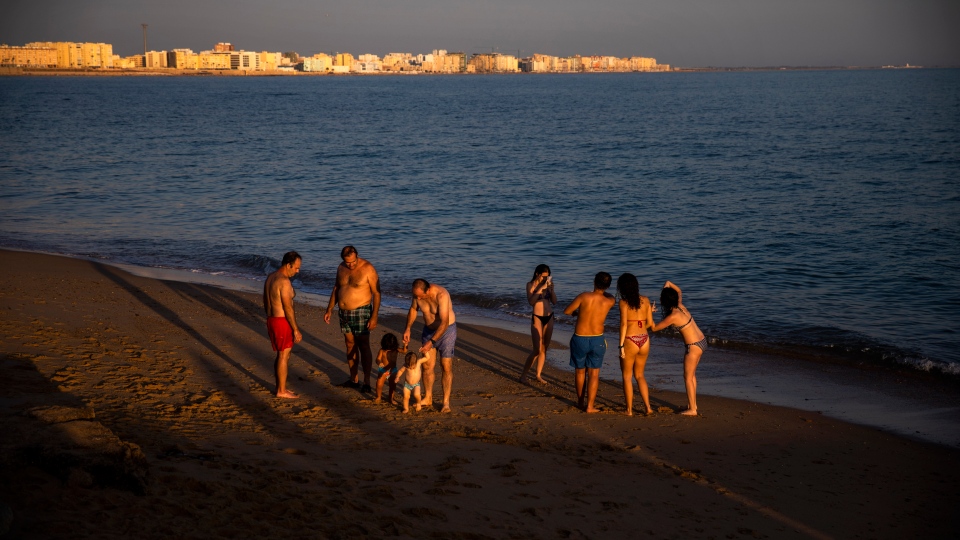
Beach in Cadiz, south of Spain
People enjoy the beach in Cadiz, south of Spain, on Friday, July 24, 2020. (AP Photo/Emilio Morenatti)

Optimism was high in the European Union that it was finally safe to reopen the borders that had been shuttered in the first wave of COVID-19 sweeping the continent. The tourism industry, like all others had been hit hard and governments were anxious to reopen borders to invite tourism to return to its former status, representing a significant proportion of many countries' GDP in a universal state of financial collapse in Europe, as elsewhere globally.

Europeans cheered, and prepared to resume business as usual as travellers and tourists, a huge relief from the enforced albeit necessary isolation in hopes of bringing the novel coronavirus pandemic under control. Restrictions lifted along with mandatory quarantines, people flocked to the French Riviera and the Greek islands for relief from boredom, seeking enjoyment during the feared-lost summer of 2020. This ebullience lasted all of several weeks.

That's all it took for coronavirus cases to rise, despite the ebb in cases earlier in the summer that gave such a lift to peoples' aspirations to rescue the summer-that-threatened-not-to-be. Governments across Europe haven once again now recognized a need to stem the rising tide of new coronavirus cases, giving second thought to the open Europe which has seen tourists bring the virus with them, and others taking the virus back home with them. Quarantines are being reinstated.

The effort aimed at rebooting the Mediterranean's tourist economy has served to slip the rug from under Europe's battle for virus control. Greece and Croatia, both popular tourism spots where the first wave of the coronavirus mostly bypassed, are experiencing a surge in cases within some of their most popular tourism regions, dealing with their largest outbreaks as a result, to date. 

Those countries experiencing their outbreaks early and succeeding in obtaining a level of control are now placing the blame on travel for an unexpected rise in cases. According to reports out of Italy, 30 percent of new cases there emanate from returnees who had been infected while abroad. New cases in Germany are estimated at an increase of 40 percent and Austrian chancellor Sebastian Kurz has stated "the virus is coming to Austria by car".

Newly imposed restrictions mostly apply to everyone travelling or returning from specific countries; occasionally they refer to "high risk" areas where, for example, people travelling from Barcelona to Belgium must now observe a mandatory 14-day quarantine, while travellers from Madrid rate a recommended quarantine. Britain has been steadily removing European countries from its safe travel list; Spain first, then Luxembuurg. Belgium, France, Malta and the Netherlands followed, then Croatia and Austria.

Northern Europe was sympathetic to the hardhit southern economies that led to a massive EU recovery package to primarily give aid to Italy and Spain. Now, however, in the interests of protecting themselves from further infection, travel to those troubled regions is once again off the books. Greece, now experiencing is highest daily cases, count 83 percent of positive cases as emanating from local transmission, and not incoming travellers.

Italy, early on the worst-hit country in Europe when the novel coronavirus raged through the country and devastated its hospitals, becoming the centre of the European pandemic, now has one of the lowest infection rates in Europe. Amidst fears that travellers just may be reimporting the virus. A list of 28 Italian hot spots across the country was published by the ANSA news agency, 11 of which were related to travel abroad to other countries in Europe.

 Tests for people coming from Malta, Greece, Croatia and Spain are now required in Italy; all countries where cases on a per-capita basis are several times higher than those in Italy. "We must continue the line of caution to defend the results achieved in recent months", stated Italian Health Minister Roberto Speranza. 

This week, authorities ordered the closure of bars and nightclubs on the tourist-friendly Spanish islands of  Mallorca, Menorca, Ibiza, and Formentera frequented by party crowds in an attempt to prevent a new wave of COVID-19 from striking.
Authorities ordered the closure of bars and nightclubs on the Spanish islands of Mallorca, Manorca, Ibiza and Formentera frequented by party crowds in an attempt to prevent a new wave of COVID-19. Joan Llado, AP


Labels: , ,

Sunday, July 19, 2020

Protecting Canadians from SARS-CoV-2 Transmission

"This is how the first wave started, it came from other countries, and some people who were clearly not observing the quarantine recommendations."
Dr.Jeff Kwong, public-health professor, University of Toronto

"The honour system is a halfwitted Canadian farce which all but guarantees that we will be reinfected from outside the country, and quite often, I should think."
"I have requested government do one of these three things [test all arrivals for COVID before entry; quarantine arrivals immediately in hotels; install an app to trace whereabouts for 14 days]."
"Government has never answered me."
Dr.Amir Attaran, public health policy professor, University of Ottawa
"Flattening the curve" provides an opportunity to significantly reduce deaths from COVID-19. MATTHEW MCQUEEN / Director, Public Health Program, University of Colorado Boulder

As far as Dr.Attaran is concerned, from his post as a Canada Research Chair in health policy, what bothers him particularly is the "total absence" of any measure of enforcement to ensure that people entering Canada take the 14-day isolation requirement seriously. Government doesn't appear to take  protection of the Canadian public seriously enough to go beyond taking people's promise to accede to the rules as a point of public policy overcoming private unwillingness for the greater public good, so why should individuals?

Close to three million people have entered Canada since the borders were officially closed on March 25, a marked decrease of the numbers that generally crossed from the United States in Canada. The representative number reflects a roughly 90 percent decline in border crossings, as opposed to the usual numbers, according to Canada Border Services Agency statistics.

The issue of maintaining closed borders for all but essential workers and services is key to the ability of the country to shield its citizens from rampant SARS-CoV-2 contagion. And experts have been quick to point out that international travel introduced COVID-19 to Canada to begin with. Which meant that mandatory border closures should have been implemented, and taken seriously, with all the tracking required to ensure that those entering the country took the required precautions of self-isolating to protect the public much earlier than it did.

BC PNP Tech Pilot

Canada has relatively low numbers of COVID-19 infections, with both Quebec and Ontario the two provinces with the highest infection rates, reaching a level of control and diminishing cases. Given the situation in the United States over the southern border, maintaining that closed border is critical. The U.S. reported 77,000 new COVID cases nationwide on Thursday, the seventh time this month record high cases were reported. Roughly half of the 50 states have mandated the wearing of masks, the other half not.

In total, 3.6 million Americans have been infected with the coronavirus, the highest count of any country. Over 138,000 Americans have died from the effect of the disease, a staggering figure of lost life. Florida, Texas and South Carolina all reported record COVID-19 death numbers for a single day, on Thursday. Texas announced over 15,000 infections for a single day. Infection rates altogether for Canada's neighbour have been trending upward.


Border restrictions are broadly supported by the Canadian public, approving of the extension to mid-August of the mutually-agreed-upon closure of the Canada-U.S. border. The fly in that ointment is not that the Canadian government claims that anyone entering Canada from abroad must go into a two-week quarantine, it is that the regulations are too lax. Of over 80 percent of the three million arrivals since late March, most have entered under exemptions whose category includes truck drivers, fishermen, soldiers, airline crew, critical infrastructure technicians and students working in health care.

Fewer than 380,000 out of the total of three million entrants have been "non-exempt", expected to isolate themselves for the required two-week period. Robo-calls and automated emails to remind the non-exempt of their obligations, augmented by live calls to check up on their commitments do occur through the Public Health Agency of Canada or through Service Canada officials. Yet hundreds of people with no intention to self-isolate or who have indicated they plan to, but fail to, have been answerable to follow-up by police.

Vancouver International Airport. (Hana Mae Nassar, NEWS 1130 Photo)

There have been scant fines resulting for violation of these critical rules. "How effective the measures are cannot be judged by how many tickets are issued. Since March -- when travel restrictions were implemented by the government of Canada -- COVID-19 cases associated with international travel have decreased substantially, from 21 percent (3,703) of all cases in March to two percent (173) in June", advised Tammy Jabreau speaking for the Public Health Agency. "This (international travellers entering Canada) is how the first wave started, it came from other countries, and some people who were clearly not observing the quarantine recommendations", pointed out Dr.Jeff Kwong.

Live calls from a trained "screening officer" who rates the person's compliance through a series of questions have reached 175,723 people, advised Tammy Jabreau, for the Public Health Agency. The Public Health Agency has passed on to the RCMP the names of about 1,500 people who failed to honour their commitments. "These measures have been essential to slowing the spread of the virus within Canada's borders."


Labels: , , , , ,

() Follow @rheytah Tweet