

Study: How the New York Times Framed the War Between Israel and Hamas
"I was not surprised by the direction of the findings but rather the magnitude. For example, the fact that Israeli military casualties were mentioned so infrequently and were not regularly tracked as part of the basic context of the reporting was a bit shocking to me. Likewise, the fact that two out of every three days had an article that mentioned a personal story of a Palestinian or Lebanese civilian suffering was more than I had anticipated.""[I was] struck by the difference in the perception of the war. [How the] human element of the Israeli experience was missing in the mainstream U.S. media.""[The Times largely depicts Israel as being the] sole aggressor [following the October 7 attack].""Palestinians are portrayed as passive victims whose suffering grows daily as they are relentlessly attacked by the Israeli military.""[Framing the war in this context] offers a distorted view of the conflict."Edieal Pinker, Yale School of Management professor
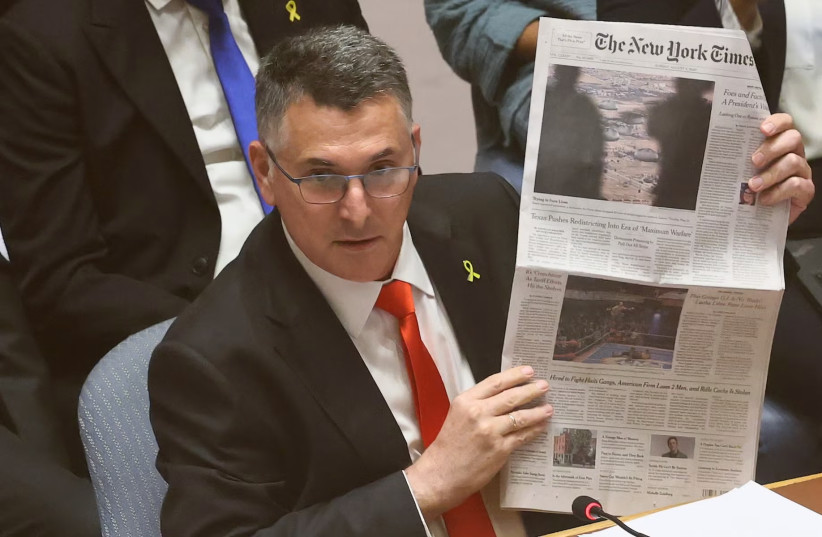 |
| Israeli Foreign Minister Gideon Sa'ar holds up a copy of The New York Times as he speaks during a United Nations Security Council meeting at the United Nations headquarters on in New York City on August 5, 2025. (credit: MICHAEL M. SANTIAGO/GETTY IMAGES) |
Making use of ProQuest as a research database to find articles, study author Edieal Pinker tagged and labelled them, and then organized them into categories. The eight-month research time-frame limited the study somewhat, with the criteria for identifying articles "almost certainly excluded some relevant" pieces, unlikely he felt, to have changed the reported statistics. The study, titled How the New York Times Framed the War Between Israel and Hamas, saw publication on September 7 in the journal Studies in Conflict & Terrorism.
The study found fewer than four percent of the articles studied contained an "account of an Israeli's struggles post October 7", while there was a wealth of details surrounding accounts of Palestinians affected by the conflict. The study had no purpose to diminish the devastation wrought by the conflict in Gaza. It makes note of the tens of thousands of deaths along with "widespread destruction of housing and critical infrastructure and the internal displacement of large proportions of the Gaza population".
Professor Pinker contends that the media plays a highly influential role in the manner in which people view the Israel/Hamas war, alongside the news stories that shape public opinion. Understanding this, is to fully comprehend that the framing carries weight and is quite deliberately instructive in how the public ends up believing the matter should be solved.
"[The imbalances in coverage] create sympathy for the Palestinian people while at the same time diminishing Hamas's responsibility for their situation and the continuation of the war.""Only 52 articles overall [out of 1,559] make any reference to some dimension of Israeli suffering among the population that are not direct victims of October 7.""[My goal is] not to prove or disprove the legitimacy of either of these framings [but to demonstrate and document that the] former framing fits [the Times' coverage].""This is important because, whether intentional or not, reinforcement of a specific framing of the war by prominent and respected news media can shape public opinion in a way that could interfere with conflict resolution."Study: How the New York Times Framed the War Between Israel and Hamas
 |
| The New York Times’ coverage of the first nine months of the war in Gaza showed bias against Israel, according to a new paper in the Studies in Conflict & Terrorism academic journal. REUTERS |
The framing of the war by the Times throughout the time frame analyzed patterned readers to view the solution to the war as simply having Israel stop or reduce its military operations in Gaza. Another narrative, points out the study, would be to consider that it is Hamas representing the problem. The terrorist organization has "the capability and intent to launch both large-scale rocket attacks on Israel's population centres and large-scale cross-border raids into Israeli towns on the Gaza border". Consequently in this case the remedy would be to support the Israeli mission to eradicate the Hamas threat.
"I also want readers to be more aware of the Hamas agency in the conduct and prolonging of this horrible war."Edieal Pinker, professor, Yale University
 |
| The Times allegedly downplayed the deaths and destruction in Israel for months after the Oct. 7, 2023, terrorist attack. AFP via Getty Images |
Labels: 7 October/23, Biased Coverage of the Israel/Gaza Conflict, Focus on Palestinians, Israel's Reaction, Overlooking Hamas Role, The New York Times
posted by Pieface | 9:08 PM


0 Comments:
Post a Comment
<< Home