

B'nei Menashe Making Aliyah to Israel
"We have faith in the Torah.""They promised that all the B'nei Menashe will go to Israel by 2030.""We all have our passports ready.""We want to go to Israel, 90 percent for our religion, but yes, other things are better there, too - like education."Shimon Ngamthenial, Manipur, India

The B’nei Menashe are not ethnically Indian. They stem from a Tibeto-Burmese people known as the Mizos in the Indian state of Mizoram and the Kukis in the adjacent state of Manipur. Until India’s British rulers seized this hilly, rain-forested region bordering on Burma in the late 19th century, the Kuki-Mizos lived in a traditional tribal society and had their own ancestral religion, which featured a mysterious progenitor called Manasia or Manmasi.With British rule came British and American missionaries. By the last part of the 20th century, the Kukis and Mizos were thoroughly Christianized. Yet as they came to know the Bible, many were struck by parallels between its stories and commandments and elements of their old, pre-Christian religion. Soon the belief began to spread that Manasia or Manmasi was the biblical Manasseh (or, to call him by his Hebrew name, Menashe), the son of Joseph, and that the Kuki-Mizos were descended from the tribe named after him -- one of the ten tribes that vanished after the Assyrian Empire conquered the Kingdom of Israel in 722 B.C.E. and exiled much of its population. In the 1970s, inspired by this belief, and by the conviction that the Hebrew Bible was God’s eternal word that could not be annulled, a Judaizing movement arose in northeast India. If we are descended from the people of the Bible, its followers held, let us live by the Bible that was given them! At first this movement had almost no contact with the outside Jewish world and struggled to live by its own idea of what Judaism was. Yet in the 1980s, the B’nei Menashe or “Children of Menashe,” as they now were called, came under the influence of an Israeli rabbi, Eliyahu Avichayil, who took them under his wing, taught them the basics of Jewish tradition, and persuaded them to live by it. Rabbi Avichayil also began to bring, with the approval of the Israeli government, groups of B’nei Menashe to Israel, where they underwent a formal conversion to Judaism and became full Israeli citizens. Degel Menashe
 |
THE B'NEI MENASHE |
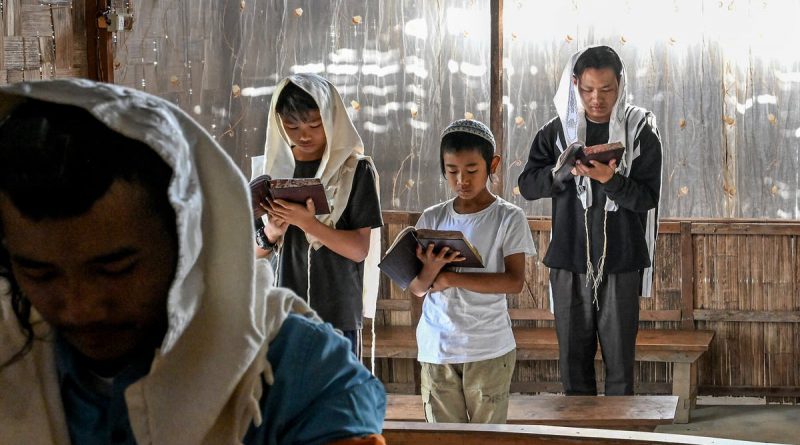
In a far corner of India close to the border of Myanmar, a few thousand B'nei Menashe live at the kibbutz Ma'oz Tzur. There, resident Shimon Ngamthenlal has amassed a collection of English-and-Hebrew-language essays on Judaism. Not far away women are busy chopping foraged greens for lunch in the Southeast Asian manner. This is a remote community believing itself one of the Ten Lost Tribes of Israel, as children of a tribal patriarch Manasseh, dispersed three thousand years ago.
Spread between the Indian states of Manipur and Mizoram there is an estimated 10,000 B'nei Menashe who for generations have taught their children that their ancestors had wandered from the ancient Middle East across Asia to eventually find refuge. Mr. Ngamthenial wears payat, which distinguishes all Orthodox Jewish men. He, like others there, awaits aliyah (homecoming) to Israel.
Close to half of the community has removed to Israel since the 1990s -- until last month Israel flew about 250 of the Menashe from Delhi to Tel Aviv, more to follow shortly. Earlier groups found their homes in Hebron in the West Bank and before 2005, Israeli settlements in Gaza. The Israeli government focused in aiding the final 5,800 of the community to emigrate en masse; 1,200 altogether were flown to Israel in 2026.
"They will complete their quarantine period at the moshav and spend some three months there going through the formal absorption process, including learning Hebrew""Following that, they are likely to be settled in the north in the Nazareth Illit area."B'nei Menashe community member"I will continue to act on behalf of the Bnei Menashe community to ensure and expedite the aliyah of the remaining members of the community in India.""We are blessed to see their arrival to Israel during the festival of Chanukah – this is a tremendous source of light for us all."Penina Tamano-Shatta, Israeli minister of Aliyah (immigration) and Absorption
 |
| The Milli Chronicle |
According to another resident of the Manipuri kibbutz, Benjamin Haokip, "We follow Judaism, and here we cannot follow all our customs". For him the appeal of moving above all, is to be able to worship among fellow Jews in Israel. There are other reasons, some involved in their life in one of the poorest parts of India where the per capita economic activity is valued at $1,200 annually, and for Israel, it is over $55,000.
Most Menashe work on family farms in India, or hire out as day labourers, whereas in Israel their counterparts tend toward truck driving, or work in factories and construction. The Menashe are classified as a Kuki people in Manipur, their languages part of the Tibetan-Burmese family. Their roots trace back to what is now China. In the early 1900s, under the influence of American missionaries, most Kukis coverted to Christianity. In the 1970s a couple of Israeli anthropologists visiting northwestern India observed that some of the pre-Christian customs of the Kuki resembled Judaic practices.
A retired tax official in New Delhi, now president of the B'nai Menashe council of India, said the dispersion of the Menashes was so ancient, "you won't find any trace of it now". Another community of Menashe lives in the town of Kangpokpi across Manipur's central valley. Manipur was split by fighting between the Kuki and the majority Meitei people.
To prove his suitability for emigration to Israel, Daniel Hangshing who lives near the Kangpokpi synagogue brought his entire family to meet with rabbis at a neighbouring state. "Israel is our destiny. We are not bothered about the war", he said, though the family prepares to leave one war-torn territory for another.
 |
Labels: B'nai Menashe, Exodus to Israel, Lost Tribe of Israel, Northeast India
posted by Pieface | 9:33 PM


0 Comments:
Post a Comment
<< Home